An Overview of Validator Redirected Revenue
Explore Validator Redirected Revenue (VRR), a proposal that could enable Ethereum validators to redirect staking rewards toward sustainable public goods funding while balancing decentralization, governance, and long-term ecosystem growth.
Ethereum has always had a public goods problem. The network depends on open-source researchers, client teams, security contributors, educators, infrastructure providers, and coordination bodies, but many of these contributors do not have a direct revenue model. Their work benefits the entire ecosystem, yet the cost of maintaining that work often falls on a small number of grant programs, foundations, DAOs, or donors.
A new proposal titled Validator Redirected Revenue attempts to rethink this problem from the protocol level. Instead of depending only on voluntary donations or centralized grant allocation, it suggests that Ethereum validators could collectively redirect a portion of staking rewards toward ecosystem funding.
The idea is simple in framing but complex in consequences, i.e., validators already earn ETH for securing Ethereum. Since they benefit from Ethereum’s long-term growth, should they also help fund the public goods that make that growth possible?
This proposal is not just about money. It raises deeper questions about Ethereum’s economic design, validator governance, public goods funding, staking incentives, and whether decentralized networks can coordinate investment without creating centralized control.
- The Public Goods Problem in Ethereum
- What Validator Redirected Revenue Proposes
- Why Validators Are Central to the Design
- How Redirect Recipients Could Be Chosen
- Risks: Cartels, Operators & Issuance Debate
- What This Means for Ethereum’s Future
The Public Goods Problem in Ethereum
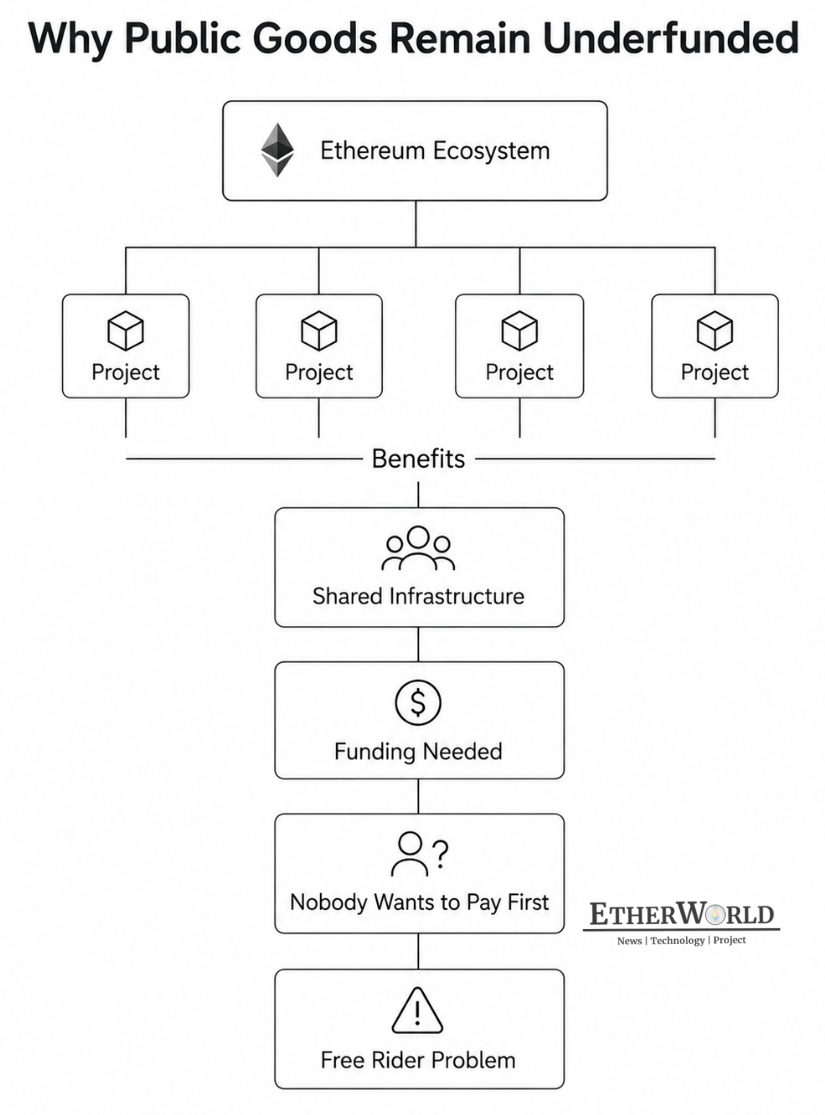
Ethereum’s economy depends on shared infrastructure. Execution clients, consensus clients, research teams, developer tooling, protocol security, education, audits, standards work, and ecosystem coordination all create value for the network. But most of this value is not captured by the contributors who create it. This creates a classic free-rider problem.
Every project wants Ethereum to be more secure, usable, scalable, and credible. But when the bill comes for maintaining shared infrastructure, each actor has an incentive to wait for someone else to pay. If someone else funds the work, everyone benefits anyway. If no one funds it, the ecosystem suffers collectively.
The Validator Redirected Revenue proposal describes this as a coordination failure. Everyone benefits from shared improvements, but no single actor wants to pay when others can free-ride. The result is persistent underfunding and deadweight loss across the Ethereum economy.
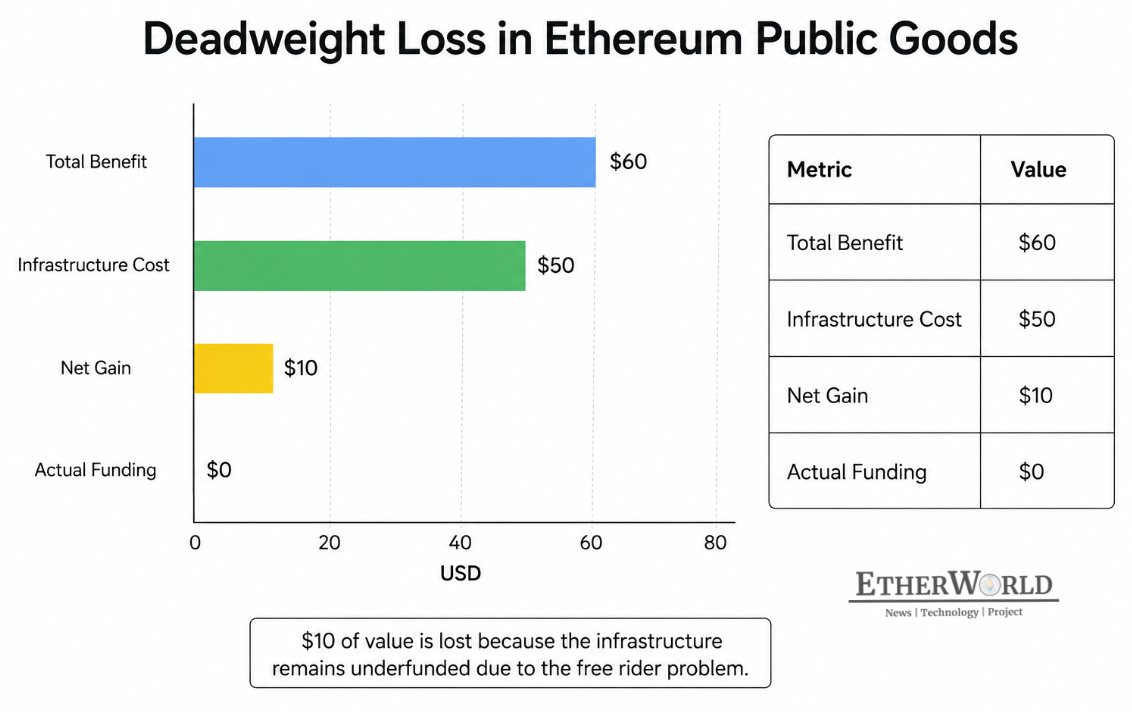
A simple example explains the issue. Suppose a piece of shared infrastructure costs $50 per year to maintain. Six projects depend on it, and each project gains $10 in value from it. Collectively, the infrastructure creates $60 of value and costs only $50, so funding it makes economic sense. But no single project gains enough to justify paying the full $50. As a result, the infrastructure may remain unfunded despite being net-positive for the ecosystem.
Ethereum has partially solved this through institutions and ecosystem initiatives. The Ethereum Foundation has historically played an important role in funding research, clients, grants, and coordination. Other efforts such as TheDAO Security Fund’s Ethereum Security QF Round and Giveth & TheDAO’s QF approach show how community-driven funding can support critical security work.
But these mechanisms remain fragmented. Grants are discretionary. Donations are inconsistent. Quadratic funding rounds are powerful but periodic. Foundation funding can create centralization concerns. Public goods need more predictable support, especially as Ethereum grows into a global settlement layer. This is where Validator Redirected Revenue enters the debate.
What Validator Redirected Revenue Proposes
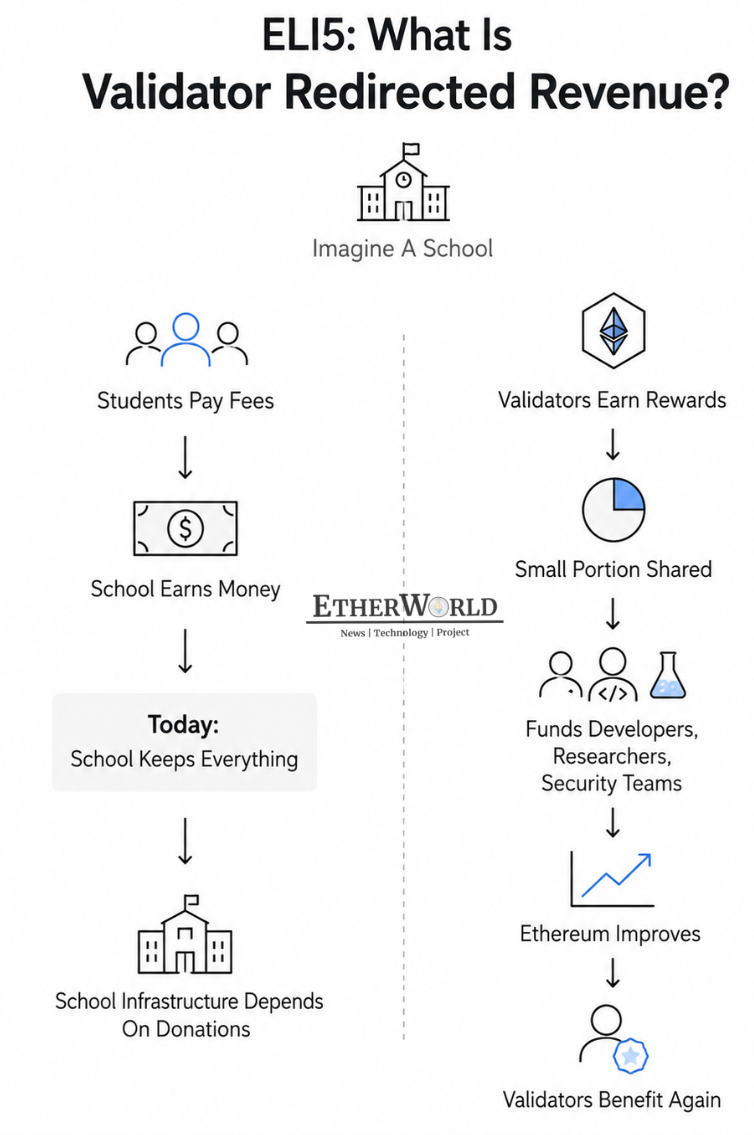
Validator Redirected Revenue, or VRR, proposes a protocol-level mechanism that allows Ethereum validators to redirect a portion of staking rewards toward ecosystem funding.
The proposal introduces two major changes:
- Validators signal the percentage of staking rewards they are willing to redirect.
- Validators signal preferred recipient addresses for those redirected funds.
The redirect rate would begin at 0%, which represents the current status quo. Validators could then signal whether the rate should move up or down. If a majority of validators agree to redirect a non-zero share of rewards, the redirect becomes mandatory for all validators.
This majority-trigger mechanism is the core of the design. Under ordinary voluntary funding, a validator who contributes alone earns less than other validators while everyone benefits from the funded work. This discourages participation.
But if the redirect only activates once a majority agrees, validators are not individually disadvantaged for cooperating. The mechanism attempts to move validators from a non-cooperative equilibrium to a cooperative one.
The proposal caps redirects at 10% of staking rewards. This cap is important because it prevents the mechanism from being used to redirect excessive amounts of validator income. The minimum remains 0%, meaning validators can collectively return to the status quo if the mechanism becomes unpopular or harmful.
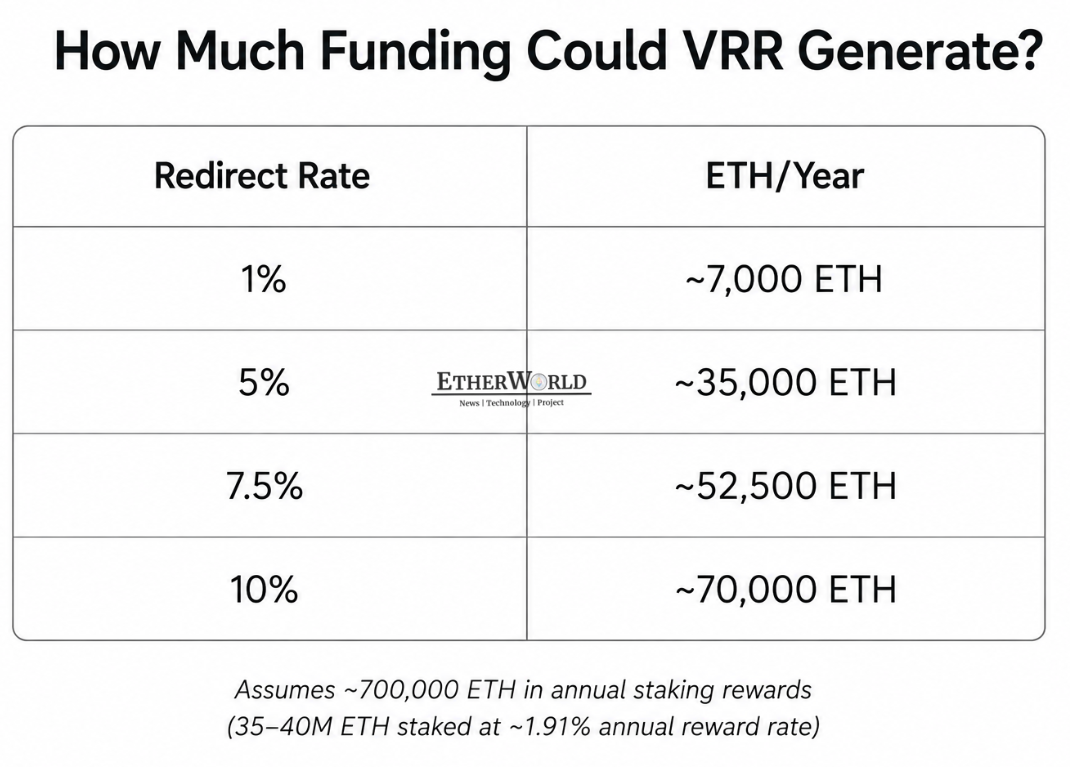
The funding potential is significant. The proposal estimates that with roughly 35–40 million ETH staked and staking rewards around 1.91%, validators collectively receive about 700,000 ETH per year. A 5–10% redirect could generate approximately 50,000–70,000 ETH annually for ecosystem funding.
That would be a major recurring source of capital for Ethereum public goods. For context, EtherWorld has previously covered Ethereum’s validator role in All About The Validator In Ethereum 2.0 Beacon Chain and Ethereum’s staking-based economic model in An Overview of Ultrasound Money.
VRR builds directly on that staking economy by asking whether validator rewards should also become a funding rail for Ethereum’s future development. However, redirecting rewards is not the same as creating a treasury. There is no single central pool controlled by a foundation or committee. Instead, validators would express preferences, and the protocol would aggregate those preferences into funding destinations.
Why Validators Are Central to the Design
The proposal focuses on validators because they are economically exposed to Ethereum’s long-term success. Validators stake ETH. They earn rewards in ETH. Their principal is held in ETH.
If Ethereum becomes more useful, more secure, and more widely adopted, validators benefit from stronger demand for the network and potentially stronger ETH value. If Ethereum underinvests in its public goods and loses competitiveness, validators also bear that downside.
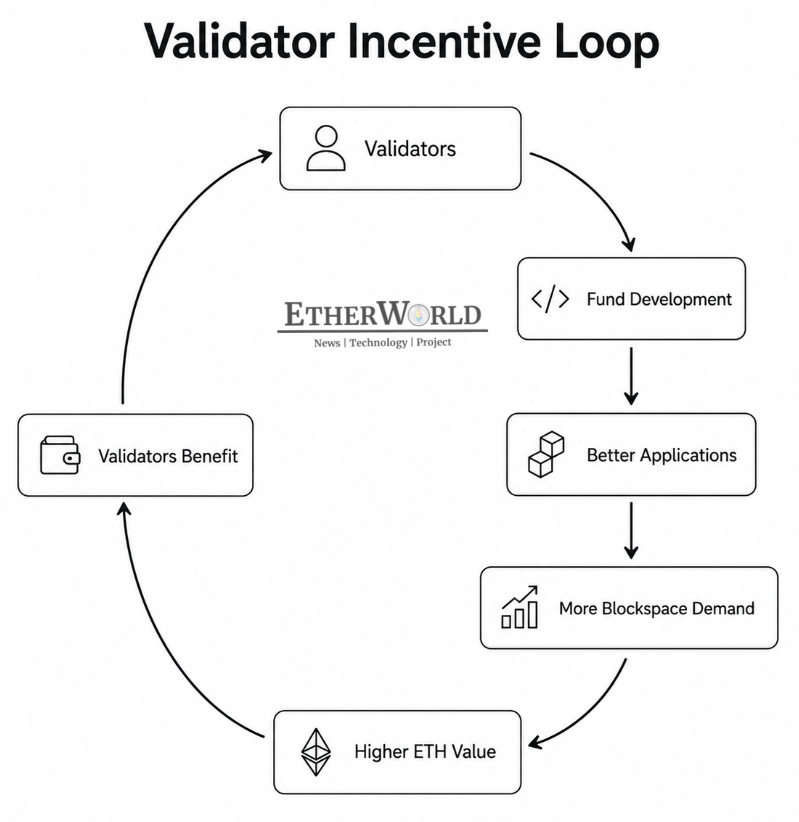
Validators fund ecosystem development. Ecosystem development improves Ethereum. Better infrastructure increases demand for blockspace. Increased demand can strengthen ETH’s economic value. Validators then benefit through rewards and principal appreciation.
This is the strongest argument in favor of VRR. Validators are not random taxpayers. They are core economic stakeholders whose returns depend on Ethereum’s health.
The proposal also fits into Ethereum’s broader validator-focused roadmap. Recent upgrade discussions, including State of Upgrade – Hegota Edition #1, have shown that Ethereum developers are already thinking deeply about validator experience, consensus-layer efficiency, inclusion guarantees, and protocol sustainability. VRR adds a funding dimension to that same validator-centered conversation.
Validators are not the only ETH holders. Non-staking ETH holders would also benefit from Ethereum growth without contributing through redirects. This means VRR only partially solves the free-rider problem. It coordinates validators, but it does not capture every beneficiary in the Ethereum economy.
There is also a difference between solo stakers and staking operators. Many users do not run validators directly. They stake through centralized exchanges, liquid staking protocols, or professional operators. This creates a principal-agent problem: the operator may control validator preferences, while the underlying ETH holder bears the economic consequences.
This distinction matters because VRR would create a new dimension of competition among staking providers. Today, users often choose staking providers based on yield, convenience, liquidity, and risk. Under VRR, they might also choose based on values. One operator may direct funds toward client diversity. Another may support zero-knowledge research. Another may prioritize Ethereum security. Another may redirect nothing.
How Redirect Recipients Could Be Chosen
The proposal suggests that validators should be able to specify recipient addresses and percentage allocations. For example, one validator might allocate 60% to a client team and 40% to a security fund. Another validator might allocate 50% to research, 30% to tooling, and 20% to education.
This keeps control with the validators who are giving up part of their rewards. But Ethereum cannot efficiently maintain a separate distribution for every validator preference. The protocol needs a way to aggregate many different preferences into a single funding splitter.
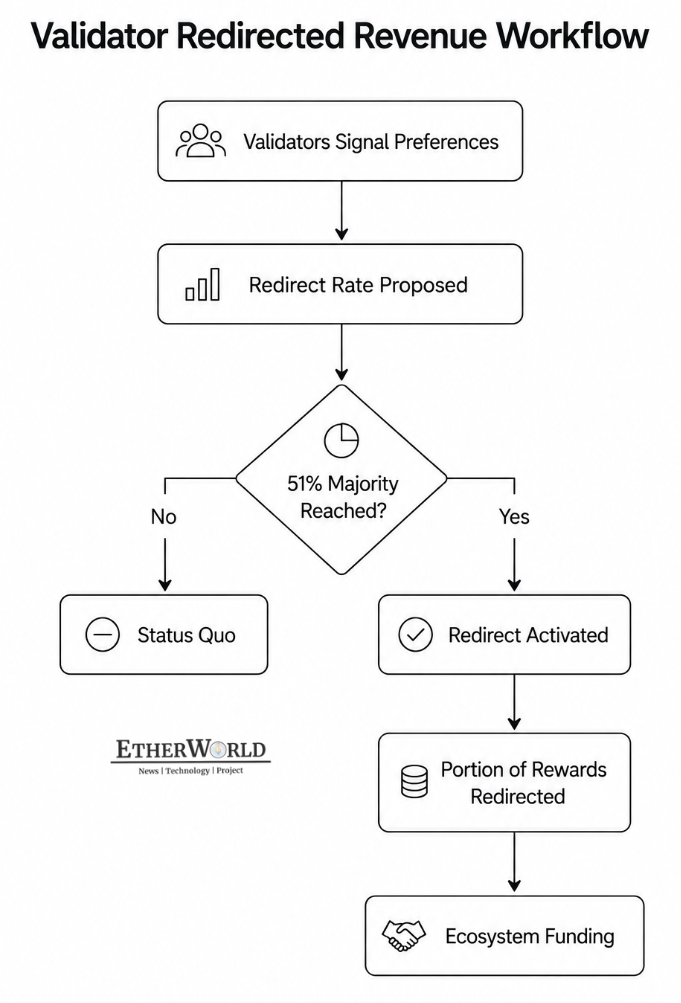
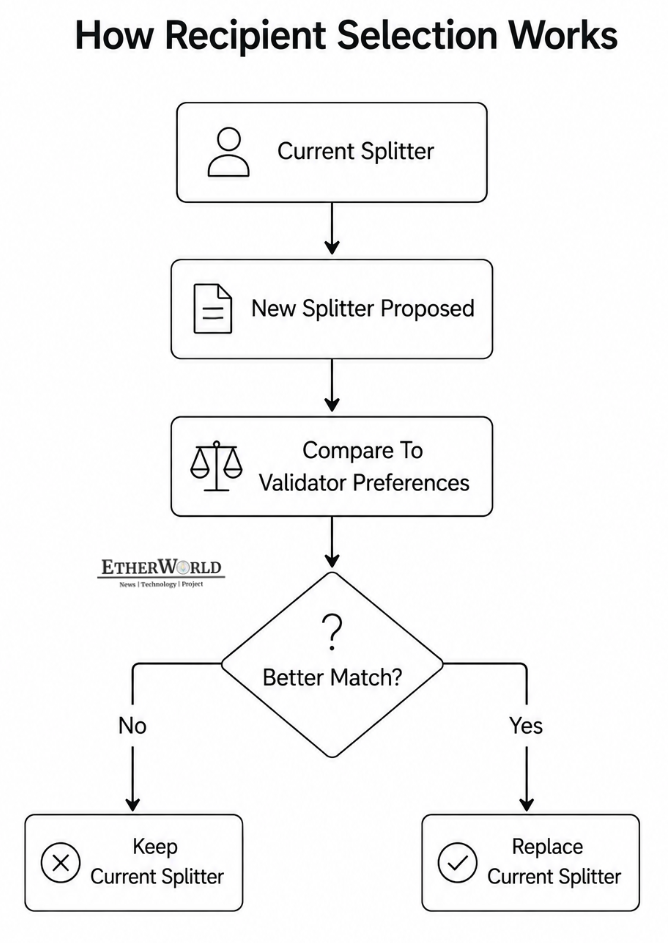
To solve this, the proposal introduces a “King of the Hill” style mechanism. The system begins with a zero redirect rate and a zero recipient address. At regular intervals, a validator can propose a new splitter contract. This candidate splitter is compared against the existing splitter. If the candidate better matches validator preferences, it replaces the current splitter. If not, the existing splitter remains.
The proposal suggests using distance metrics, such as Manhattan distance, to compare how closely a splitter matches validator preferences. A validator automatically supports the splitter that is closer to its preferred allocation.
Over time, this process is expected to converge toward a Condorcet winner. In simple terms, a Condorcet winner is an option that would beat every other option in a head-to-head comparison.
This is an ambitious attempt to simplify governance. At the protocol level, validators do not need to vote on every grant. They only need to maintain preferences. Execution clients and the aggregation mechanism handle the complexity of comparing splitters.
This “set and forget” design is one of the proposal’s strongest features. Ethereum governance already has enough attention overhead. Validators are unlikely to manually vote on thousands of funding decisions. A preference-based mechanism reduces governance fatigue while still preserving validator choice.
However, the design also introduces new complexity. Different execution clients may implement comparison methods differently. Preference aggregation can produce unexpected outcomes. Funding recipients may campaign for validator support. Staking providers may become political actors. The system may reduce one coordination problem while creating another.
Ethereum has seen similar tensions in governance and funding before. Community-driven models such as quadratic funding, covered in Securing Ethereum Together: Giveth & TheDAO’s QF Approach, try to broaden allocation power. VRR would go further by tying allocation directly to validator economics.
Risks: Cartels, Operators & Issuance Debate
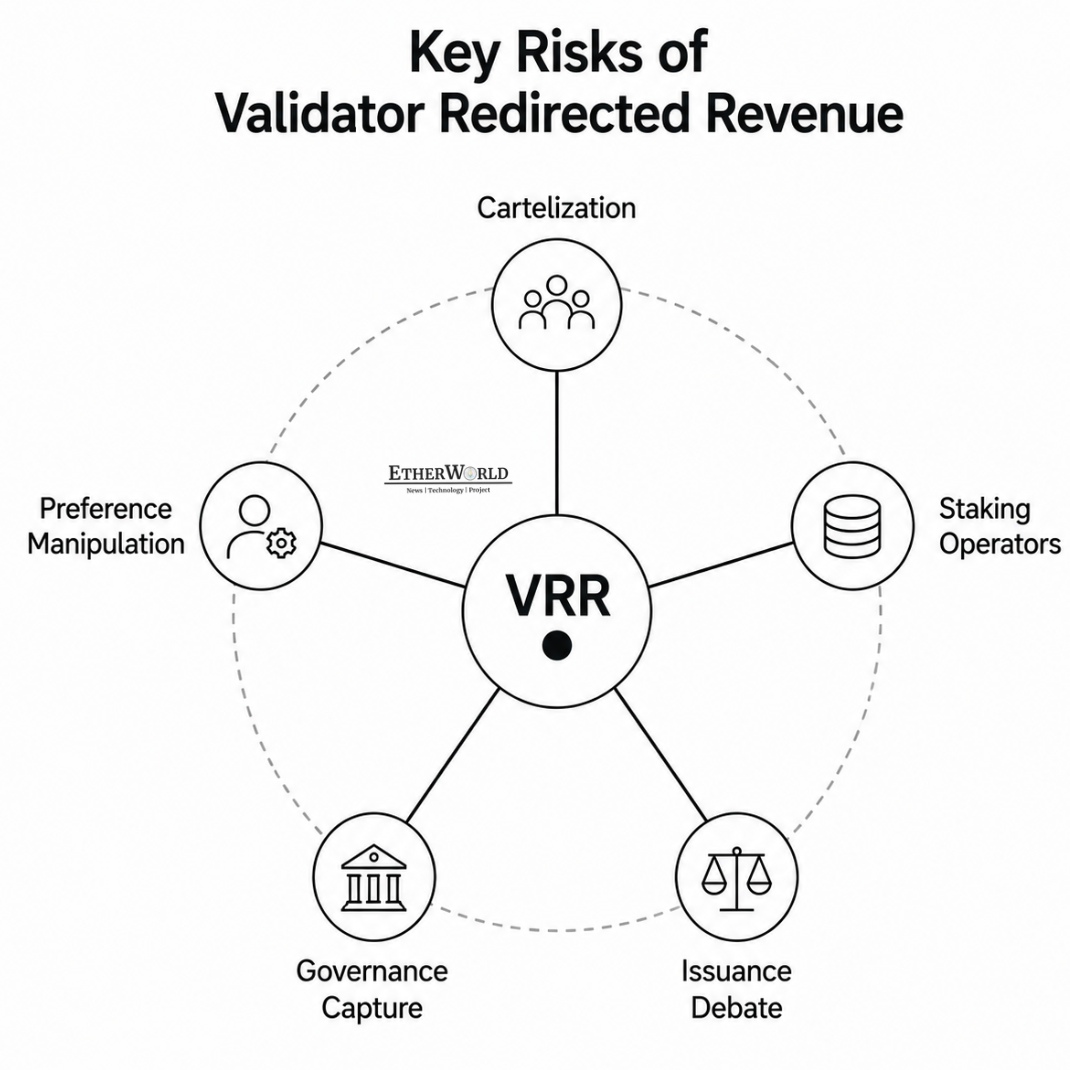
The biggest criticism of Validator Redirected Revenue is cartelization. If a majority of validators collude, they could theoretically raise the redirect rate and direct funds back to themselves.
For example, 51% of validators could set the redirect rate to the 10% maximum and choose a splitter that benefits only their own group. This would effectively extract rewards from the remaining 49%. The proposal acknowledges this concern. It argues that such behavior may be economically self-defeating because visible validator capture could damage confidence in Ethereum and reduce ETH value.
Since validators hold ETH, harming Ethereum’s credibility could hurt them as well. But this defense depends on assumptions about long-term incentives. In real markets, short-term extraction can still happen. Governance capture does not need to be permanently profitable to cause damage.
A second concern is staking operator capture. If most ETH is staked through operators, those operators may control redirect preferences. Their incentives may differ from the underlying ETH holders. Operators might favor projects that improve their own infrastructure, reduce their own costs, or increase their market power.
ETH holders may care more about Ethereum’s long-term neutrality, decentralization, and value. The proposal’s answer is market competition. If users dislike an operator’s redirect preferences, they can move to another provider. Some operators may even allow users to set preferences directly.
This is plausible, but not guaranteed. Staking can be sticky. Liquid staking tokens, exchange custody, tax implications, convenience, and perceived safety can reduce user mobility. If a few large staking providers dominate, redirect governance could become concentrated.
A third concern is monetary policy signaling. If validators are willing to give up 10% of rewards, critics may argue that Ethereum issuance is too high. Why redirect rewards when issuance could simply be reduced? This links VRR to the broader debate around ETH issuance, staking incentives, validator profitability, and Ethereum’s security budget.
EtherWorld has covered Ethereum’s proof-of-stake economics in earlier explainers such as Proof of Stake - Casper “the friendly ghost” and All About The Validator In Ethereum 2.0 Beacon Chain. VRR adds a new layer to that discussion: staking rewards are not only compensation for security, but potentially a source of ecosystem reinvestment.
Supporters may argue that redirects are better than pure issuance cuts because they preserve the same issuance flow while reallocating part of it toward Ethereum development. Critics may argue that this makes staking economics harder to understand and politicizes validator rewards.
What This Means for Ethereum’s Future
Validator Redirected Revenue is unlikely to be accepted without intense debate. It touches too many sensitive areas: validator economics, protocol governance, issuance, public goods funding, staking centralization, and ecosystem legitimacy.
But even if the exact proposal never becomes an EIP, the discussion is valuable. Ethereum’s public goods funding challenge is real.
As the ecosystem grows, the cost of maintaining credible neutrality, security, research, clients, tooling, and education also grows. Relying only on foundations, donations, and periodic grants may not be enough forever.
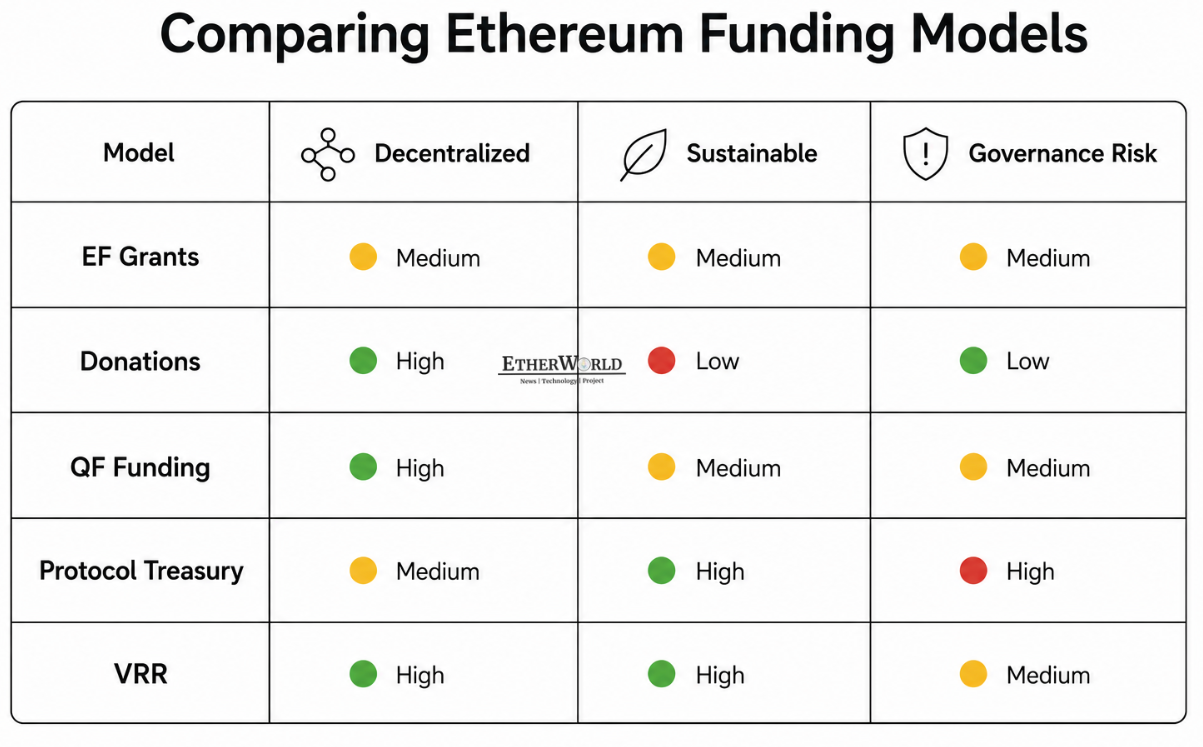
The question is not whether Ethereum needs public goods. It clearly does. The question is how a decentralized ecosystem should pay for them. There are several possible models:
| Funding Model | Strength | Weakness |
|---|---|---|
| Foundation grants | Fast coordination | Centralization concerns |
| DAO funding | Community participation | Governance fatigue |
| Quadratic funding | Broad signal aggregation | Periodic and limited |
| Philanthropy | Flexible support | Unpredictable |
| Protocol treasury | Stable funding | Governance capture risk |
| Validator redirects | Stakeholder-aligned funding | Cartel and operator risks |
VRR sits between voluntary funding and protocol taxation. It is not a traditional tax because validators can collectively return the rate to zero. It is not purely voluntary because once activated, all validators contribute.
It is not a central treasury because recipients are determined through validator preferences. It is not simple donation because the mechanism is embedded into Ethereum’s validator economy. This hybrid nature is what makes it interesting.
It also reflects a broader trend in Ethereum governance. As the protocol matures, Ethereum is no longer only asking how to scale. It is asking how to sustain itself. Upgrade discussions around Glamsterdam and Hegota, tracked in EtherWorld’s State of Upgrade – Glamsterdam Edition #1 and State of Upgrade – Hegota Edition #1, show that Ethereum’s roadmap increasingly includes questions of operational efficiency, validator experience, censorship resistance, and long-term resilience.
VRR belongs in that same category of long-term resilience. If implemented carefully, it could create a powerful recurring funding mechanism for Ethereum public goods. If implemented poorly, it could create validator politics, staking cartel risks, and new governance attack surfaces.
The safest conclusion is that Validator Redirected Revenue should be treated as a serious research direction, not an immediate upgrade candidate. It needs deeper modeling, client-team review, staking-provider feedback, solo-staker input, and public debate.
It also needs clear answers on cartel resistance, operator accountability, recipient transparency, and emergency rollback mechanisms. The answer may shape how Ethereum thinks about public goods for years to come.
To promote your Web3 articles, events, and projects, you may reach out anytime via EtherWorld PR for submissions and collaboration.
Related Articles
- New Leadership at Ethereum: A Fresh Start for the Blockchain Community
- Hsiao-Wei Wang Joins Ethereum Foundation Leadership Team
- Highlights from the All Core Developers Consensus Call #180
- State of Upgrade – Hegota Edition #1
- Vitalik Buterin’s 2026 Vision for Ethereum Foundation
To follow blockchain news, track Ethereum protocol progress, and read our latest stories, subscribe to our weekly today.
Disclaimer: The information contained in this website is for general informational purposes only. The content provided on this website, including articles, blog posts, opinions, & analysis related to blockchain technology & cryptocurrencies, is not intended as financial or investment advice. The website & its content should not be relied upon for making financial decisions. Read full disclaimer & privacy policy.
To stay updated on blockchain news, Ethereum protocol progress, and our latest stories, subscribe to our weekly digest and YouTube channel for ELI5 content.
To promote your Web3 articles, events, project updates, and Press Releases, reach out anytime via EtherWorld PR for submissions and collaboration. For other queries, email contact@etherworld.co.
If you’d like to support our work, share the content and consider donating at avarch.eth.
Join our community on Discord and follow us on Twitter, Facebook, LinkedIn & Instagram.

 ×
×

Author

Yash Kamal Chaturvedi is a Blockchain Content & Ops Specialist at Avarch LLC, writing on Ethereum & governance since 2021. Covers ACD/ACDE calls, EIPs, upgrades, staking, security & ecosystem trends.