Upgrade Watch #2: Hegota Takes Shape with FOCIL
Hegota begins taking shape as Ethereum developers evaluate FOCIL, validator-focused EIPs, implementation status, testing needs, & ecosystem implications.
State of Upgrade is EtherWorld’s ongoing series tracking Ethereum’s major network upgrades through proposal discussions, implementation progress, testing milestones, client readiness, and ecosystem impact. In this first Hegota edition, we look at the early proposals shaping Ethereum’s next upgrade after Glamsterdam.
As Ethereum developers continue advancing Glamsterdam toward deployment, attention is gradually turning to the network’s next major upgrade: Hegota. While still in the proposal selection phase, recent discussions across All Core Developers Consensus calls have started to reveal the themes likely to define Ethereum’s late-2026 roadmap.
Unlike Glamsterdam, which is already moving through active devnet testing and client coordination, Hegota remains focused on research, specification development, and early proposal evaluation. Current discussions suggest the upgrade could prioritize censorship resistance, validator experience, network efficiency, and consensus-layer improvements.
The early direction of Hegota also builds on ongoing Ethereum roadmap debates around proposer-builder separation, transaction inclusion guarantees, and validator operations. These themes have appeared across recent protocol discussions, including EtherWorld’s coverage of ACDC call updates and Ethereum’s broader upgrade planning.
- FOCIL Emerges as the Leading Candidate
- Key Hegota EIPs Under Evaluation
- Implementation Status and Client Readiness
- Research, Testing, and Ecosystem Implications
FOCIL Emerges as the Leading Candidate
The most prominent proposal currently associated with Hegota is Fork Choice Enforced Inclusion Lists, commonly known as FOCIL.
FOCIL aims to strengthen Ethereum’s censorship resistance by ensuring valid transactions cannot be indefinitely excluded from blocks. Instead of relying only on block builders to decide transaction inclusion, the proposal introduces inclusion guarantees enforced through Ethereum’s fork-choice mechanism.
This matters because Ethereum’s block production pipeline has become more complex after the rise of proposer-builder separation. While PBS improves specialization and efficiency, it also raises concerns around transaction censorship and builder centralization. FOCIL attempts to address this by giving the protocol stronger tools to preserve credible neutrality.
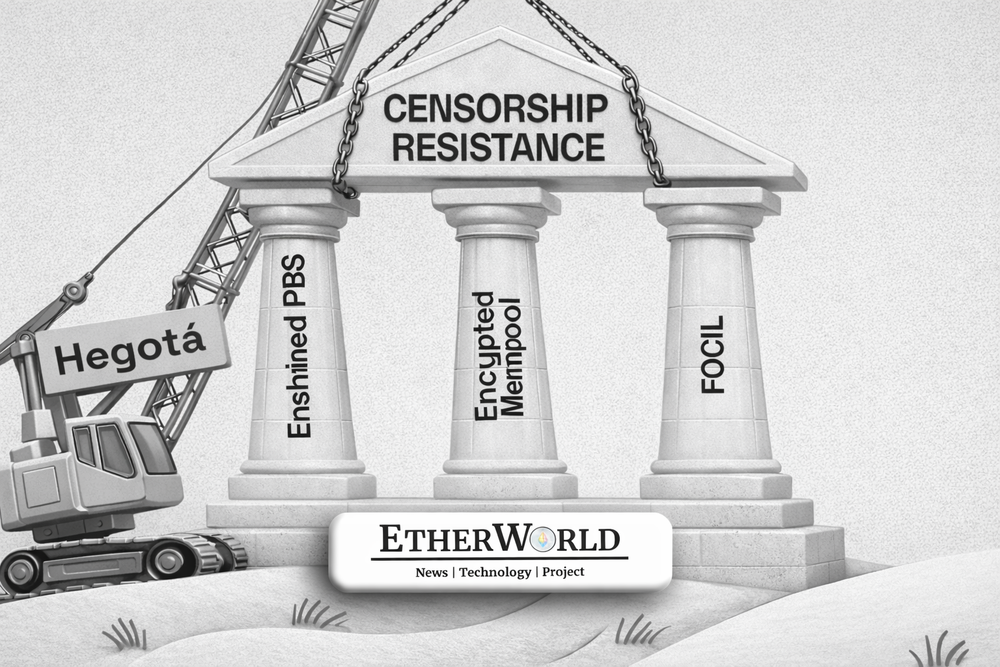
As discussed in EtherWorld’s earlier article, Hegota Should Complete the Holy Trinity of Censorship Resistance, Hegota could become an important upgrade for Ethereum’s long-term neutrality if FOCIL moves into the final scope.
If adopted, FOCIL may become one of Ethereum’s most significant censorship-resistance upgrades since the Merge.
Key Hegota EIPs Under Evaluation
Several Ethereum Improvement Proposals have already entered early Hegota discussions. These proposals are mostly focused on validator operations, consensus-layer efficiency, and improvements to staking-related workflows.
- EIP-8148: Custom Validator Sweep Thresholds: EIP-8148 proposes allowing validators greater flexibility in configuring balance sweep behavior. The change could improve operational efficiency for staking participants while reducing unnecessary validator management overhead. For validators and staking providers, more flexible sweep thresholds may help improve treasury management, reduce operational friction, and support more customized staking setups.
- EIP-8243: Batching Attestations at Source: EIP-8243 focuses on improving validator networking efficiency by batching attestations closer to their source. The proposal aims to reduce bandwidth requirements and improve attestation propagation without introducing major protocol complexity. This proposal fits into Ethereum’s broader effort to improve consensus-layer performance as validator participation grows. More efficient attestation handling could help reduce network load and improve validator communication.
- EIP-7684: Return Deposits for Distinct Credentials: EIP-7684 targets validator deposit handling and credential management. The proposal seeks to simplify validator operations while providing greater flexibility for staking infrastructure providers and individual validators. Deposit and credential management remain important parts of Ethereum’s staking experience. Improvements in this area could make validator operations easier, especially for large staking operators and infrastructure teams.
In addition to these proposals, developers have continued discussing validator-focused improvements such as EIP-8061 and EIP-8080. Together, these conversations show that Hegota is likely to place strong emphasis on validator experience and consensus-layer efficiency.
For readers tracking Ethereum’s previous upgrade work, this follows a broader pattern seen in recent protocol development, where upgrades increasingly combine scalability, security, decentralization, and operational improvements. EtherWorld has covered this evolution across several upgrade-focused articles, including Highlights From the All Core Developers Consensus Call #180.
Implementation Status and Client Readiness
At present, Hegota has not entered formal implementation or interoperability testing. No dedicated Hegota devnet has been launched yet, and client teams remain focused on evaluating candidate EIPs, identifying technical risks, and determining which proposals are mature enough for inclusion.
This is very different from Glamsterdam, where client teams are already working through devnet stability, testing issues, and implementation readiness. Hegota remains earlier in the pipeline, with developers still deciding what the upgrade should contain.
Core developers have also emphasized that Hegota’s final scope will depend heavily on Glamsterdam’s successful rollout and post-upgrade stability. This means proposal evaluation is expected to proceed cautiously, with technical maturity prioritized over aggressive timelines.
Research, Testing, and Ecosystem Implications
Although formal Hegota testing has not yet begun, active research continues across several areas that could influence the final upgrade design.
Researchers are studying how inclusion lists may affect proposer-builder separation, validator participation requirements, attestation propagation, and long-term censorship-resistance guarantees. Additional work is also focused on understanding the networking overhead associated with new consensus-layer mechanisms.
For the broader Ethereum ecosystem, Hegota is increasingly shaping up as a consensus-layer focused upgrade designed to strengthen neutrality and validator operations.
This makes Hegota especially relevant for validators, staking providers, client teams, infrastructure operators, builders, and users who rely on Ethereum’s neutrality as a base layer.
Ethereum’s upgrade roadmap continues to reflect a balance between scalability and credible neutrality. While Glamsterdam is focused on execution-layer improvements, networking upgrades, and builder-related changes, Hegota appears more focused on consensus-layer resilience and censorship resistance.
Hegota remains in its formative stages, but its priorities are becoming clearer. With FOCIL emerging as the likely headline feature and multiple validator-focused EIPs under active review, Ethereum’s next upgrade is positioning itself around stronger censorship resistance, improved validator operations, and better consensus-layer performance.
As Glamsterdam progresses through testing and implementation, core developers will continue refining Hegota’s scope. The coming months will be important as researchers, client teams, and protocol contributors decide which proposals are mature enough to move from discussion into implementation.
If the current direction holds, Hegota could become one of Ethereum’s most consequential upgrades after Glamsterdam, reinforcing the network’s long-term commitment to credible neutrality, decentralization, and protocol resilience.
To promote your Web3 articles, events, and projects, you may reach out anytime via EtherWorld PR for submissions and collaboration.
Related Articles
- TheDAO Security Fund’s First Funding Round Goes Live with Over $1M for Ethereum Security
- Highlights From the All Core Developers Consensus Call #180
- Hegota Should Complete the Holy Trinity of Censorship Resistance
- Ethereum Introduces Clear Signing for Safer Crypto Transactions
- Vitalik Buterin’s 2026 Vision for Ethereum Foundation
To follow blockchain news, track Ethereum protocol progress, and read our latest stories, subscribe to our weekly today.
Disclaimer: The information contained in this website is for general informational purposes only. The content provided on this website, including articles, blog posts, opinions, & analysis related to blockchain technology & cryptocurrencies, is not intended as financial or investment advice. The website & its content should not be relied upon for making financial decisions. Read full disclaimer & privacy policy.
To stay updated on blockchain news, Ethereum protocol progress, and our latest stories, subscribe to our weekly digest and YouTube channel for ELI5 content.
To promote your Web3 articles, events, project updates, and Press Releases, reach out anytime via EtherWorld PR for submissions and collaboration. For other queries, email contact@etherworld.co.
If you’d like to support our work, share the content and consider donating at avarch.eth.
Join our community on Discord and follow us on Twitter, Facebook, LinkedIn & Instagram.

 ×
×

Author

Yash Kamal Chaturvedi is a Blockchain Content & Ops Specialist at Avarch LLC, writing on Ethereum & governance since 2021. Covers ACD/ACDE calls, EIPs, upgrades, staking, security & ecosystem trends.