ENS Governance Crisis Explained: What Went Wrong?
Explore the ENS governance crisis, from the Foundation proposal and Security Council whale vote to Brantly Millegan's exit, EFP's uncertain future, and what it means for DAO governance.
The Ethereum Name Service (ENS), one of Ethereum's most important identity protocols, is facing a major governance crisis. What began as a debate over how ENS should manage its treasury, grants, operations, and emergency safeguards has now turned into a broader dispute over the future of DAO governance itself.
Over the past few weeks, ENS has seen a controversial Foundation restructuring proposal, a whale-driven rejection of the Security Council renewal, the shutdown of major working groups, and the exit of one of its most visible long-time contributors, Brantly Millegan. His decision to remove “.eth” from his public identity and wind down EthID, Ethereum Follow Protocol (EFP), Grails Market, ENS Market Bot, and other ecosystem projects became a symbolic moment in a conflict that had already been building inside ENS governance.
This crisis matters far beyond ENS. It raises a difficult question for Ethereum-aligned projects: can token-weighted DAOs govern large treasuries and critical public infrastructure without becoming captured by insiders, whales, or institutional structures?
- ENS Enters Its Biggest Governance Crisis
- Foundation Proposal Sparks Treasury Capture Concerns
- Security Council Vote Exposes Whale Power
- Brantly Millegan's Exit Deepens the Rift
- EFP & Public Goods Funding Face Uncertain Future
- What ENS Crisis Means for DAO Governance
ENS Enters Its Biggest Governance Crisis
ENS is one of Ethereum's most widely used identity systems. It allows users to map human-readable names such as name.eth to complex Ethereum addresses, making crypto payments, wallet interactions, decentralized websites, and Web3 profiles easier to use. ENS is deeply integrated across wallets, dApps, explorers, and identity tools, which is why its governance structure matters to the broader Ethereum ecosystem.
The ENS DAO was launched in 2021 after ENS tokens were airdropped to early users and community members. The idea was to move ENS toward decentralized governance, where tokenholders and delegates would help steward the protocol, treasury, grants, working groups, and long-term direction. This model reflected the broader DAO optimism of the 2021 cycle, when many Ethereum projects believed token voting could replace traditional organizational control.
But the current dispute has exposed the limits of that model. ENS is no longer a small community experiment. It controls a large treasury, funds ecosystem projects, maintains important public infrastructure, and must coordinate between ENS Labs, the ENS Foundation, DAO delegates, working groups, and tokenholders.
EtherWorld recently covered how ENS DAO is considering a major restructuring that would empower the ENS Foundation to manage operations and treasury strategy while leaving tokenholders with protocol-level control. Read more: ENS DAO Weighs Major Governance Shift to Empower ENS Foundation.
The crisis intensified when the ENS Security Council renewal failed in an on-chain vote, after ENS founder Nick Johnson used a large voting position to oppose the proposal. EtherWorld explained the details in ENS DAO Voters Reject Security Council Renewal in Whale-Driven Vote.
Soon after, Brantly Millegan announced that he was leaving ENS and removing “.eth” from his identity. EtherWorld covered that development in Top ENS Contributor Exits Amid Governance Rift.
Foundation Proposal Sparks Treasury Capture Concerns
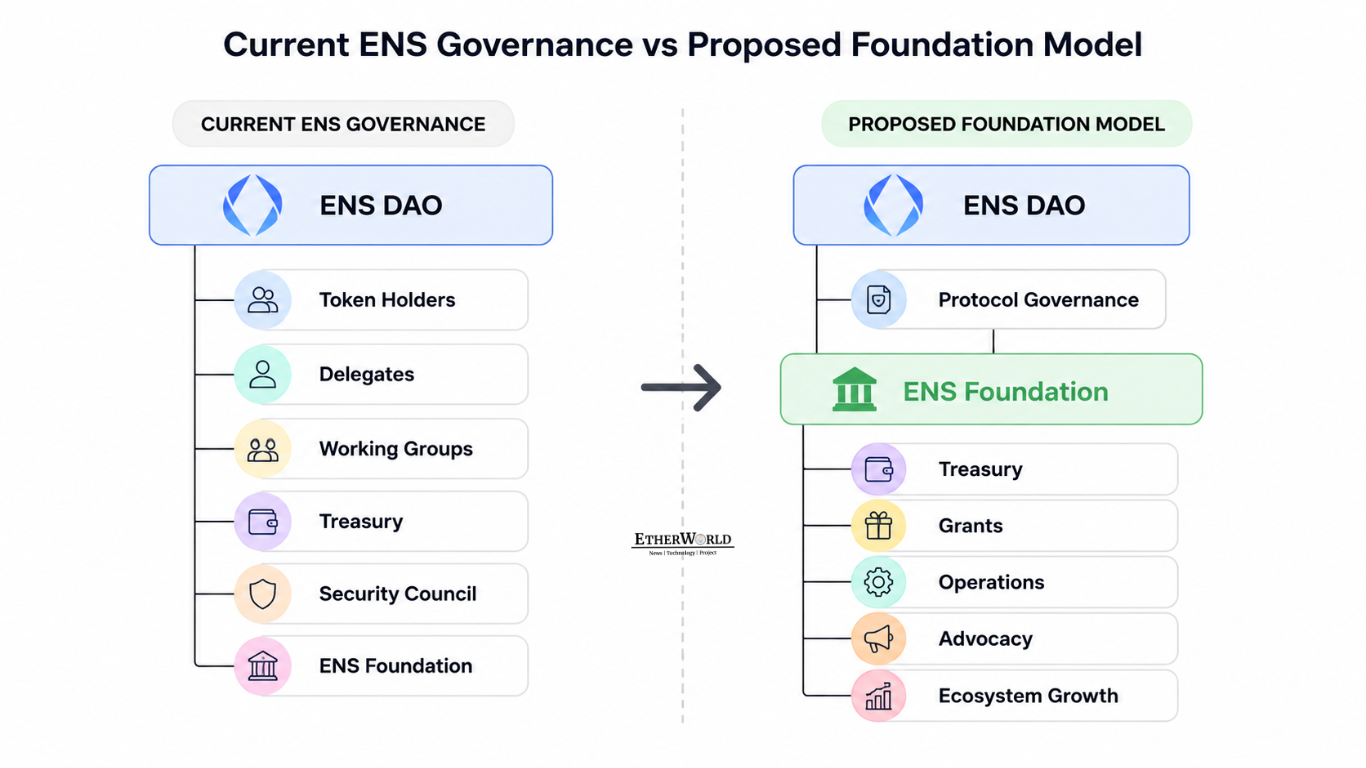
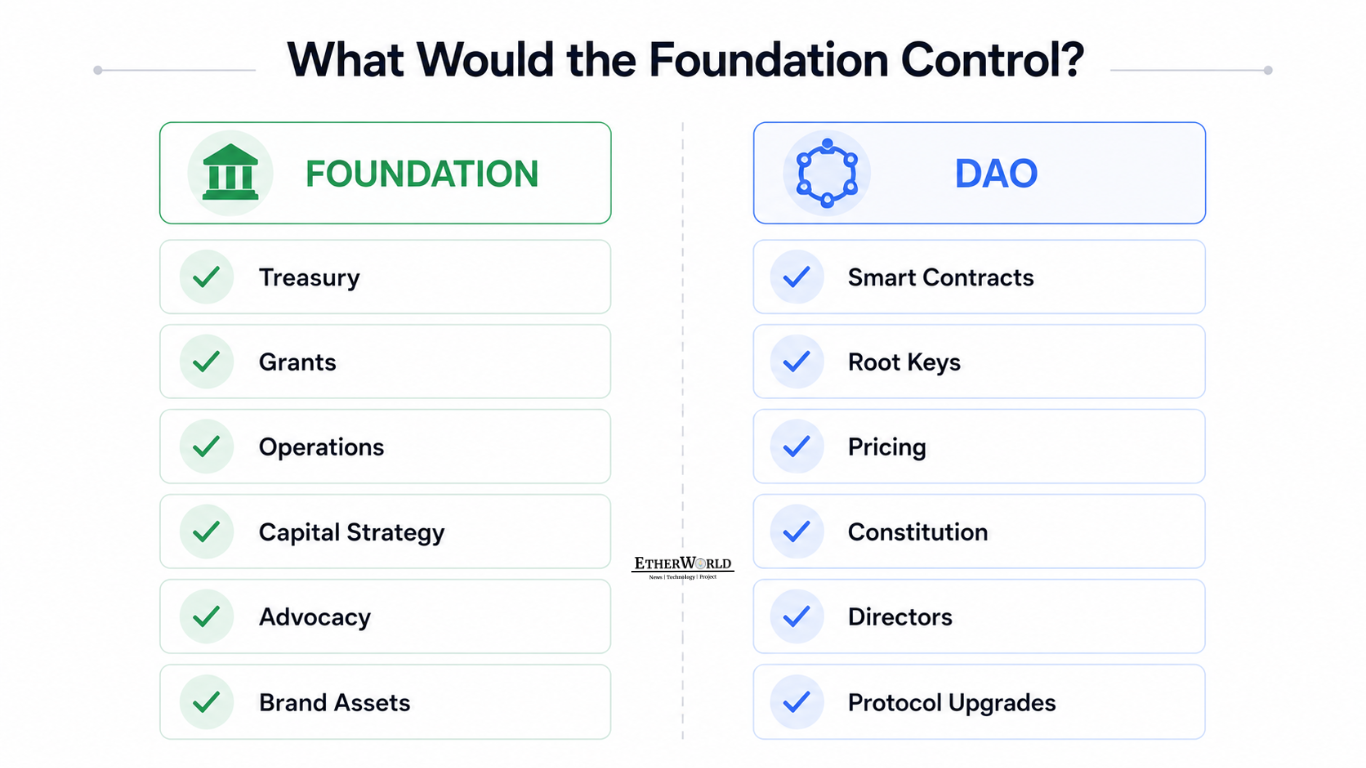
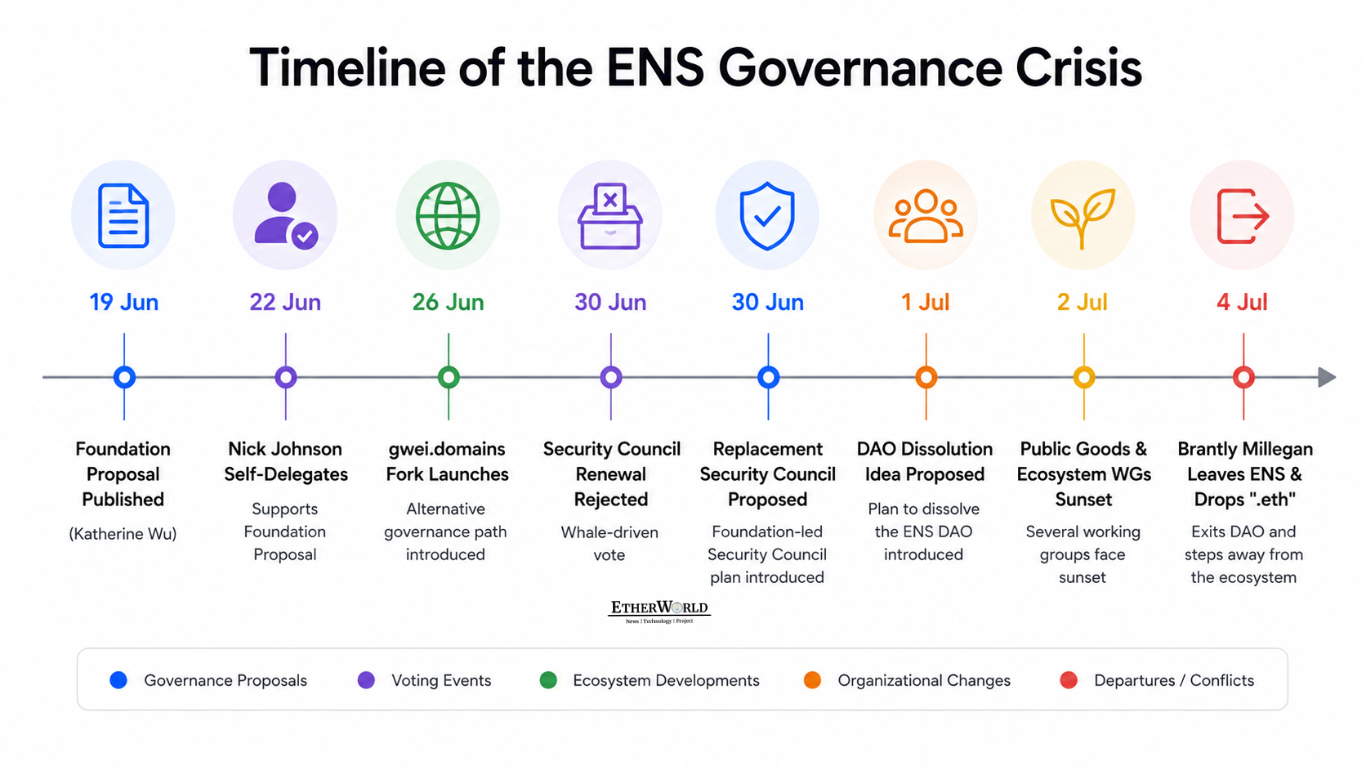
The central dispute began with the “Next Era of ENS DAO: Empowering the ENS Foundation” temperature check proposal introduced by Katherine Wu, ENS Labs COO. The proposal suggested moving day-to-day operations, treasury management, grants, long-term capital planning, ecosystem coordination, and advocacy functions from the DAO to a strengthened ENS Foundation.
Under this model, ENS tokenholders would retain control over core protocol governance. This includes smart contract upgrades, ENS pricing, fee structures, constitutional amendments, root key control, and director appointments or removals. However, operational decision-making would shift toward a more professional foundation structure.
Supporters argue that this is necessary. According to them, token-weighted DAOs are not well suited for managing grants, investments, legal work, staff, vendor relationships, brand assets, and long-term ecosystem planning. DAO delegates may be active during major controversies, but day-to-day governance often suffers from low participation, slow execution, weak accountability, and coordination fatigue.
This argument is not unique to ENS. Many DAOs have faced similar challenges as they scaled. EtherWorld has previously explored broader DAO questions in Is DAO more efficient than corporations?, where Vitalik Buterin's views on decentralized organizations were discussed in the context of efficiency, decentralization, and governance design.
Critics, however, view the ENS Foundation proposal differently. Brantly Millegan called it “treasury capture by ENS Labs,” arguing that it would move too much control away from the DAO and into a Foundation structure aligned with existing insiders. Other ENS delegates warned that the proposal could weaken community governance and reduce tokenholder oversight over one of the largest treasuries in Ethereum.
The board structure also became controversial. The proposed Foundation Board would include ENS founder Nick Johnson, proposed Executive Director Alexander Urbelis, and three independent directors. Supporters saw this as a professional governance upgrade. Critics saw it as a centralization of control.
The key tension is simple: should ENS remain DAO-first, even if that means slower and messier governance, or should it shift toward a Foundation-led structure to improve execution?
That question sits at the heart of the crisis.
Security Council Vote Exposes Whale Power
The ENS Security Council was designed as an emergency safeguard. It is not supposed to manage ENS on a daily basis. Its role is to cancel malicious or unconstitutional proposals before they execute on-chain.
The council's first two-year term was nearing expiry, and a proposal was introduced to renew it for another term. The renewal passed earlier off-chain governance steps, but the final on-chain executable vote produced a very different outcome.
Nick Johnson voted against renewal using roughly half of the active delegated voting supply. The result was a decisive rejection, with around 82% voting against the renewal. Because one large voting position drove most of the opposition, the vote immediately became a flashpoint in the ENS governance debate.
Johnson's stated concern was that some Security Council members had suggested they might use their veto power against the Foundation proposal. From his perspective, if the Foundation proposal passed through normal DAO governance, a Security Council veto would represent political interference rather than an emergency security action.
Critics responded that this was exactly why the Security Council existed: to protect the DAO from governance attacks, including attempts to shift control of treasury and operations away from the community. The disagreement therefore became a dispute over what counts as a “governance attack.”
This incident exposed a central weakness in token-weighted governance. If one founder or whale can control around half of active voting power, then the DAO's legitimacy becomes fragile. Even if the vote is technically valid, community members may view the outcome as captured.
The ENS debate also connects to wider Ethereum governance concerns. EtherWorld's coverage of Ethereum neutrality in Vitalik Buterin on Why Ethereum Must Stay Neutral is relevant here because ENS governance is now testing whether critical Ethereum infrastructure can remain neutral when power becomes concentrated.
After the renewal failed, Katherine Wu introduced a replacement Security Council proposal with stricter rules, a clearer public mandate, a higher cancellation threshold, and member removal mechanisms. This may address some concerns, but it does not fully resolve the deeper issue: who should hold emergency power when the DAO itself is divided?
Brantly Millegan's Exit Deepens the Rift
Brantly Millegan's departure was one of the most symbolic moments in the ENS crisis. He was not just another contributor. He authored the ENS Constitution, previously served as Director of Operations at ENS Labs, remained active in DAO governance, served on the Security Council, and built EthID and Ethereum Follow Protocol.
When Millegan announced that “the .eth comes off,” it was widely interpreted as a public break from the identity system he had helped shape. For a long-time ENS contributor to remove .eth from his public identity during a governance dispute sent a strong message.
His exit also had practical consequences. Millegan confirmed that EthID and related projects would wind down. This includes Ethereum Follow Protocol, Grails Market, ENS Market Bot, and other identity-focused tools. All code is expected to remain open source, but active maintenance and development are now uncertain.
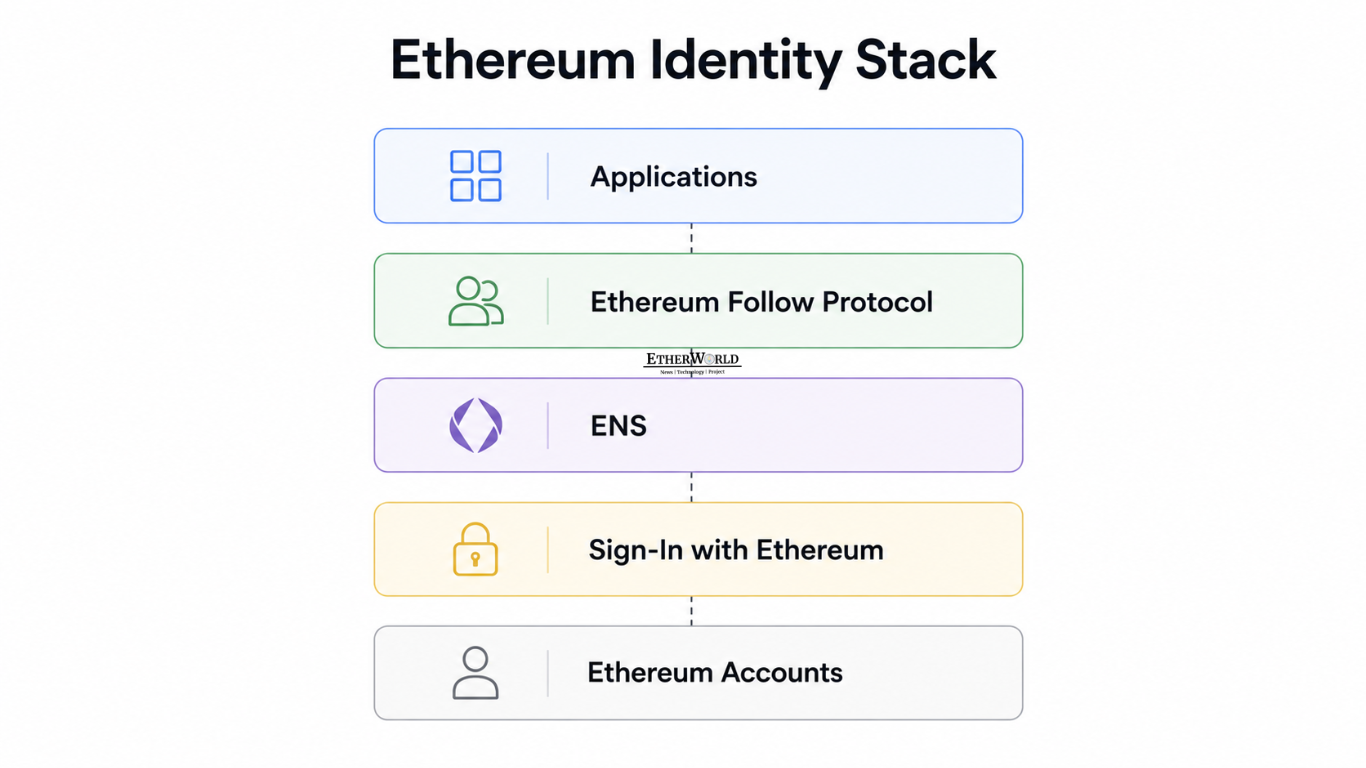
This is significant because ENS is not only a naming protocol. It is part of Ethereum's broader identity stack. ENS names, Sign-In with Ethereum, profiles, avatars, social graphs, and reputation systems all contribute to the idea of a user-owned Web3 identity layer. If major contributors and identity projects leave, ENS loses more than governance participants; it loses ecosystem momentum.
EtherWorld's report on Millegan's exit, Brantly Milligan Exits ENS Exits Amid Governance Rift, captured this turning point in detail.
EFP & Public Goods Funding Face Uncertain Future
One of the most important projects affected by the crisis is Ethereum Follow Protocol. EFP is an onchain social graph protocol for Ethereum accounts. Instead of building a full social network, it focuses on a minimal primitive: allowing Ethereum users to follow and tag each other onchain.
This makes EFP highly complementary to ENS. ENS provides names and profiles. Sign-In with Ethereum provides authentication. EFP adds social connections. Together, these tools can support a decentralized identity and reputation layer for Ethereum.
EFP had meaningful traction, including tens of thousands of list minters, more than one million list operations, and growing interest from the Ethereum identity community. Its shutdown therefore creates a real gap. Even though the code remains open source, open-source software does not maintain itself. Without funded teams, active leadership, and ecosystem support, public goods often decay.
At the same time, the ENS Public Goods Working Group and Ecosystem Working Group have also been sunset. The Public Goods Working Group had distributed grants to Ethereum infrastructure, including projects such as Vyper, Argot Collective, and Remix Labs. These are not peripheral efforts. They support developer tooling, smart contract languages, security, and Ethereum's open-source base layer.
This creates an uncomfortable contrast. ENS itself began with support from Ethereum public goods funding. Nick Johnson received a major Ethereum Foundation grant to build ENS. Years later, ENS had the treasury and position to become a major public goods funder in the ecosystem. Instead, the current crisis has led to a contraction of grants and contributor support.
EtherWorld has often covered Ethereum public goods, open governance, and ecosystem coordination, including 100 Office Hours of Open Governance and EtherWorld Weekly - Edition 371, where governance, client updates, standards, and ecosystem developments are tracked together.
The ENS situation shows that public goods funding is not only about treasury size. It also depends on governance stability, community trust, and institutional clarity.
What ENS Crisis Means for DAO Governance
The ENS governance crisis is now a major case study for Ethereum DAOs. It brings together several unresolved problems that many decentralized organizations face.
First, token-weighted voting can become highly concentrated. If one large holder or founder controls enough active voting power, formal governance may remain decentralized in theory but centralized in practice.
Second, DAOs struggle with operations. Grant management, treasury allocation, legal responsibilities, hiring, vendor oversight, and ecosystem strategy are difficult to manage through public token votes alone.
Third, emergency safeguards are hard to define. A Security Council can protect a protocol from malicious proposals, but if members use emergency powers to block controversial political decisions, critics may view that as overreach.
Fourth, foundations can improve execution but also raise capture concerns. A professional board and staff may make ENS more efficient, but moving authority away from tokenholders can weaken trust if the community sees the transition as insider-led.
Fifth, contributor morale matters. When long-time builders leave and projects wind down, governance damage becomes operational damage.
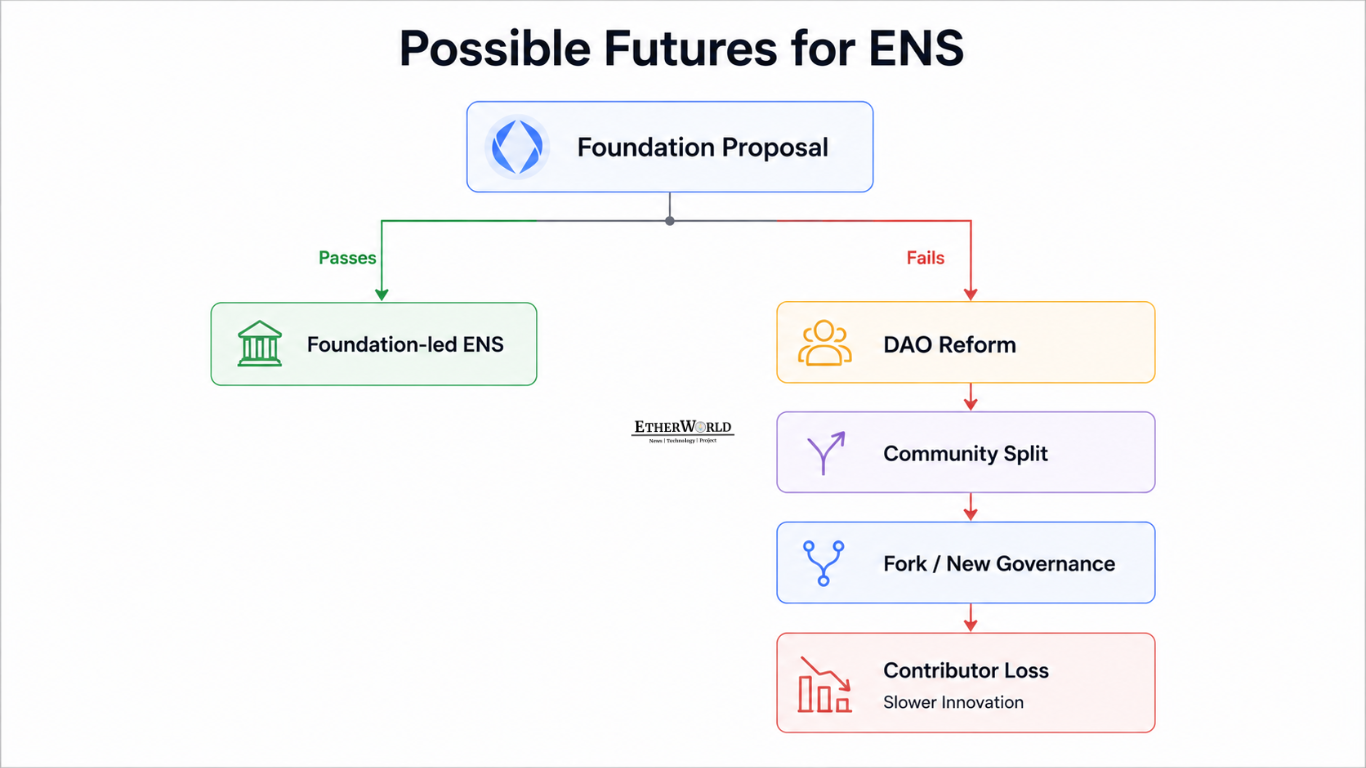
ENS now appears to have several possible paths. The Foundation proposal could move forward and reshape ENS into a more foundation-led structure. A revised Security Council could be approved with clearer powers. The DAO could reject restructuring and attempt to repair its existing governance model. More radically, some community members have even discussed dissolving the DAO entirely and transferring treasury stewardship elsewhere.
None of these paths are simple. A Foundation-led model may improve execution but reduce community confidence. A DAO-first model may preserve decentralization but remain slow and vulnerable to whale voting. A dissolution model may solve one governance problem while creating an even bigger legitimacy crisis.
For Ethereum, the lesson is clear: governance design cannot be treated as an afterthought. Protocols that manage public infrastructure and large treasuries need clear separation of powers, transparent delegation, conflict-of-interest rules, emergency safeguards, contributor funding, and legitimacy mechanisms that go beyond raw token voting.
The coming weeks will determine whether ENS can turn this crisis into a governance reset or whether the dispute becomes a lasting fracture in Ethereum's identity layer.
To promote your Web3 articles, events, and projects, you may reach out anytime via EtherWorld PR for submissions and collaboration.
Related Articles
- ENS DAO Voters Reject Security Council Renewal in Whale-Driven Vote
- ENS DAO Weighs Major Governance Shift to Empower ENS Foundation
- ENS celebrates 5th anniversary with a million registered .eth addresses
- ERC-4361 Finalized: What Sign-In with Ethereum Means for Ethereum
- Uniswap Founder Pays $29K to Reclaim ENS
To follow blockchain news, track Ethereum protocol progress, and read our latest stories, subscribe to our weekly today.
Disclaimer: The information contained in this website is for general informational purposes only. The content provided on this website, including articles, blog posts, opinions, & analysis related to blockchain technology & cryptocurrencies, is not intended as financial or investment advice. The website & its content should not be relied upon for making financial decisions. Read full disclaimer & privacy policy.
To stay updated on blockchain news, Ethereum protocol progress, and our latest stories, subscribe to our weekly digest and YouTube channel for ELI5 content.
To promote your Web3 articles, events, project updates, and Press Releases, reach out anytime via EtherWorld PR for submissions and collaboration. For other queries, email contact@etherworld.co.
If you’d like to support our work, share the content and consider donating at avarch.eth.
Join our community on Discord and follow us on Twitter, Facebook, LinkedIn & Instagram.

 ×
×

Author

Yash Kamal Chaturvedi is a Blockchain Content & Ops Specialist at Avarch LLC, writing on Ethereum & governance since 2021. Covers ACD/ACDE calls, EIPs, upgrades, staking, security & ecosystem trends.