What Happens If India Bans Crypto?
A data-driven analysis of risks, realities, and what is at stake for India's crypto users, startups, investors, developers, exchanges, and policymakers.
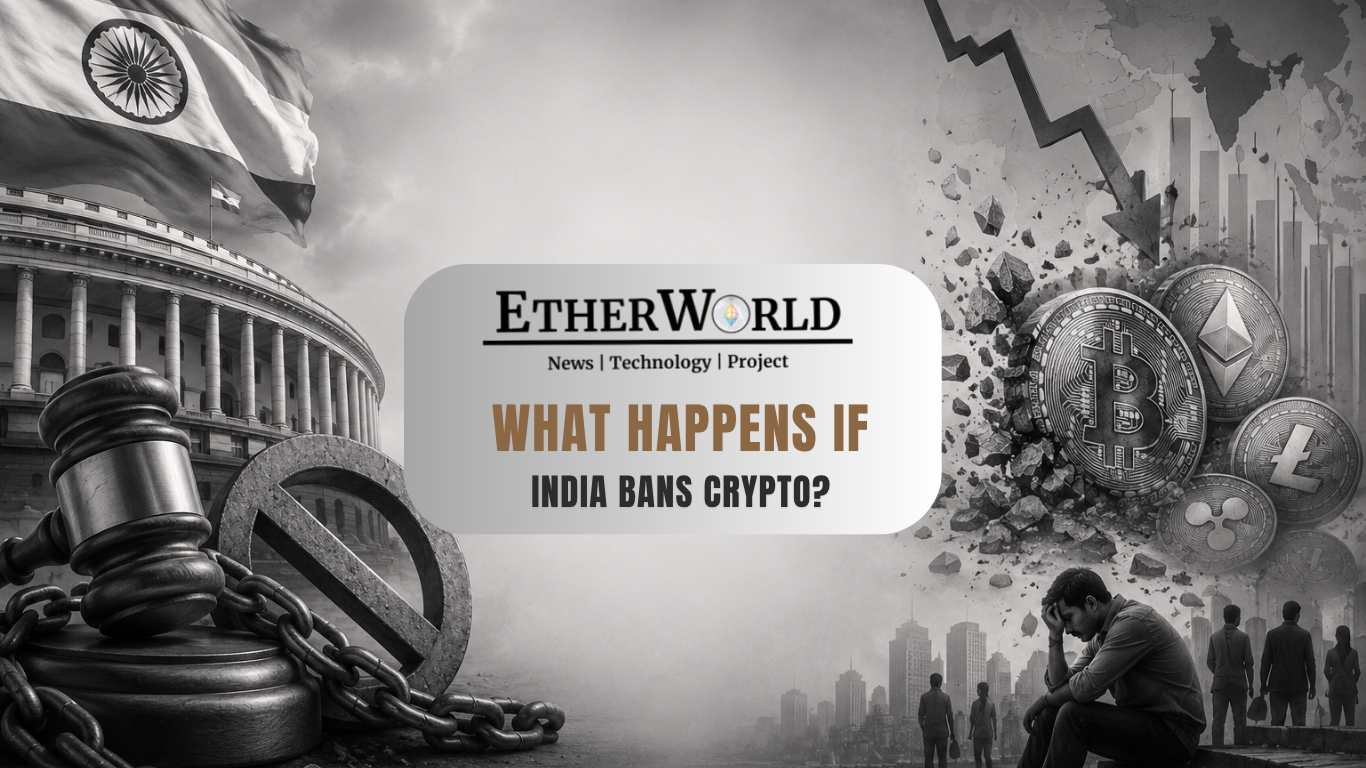
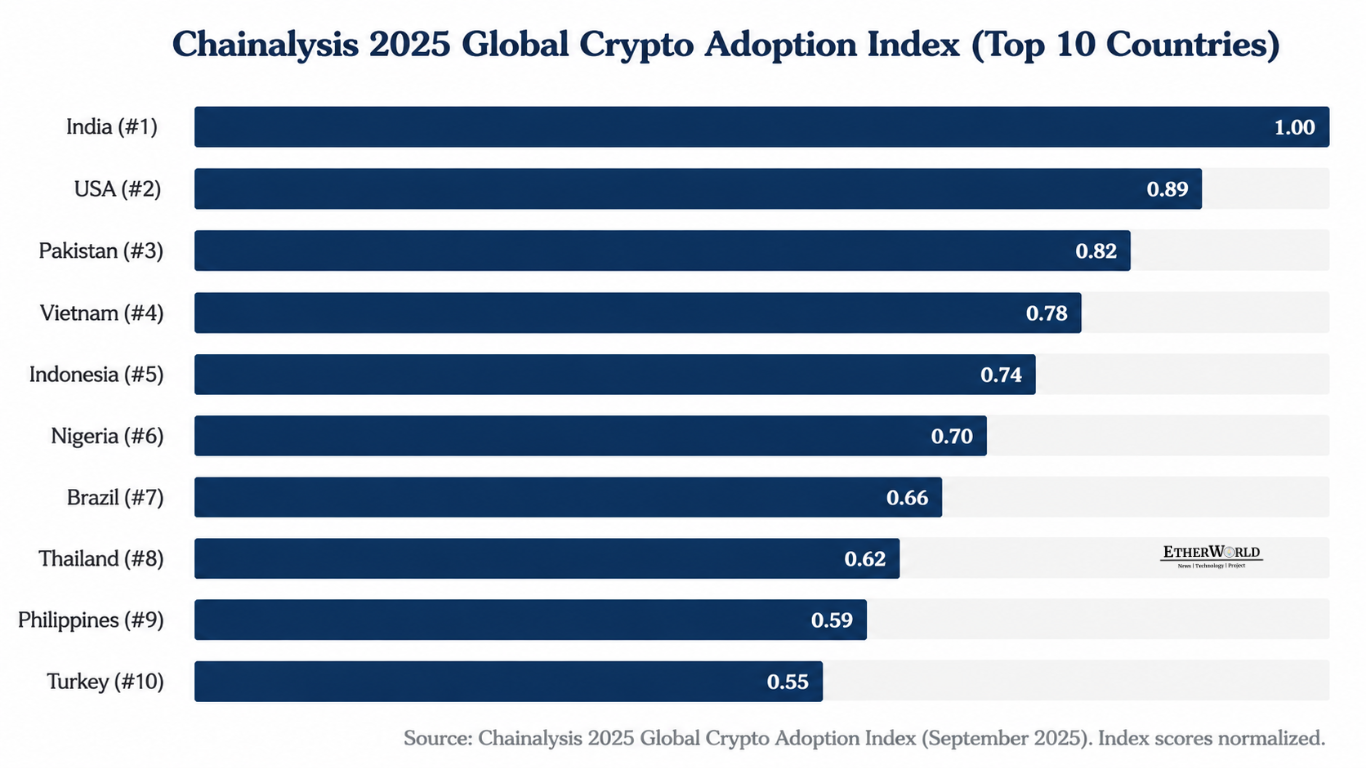
India is the world's number one cryptocurrency adoption nation for the third consecutive year. Approximately 119 million Indians own digital assets, accounting for roughly 15% of the global crypto user base. Over $340 billion in crypto value flowed through Indian addresses in a single 12 month period, equivalent to 9% of the country's GDP according to the OECD's Asia Capital Markets Report 2026.
Yet the country still has no dedicated crypto legislation, no licensing framework, no investor protection law, and no stablecoin regulation. What it has instead is a punitive 30% flat tax, a 1% TDS on every transaction, and a rapidly intensifying enforcement apparatus.
The question "What happens if India bans crypto?" is no longer hypothetical. It is the most consequential policy question facing 119 million people, 1,250+ Web3 startups, and a $3.5 billion venture ecosystem.
- India's Crypto Paradox
- Why a Ban Is Still Being Discussed
- Who Would Be Hit the Hardest?
- What India Can Learn from Other Countries
- Possible Scenarios If India Bans Crypto
- Why Regulation Is Better Than Prohibition
India's Crypto Paradox
India's crypto story is full of contradictions. On one hand, the country has a massive retail investor base, strong blockchain developer talent, and a growing number of Web3 startups. On the other hand, India still treats virtual digital assets mainly through taxation and enforcement rather than a complete regulatory framework.
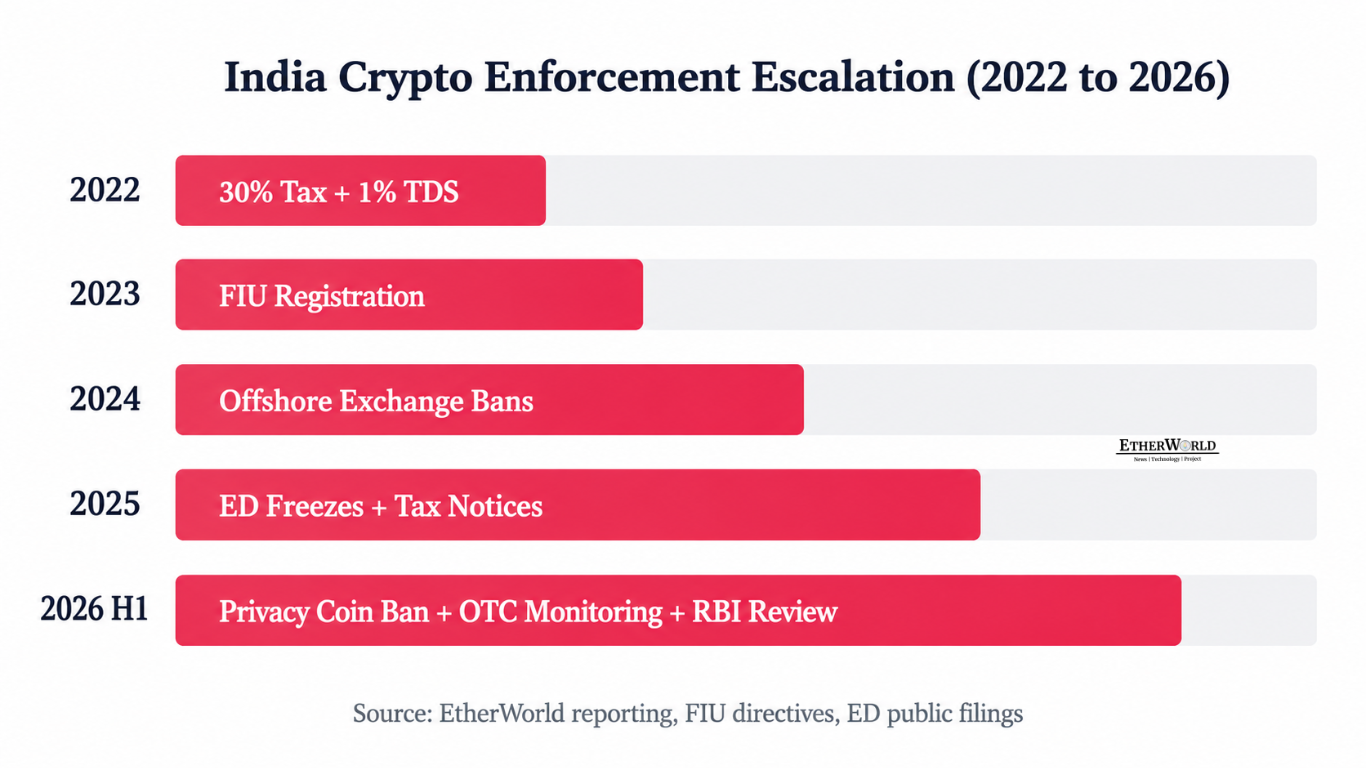
The current tax structure has become one of the biggest pressure points. Since 2022, India has imposed a 30% flat tax on crypto gains and a 1% TDS on transactions. EtherWorld previously covered this in Cryptocurrency Taxation in India and later reported that India's Budget 2026 offered no tax relief for crypto.
This means the government recognizes crypto enough to tax it, but not enough to provide a clear licensing regime, investor protection law, or asset classification framework. That creates a strange middle ground: crypto is not banned, but it is not fully regulated either.
The result has been a shift away from domestic platforms. High taxation has pushed a large part of trading activity offshore, reducing transparency for Indian regulators and weakening local exchanges. Instead of reducing crypto activity, strict tax policy has moved users toward foreign exchanges, peer-to-peer markets, and informal channels.
This matters because crypto is no longer a niche investment category. It touches trading, remittances, tokenized assets, stablecoins, DeFi, gaming, creator payments, and institutional settlement. India is also preparing for a larger role in Ethereum and Web3 conversations, especially as Devcon 8 is scheduled for Mumbai in November 2026.
A full ban would therefore not affect only traders. It would affect startups, developers, investors, compliance teams, exchanges, global partnerships, and India's positioning in the future digital asset economy.
Why a Ban Is Still Being Discussed
The RBI's concern is not only about Bitcoin price volatility. It is also about monetary sovereignty. Stablecoins such as USDT and USDC can create a dollar-linked parallel payment layer outside the banking system. EtherWorld has covered this debate in India Has No Case for Stablecoins, Says RBI Deputy Governor and Does India Need Stablecoins When UPI Already Works?.
India already has UPI, one of the world's most successful domestic digital payment systems. So, from the RBI's perspective, stablecoins may not be needed for local retail payments. However, stablecoins may still matter for cross-border trade, remittances, global treasury operations, and tokenized asset settlement.
Enforcement is another major driver. Indian agencies have been expanding their crypto-tracking capabilities. EtherWorld has reported on India's Ministry of Finance expanding crypto enforcement training, India's FIU banning privacy coins like Monero and Zcash, and India FIU targeting OTC crypto trades above $10K.
These moves show that regulators are increasingly focused on traceability, beneficial ownership, anti-money laundering controls, and suspicious transaction monitoring. Recent cases, including Bengaluru crypto firms coming under scrutiny over alleged ₹2,500 crore transfers, have strengthened concerns around capital flight and illegal cross-border movement of funds.
So the fear is real. Crypto can be misused. But the policy question is whether banning it would reduce misuse or simply push activity underground.
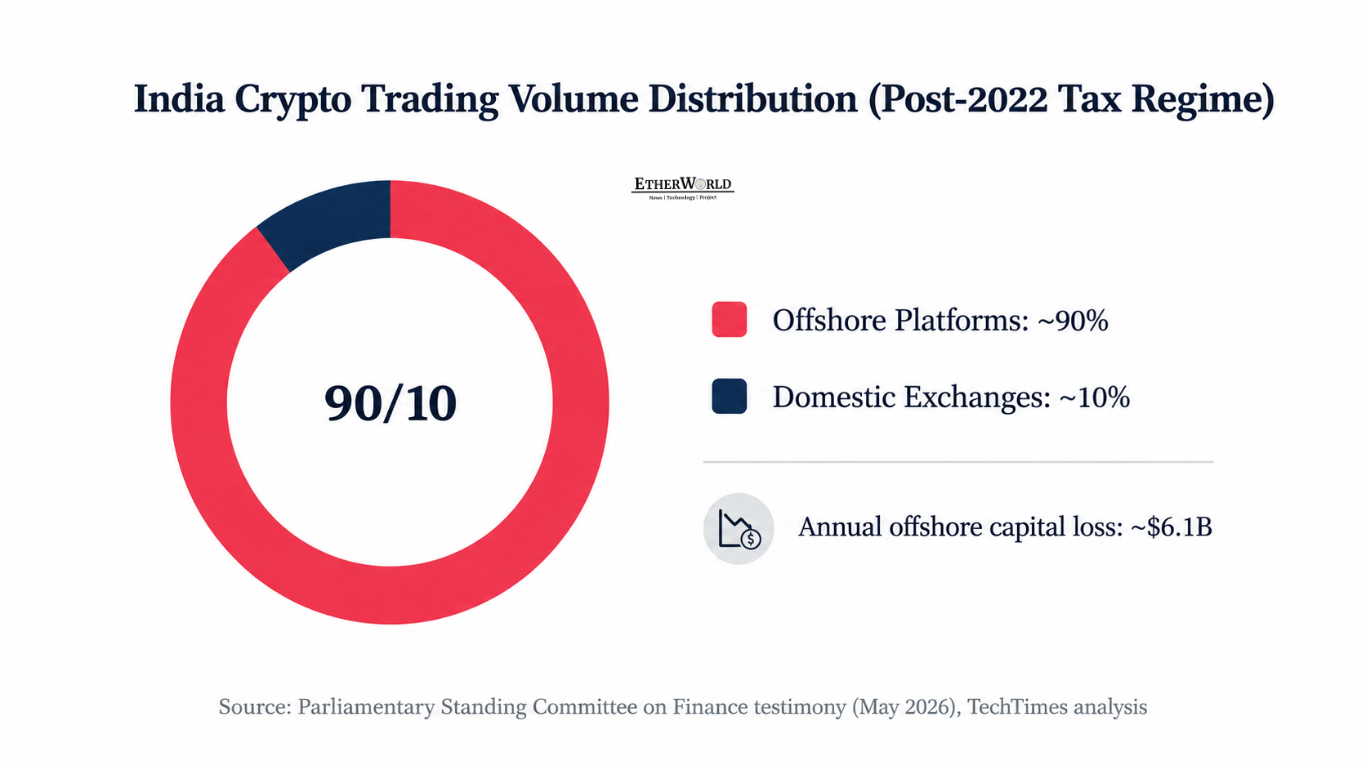
Yet the domestic picture tells a different story from the on-chain picture. In May 2026, India's Parliamentary Standing Committee on Finance did something unprecedented (detailed analysis by TechTimes): it formally sat down with the country's three largest cryptocurrency exchanges, WazirX, Binance, and ZebPay, and asked why so much of India's crypto economy was leaving.
The answer: India's tax structure has driven roughly 90% of the country's crypto trading volume to offshore platforms, costing the country approximately $6.1 billion per year in capital that no longer moves through the domestic financial system.
Who Would Be Hit the Hardest?
A crypto ban would create a chain reaction across India's digital economy.
Retail investors would face the first shock. If holding, trading, or transferring crypto became illegal, users would be forced to liquidate, move assets offshore, or use informal channels. This could create panic selling, legal confusion, and consumer losses. Many users may not even understand whether self-custody wallets, DeFi positions, NFTs, staking rewards, or foreign exchange accounts fall under the ban.
Domestic exchanges would be the next major casualty. Indian platforms have already been weakened by tax-driven volume migration. A ban or banking restriction would make normal operations nearly impossible. Compliance teams, customer support, legal departments, engineers, and exchange employees would all be affected.
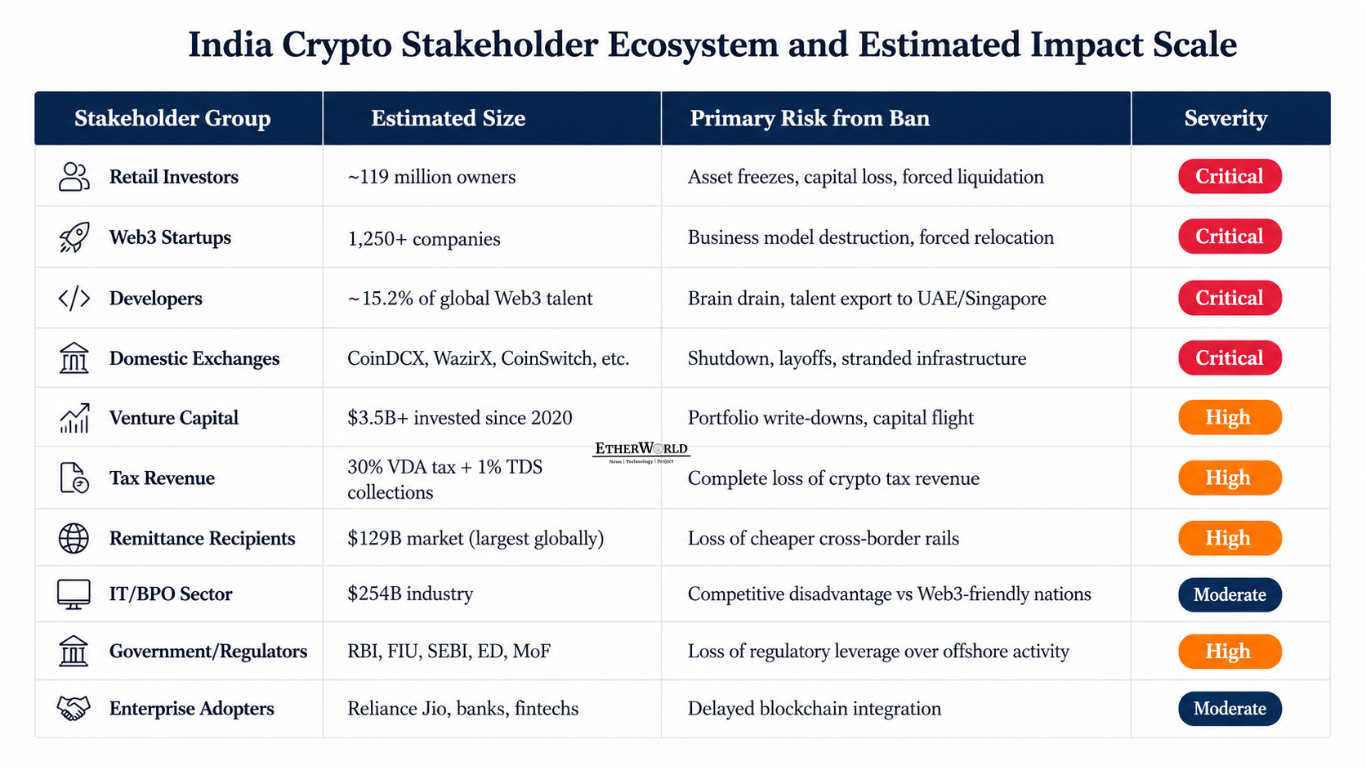
Startups would also face a direct threat. India has a growing Web3 startup ecosystem working across infrastructure, wallets, DeFi, gaming, identity, tokenization, and developer tooling. If India bans crypto broadly, many founders would relocate to friendlier jurisdictions such as the UAE, Singapore, Hong Kong, or Europe.
Developer talent is another major concern. Web3 is not only about trading tokens. It includes cryptography, zero-knowledge proofs, decentralized identity, Ethereum scaling, smart contract security, wallets, tokenized securities, and blockchain-based settlement systems. If policy becomes hostile, Indian developers may continue building for global protocols, but from outside India.
This is why political voices have warned about brain drain. EtherWorld covered this issue in Indian MP Flags Crypto Talent Drain Amid Heavy Taxation and Indian MP Raghav Chadha Pushes Crypto & Blockchain Reforms.
The government would also lose tax visibility. A ban may look strict on paper, but if users continue through VPNs, offshore exchanges, Telegram brokers, and P2P markets, the state loses both revenue and oversight. That is the opposite of consumer protection.
What India Can Learn from Other Countries
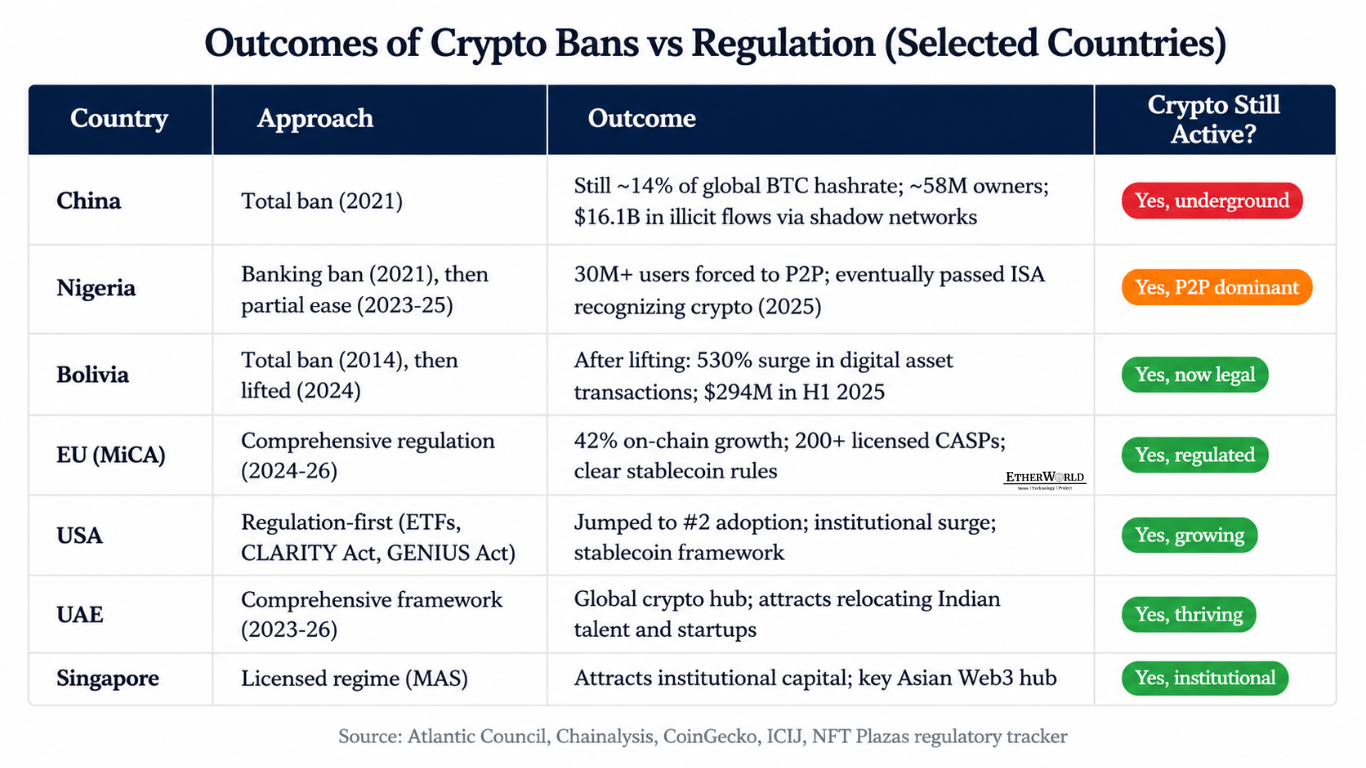
Global experience shows that crypto bans rarely eliminate crypto activity. They usually change where and how it happens.
China is the clearest example. Despite strict restrictions on crypto trading and mining, crypto activity did not disappear completely. Users shifted to offshore platforms, informal networks, and other access routes. The lesson is simple: when demand remains strong, prohibition often reduces visibility rather than activity.
Nigeria offers another useful case. A banking restriction pushed users toward peer-to-peer markets. Eventually, the country moved toward a more structured regulatory approach because informal activity was harder to supervise.
Bolivia also reversed its earlier prohibition after years of restrictions. Once the ban was lifted, reported crypto transactions increased sharply, showing that demand had not disappeared during the ban period.
On the other side, regulated markets are trying to bring activity into licensed channels. The European Union has MiCA. The United States is debating market structure and stablecoin legislation. The UAE has positioned itself as a crypto and Web3 hub. Singapore continues to build a controlled but innovation-friendly framework.
India has already begun studying global models. EtherWorld covered this in India, Australia, Germany, US: A Global Look at Cryptocurrency Regulation and Parliament Finance Panel to Meet RBI Over Crypto Regulations.
The important point is that regulation gives governments tools. Licensing creates accountable entities. Reporting requirements create data trails. Custody rules protect users. Stablecoin rules protect monetary policy. Tax reform can bring volume back onshore.
A ban removes these tools and replaces them with enforcement after the damage is already done.
Possible Scenarios If India Bans Crypto
India has several possible policy paths.
The first is a complete ban. This would prohibit holding, trading, mining, transferring, or offering crypto services. It would be the most extreme route and would likely face legal, technical, and practical challenges. Millions of users would need clarity on liquidation timelines, tax treatment, wallet holdings, NFTs, DeFi funds, and foreign accounts.
The second is a trading ban. In this model, users may be allowed to hold crypto, but domestic exchanges would not be allowed to offer trading. This would likely push almost all market activity offshore. It may reduce visible domestic trading but increase informal activity.
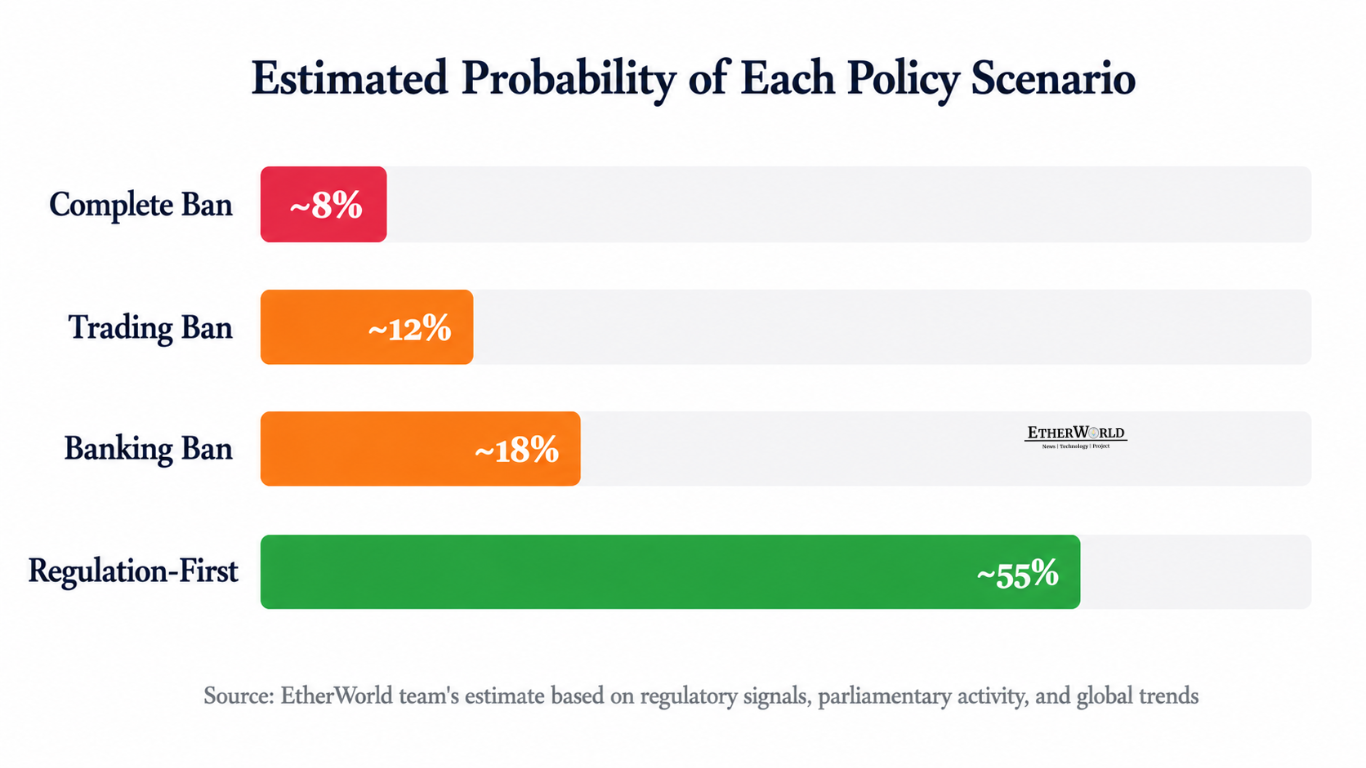
The third is a banking ban. India has already seen a version of this through the RBI's 2018 circular, which was later struck down by the Supreme Court. A new banking restriction would hurt exchanges, payment ramps, stablecoin conversions, and institutional access. EtherWorld's coverage of Coinbase's comeback in India shows how important banking and compliance clarity are for global platforms entering India.
The fourth option is the current status quo: heavy taxation, selective enforcement, no dedicated law, and limited regulatory clarity. This avoids the political cost of a ban but continues pushing activity offshore.
The fifth and most constructive option is regulation-first. India could create a licensing framework for exchanges and custodians, define different asset categories, regulate stablecoins separately, reduce tax friction, allow loss offsets, and impose strict AML reporting.
Recent developments suggest India may already be moving toward recognition rather than pure prohibition. Maharashtra became the first Indian state to recognize crypto as recoverable property under the MPID Act, allowing authorities to seize, value, liquidate, and return crypto linked to financial fraud. EtherWorld covered this in Maharashtra Becomes First State to Recognize Crypto.
That does not mean crypto is fully legal tender or formally regulated as a financial asset. But it does show that Indian law is beginning to treat digital assets as something that exists, can be recovered, and must be handled through legal processes.
Why Regulation Is Better Than Prohibition
India does not need to choose between an uncontrolled crypto market and a total ban. The better path is a structured regulatory framework.
First, India should reform crypto taxation. The 30% flat tax and 1% TDS have discouraged domestic trading and reduced exchange liquidity. A more balanced structure, closer to equity taxation, could bring volume back into compliant Indian platforms. Lower TDS, loss offsets, and clearer reporting rules would improve tax compliance instead of punishing legitimate users.
Second, India needs licensing. Exchanges, custodians, brokers, OTC desks, wallet providers, and stablecoin service providers should operate under clear standards. Licensing should include capital requirements, proof of reserves, cybersecurity audits, grievance redressal, segregation of customer assets, and mandatory disclosures.
Third, stablecoins need separate rules. India may not need stablecoins for local UPI-style payments, but they can be important for cross-border settlement, trade finance, tokenized assets, and global digital commerce. A blanket ban on stablecoins would push this activity offshore. A regulated framework would give India visibility and control.
Fourth, India should support tokenization. SEBI's interest in tokenized corporate bonds shows that blockchain can be useful beyond crypto speculation. EtherWorld has reported on India's SEBI plans for tokenised corporate bonds and broader tokenization discussions. Tokenization could improve transparency, settlement speed, and access in financial markets if properly regulated.
Fifth, enforcement should target fraud, not the entire technology. India should continue acting against scams, illegal betting, darknet finance, and money laundering. EtherWorld has covered enforcement actions such as India Intensifies Crackdown on Rising Crypto Scams and India Blocks Polymarket & Kalshi Over Illegal Betting Concerns. But enforcement against fraud should not become a reason to eliminate legitimate innovation.
The real risk of a ban is that it would not stop crypto. It would only move it away from Indian institutions, Indian regulators, Indian tax systems, and Indian courts. Users would still find ways to access crypto, but with fewer protections.
A ban may look decisive, but regulation is more effective. For a country with India's scale, developer base, remittance market, and digital public infrastructure, the question is not whether crypto should exist. It already does.
The real question is whether India wants this activity to happen under Indian law or outside it.
To promote your Web3 articles, events, and projects, you may reach out anytime via EtherWorld PR for submissions and collaboration.
Related Articles
- Parliament Finance Panel to Meet RBI Over Crypto Regulations on July 2
- India FIU Targets Crypto OTC Trades Above $10K
- India USDT Premium Jumps Above 8.5% Amid Supply Crunch
- India Intensifies Crypto Oversight as ED Freezes ₹4,190 Cr & 44,057 Tax Notices Sent
- RBI’s $5B USD/INR Swap Puts Stablecoin Debate Back
To follow blockchain news, track Ethereum protocol progress, and read our latest stories, subscribe to our weekly today.
Disclaimer: The information contained in this website is for general informational purposes only. The content provided on this website, including articles, blog posts, opinions, & analysis related to blockchain technology & cryptocurrencies, is not intended as financial or investment advice. The website & its content should not be relied upon for making financial decisions. Read full disclaimer & privacy policy.
To stay updated on blockchain news, Ethereum protocol progress, and our latest stories, subscribe to our weekly digest and YouTube channel for ELI5 content.
To promote your Web3 articles, events, project updates, and Press Releases, reach out anytime via EtherWorld PR for submissions and collaboration. For other queries, email contact@etherworld.co.
If you’d like to support our work, share the content and consider donating at avarch.eth.
Join our community on Discord and follow us on Twitter, Facebook, LinkedIn & Instagram.

 ×
×

Author

Yash Kamal Chaturvedi is a Blockchain Content & Ops Specialist at Avarch LLC, writing on Ethereum & governance since 2021. Covers ACD/ACDE calls, EIPs, upgrades, staking, security & ecosystem trends.