Passing the Torch: The Mission Continues
A note on continuity, community resilience, and how EIPsInsight is helping preserve open access to Ethereum’s upgrade information by building on the foundations laid by the Ethereum Protocol Support team.
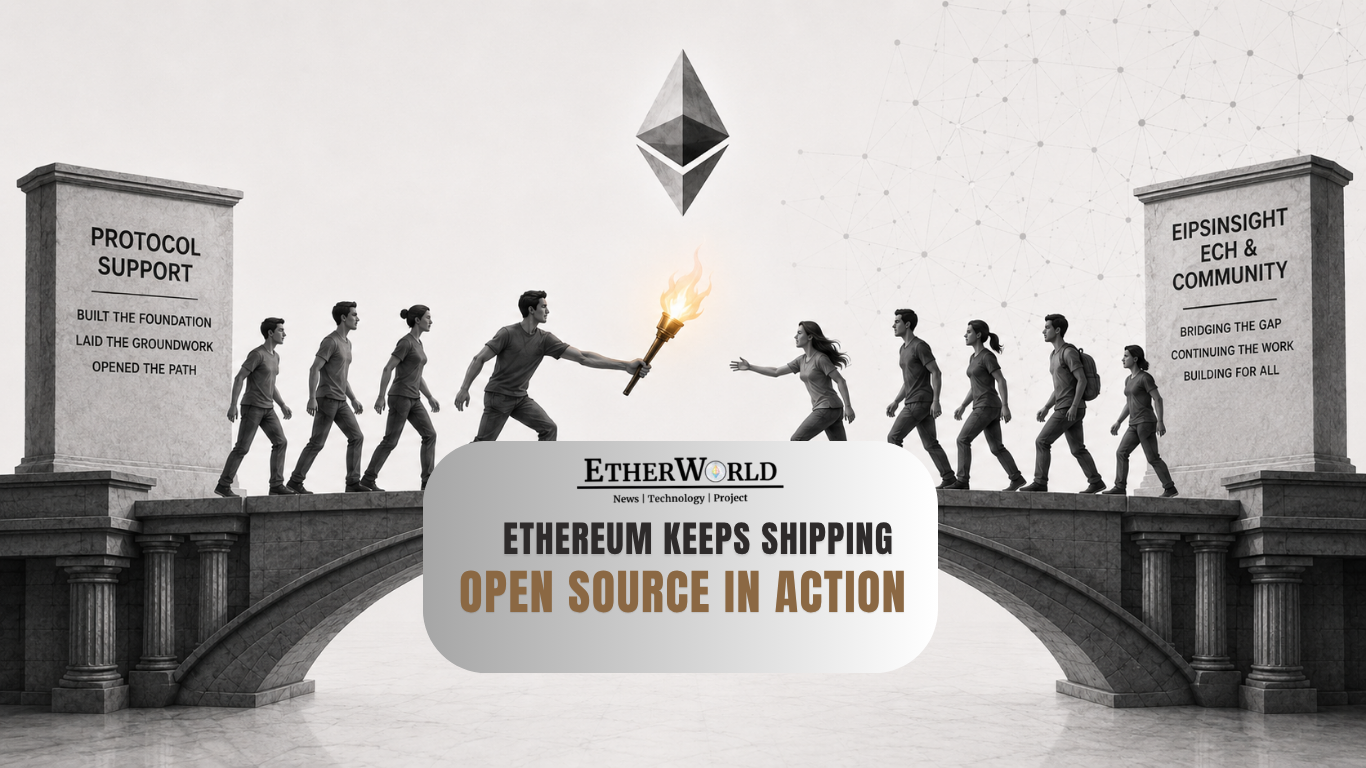
This week, the Ethereum Foundation's Protocol Support team announced that it has been dissolved, signing off with a simple, gracious 🖖.
It's worth pausing to appreciate what that team helped make possible. Protocol Support helped run AllCoreDevs, enabled the breakout calls where hard technical questions get worked out, and contributed to much of the connective tissue that made Ethereum's upgrade process visible to the outside world, including well-loved community tools like Forkcast, the clean upgrade tracker many of us relied on. That work made Ethereum's governance more legible for developers, researchers, writers, and newcomers alike. Thank you for it.
A change like this can feel unsettling. So the most important thing to say up front is this: Ethereum keeps shipping. Teams and contributors will come and go (that's true of every long-lived open project), but the protocol itself does not depend on any single team, company, or organization to keep moving forward.
Ethereum is bigger than any one team
Ethereum's development has never been centralized in one place. It runs on a decentralized contributor base: multiple independent client teams (execution and consensus), researchers, EIP authors and editors, testing groups, and volunteers spread across the world and across organizations.
The process is owned by the community, not by any one steward:
- EIPs are proposed, discussed, and standardized in the open, in public repositories.
- AllCoreDevs and breakout calls are public, recorded, and transcribed.
- Specifications, tests, and devnets are all developed in the open.
When one part of the ecosystem steps back, the process continues because the process was designed to be resilient to exactly this. We see this resilience in action as multiple groups step up to fill the void: the ECH Institute community is now managing all AllCoreDevs protocol call streaming and Upgrade Meta EIP monitoring, while EIPsInsight ensures upgrade tracking and analytics remain open and accessible. This isn't a gap in Ethereum's model; it's the model working as intended.
Open source makes continuity possible
Here is the quiet superpower behind all of this: everything Ethereum's upgrade process produces is public and open. The EIP repositories, the AllCoreDevs agendas and recordings, the meeting summaries, the client-support matrices, the devnet specs, the test suites. All of it lives in the open, published by the community for the community.
That openness means that if a particular interface to this information becomes harder to maintain, the information itself is never lost. Anyone can build a new way to view it. Complementary tooling can be created by anyone, and it benefits everyone.
That's not a hypothetical. It's what happened here.
Where EIPsInsight fits in
EIPsInsight is a community-driven initiative that has, for some time, been building observability and analytics for Ethereum's standards process: tracking EIP statuses, contributor and editor activity, and network-upgrade progress, all from publicly available data and open-source tooling.
We want to be very clear about our intent: this is not about replacing Forkcast. Forkcast set a wonderful standard for how to present upgrade information, and we have nothing but respect for it. Our goal is simpler and more modest: to make sure the protocol information the community relies on stays accessible and easy to navigate, no matter what happens to any individual tool.
Much of what people were used to finding in one place is now also available through a different UI on EIPsInsight, often with a few extra ways to explore it. Same public data. A new front door.
What's available today
Everything below is live on eipsinsight.com, built entirely on public data.
For protocol meetings & network upgrades
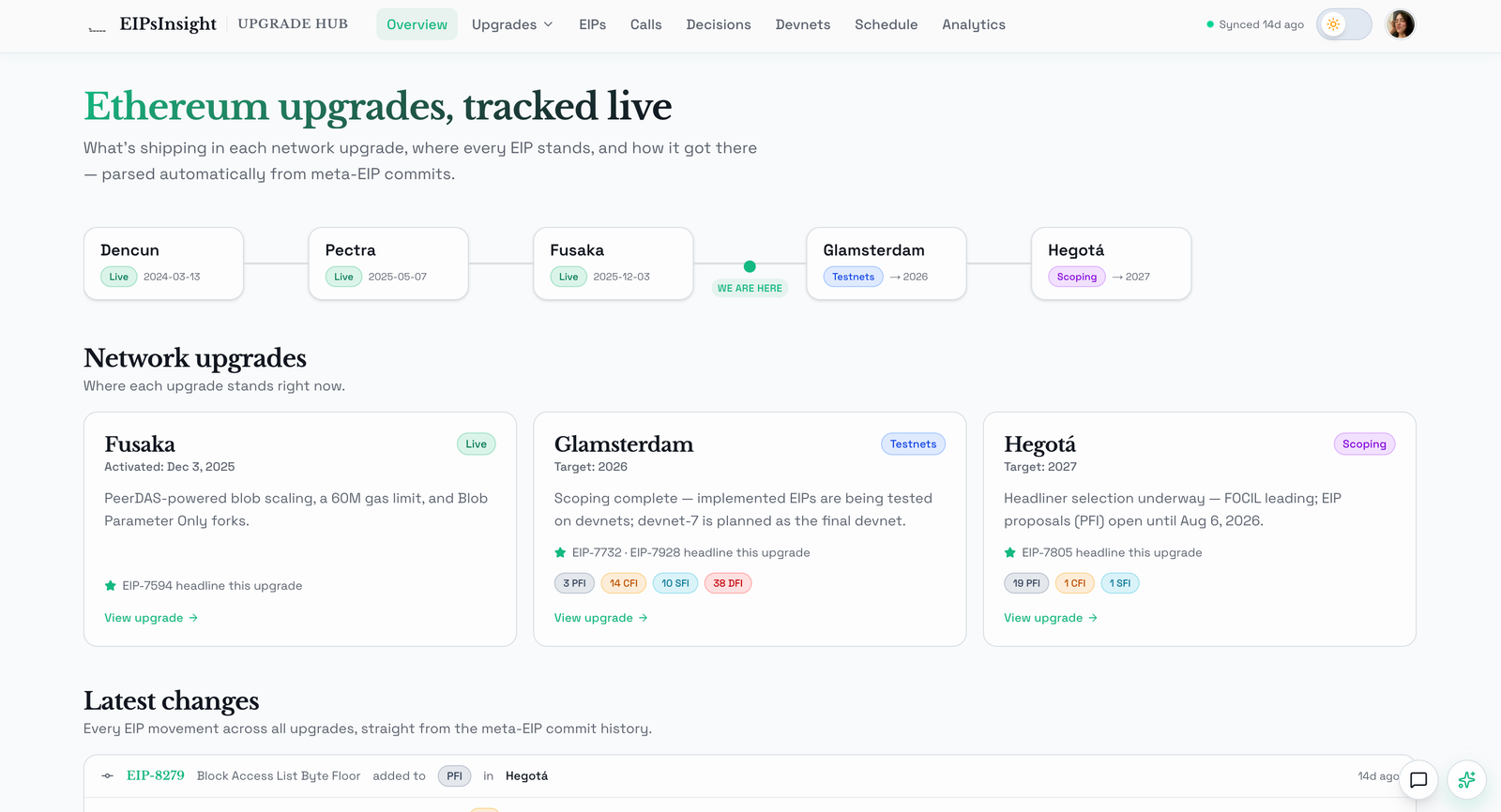
- Upgrade Dashboard: a single hub for in-progress and recent network upgrades. → eipsinsight.com/upgrade
- Meta EIP tracking: each upgrade tied to its meta-EIP, with the EIPs it includes grouped by inclusion stage.
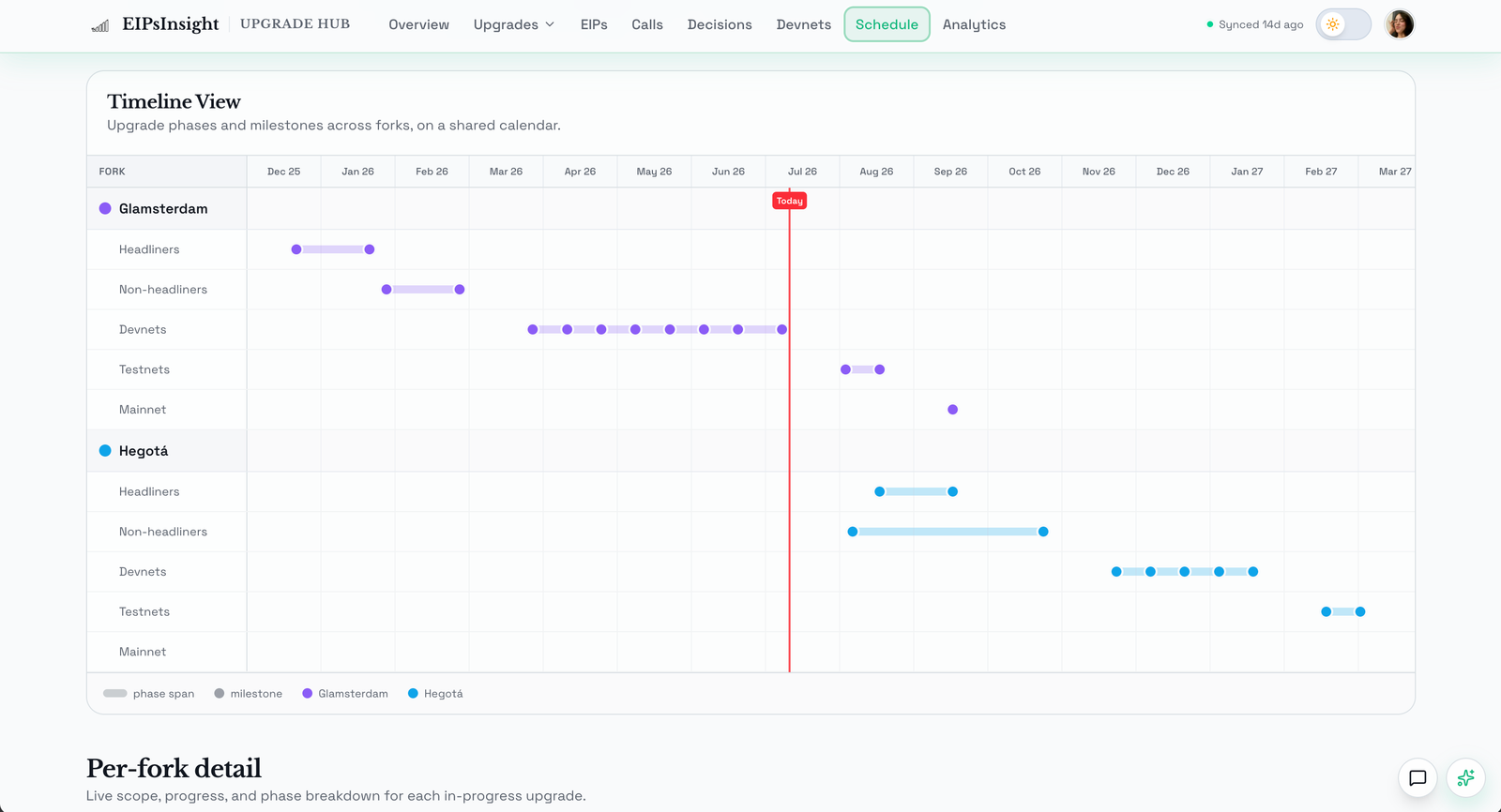
- Upgrade "Forecast" & schedule: projected phase-by-phase schedules (scoping → devnets → testnets → mainnet), with confirmed AllCoreDevs dates pinned and the rest projected — plus an editable planning sandbox and a timeline view. → eipsinsight.com/upgrade/schedule
- Protocol calls: AllCoreDevs and breakout calls with agendas, recordings, and AI summaries, filterable by series. → eipsinsight.com/upgrade/calls
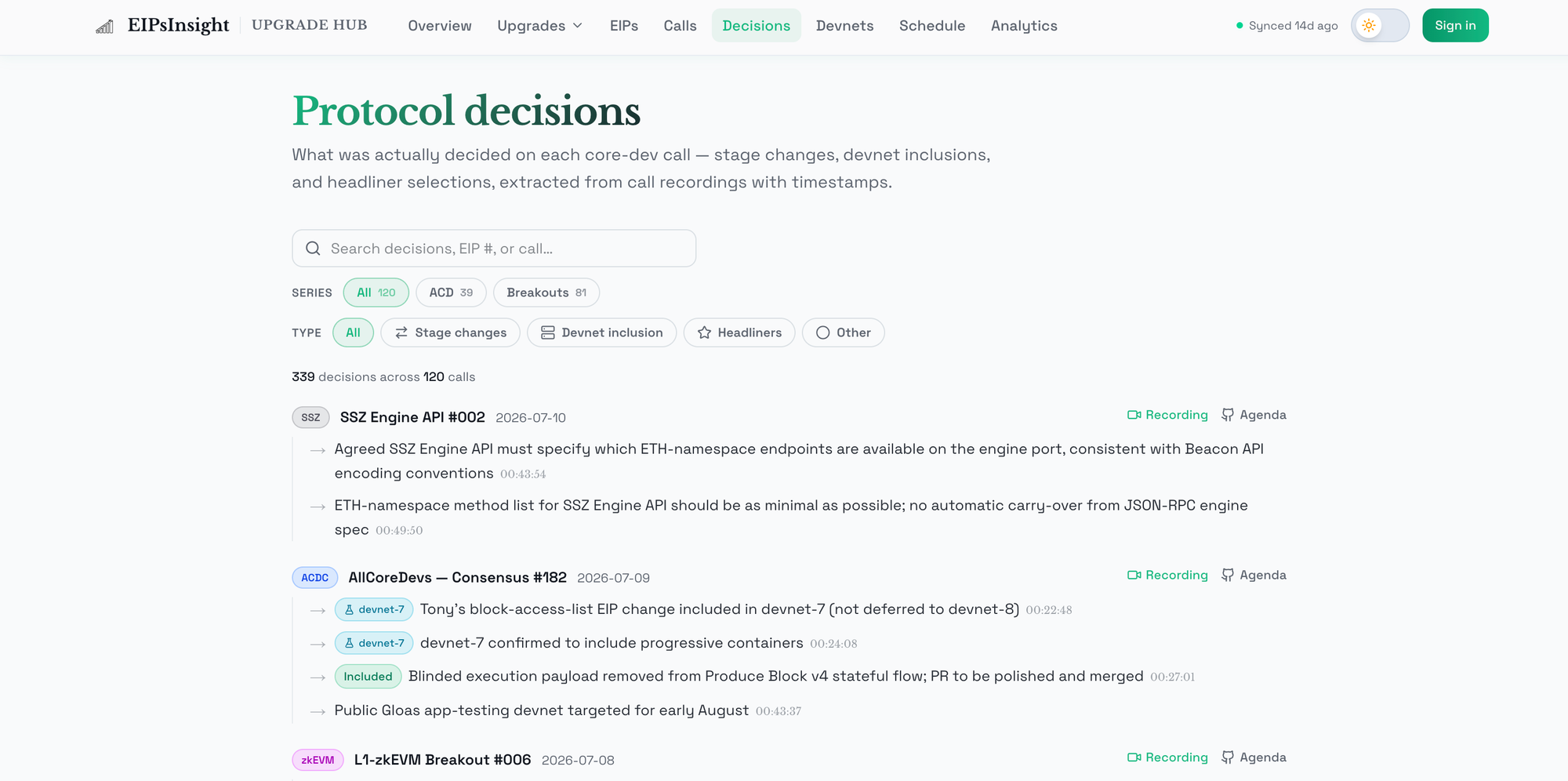
- Decisions: what was actually decided on each call — stage changes, devnet inclusions, headliner picks — with timestamps and sources. → eipsinsight.com/upgrade/decisions
- Devnets: devnet specs, EIP scope, client-support matrices, and live service links. → eipsinsight.com/upgrade/devnets
- Upgrade analytics: how each upgrade's scope has changed over time.
- Historical upgrade information: every fork from the early days through the ones in progress, all in one browsable place.
For EIPs & tooling
- EIP lifecycle / status tracking: Draft → Review → Last Call → Final, updated continuously.
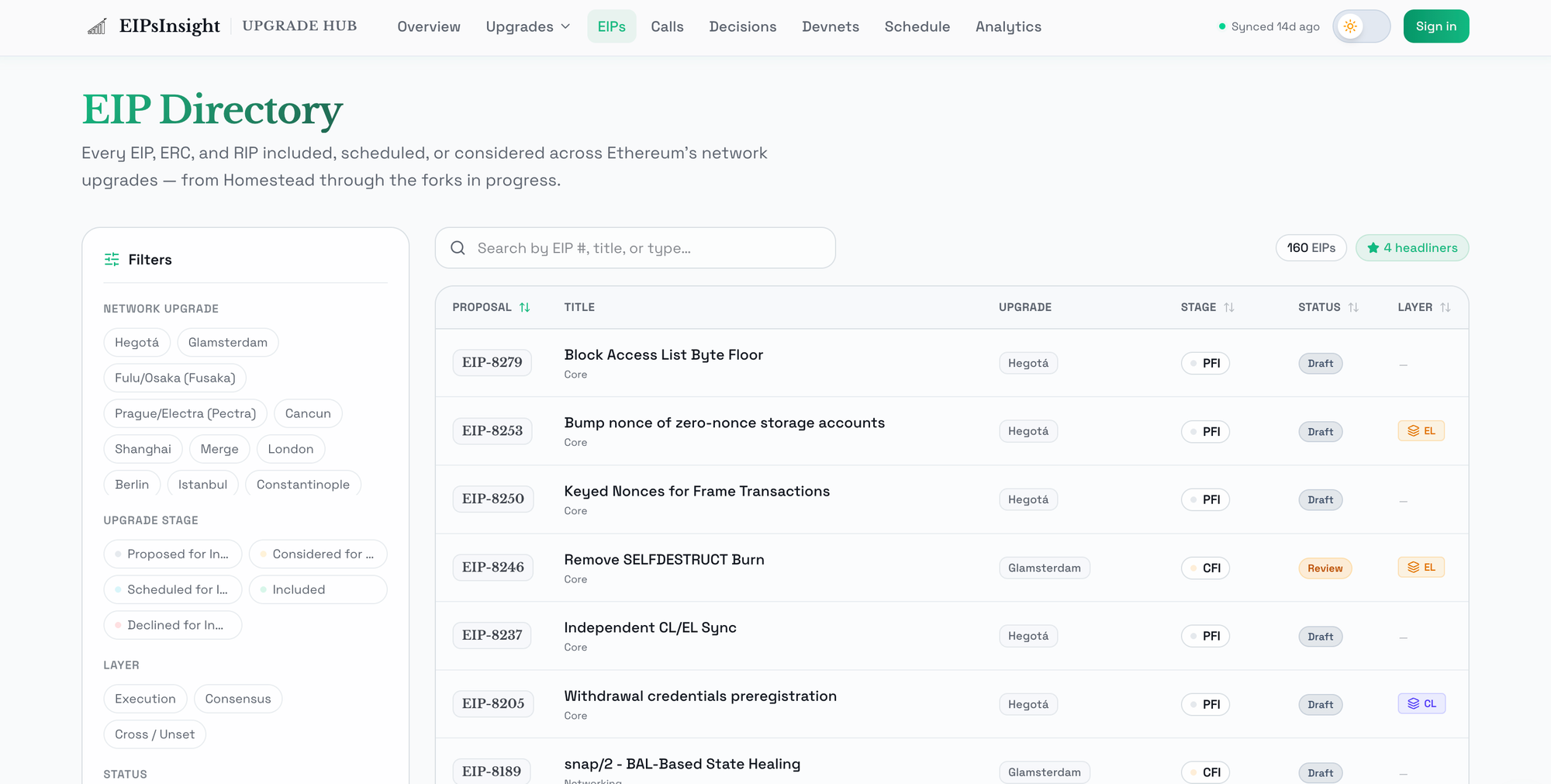
- EIP directory: a filterable directory of every EIP, ERC, and RIP across every upgrade, with multi-facet filters — upgrade, stage, layer, and headliner. → eipsinsight.com/upgrade/eips
- Open PR Board for editors: every open EIP/ERC/RIP pull request, sorted so the longest-waiting rise to the top — a purpose-built triage queue for editors (more below). → eipsinsight.com/board
- Cross-linking between EIPs, Meta EIPs, and upgrades: follow any thread from a single EIP up to the fork it ships in, and back down again.
- Editor & reviewer analytics: contributor leaderboards and editorial activity.
Editors are already putting it to work
One tool is worth calling out on its own: the EIP / ERC / RIP Board at eipsinsight.com/board, built specifically for the editors who keep the standards process moving.
One of the most rewarding parts of building community infrastructure is seeing it become useful to the people who help maintain Ethereum itself.
Several of EIPsInsight's workflows are already finding their way into the day-to-day work of contributors and editors. For example, Ethereum editor Jochem Brouwer recently shared this feedback in the ECH Institute Discord:
"It is very helpful to review by longest-wait-first. The site is super useful."
That comment referred to EIPsInsight's ability to sort and surface EIPs based on how long they have been waiting for review, making it easier for editors to prioritize work across the growing standards pipeline.
Feedback like this reinforces our goal: not only to make Ethereum's governance more accessible for the wider community, but also to build practical tools that help contributors and editors navigate the process more efficiently.
Nothing lost: where to find what you relied on
For anyone who used Forkcast day-to-day, here's a side-by-side map of where the same kinds of information now live on EIPsInsight, every link points to a working page:
| What you were tracking (Forkcast) | Where to find it on EIPsInsight |
|---|---|
| Upgrade overview & EIP inclusion by stage | → eipsinsight.com/upgrade · a specific fork, e.g. /upgrade/glamsterdam |
| Fork-scoped EIP directory | → eipsinsight.com/upgrade/eips |
| Stakeholders / who each EIP affects | → /upgrade/glamsterdam/stakeholders |
| Client priority per EIP | → /upgrade/glamsterdam/client-priority |
| Devnet inclusion & client support | → /upgrade/glamsterdam/devnet-inclusion · all devnets |
| Test complexity | → /upgrade/glamsterdam/test-complexity |
| Protocol calls (video, transcript, summary) | → eipsinsight.com/upgrade/calls |
| Key decisions | → eipsinsight.com/upgrade/decisions |
| Upgrade schedule / timeline | → eipsinsight.com/upgrade/schedule |
| Open PRs / editorial review queue | → eipsinsight.com/board |
And a genuine, open invitation: if there's something you relied on that you can't find, tell us and we'll build it. Reach out on X (@EIPsInsight) or open an issue on our GitHub.
Why any of this is even possible
It's worth naming the deeper point. The reason a community project can step in and keep this information flowing is that Ethereum's governance is transparent and its data is open by default.
No one had to ask permission to keep the lights on. The agendas, the recordings, the specs, the EIP metadata. They were already public. That is a design choice the Ethereum community made a long time ago, and moments like this are exactly when it pays off. Open governance and open data are what make community innovation possible.
Looking ahead
To the Protocol Support team: thank you for the foundation you laid, and for doing it all in the open. 🖖
To everyone who depends on this information: you won't lose visibility into Ethereum's progress. The process is decentralized, the data is public, and the community is already carrying it forward.
EIPsInsight will keep improving accessibility: adding features, closing gaps, and collaborating with anyone in the ecosystem who wants to make Ethereum's upgrade process easier to understand. If Forkcast, its contributors, or anyone else wants to work together, our door is open. We share the same goal we always have: make Ethereum's upgrade process legible to everyone.
Ethereum is bigger than any one tool. And Ethereum keeps shipping.
EIPsInsight is an open, community-built observability and analytics platform for Ethereum Improvement Proposals and network upgrades, developed by Avarch and the EtherWorld community. Explore it at eipsinsight.com.
Disclaimer: The information contained in this website is for general informational purposes only. The content provided on this website, including articles, blog posts, opinions, & analysis related to blockchain technology & cryptocurrencies, is not intended as financial or investment advice. The website & its content should not be relied upon for making financial decisions. Read full disclaimer & privacy policy.
To stay updated on blockchain news, Ethereum protocol progress, and our latest stories, subscribe to our weekly digest and YouTube channel for ELI5 content.
To promote your Web3 articles, events, project updates, and Press Releases, reach out anytime via EtherWorld PR for submissions and collaboration. For other queries, email contact@etherworld.co.
If you’d like to support our work, share the content and consider donating at avarch.eth.
Join our community on Discord and follow us on Twitter, Facebook, LinkedIn & Instagram.

 ×
×

Author

Breaking stuff @TeamAvarch (and pretending it’s a feature) 🛠️ @EIPsInsight