Securing Ethereum Together: Giveth & TheDAO’s QF Approach
Exploring how Giveth & TheDAO are funding Ethereum security through quadratic funding & community coordination.
Ethereum has grown into one of the most important digital infrastructures in the world, powering DeFi, governance systems, and global-scale applications. But as the ecosystem expands, the demand for stronger security tooling has grown alongside it.
Wallet monitoring systems, exploit detection platforms, auditing infrastructure, phishing protection tools, and on-chain threat intelligence systems have become increasingly important in protecting users and protocols across Ethereum. Unlike many consumer-facing crypto applications, security tooling projects often struggle to attract sustainable funding, even though they protect billions of dollars in ecosystem value.
While application-layer projects can monetize users directly, many teams building security infrastructure operate more like public goods, where the broader ecosystem benefits from their work even when direct business incentives remain limited. As Ethereum has faced repeated phishing attacks, wallet exploits, smart contract vulnerabilities, and infrastructure risks over the years, the need to support builders developing preventative security tooling has become more evident than ever.
This is where Quadratic Funding and Security DAOs come into play. In 2026, Ethereum’s ecosystem is experimenting with new community-driven funding approaches that aim to support public goods and security infrastructure more sustainably.
- Giveth's QF with TheDAO Security
- What is Quadratic Funding
- How a Quadratic Funding Round Works
- Why Fund Security Tooling?
- Quadratic Funding as the Solution
- TheDAO Origin story
- Giveth Platform & Mechanisms
- Projects Securing Ethereum
- Challenges & Mitigations
Giveth's QF with TheDAO Security
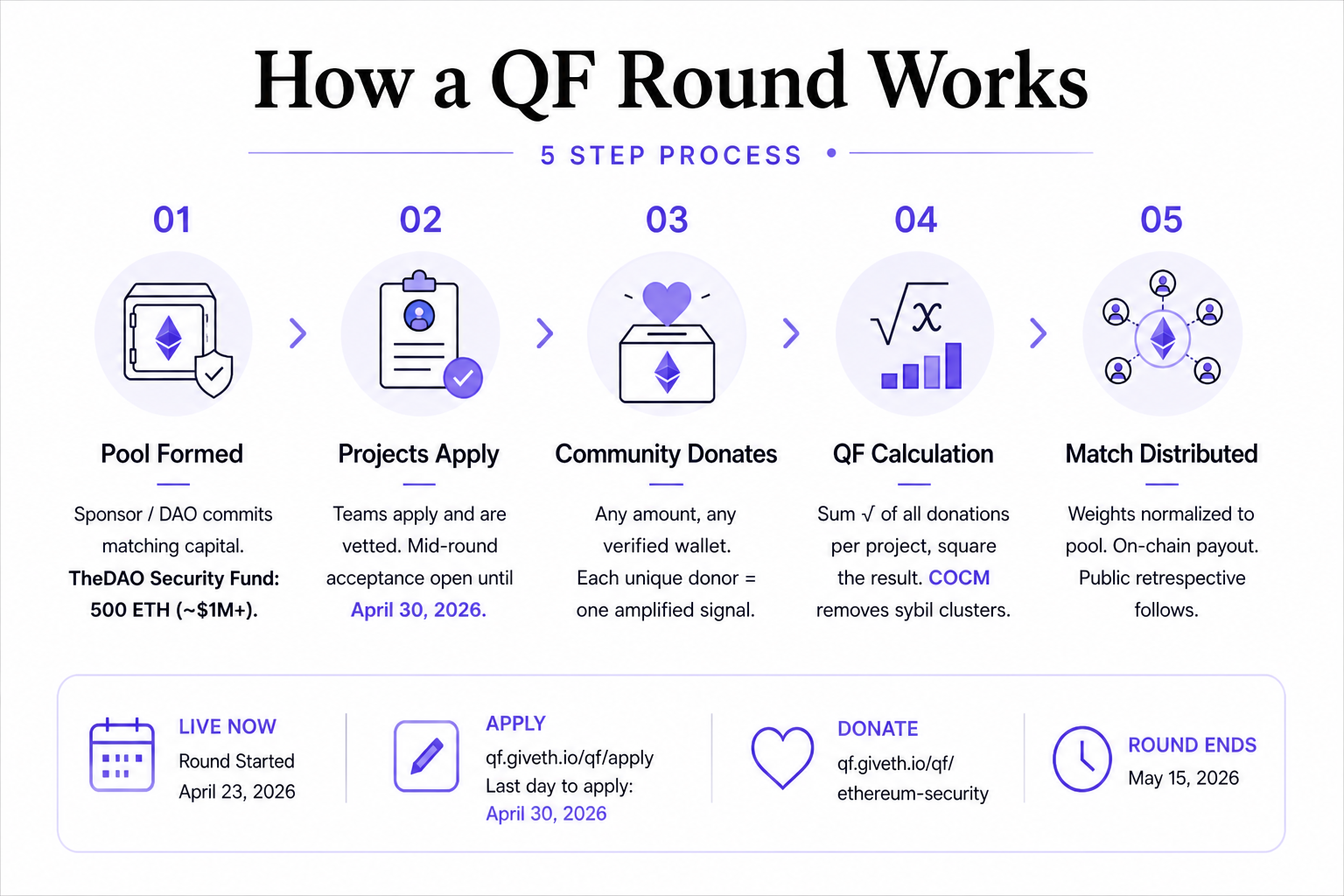
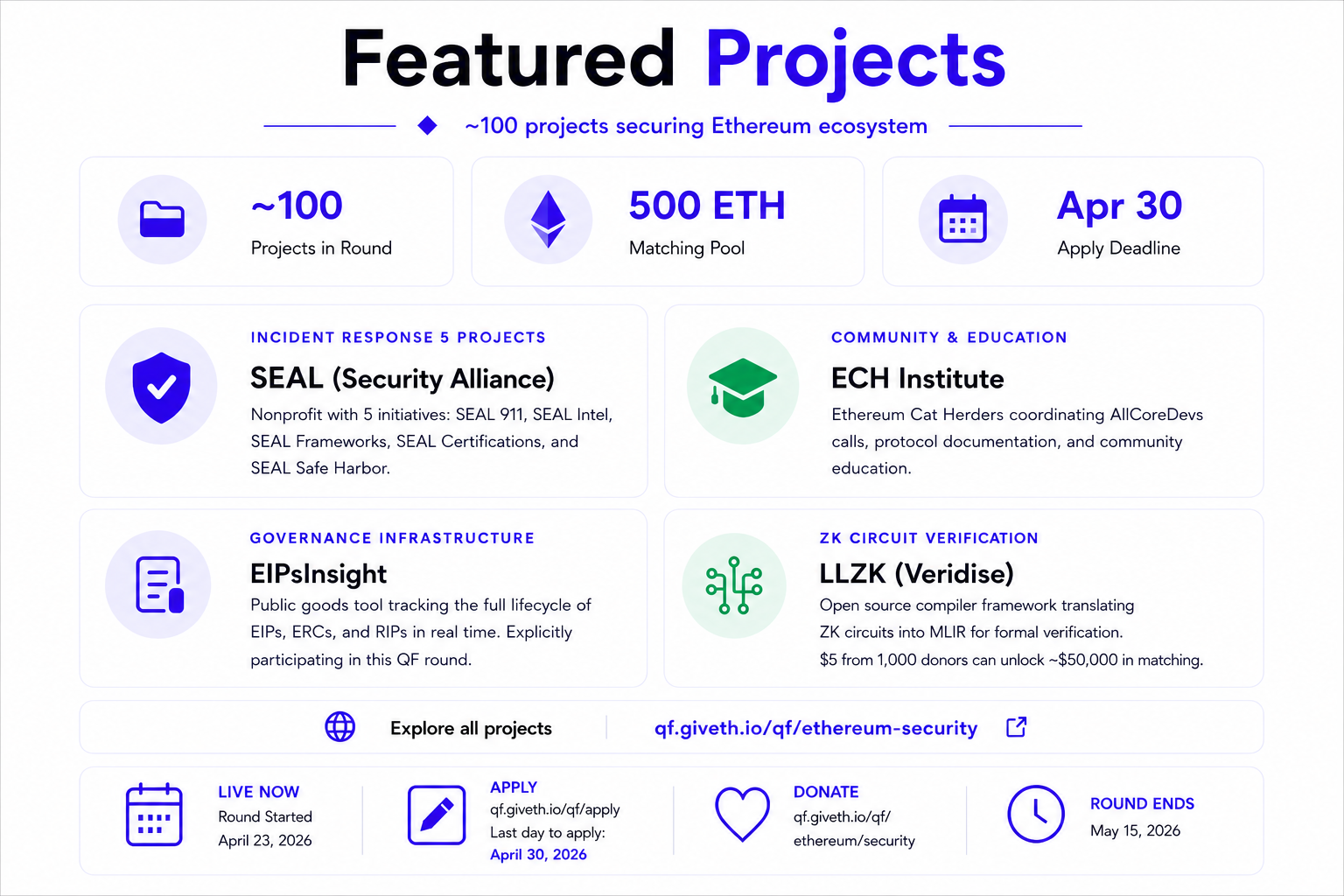
The Ethereum Security Quadratic Funding Round is currently live on Giveth, bringing together nearly 100 projects focused on improving the ecosystem. This first-of-its-kind round features a 500-ETH matching pool (over $1M) running from April 23, 2026, to May 15, 2026.
Unlike traditional grant programs, this round is not just about distributing funds. It is about testing a fundamentally different way of allocating resources based on collective belief. To make Ethereum more secure, the ecosystem is encouraging more people to build tools and share ideas that can find problems early.
This is possible because of public goods funding, especially when combined with Quadratic Funding (QF) for Ethereum security. Instead of relying on a few big donors, this system lets many people with small contributions decide what to fund, making security a shared effort across the community.
What is Quadratic Funding
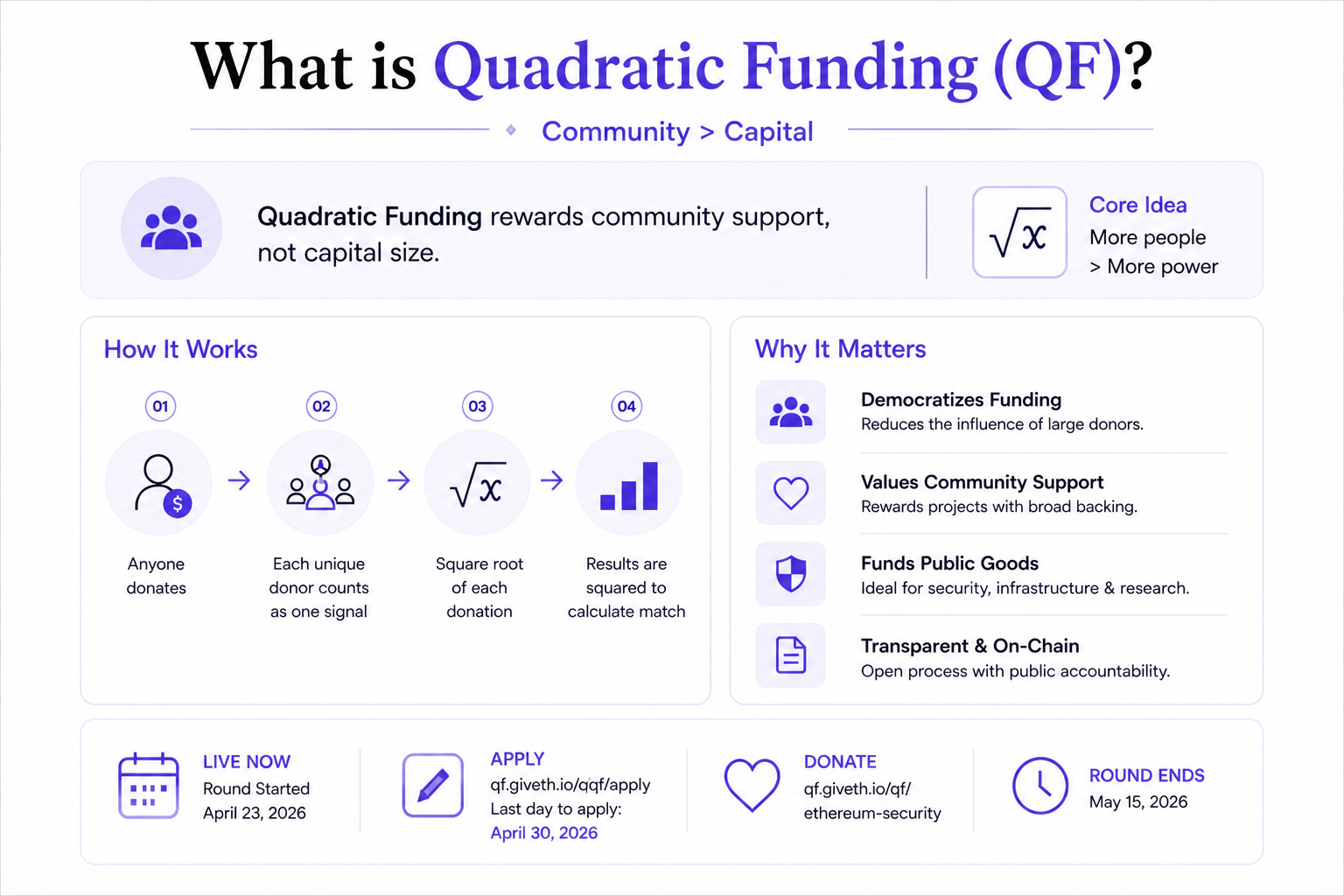
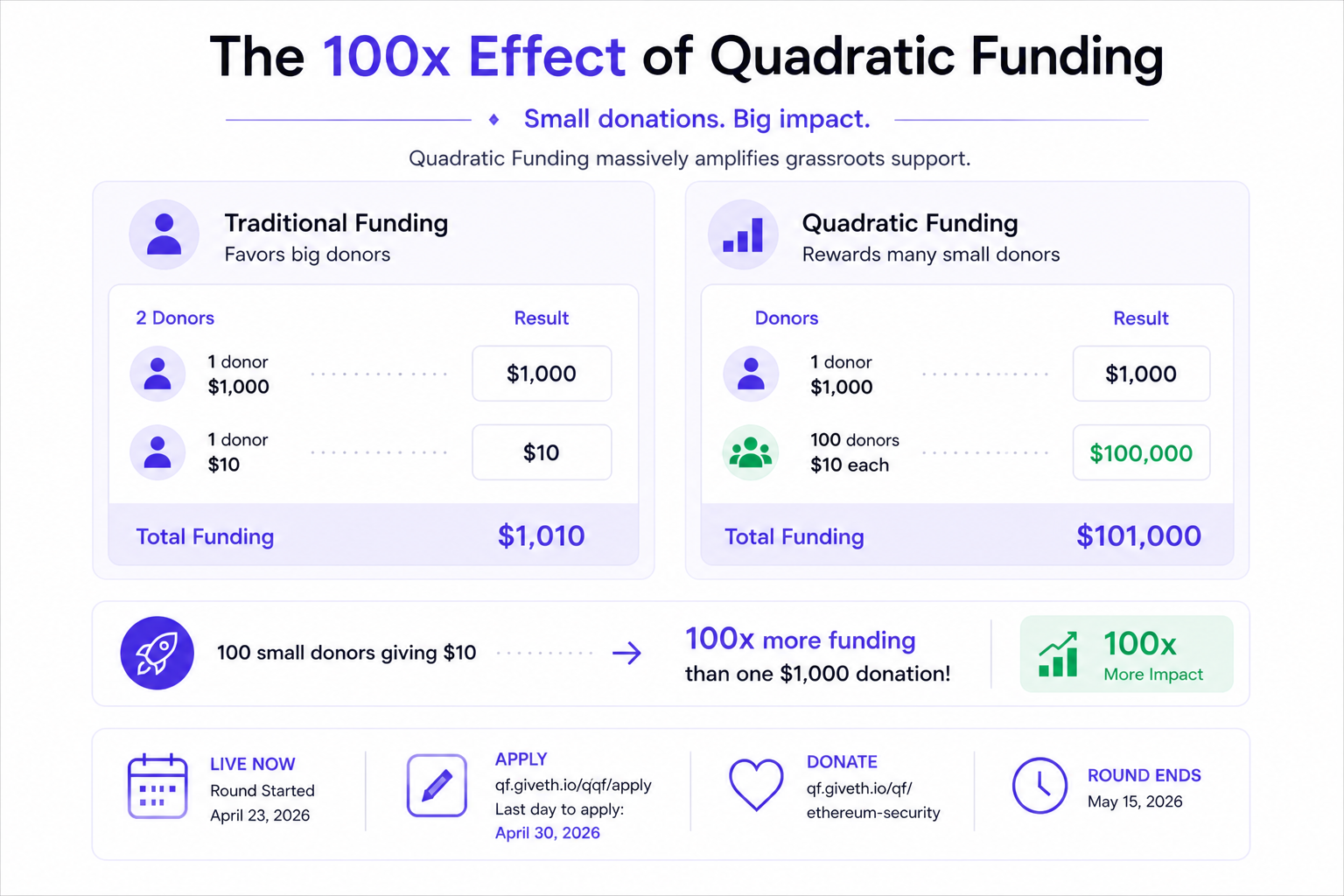
Quadratic Funding (QF) is a way to fund projects beyond donations alone. It uses a "matching pool" and distributes it based on participation, which means how many people support a project, not just how much money is donated to a project.
This is a unique way to support public goods. It gives greater weight to many small donations than to a few large ones. So if lots of people contribute even a small amount, the project receives more matching funds. This helps fund projects that the community truly cares about and makes funding more fair and open.
The formula uses the square root of each contribution, reducing the influence of large donations and amplifying smaller ones. This creates a situation in which a project supported by 100 people donating small amounts can receive significantly more matching funds than one backed by a single large donor. This is an independently designed formula that uses a different model for each matching QF.
This idea was originally proposed by Vitalik Buterin and researchers in 2018 and has since become one of the most important innovations in public goods funding. The core insight is simple. Community consensus is a stronger signal than capital size.
How a Quadratic Funding Round Works
A Quadratic Funding round follows a structured but transparent process.
- First, a sponsor or DAO commits a matching pool. In this case, the DAO Security Fund has allocated 500 ETH.
- Next, projects apply and go through a vetting process to ensure they meet eligibility criteria.
- Once the round begins, the community can donate any amount. Each donor counts as a unique signal of support, not just a financial contributor.
- The system then calculates matching allocations using the quadratic formula. Advanced filtering mechanisms remove fake identities and coordinated manipulation.
- Finally, funds are distributed on chain, and the entire process remains publicly verifiable.
This model ensures that funding decisions are not hidden behind committees but emerge from collective participation.
Why Fund Security Tooling?
Security in Web3 is hard to fund. It does not directly make money; it prevents losses. Because of this, it often receives less attention and fewer resources than applications that generate revenue. Ethereum has seen many contract exploits, phishing attacks, and wallet vulnerabilities. These risks affect everyone, and many builders work to prevent them, but the people building security tools and conducting research are often underfunded.
Security tools are most powerful when they are open and accessible to all. If they are limited to a small group of users or private systems, only a few benefit, while the rest of the ecosystem remains exposed. This is why security should be treated as a public good. Open security tooling allows more people to test, review, and improve systems early, making Ethereum safer for everyone, not just a few.
The 2016 DAO hack showed how costly it can be when security is overlooked. While awareness has improved, funding for security has not kept up. If Ethereum is to grow safely, security tooling must be funded openly and collectively, so the entire ecosystem benefits.
Even though things have gotten better, the way people pay for security has not changed as fast as the technology itself. Security in Web3 is still important. People need to think about how to pay for it. Web3 security is a deal that needs more attention.
Quadratic Funding as the Solution
Quadratic Funding changes the dynamics completely. It ensures that funding flows toward projects that have genuine community backing. A small contribution is no longer symbolic. It becomes part of a collective signal that can unlock significant matching funds.
This model reduces dependence on large donors and increases accessibility for smaller participants. It also creates a transparent system where anyone can verify how funds are allocated.
More importantly, it introduces sustainability. With recurring rounds and community participation, security funding becomes an ongoing process rather than a one time event.
TheDAO Origin story
The origins of this security round trace back to one of the most defining moments in Ethereum’s history, the 2016 DAO hack. At the time, TheDAO had accumulated nearly $150 million worth of ETH, making it one of the largest crowdfunding experiments the crypto industry had ever seen. But shortly after launch, attackers exploited a vulnerability in the smart contract code and drained roughly one-third of the treasury, triggering a crisis that shook the entire Ethereum ecosystem.
The exploit led to one of the most controversial decisions in Ethereum’s history. After weeks of debate, the community executed a hard fork to recover the stolen funds, ultimately splitting the network into Ethereum and Ethereum Classic. During the recovery process, white-hat groups also helped secure portions of the remaining treasury and return funds to users.
What received far less attention over the years was that some ETH linked to the recovery process remained unclaimed inside DAO-related contracts. Those dormant assets sat untouched for nearly a decade while ETH appreciated significantly in value. By 2025 and 2026, the value of these inactive funds had grown into a treasury worth more than $220 million.
Instead of allowing those funds to remain inactive indefinitely, Ethereum contributors and ecosystem leaders launched TheDAO Security Fund, an initiative designed to redirect staking yield from these assets toward Ethereum security tooling, research, audits, incident response, and ecosystem defense. In a full-circle moment for Ethereum, funds connected to one of the ecosystem’s earliest security failures are now being used to strengthen its long-term security infrastructure.
TheDAO Security Fund is structured to ensure long term sustainability. A large portion of the funds is staked, generating annual yield that can be used for continuous grants. This creates a recurring funding source rather than relying on external donations.
Another portion is reserved for immediate deployment, allowing the ecosystem to support urgent security initiatives. Importantly, original claimants from 2016 can still access their funds, ensuring fairness and continuity. This model represents one of the first attempts to create a self sustaining security budget in a decentralized ecosystem.
Giveth Platform & Mechanisms
The fund is overseen by a group of experienced contributors from across the Ethereum ecosystem. These curators include protocol researchers, infrastructure builders, and security experts. Their role is not to control funding decisions directly but to ensure that the system operates transparently and fairly.
They define eligibility criteria, oversee governance processes, and maintain the integrity of the fund. Operational support is provided by platforms like Giveth, which handle the technical execution of funding rounds.
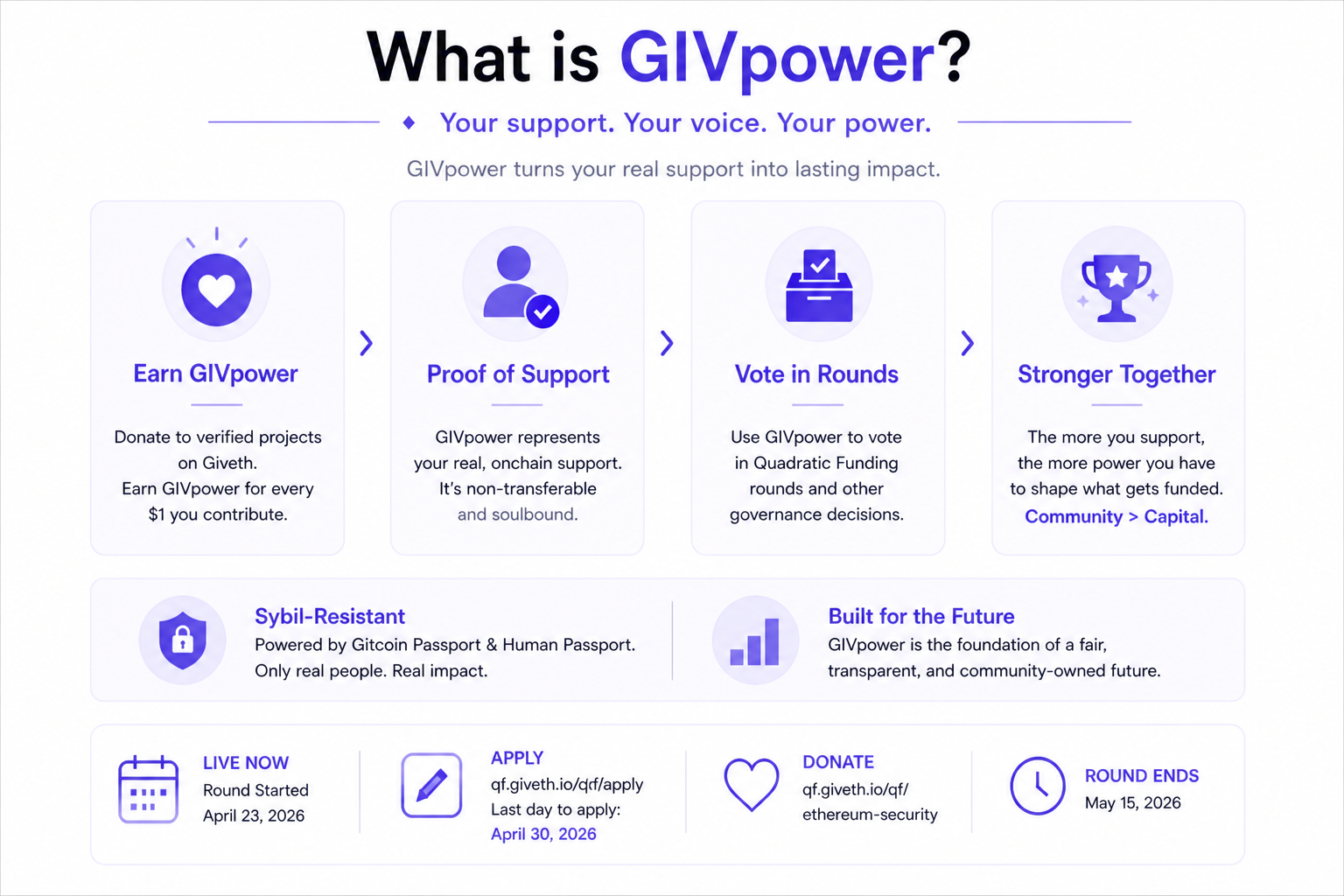
Giveth provides the infrastructure that makes Quadratic Funding possible at scale. One of its key features is GIVpower, which allows users to stake tokens and influence project visibility. By allocating GIVpower, participants can boost projects they believe in, improving their ranking and exposure.
The platform also integrates identity verification systems to reduce manipulation. Advanced algorithms detect patterns that indicate fake or coordinated activity. Another important feature is multi chain support, allowing donations across different networks while ensuring that projects receive the full amount without fees. These mechanisms make the funding process both accessible and secure.
The Ethereum Security QF round has also continued attracting support from major security firms across the ecosystem. Companies like CertiK, Quantstamp, and ChainSecurity have contributed directly to the initiative, expanding both the matching pool and community participation around the round.
BIG NEWS!@CertiK, the largest security firm in Web3, is contributing $50,000 to the Ethereum Security QF round. 🔥
Their contribution will be distributed through TIK - the CertiK Giveth QF Security Donation Token, giving each of @thedaofund Top 200 ETHSecurity badgeholders…— Giveth (@Giveth) May 3, 2026
While Quantstamp added $50,000 to strengthen the matching pool itself, CertiK distributed funding through its TIK donation initiative to ETHSecurity badgeholders, allowing contributors to allocate support across participating projects.
We’re happy to share that @Quantstamp is contributing $50,000 to the Ethereum Security QF matching pool 🛡️
A global leader in blockchain security, Quantstamp has conducted 1,300+ audits and secured $500B+ in digital assets since 2017, working across smart contracts, L1s, and web…— Giveth (@Giveth) May 5, 2026
ChainSecurity also introduced a team-based contribution model, giving employees dedicated funding to support projects they believe are important for Ethereum’s security ecosystem. Together, these contributions highlight growing industry recognition that Ethereum security tooling, audits, monitoring systems, and public-good infrastructure require long-term ecosystem-wide support rather than relying solely on individual grants or isolated funding efforts.
We’re excited to announce that @chain_security is contributing to the Ethereum Security QF round! 🛡️
ChainSecurity is splitting the contribution across their team and granting $200 per employee, so that each member can back the work they think matters most.
Since 2017,…— Giveth (@Giveth) May 4, 2026
Projects Securing Ethereum
The current QF round includes a diverse set of projects working across different areas of security. Some focus on governance infrastructure, tracking proposal lifecycles and protocol upgrades. Others work on zero knowledge verification tools, enabling more secure cryptographic systems.
There are also incident response networks that provide real time assistance during attacks, along with educational initiatives that help developers build safer applications. This diversity reflects the complexity of Ethereum’s security landscape.
Challenges and Mitigations
While Quadratic Funding is powerful, it is not without challenges.
- One major concern is the possibility of fake identities being used to manipulate funding outcomes. To address this, systems like identity verification and machine learning scoring are implemented.
- Another issue is coordinated behavior, where groups attempt to artificially boost a project. Advanced detection methods help reduce the impact of such actions.
- There is also the challenge of popularity bias, where well known projects may attract more attention. This is mitigated through curation and eligibility filters.
Finally, QF depends on the existence of a matching pool. Without sustained funding sources, the system cannot function effectively. TheDAO Security Fund addresses this by creating a long term endowment model.
Quadratic Funding is a change in how public goods get funded in decentralized communities. It takes power away from people with a lot of money. Give it to the community. This system makes participation more important than wealth. It lets the community decide how to use resources.
The Ethereum Security QF Round is more than a funding event. It shows what can happen when people work together in a way. Ethereum has come a long way since the 2016 DAO hack. The community created a 220 million security fund. Ethereum keeps changing and getting stronger through trying things and being resilient.
If this model works, it could be used in public goods funding, not just in blockchain. It could change how societies use resources in the future. For Ethereum, it is a step towards a future where security isn't something added later but something the community takes care of together.
If you find any issues in this article or notice missing information, please feel free to reach out at team@etherworld.co for clarifications or updates.
To promote your Web3 articles, events, and projects, you may reach out anytime via EtherWorld PR for submissions and collaboration.
Related Articles
- KelpDAO Exploit Triggers $290M Crisis Across DeFi
- DeFi Unites After KelpDAO $292M Hack
- Drift Maps a $150M Recovery Path With Tether
- Rhea Finance Exploit Drains $7.6M
- Volo Protocol Confirms $3.5M Exploit, Assures Full Coverage
To follow blockchain news, track Ethereum protocol progress, and read our latest stories, subscribe to our weekly today.
Disclaimer: The information contained in this website is for general informational purposes only. The content provided on this website, including articles, blog posts, opinions, & analysis related to blockchain technology & cryptocurrencies, is not intended as financial or investment advice. The website & its content should not be relied upon for making financial decisions. Read full disclaimer & privacy policy.
To stay updated on blockchain news, Ethereum protocol progress, and our latest stories, subscribe to our weekly digest and YouTube channel for ELI5 content.
To promote your Web3 articles, events, project updates, and Press Releases, reach out anytime via EtherWorld PR for submissions and collaboration. For other queries, email contact@etherworld.co.
If you’d like to support our work, share the content and consider donating at avarch.eth.
Join our community on Discord and follow us on Twitter, Facebook, LinkedIn & Instagram.

 ×
×

Author

Yash Kamal Chaturvedi is a Blockchain Content & Ops Specialist at Avarch LLC, writing on Ethereum & governance since 2021. Covers ACD/ACDE calls, EIPs, upgrades, staking, security & ecosystem trends.