Vitalik Buterin Explains Diamond iO for Ethereum
Vitalik Buterin explores Diamond iO, a new indistinguishability obfuscation design combining attribute-based encryption and fully homomorphic encryption to make private smart contracts and trustless voting on Ethereum more practical.
In the second edition of his indistinguishability obfuscation (iO) series, Vitalik Buterin presents a novel design known as Diamond iO. This article describes how a different design could make iO significantly more feasible than previous recommendations, rather than concentrating on abstract cryptographic theory. Diamond iO hides a program's secrets while enabling regular operation by combining attribute-based encryption (ABE) and fully homomorphic encryption (FHE). Buterin thinks the concept is a significant step toward privacy-preserving applications like private smart contracts and trustless voting on Ethereum, even though it is still speculative.
Diamond iO Brings a New Approach to Obfuscation
Diamond iO itself is the main subject of Buterin's recent post. Earlier proposals for indistinguishability obfuscation often just functioned in theory because of their excessive computational demands. Certain structures were so inefficient that it may theoretically take longer than the universe's existence to complete a single execution.
Diamond iO is built to overcome such constraints.
The design integrates fully homomorphic encryption (FHE) and attribute-based encryption (ABE) into a unified framework that safeguards a program's internal secrets while enabling users to use the application exactly as intended. Sensitive information is concealed throughout the computation by the system rather than being revealed during execution.
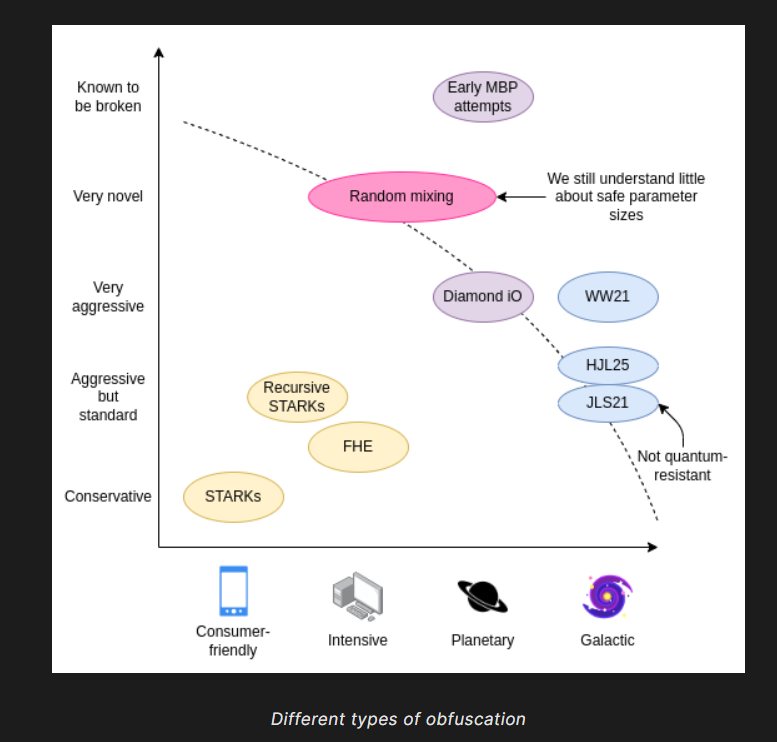
Buterin claims that this creates what researchers refer to as a "planetary" runtime. It is significantly more realistic than earlier techniques that essentially required universe-scale calculation, even if it is still computationally costly in comparison to standard software. Diamond iO is one of the most promising avenues for useful indistinguishability obfuscation research because of this distinction.
Buterin describes Diamond iO as a significant advancement that alters researchers' perspectives on practical obfuscation rather than as a completed answer.
How ABE & FHE Work Together?
Combining two distinct cryptographic methods, each of which addresses a distinct issue, forms a significant portion of Diamond iO's design.
By verifying that certain traits or conditions are met, attribute-based encryption (ABE) limits who is able to decrypt data. Access is dependent on predetermined rules that are incorporated into the encryption itself, rather than just traditional keys.
Conversely, fully homomorphic encryption (FHE) enables computations to be carried out on encrypted data directly without the need to first decode it. Only the final approved output is made available, and the encrypted data remains secure throughout the computation.
Diamond iO combines these functions into a single structure.
By guaranteeing that only legitimate execution paths meet the requirements, the ABE component aids in the protection of program secrets. While everything is still encrypted, FHE simultaneously completes the required computations. When combined, they enable the program to function normally without disclosing its fundamental secrets.
Diamond iO differs greatly from previous iO concepts due to this combination. It proposes a structure that isolates access control from encrypted execution rather than relying solely on impractical computation, thus increasing overall design efficiency while maintaining the security objectives of indistinguishability obfuscation.
https://t.co/IYE99Rv8JG
— vitalik.eth (@VitalikButerin) July 28, 2026
The second part of my series on cryptographic obfuscation protocols, this time on diamond iO!
Why Diamond iO Matters for Ethereum Privacy?
What Diamond iO might in the future enable for Ethereum is among Buterin's posts' most significant concepts.
One of Ethereum's most challenging technological problems has always been privacy. By design, smart contracts are transparent, making it possible for anybody to confirm their execution. Although this openness fosters confidence, it also makes it challenging to develop private apps.
If practical indistinguishability obfuscation is made possible, developers might create private smart contracts that function well without disclosing private information or sensitive functionality.
The same concept might also be used to support trustless voting systems, in which votes are kept private, but the outcome of the election is verifiable by anybody. Both privacy and accuracy would be enforced by the encryption itself, rather than requiring users to trust a central authority.
These explanations help to explain why, despite the complexity of iO research, many Ethereum developers continue to pursue it. Diamond iO offers a viable route toward applications that have long been thought to be challenging or impossible to create on public blockchains, but it does not currently address Ethereum privacy.
For Ethereum researchers, the significance is more in demonstrating that practical privacy-preserving computation may be getting closer to reality than in rapid implementation.
Still Theoretical but a Major Research Milestone
Buterin clarifies that although Diamond iO has generated a lot of interest, the architecture remains theoretical.
Before it becomes feasible, a number of significant technological obstacles must be overcome. In completely homomorphic encryption, one of the most significant drawbacks is noise development. The amount of work that can be completed effectively is limited as encrypted computations grow more sophisticated because accumulated noise eventually renders further computation challenging.
Additionally, Diamond iO's security relies on cryptographic presumptions that have not yet been thoroughly validated. Its long-term security depends on mathematical underpinnings that researchers are still investigating and verifying, just like a lot of modern cryptography research.
Diamond iO is not prepared for deployment in Ethereum or any other production system because of these unanswered questions.
Nevertheless, because the research shows significant advancements over previous obfuscation techniques, it has attracted a lot of attention. Diamond iO provides an architecture that greatly increases efficiency while maintaining the security qualities researchers desire, as opposed to requiring unachievable calculation durations.
Buterin also acknowledges scholars who have contributed to this field of cryptography, such as Sora Suegami, whose research has advanced knowledge of practical indistinguishability obfuscation. Their continued research continues to influence developers' perspectives on privacy solutions that may potentially increase Ethereum's functionality.
Buterin emphasises Diamond iO's potential as well as its ongoing difficulties by framing it as a viable research path rather than a final product. Even while the structure is still years away from being used in practice, it has already reached a significant turning point in the endeavour to use cutting-edge cryptography to give Ethereum greater privacy.
If you find any issues in this article or notice missing information, please feel free to reach out at team@etherworld.co for clarifications or updates.
To promote your Web3 articles, events, and projects, you may reach out anytime via EtherWorld PR for submissions and collaboration.
Related Articles
- AGI Could Change Humanity Forever, Says Vitalik Buterin
- Vitalik Buterin Outlines Ethereum's Lean Vision
- Vitalik Buterin Explains Cryptography’s “Final Boss”
- Vitalik Buterin Says Options-Based DeFi Is Already Taking Shape
- Vitalik’s Options-Based DeFi Model Explained
To follow blockchain news, track Ethereum protocol progress, and read our latest stories, subscribe to our weekly today.
Join the EtherWorld & Avarch Internship Program and build your career in blockchain, content, social media, video, podcast editing, or operations. Send your resume and brief introduction to contact@etherworld.co.
Disclaimer: The information contained in this website is for general informational purposes only. The content provided on this website, including articles, blog posts, opinions, & analysis related to blockchain technology & cryptocurrencies, is not intended as financial or investment advice. The website & its content should not be relied upon for making financial decisions. Read full disclaimer & privacy policy.
To stay updated on blockchain news, Ethereum protocol progress, and our latest stories, subscribe to our weekly digest and YouTube channel for ELI5 content.
To promote your Web3 articles, events, project updates, and Press Releases, reach out anytime via EtherWorld PR for submissions and collaboration. For other queries, email contact@etherworld.co.
If you’d like to support our work, share the content and consider donating at avarch.eth.
Join our community on Discord and follow us on Twitter, Facebook, LinkedIn & Instagram.

 ×
×

Author

Nidhi Kumari is a Web3 content writer at EtherWorld.co, tracking ecosystem developments, funding activity, and market trends shaping the crypto space.