Vitalik Buterin Explains Cryptography’s “Final Boss”
Ethereum co-founder Vitalik Buterin explores indistinguishability obfuscation (iO), explaining why it is cryptography's "final boss" and how it could transform privacy, blockchain governance, and trustless computing.
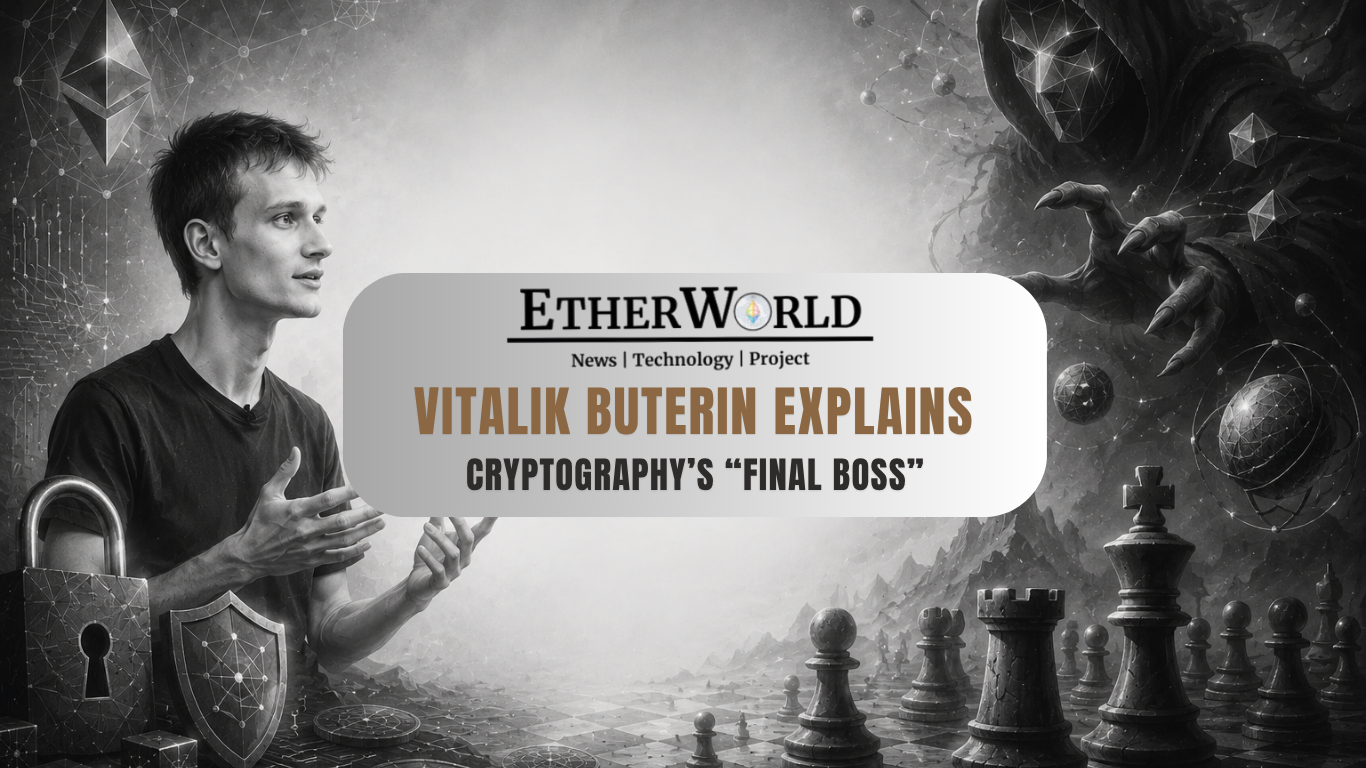
Ethereum co-founder Vitalik Buterin has published a deep technical blog post on one of cryptography’s most ambitious ideas: indistinguishability obfuscation, often called iO. In the post, titled “Obfuscation: building the final boss of cryptography (Part I)”, Buterin walks readers through the long research path behind obfuscation protocols and explains why this primitive is seen as one of the most powerful tools in cryptography.
Buterin frames this as a breakthrough that could one day act like a “trustless trusted third party.” In blockchain terms, this means users could interact with systems that perform sensitive computation correctly without needing to trust the person, server, or institution running them.
- What Indistinguishability Obfuscation Means
- Why Buterin Calls iO Cryptography’s Final Boss
- How iO Could Enable Private Blockchain Applications
- Why Practical Use Is Still Far Away
What Indistinguishability Obfuscation Means
Indistinguishability obfuscation is one of the most advanced concepts in modern cryptography. At a basic level, it allows a program to be transformed into a version that can still be executed, but whose inner working cannot be easily understood.
For example, imagine a voting program. The program accepts votes, counts them, and publishes the final result. In a normal system, someone operating the program may be able to see the votes or manipulate the process. With strong obfuscation, the program could still count votes correctly, but the private details inside the process would remain hidden.
This is why Buterin describes iO as more than just privacy technology. It is a way to create systems where the rules are enforced by mathematics rather than institutional trust. This idea connects closely with Ethereum’s broader mission of reducing dependence on centralized intermediaries.
EtherWorld has previously covered this larger philosophy in Vitalik Buterin on Why Ethereum Must Stay Neutral, where Buterin emphasized censorship resistance, permissionless access, and neutrality as Ethereum’s core values. iO fits into that same direction because it could allow people to use powerful systems without relying on hidden operators or privileged insiders.
Buterin’s post also explains that iO is not a single standalone invention. It sits at the top of a long technical tree involving fully homomorphic encryption, garbled circuits, functional encryption, zero-knowledge proofs, and recursive cryptographic constructions. Each of these tools solves part of the trust problem. iO tries to combine them into something much stronger.
Why Buterin Calls iO Cryptography’s Final Boss
Buterin calls obfuscation the “final boss” of cryptography because, if achieved efficiently, it could unlock many other cryptographic tools almost as by-products. In gaming language, a final boss is the hardest challenge at the end of the journey. For cryptographers, iO has that reputation because it is extremely powerful but also extremely difficult to make practical.
In traditional cryptography, users usually protect data through encryption. A message is hidden, and only someone with the right key can read it. But programs are different from messages. A program contains logic, rules, and decision-making steps. Hiding a program while still allowing others to run it is much harder.
For Ethereum, this matters because the network is increasingly moving toward cryptographic verification. The roadmap already includes stronger zero-knowledge tools, formal verification, stateless clients, and more efficient scaling designs. EtherWorld discussed this broader roadmap in Vitalik Buterin Outlines Ethereum’s 2025–2027 Roadmap at Devconnect, where Buterin highlighted scaling, decentralization, ZK-friendly design, and real-world usability.
How iO Could Enable Private Blockchain Applications
The most important blockchain use case Buterin highlights is private on-chain voting. Today, blockchain voting faces a major trade-off. If votes are public, the process is transparent but voter privacy is weak. If votes are private, users often need to trust some authority to count them correctly.
Indistinguishability obfuscation could change this balance. A voting system could hide individual ballots while still proving that the final result was computed correctly. This would be especially useful for DAOs, public goods funding, governance systems, and other Ethereum-based coordination tools.
The idea also connects with Buterin’s long-running interest in privacy-preserving public infrastructure. EtherWorld has covered similar themes in Vitalik Buterin Bets on Privacy Pools, A New Chapter for Ethereum Privacy?, where the focus was on balancing privacy with accountability.
Beyond voting, iO could support private auctions, encrypted DeFi strategies, secure key management, confidential identity systems, and trust-minimized applications where sensitive information should not be exposed publicly.
This is particularly relevant as Ethereum moves from basic financial applications toward more mature infrastructure. In Vitalik Buterin Says Options-Based DeFi Is Already Taking Shape, EtherWorld covered Buterin’s view that advanced DeFi systems need stronger formal verification and better oracle design before reaching mainnet. iO would take this even further by allowing more complex financial systems to protect internal logic while remaining verifiable.
Another possible use case is private smart contract execution. Ethereum currently offers public verifiability, but most data and contract activity are visible. This transparency is useful for security but creates privacy limits. If practical iO eventually arrives, developers may be able to build applications that are both transparent in outcome and private in process.
Why Practical Use Is Still Far Away
Despite the excitement, Buterin is clear that iO is not ready for real-world use. The biggest issue is performance. Current constructions are so computationally expensive that running them practically is impossible.
Buterin notes that some approaches involve runtimes so large that they exceed the age of the universe. This does not mean the theory is useless. It means researchers have proven that the concept can work under certain assumptions, but the engineering gap remains enormous.
This is a common pattern in cryptography. Many tools begin as impossible-looking theory before slowly becoming practical. Zero-knowledge proofs were once considered too slow for common blockchain use. Today, ZK systems are central to Ethereum scaling discussions. However, iO is still much earlier in that journey.
The current state of iO research depends on deep mathematical assumptions, lattice-based cryptography, homomorphic encryption, and complex recursive constructions. Each improvement reduces the cost, but the distance between academic possibility and production deployment remains massive.
For Ethereum, the short-term lesson is not that iO will soon become part of the protocol. The real lesson is that Ethereum’s future depends on continuous investment in cryptographic research. Buterin’s recent writing shows that Ethereum is not only focused on immediate scaling wins, but also on the deeper foundations of trust, privacy, and decentralization.
EtherWorld has also covered this pattern in Vitalik Buterin Reframes Ethereum Scaling Strategy After 60M Gas Breakthrough, where the emphasis was on targeted growth rather than uniform expansion. The same mindset applies here: not every powerful idea is ready immediately, but long-term progress comes from understanding which research paths matter.
Buterin’s post is only Part I, which means more discussion is expected. Future parts may explore newer constructions, optimizations, and possible paths toward making obfuscation less theoretical. For now, iO remains one of cryptography’s hardest challenges and one of its most promising frontiers.
If indistinguishability obfuscation ever becomes practical, it could reshape how blockchain systems handle trust. Ethereum applications could become more private without becoming less verifiable. Governance could become more confidential without becoming opaque. Financial systems could protect strategies without hiding settlement integrity.
That is why Buterin’s article matters. It does not announce an imminent Ethereum upgrade. It maps the edge of what cryptography may one day make possible.
To promote your Web3 articles, events, and projects, you may reach out anytime via EtherWorld PR for submissions and collaboration.
Related Articles
- Vitalik Buterin on Why Ethereum Must Stay Neutral
- Vitalik Buterin Says Options-Based DeFi Is Already Taking Shape
- Vitalik Buterin Outlines Ethereum’s 2025–2027 Roadmap at Devconnect
- Vitalik Buterin Reframes Ethereum Scaling Strategy After 60M Gas Breakthrough
- Vitalik Buterin Bets on Privacy Pools, A New Chapter for Ethereum Privacy?
To follow blockchain news, track Ethereum protocol progress, and read our latest stories, subscribe to our weekly today.
Disclaimer: The information contained in this website is for general informational purposes only. The content provided on this website, including articles, blog posts, opinions, & analysis related to blockchain technology & cryptocurrencies, is not intended as financial or investment advice. The website & its content should not be relied upon for making financial decisions. Read full disclaimer & privacy policy.
To stay updated on blockchain news, Ethereum protocol progress, and our latest stories, subscribe to our weekly digest and YouTube channel for ELI5 content.
To promote your Web3 articles, events, project updates, and Press Releases, reach out anytime via EtherWorld PR for submissions and collaboration. For other queries, email contact@etherworld.co.
If you’d like to support our work, share the content and consider donating at avarch.eth.
Join our community on Discord and follow us on Twitter, Facebook, LinkedIn & Instagram.

 ×
×

Author

Yash Kamal Chaturvedi is a Blockchain Content & Ops Specialist at Avarch LLC, writing on Ethereum & governance since 2021. Covers ACD/ACDE calls, EIPs, upgrades, staking, security & ecosystem trends.