Taking Ethereum’s Protocol Process to the Enterprise Room
A first look at Ethereum Intelligence, a new EEA initiative helping enterprises understand Ethereum upgrades, EIPs & when protocol changes may actually matter to them.
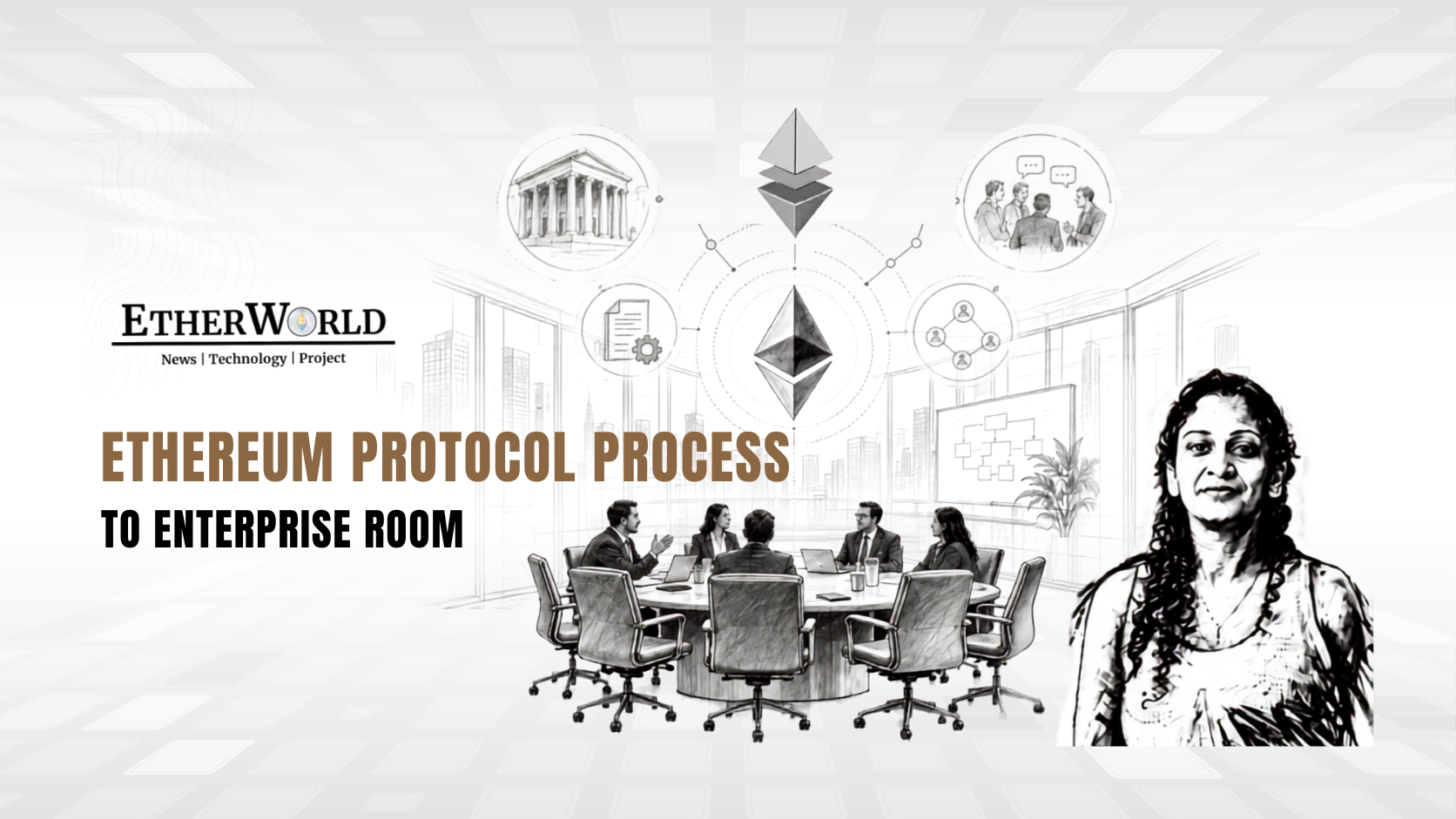
Ethereum Improvement Proposals (EIPs) have been a big part of my journey in the Ethereum ecosystem. Over the years, I have spent countless hours discussing EIPs with authors, editors and client developers: understanding why a proposal is not moving, working through specifications and pull requests, or discussing whether an EIP is ready for an upgrade. Through EIP Office Hours, I also meet people who are trying to understand and navigate the process for the first time.
The Bridge to the Enterprise Room
Over the years, I have had multiple opportunities to talk about the EIP and network upgrade process at conferences, workshops, universities, community calls and in mainstream media.
My conversations with the Enterprise Ethereum Alliance (EEA) go back several years. In 2021, I joined for the first time an EEA educational session for a deep dive into the EIP standardization and network upgrade process, including EIPs and ERCs to watch at the time. The following year, as Ethereum was getting closer to its biggest upgrade, The Merge, I was invited back by EEA to share the space with then ACD Chair Tim Beiko and talk about Ethereum’s transition to Proof-of-Stake. Around the same time, I was also featured in EEA 7th Ethereum anniversary special and invited by CNBC to talk about Ethereum’s major changes and upgrades.
So, this wasn’t my first time taking Ethereum’s protocol process into an enterprise room. This time, however, it felt different.
Instead of a one-time session around a particular upgrade or set of EIPs, I am now part of building something more organized: a recurring space where enterprises can understand Ethereum protocol changes, ask questions, identify what may affect their organizations and gradually become more familiar with the process itself.
A New Model: Ethereum Intelligence
The Enterprise Ethereum Alliance (EEA) is a global, member-led non-profit industry organization dedicated to driving the adoption of Ethereum blockchain technology as an open standard for business.
My conversation with EEA about the program started this summer. My initial idea was a monthly series called Ethereum Development Governance for Enterprise (EDGE) imagined as an initiative to help organizations better understand Ethereum developments and what they may mean for their business and operations. Redwan, EEA’s Executive Director, and I went through several discussions, different versions of the program and quite a few iterations of the presentation. Over time, that idea evolved into Ethereum Intelligence - a program bigger than I had initially imagined.
Earlier this month, we finally had our first Ethereum Intelligence Monthly Briefing with EEA members, earlier this month. I joined the pilot program as Program Advisor, Ethereum Protocol Process. And with that, I found myself back in the enterprise room, this time in a more structured and recurring setting.
We hope the Monthly Briefing will help organizations understand Ethereum protocol changes and what they may mean for their operations. The information itself is public. The challenge is figuring out what matters, when it matters and who inside an organization should pay attention. This is at the heart of the program, and it became much clearer to me during our first session.
Translating Protocol Noise into Signal
Ethereum has plenty of information about how the protocol is changing. EIPs, Ethereum Magicians discussions, AllCoreDevs meetings, devnet and public testnet updates, and client implementations are all open and available to follow. The challenge is that this information is spread across different places and often discussed by people who are already familiar with the process. If you work around Ethereum protocol development every day, terms like EIP, ERC, PFI, CFI, SFI, devnet, public testnet and rough consensus become part of your regular vocabulary. But for someone looking at Ethereum from an enterprise perspective whether through infrastructure, custody, settlement, compliance, procurement or technology risk—the question is: What does any of this mean for us?
This became the most interesting part of the session for me.
I started by explaining what an Ethereum Improvement Proposal (EIP) is and why not every change in Ethereum requires the same kind of attention. Share with a simple example of a wallet adding its own feature is a product decision, while multiple wallets agreeing on a common feature may lead to an ERC. If Ethereum Protocol decides to add that feature natively then it requires changing the rules of the Ethereum network itself, it needs a Core EIP. From there, we moved into the network upgrade process: how an idea becomes a specification, gets discussed and reviewed by different stakeholders, considered for implementation by client teams, and tested. With enough technical confidence and rough consensus, it may eventually become part of a network upgrade.
Explaining how the process works was only half of the conversation. The more useful question for this audience was:
When should an enterprise actually start paying attention?
An EIP that is only Proposed for Inclusion (PFI) may or may not make it into an upgrade. At that point, an organization may simply want to know that the conversation exists.
As the proposal moves further through the selection and testing process, monitoring becomes more useful. Once an EIP reaches Scheduled for Inclusion (SFI), the conversation changes. If that change affects your systems, products or providers, it may be time to prepare. “The object is closer than it appears in the rearview mirror.”
My goal with the talk was not to turn every institutional executive into an Ethereum protocol developer. It was to provide the minimum understanding needed to know what is coming with the next upgrade, how it may affect their organization, and when they should start paying attention, just as institutions keep track of regulatory, market and technology changes.
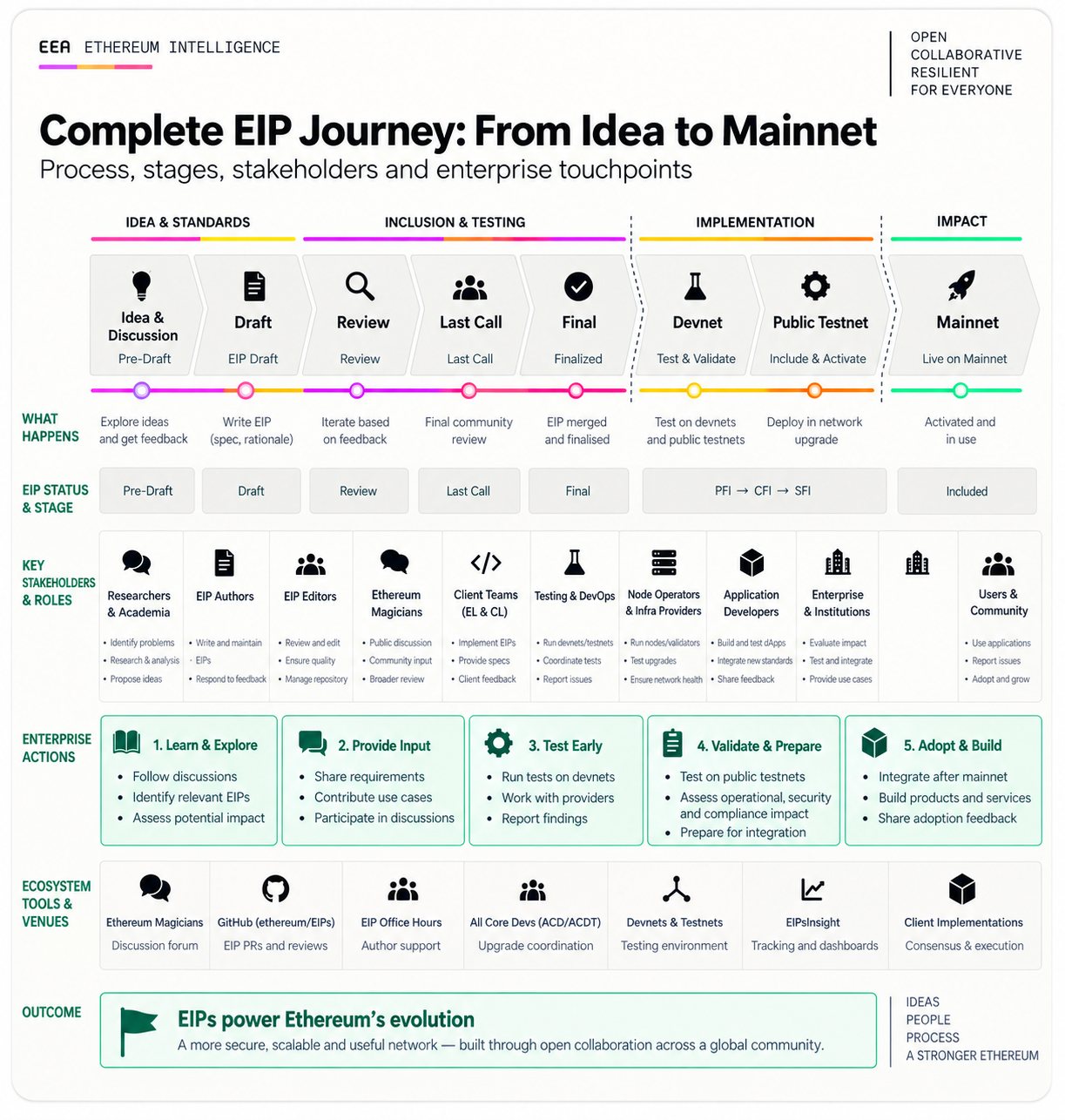
This image brings together the key stages, where discussions happen, and when different stakeholders may want to start paying attention. I hope it is a useful reference for anyone trying to understand how an idea moves from an EIP to a network upgrade, especially those just starting to find their way into the room.
What I enjoyed most about the first session was listening to the questions.
One participant wanted to understand whether ERC adoption is mandatory. Another asked who actually decides what goes into Ethereum. We discussed “rough consensus” and the role of different client teams. There were questions about backward compatibility, Layer 2s, validators and how infrastructure changes eventually reach organizations building on Ethereum.
Shifting Focus: Vendor Readiness & The Dependency Chain
Then the discussion moved into something I found particularly interesting: vendor readiness.
Many enterprises may not operate Ethereum infrastructure directly. They may depend on staking providers, node providers, custodians, data providers or other infrastructure companies.
So when Ethereum changes, the question is not necessarily: “What do we need to change?”
It may instead be: “What should we be asking our providers?”
One participant suggested the idea of a "vendor-readiness questionnaire". As an upgrade approaches, what should an organization ask its staking provider, custody provider, node provider or other vendors?
That was a useful shift in perspective. We had moved from explaining an EIP to thinking about how a protocol change travels through an enterprise’s dependency chain.
Beyond EIP Numbers: What Organizations Actually Need
We also looked at a selection of EIPs at different stages of the upgrade process. The purpose was not to make everyone remember EIP numbers. It was to understand why different organizations may care about different changes.
A staking operator may care about an EIP for completely different reasons than a wallet provider. A data infrastructure company may see an opportunity where another organization sees a reporting dependency. A transaction-level change may be important for applications, while a consensus-layer change may mostly require attention from validators and infrastructure providers.
This made me think that protocol education for enterprises should not become another long list of EIPs.
It should help answer a much smaller set of questions:
- What is changing?
- Does it affect us?
- When should we pay attention?
- What should we do now? Who should we talk to?
Closing the Communication Gap
The session also showed me the communication gap from the other side. Protocol developers usually look at a change through specifications, implementation, testing and network safety, while enterprises may look at the same change through operational risk, custody, compliance, procurement or their technology providers.
One of the protocol developers participating in the session made an observation that stayed with me. "Protocol developers can sometimes live in a technical bubble. Hearing questions directly from organizations that use or depend on Ethereum gives developers another view of what people building on the network actually need."
A Two-Way Street for Protocol Governance
For years, a significant part of my work has been helping people find their way into the EIP process: where to propose an idea, where to discuss it, how to get feedback, when to approach editors, where client developers discuss changes and how an EIP eventually moves toward an upgrade.
After this session, I started thinking more about the other side of that work.
Not everyone who depends on Ethereum needs to enter the EIP process.
But they should be able to understand it.
An enterprise does not need someone sitting through every AllCoreDevs call. But somebody should know that those conversations exist. Somebody should know what upgrade is coming. Somebody should understand which changes may affect the organization. Somebody should know when an early proposal becomes something worth monitoring or testing. And somebody should know where to ask a question before a change reaches Mainnet.
There is another side to this bridge that I find even more interesting.
Today, much of the conversation is about bringing Ethereum protocol information from the AllCoreDevs room to the enterprise room. I would like to see this bridge work in the other direction too. The goal is to help enterprise understand Ethereum's open governance process and participate where relevant.
The first session showed some of that. Participants were not only asking what an EIP does, but how it affects vendors, whether changes are backward compatible, when organizations should test, who is responsible for implementation and how they can provide feedback.
My hope is that, over time, more informed enterprise representatives can follow relevant EIPs earlier, understand where discussions happen and, when they have something useful to contribute, participate in Ethereum Magicians, testing efforts and relevant AllCoreDevs discussions.
Protocol developers understanding enterprise concerns, and enterprises understanding how Ethereum actually changes.
That would make the bridge much more valuable.
The Ethereum Intelligence program is still evolving. What we delivered in September is different from the idea we started discussing in May, and I am also learning and adjusting how I contribute during this six-month pilot. For me, the most encouraging part of the first session was seeing the kind of questions people were already asking.
It was not simply:
“Why should our company care about Ethereum?”
But:
“Will this change affect us?”
“When should we prepare?”
“Should our vendor already know about this?”
“Where can we provide feedback?”
These are the kinds of questions that can lead to more informed participation, and I am looking forward to more of these conversations in the coming months.
If enterprises can better understand what is changing and when it may affect them, they can also bring useful questions and real-world concerns into Ethereum’s open development process. That exchange can help reduce the awareness gap on both sides.
Maybe success is not just taking Ethereum’s protocol process into the enterprise room, but seeing more informed enterprise voices find their way into Ethereum’s open protocol discussions. I hope these conversations can bring the two rooms a little closer, one session at a time.
This post is part of our new “Stories” collection - a space to share Web3 experiences through personal journeys.
Disclaimer: The information contained in this website is for general informational purposes only. The content provided on this website, including articles, blog posts, opinions, & analysis related to blockchain technology & cryptocurrencies, is not intended as financial or investment advice. The website & its content should not be relied upon for making financial decisions. Read full disclaimer & privacy policy.
To stay updated on blockchain news, Ethereum protocol progress, and our latest stories, subscribe to our weekly digest and YouTube channel for ELI5 content.
To promote your Web3 articles, events, project updates, and Press Releases, reach out anytime via EtherWorld PR for submissions and collaboration. For other queries, email contact@etherworld.co.
If you’d like to support our work, share the content and consider donating at avarch.eth.
Join our community on Discord and follow us on Twitter, Facebook, LinkedIn & Instagram.

 ×
×

Author

Pooja Ranjan is a long-time Ethereum contributor. She founded EtherWorld.co and EIPsInsight, co-founded WiEP, and serves as President of ECH Institute, leading education, governance, and community coordination across Ethereum. Follow @poojaranjan19