USDT vs USDC: Which One Is Better?
Dune Analytics data shows USDT dominates global payments and B2B settlements, while USDC continues to power the majority of high-value DeFi activity on Ethereum and Base.
According to recent statistics from Dune Analytics, USDT and USDC are no longer directly competing in the stablecoin market. Rather, each item has established a specific function. While USDC dominated decentralised finance with $2.6 trillion in transfer data traffic on Base and $1.6 trillion on Ethereum in June alone, USDT processed almost $95 billion in commercial payment settlements during the first half of 2026 and held 92% of the B2B payments industry. The figures demonstrate a distinct disparity in the usage of each stablecoin.
- USDT Dominates Commercial Payments Across Global Markets
- Tron Remains the Foundation of USDT's Payment Network
- USDC Continues to Lead High-Value DeFi Activity
- USDT vs. USDC: What Should Users Choose?
USDT Dominates Commercial Payments Across Global Markets
According to recent data from Dune Analytics, USDT was the clear leader in real payment activity during the first half of 2026, processing about $95 billion in commercial payment settlements. There is a big difference between the two biggest stablecoins, with USDC settling at almost $14 billion within the same time.
In the business-to-business (B2B) market, the distinction is even more noticeable. According to the survey, USDT accounted for 92% of all B2B payment volume, demonstrating that businesses favour Tether over other stablecoins when conducting commercial transactions, supplier payments, and cross-border settlements.
The extent of this dominance indicates that USDT's strong liquidity, broad acceptance, and availability across several blockchain networks are the main reasons why businesses value it. Commercial customers seem to have concentrated behind USDT as their preferred settlement asset rather than distributing payment flows equally among the top stablecoins.
With USDT acting as the main infrastructure layer for commercial digital dollar transactions, the statistics also show that the stablecoin payment market is growing more consolidated.
Tron Remains the Foundation of USDT's Payment Network
USDT's dominance in payments is largely due to its robust presence on the Tron blockchain.
According to Dune Analytics, the distribution of tokens on the network shows how the stablecoin is really being utilised, and Tron is still the biggest network for USDT. Rather than being concentrated in smart contracts or decentralised financial protocols, about 93% of the USDT in circulation on Tron is kept in standard wallets.
A payment-focused ecosystem is reflected in this wallet distribution. Users are actively keeping and moving USDT between wallets for settlements and regular business transactions rather than locking money into lending protocols or liquidity pools.
The data backs up Tron's well-established status as the preferred network for quick and affordable transfers. Together with USDT's high liquidity, this has helped to create a setting that makes it possible for individuals and businesses to efficiently move significant quantities of money.
Rather than merely serving as collateral for DeFi applications, a substantial quantity of USDT on Tron facilitates large-scale payment activity as a transactional asset.
Dune: USDT wins payments, USDC wins DeFi as stablecoins diverge
— Wu Blockchain (@WuBlockchain) July 8, 2026
According to Cointelegraph, Dune Analytics data show that USDT processed approximately $95 billion in commercial payment settlements in the first half of 2026, far exceeding USDC’s $14 billion. In B2B payments, USDT… pic.twitter.com/edj3jRsOhv
USDC Continues to Lead High-Value DeFi Activity
The data shows a totally different picture inside decentralised finance, despite the fact that USDT dominates commercial payments.
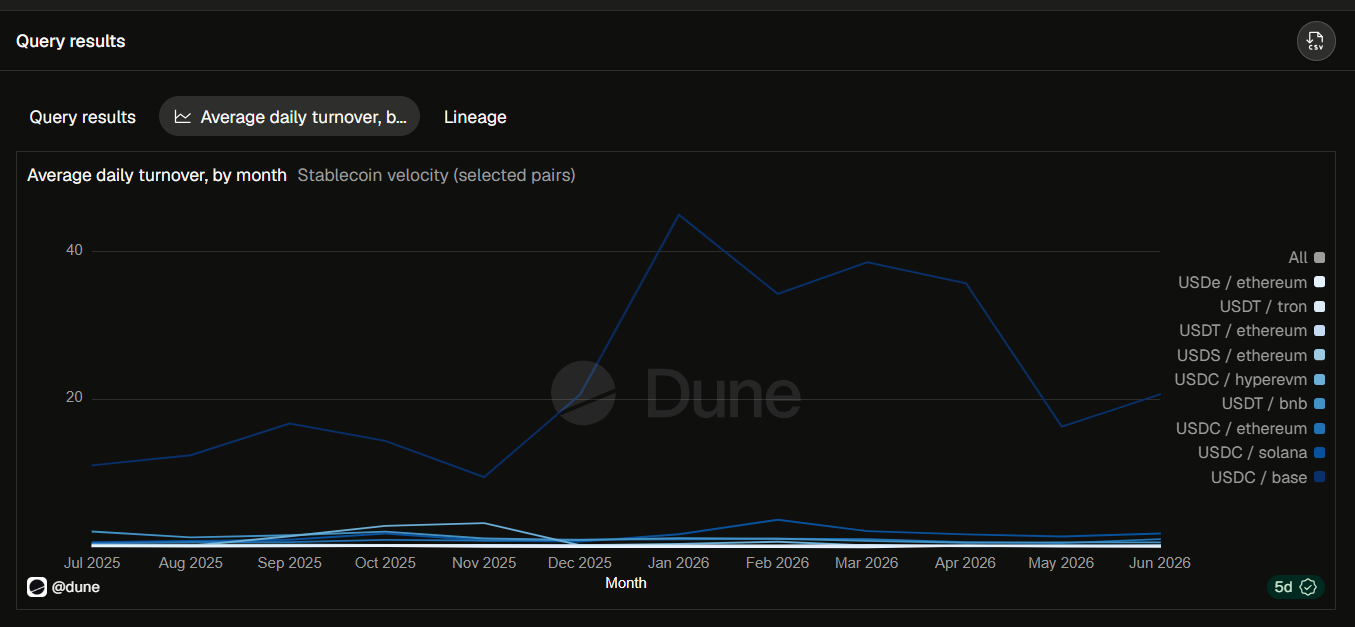
USDC's crucial position in Coinbase's Layer-2 ecosystem is demonstrated by the $2.6 trillion in transfer volume it processed on Base in June alone. Another $1.6 trillion in transfers were made on Ethereum, the stablecoin, indicating ongoing demand throughout the biggest smart contract network.
Source: Dune
These numbers highlight the significance of USDC in the DeFi architecture, where highly liquid stable assets are needed for loan markets, decentralised exchanges, liquidity pools, and on-chain financial applications.
USDC seems to have solidified its position as the favoured stablecoin for blockchain-native financial activities rather than directly competing with USDT in payment settlements.
Massive transfer volumes are concentrated on Ethereum and Base, which is also where most of the current DeFi innovation is occurring. USDC is a crucial feature of decentralised financial markets since developers, protocols, and institutional participants still mostly rely on it for high-frequency on-chain transactions.
The disparate data demonstrates that USDC is still intricately linked to DeFi's operational infrastructure, even while USDT is enabling commercial payments.
USDT vs. USDC: What Should Users Choose?
According to the most recent statistics from Dune Analytics, determining a single market leader is no longer the goal of comparing USDT and USDC. Rather, each stablecoin has established its own area of expertise.
The figures clearly support USDT for companies engaged in B2B transactions, commercial settlements, and cross-border payments. Unmatched acceptance in commercial use cases is demonstrated by handling $95 billion in payment settlements and holding 92% of the B2B payment industry. Its status as a transactional stablecoin is further supported by its widespread engagement on Tron, where 93% of the supply is kept in standard wallets.
USDC is still the better option for those who actively engage in DeFi, decentralised exchanges, lending protocols, or Layer-2 ecosystems. Its vital role in decentralised finance is demonstrated by its $2.6 trillion monthly transfer volume on Base and $1.6 trillion on Ethereum.
These two assets continue to be at the centre of the larger stablecoin market. Despite having increasingly distinct functions, USDT and USDC together account for around 83% of the stablecoin industry's nearly $315 billion total market valuation, demonstrating their continued dominance in the adoption of digital currencies.
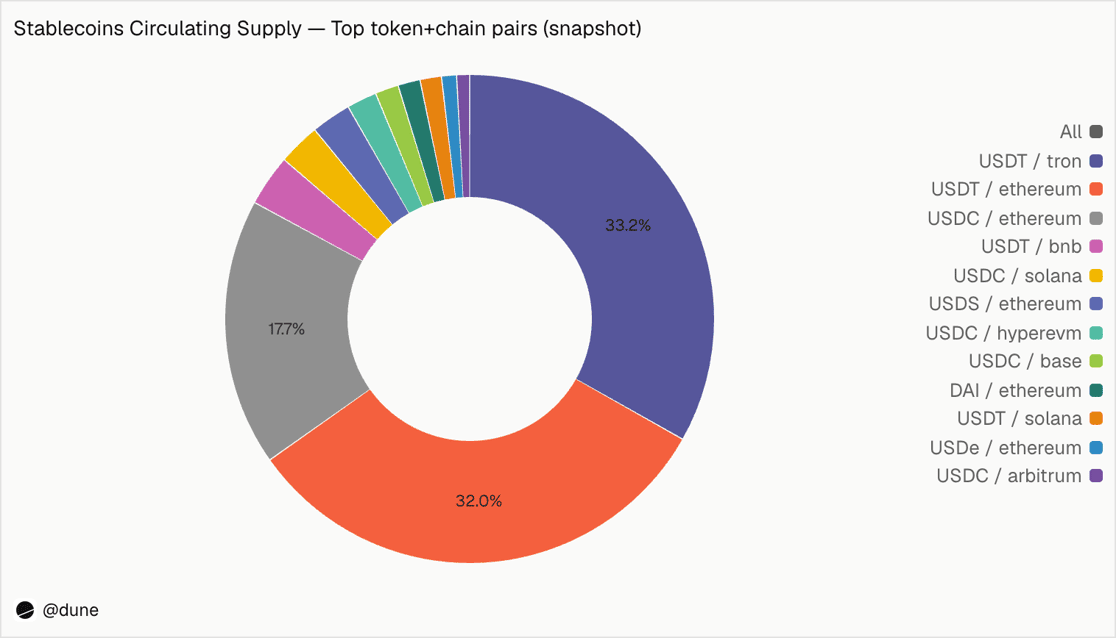
The most recent market data indicates that the ecosystem is moving toward specialisation rather than displacing one another; USDC still powers most large-scale DeFi activity, while USDT has emerged as the preferred stablecoin for payments.
If you find any issues in this article or notice missing information, please feel free to reach out at team@etherworld.co for clarifications or updates.
To promote your Web3 articles, events, and projects, you may reach out anytime via EtherWorld PR for submissions and collaboration.
Related Articles
- Trump Reports $100M Crypto, Vance Owns Bitcoin
- Vitalik Buterin Outlines Ethereum's Lean Vision
- Europe's Largest Fintech Revolut to Delist USDT by August 31
- Brantly Milligan Exits ENS Exits Amid Governance Rift
- Binance System Outage Triggers Liquidation Debate
To follow blockchain news, track Ethereum protocol progress, and read our latest stories, subscribe to our weekly today.
Disclaimer: The information contained in this website is for general informational purposes only. The content provided on this website, including articles, blog posts, opinions, & analysis related to blockchain technology & cryptocurrencies, is not intended as financial or investment advice. The website & its content should not be relied upon for making financial decisions. Read full disclaimer & privacy policy.
To stay updated on blockchain news, Ethereum protocol progress, and our latest stories, subscribe to our weekly digest and YouTube channel for ELI5 content.
To promote your Web3 articles, events, project updates, and Press Releases, reach out anytime via EtherWorld PR for submissions and collaboration. For other queries, email contact@etherworld.co.
If you’d like to support our work, share the content and consider donating at avarch.eth.
Join our community on Discord and follow us on Twitter, Facebook, LinkedIn & Instagram.

 ×
×

Author

Nidhi Kumari is a Web3 content writer at EtherWorld.co, tracking ecosystem developments, funding activity, and market trends shaping the crypto space.