Ethereum's 1% Issuance Plan Sparks Staking Debate
Ethereum's proposed 1% ETH issuance cap has sparked a debate over staking rewards, with solo validators warning it could accelerate stake centralization & weaken Ethereum's decentralization.
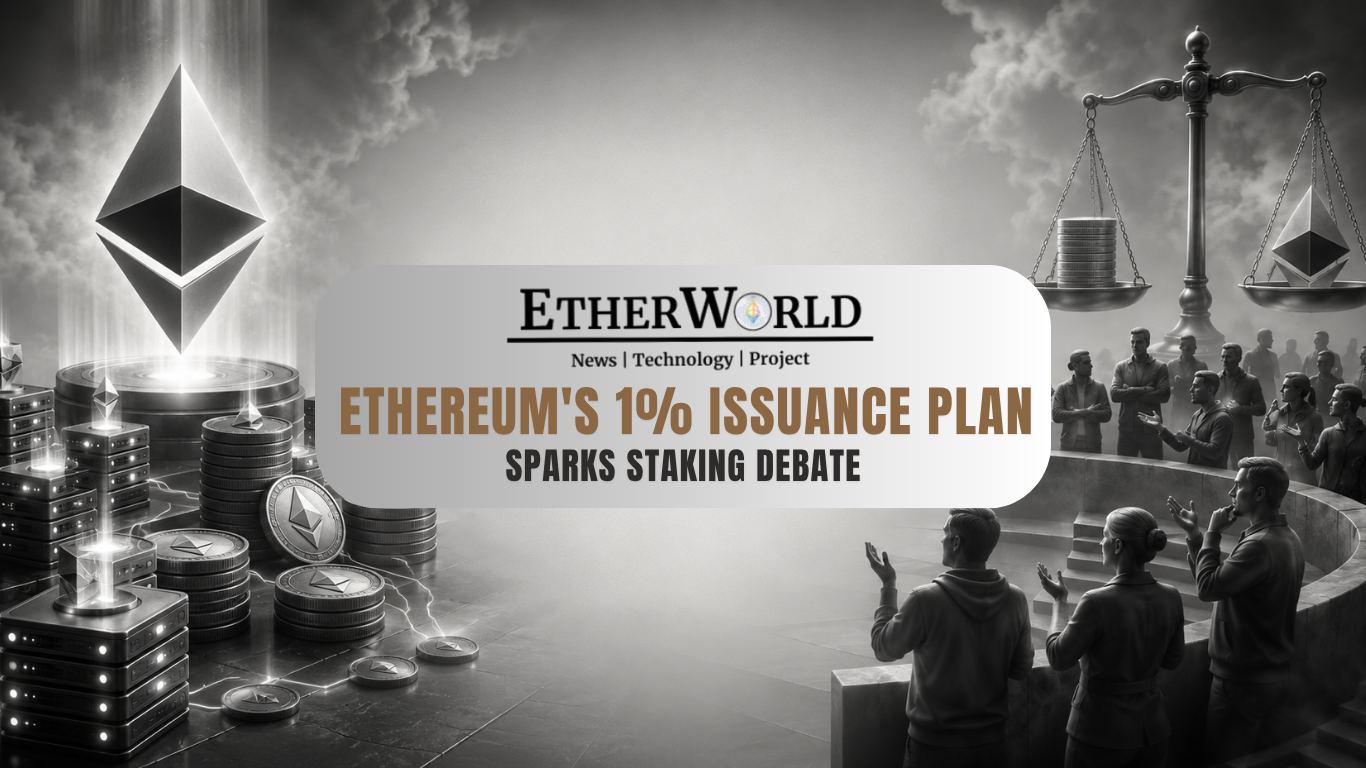
Ethereum's most recent stake incentives disagreement has shown a growing divide between solo validators, protocol developers, and liquid staking providers. At the centre of the controversy is the idea to reduce ETH issuance and cap it at 1%; supporters claim that this will enhance Ethereum's monetary policy and preserve its deflationary character. Solo stakers argue that lowering rewards could make independent validation more difficult and shift more stake toward large operators and staking providers at a time when network diversity is still a significant concern.
- Solo Validators Face Rising Economic Pressure
- Preston Van Loon Pushes Back on Cost Estimates
- Critics Warn Reward Cuts Could Strengthen Centralized Providers
- Supporters Seek a 1% Issuance Cap Despite Staking Concerns
Solo Validators Face Rising Economic Pressure
After Yearn Finance writer Banteg analysed the economics of operating Ethereum validators and emphasised the expenses incurred by lone stakers, the conversation became more heated. In comparison to the 10% price Lido charges for its liquid staking service, his estimates show that a single validator operator spends about 22% of their staking returns on hardware-related expenses.
The economics of rented infrastructure were also highlighted by the investigation. It appears that staking on rented infrastructure becomes economically inefficient at lesser scales, as validators using leased servers would need to run about 40 validators just to break even. As opponents of incentive reductions contended that decreased issuance would further reduce already narrow margins for independent validators, these numbers soon came to dominate the discussion.
Many lone operators are concerned about more than just making less ETH. They argue that declining rewards would eventually reduce the financial incentive for maintaining independently run nodes, encouraging validators to move to larger staking providers who can split operational expenses across thousands of validators.
did the math on my solo staking for the first time. my hardware costs amount to 22% of rewards. i’d be better off with lido with their 10% cut. pretty sure people suggesting cutting the emissions have never tried solo staking and have no idea of its requirements or economics.
— banteg (@banteg) June 24, 2026
Preston Van Loon Pushes Back on Cost Estimates
Preston Van Loon, an Ethereum core engineer, contested the idea that solo staking is now too costly. He provided information about his own validator setup to refute Banteg's calculations, stating that he uses a five-year-old Intel NUC that he bought for about $1,200 to run validators.
Van Loon's example was meant to show that, for those who are prepared to handle their own hardware and refrain from renting cloud servers, operating costs can stay comparatively low. According to his argument, staking costs can differ significantly depending on the infrastructure decisions validators make.
Opponents of incentive reductions, however, argue that isolated instances do not accurately represent the overall experience of all participants. The upkeep of hardware, the dependability of the internet, the cost of electricity, and the technical know-how required to run a validator might vary greatly between locations and users. Opponents contend that when lesser issuance compresses staking yields, these issues become significantly more crucial.
I have been running my validator on a $1200 Intel nuc from 5 years ago.
— prestonvanloon.eth (@preston_vanloon) June 24, 2026
We have good / fast fiber internet in my area. Costs are $80 for internet (which I was already paying) and marginal energy costs.
Seems wild to rent a server unless you have weak internet. You need at…
Critics Warn Reward Cuts Could Strengthen Centralized Providers
Reducing staking incentives may have unexpected effects on decentralisation, according to a number of well-known figures in the Ethereum ecosystem.
Legal expert Gabriel Shapiro and community member donnoh.eth contend that reducing compensation would probably result in fewer single validators taking part in the network. They think that rather than continuing to manage their own infrastructure, independent operators who are seeing a decline in profitability may increasingly decide to assign their ETH to major staking providers.
Critics believe that incentive reductions would inadvertently make these services even more appealing because platforms like Lido currently charge a 10% fee, which is less than the projected cost burden faced by some single validators. They contend that Ethereum may grow more reliant on centralised organisations for block production and validation as more stake is concentrated in a small number of suppliers.
For many detractors, the problem goes beyond economic considerations. They think that maintaining a healthy distribution of independently operated nodes should continue to be a top priority and that validator diversity is an essential part of Ethereum's resilience.
did the math on my solo staking and it was worth it because my wrench attackers couldn't steal it https://t.co/56tOo0VRxn
— Jrag.eth (@Jrag0x) June 24, 2026
Supporters Seek a 1% Issuance Cap Despite Staking Concerns
Lower staking reward proponents contend that improving Ethereum's long-term financial profile requires lowering issuance. Their objective is to limit the amount of new ETH that enters circulation while maintaining the asset's deflationary features by capping yearly ETH supply at 1%.
Additionally, proponents contend that by lowering the incentives to lock up ever-increasing chunks of the supply, smaller issuance could deter excessive staking concentration. They believe that this would support Ethereum's decentralisation objectives while fostering a better balance between staked and liquid ETH.
Single validators are still not convinced. Many think that reward decreases could undermine the very group that has contributed to the network's distributed character, four years after the Merge turned Ethereum into a proof-of-stake network. They worry that the diversity of participants that Ethereum has spent years attempting to foster may be undermined if reduced returns gradually shift power toward large-scale operators.
If you find any issues in this article or notice missing information, please feel free to reach out at team@etherworld.co for clarifications or updates.
To promote your Web3 articles, events, and projects, you may reach out anytime via EtherWorld PR for submissions and collaboration.
Related Articles
- Ethereum Staking Boom Sparks Liquidity & Incentive Debate
- Ethereum Sees Rapid User Growth via New Addresses
- Ethereum Phishing Attack Drains $585K in 11 Hours
- Ethereum Foundation Unstakes 17K ETH Worth $48.9M
- Ethereum Foundation Converts 5,000 ETH to Stablecoins Via CoWSwap
To follow blockchain news, track Ethereum protocol progress, and read our latest stories, subscribe to our weekly today.
Disclaimer: The information contained in this website is for general informational purposes only. The content provided on this website, including articles, blog posts, opinions, & analysis related to blockchain technology & cryptocurrencies, is not intended as financial or investment advice. The website & its content should not be relied upon for making financial decisions. Read full disclaimer & privacy policy.
To stay updated on blockchain news, Ethereum protocol progress, and our latest stories, subscribe to our weekly digest and YouTube channel for ELI5 content.
To promote your Web3 articles, events, project updates, and Press Releases, reach out anytime via EtherWorld PR for submissions and collaboration. For other queries, email contact@etherworld.co.
If you’d like to support our work, share the content and consider donating at avarch.eth.
Join our community on Discord and follow us on Twitter, Facebook, LinkedIn & Instagram.

 ×
×

Author

Nidhi Kumari is a Web3 content writer at EtherWorld.co, tracking ecosystem developments, funding activity, and market trends shaping the crypto space.