Ethereum’s Issuance Debate: Could Staking Rewards Fall to Zero?
EIP-8363 has ignited a wider Ethereum debate over staking rewards, issuance policy, solo-staker economics & how controversial proposals move from discussion to mainnet.

Ethereum is debating a major change to how staking rewards work. A new proposal, EIP-8363, would gradually reduce the rewards validators earn as more ETH is locked in staking. Under the current design, rewards would keep falling as staking grows, and once around half of all ETH is staked, the proposal would reduce the protocol-issued reward to nearly zero.
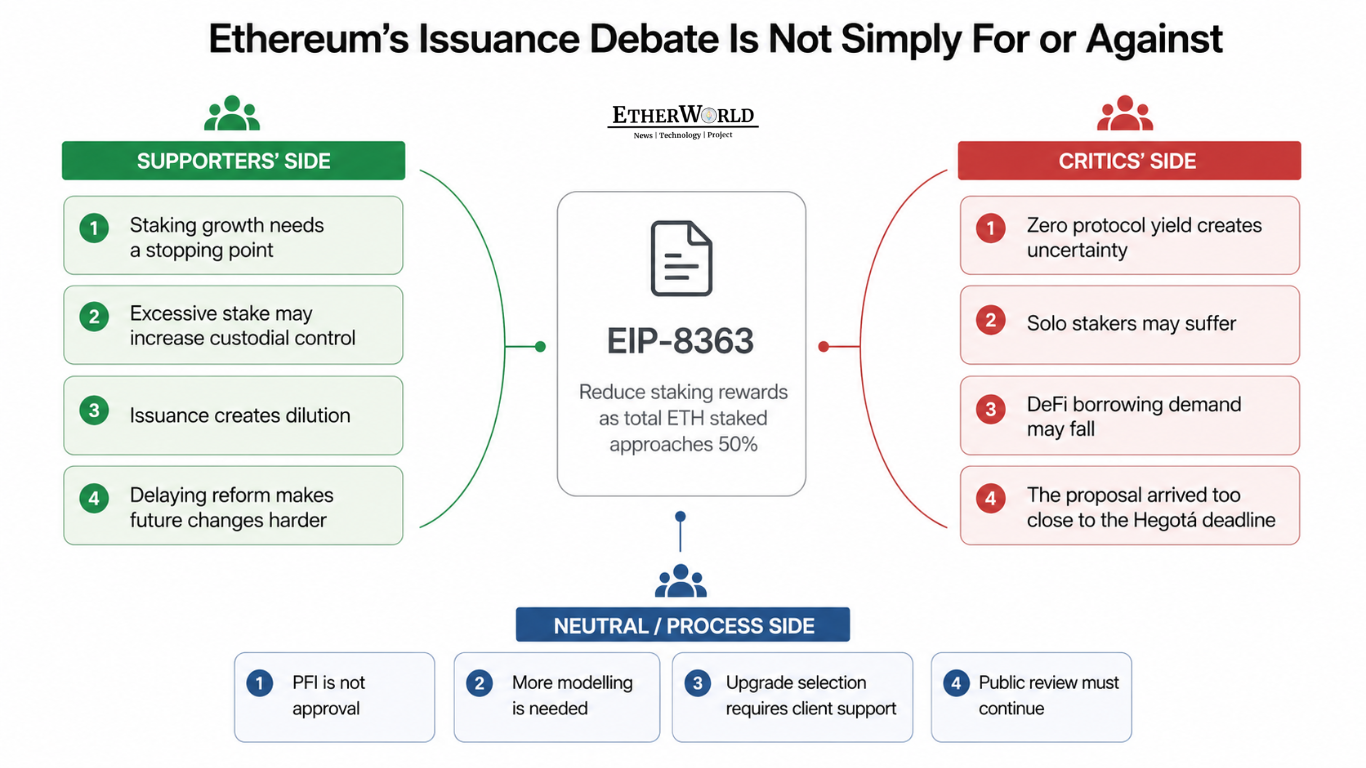
The idea is to stop Ethereum from encouraging more and more staking once the network already has enough economic security. Supporters worry that unchecked staking growth could give large custodians and liquid staking platforms too much influence, while making more of the ETH supply dependent on yield-bearing staking products.
Why EIP-8363 Arrived Now
Ethereum’s staking system currently follows an issuance curve under which the reward earned by each validator declines as more ETH is staked. The design reduces individual yield as participation grows, but aggregate issuance can still rise because a larger number of validators continue receiving rewards.
The concern behind EIP-8363 is that this declining yield may not create a sufficiently strong stopping point. ETH holders may continue staking even at lower yields because remaining unstaked creates dilution. Liquid staking tokens, custodial products and institutional staking services also make it easier to retain liquidity while earning protocol rewards.
This can produce a feedback loop in which staking continues because other holders are staking, rather than because Ethereum requires additional economic security. The proposal’s authors describe this as a monetary and security problem.
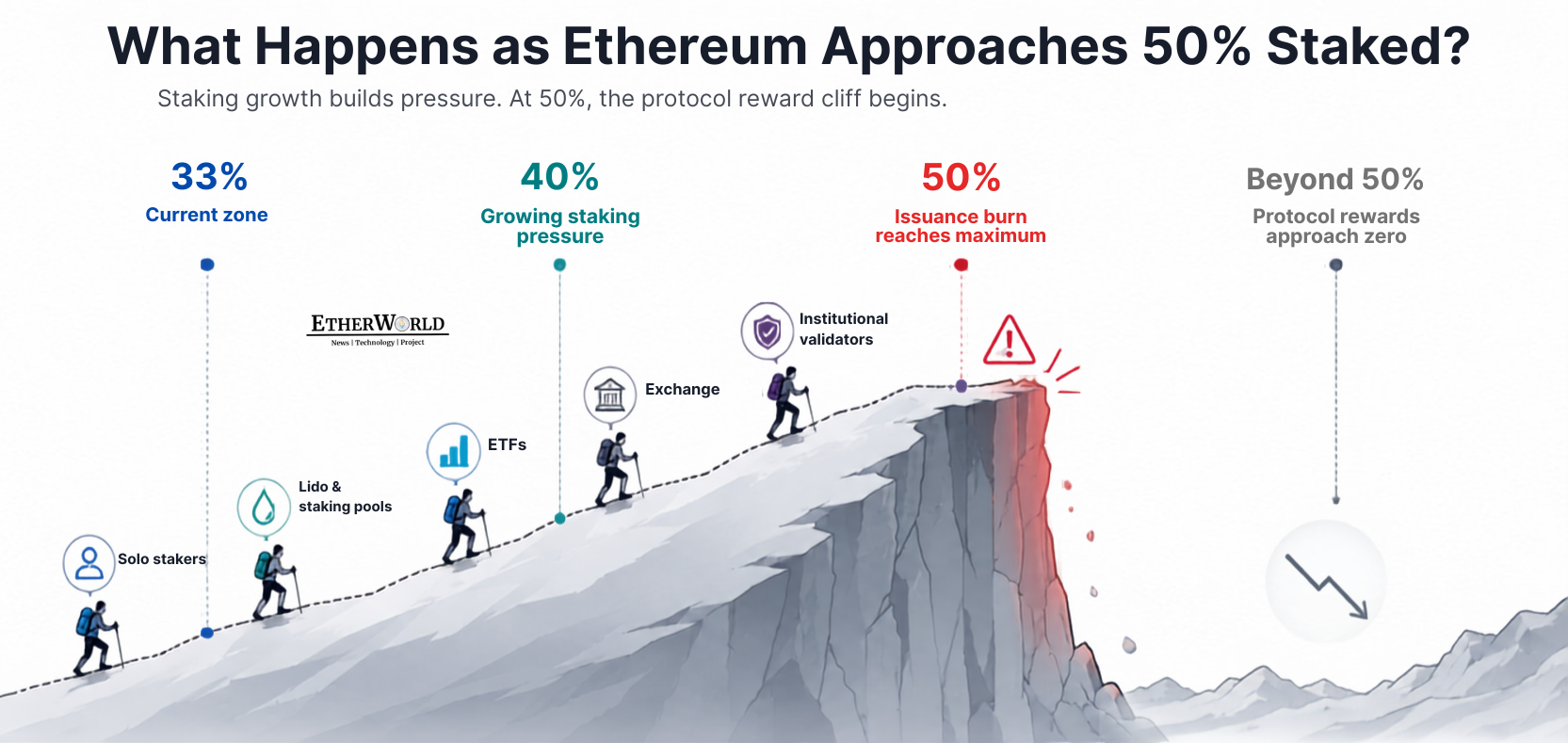
Once a large portion of ETH is staked, the validator set may become increasingly shaped by custodians, staking pools, exchange products and institutional vehicles. The issue is therefore not only the absolute amount of stake securing Ethereum, but who controls that stake and what economic structures form around it.
EtherWorld previously examined similar tensions in Ethereum’s 1% Issuance Plan Sparks Staking Debate, where proposals to reduce issuance raised questions about validator profitability and the potential displacement of solo operators. The debate also overlaps with An Overview of Validator Redirected Revenue, which explored whether validator rewards could support public goods.
The authors therefore consider timing central to the proposal. Their argument is that Ethereum has a limited window in which it can introduce a gradual taper before the staking ratio overshoots the desired range. Critics challenge this urgency. They argue that the existence of a long-term concern does not justify placing a full monetary-policy redesign into an active upgrade discussion with limited time for initial review.
How the Tapered Issuance Burn Works
EIP-8363 does not directly rewrite the existing reward calculation by simply minting less ETH. Instead, validators would continue receiving consensus-layer rewards under the existing structure, after which the protocol would calculate a deduction associated with each assigned duty. The deducted amount would then be burned.
The burn fraction would rise with the staking ratio. At lower staking levels, only part of a validator’s idealised reward would be deducted. As the total amount of staked ETH approaches the proposal’s saturation point of roughly 60.25 million ETH, approximately half of Ethereum’s present supply, the deduction would approach 100%.
🚨 New EIP: Tapered Issuance Burn
— Jerome de Tychey 🦇🔊 (@jdetychey) August 4, 2026
We just submitted an EIP to ethereum/EIPs: a minimal, market-driven fix to Ethereum's issuance policy removing the incentive for stake growth beyond 50% of ETH supply.
EIP-8361 by @pintail_xyz, @jdetychey, @dapplion, @pa7x1, @ladislaus0x &… pic.twitter.com/g1uzWPycQ4
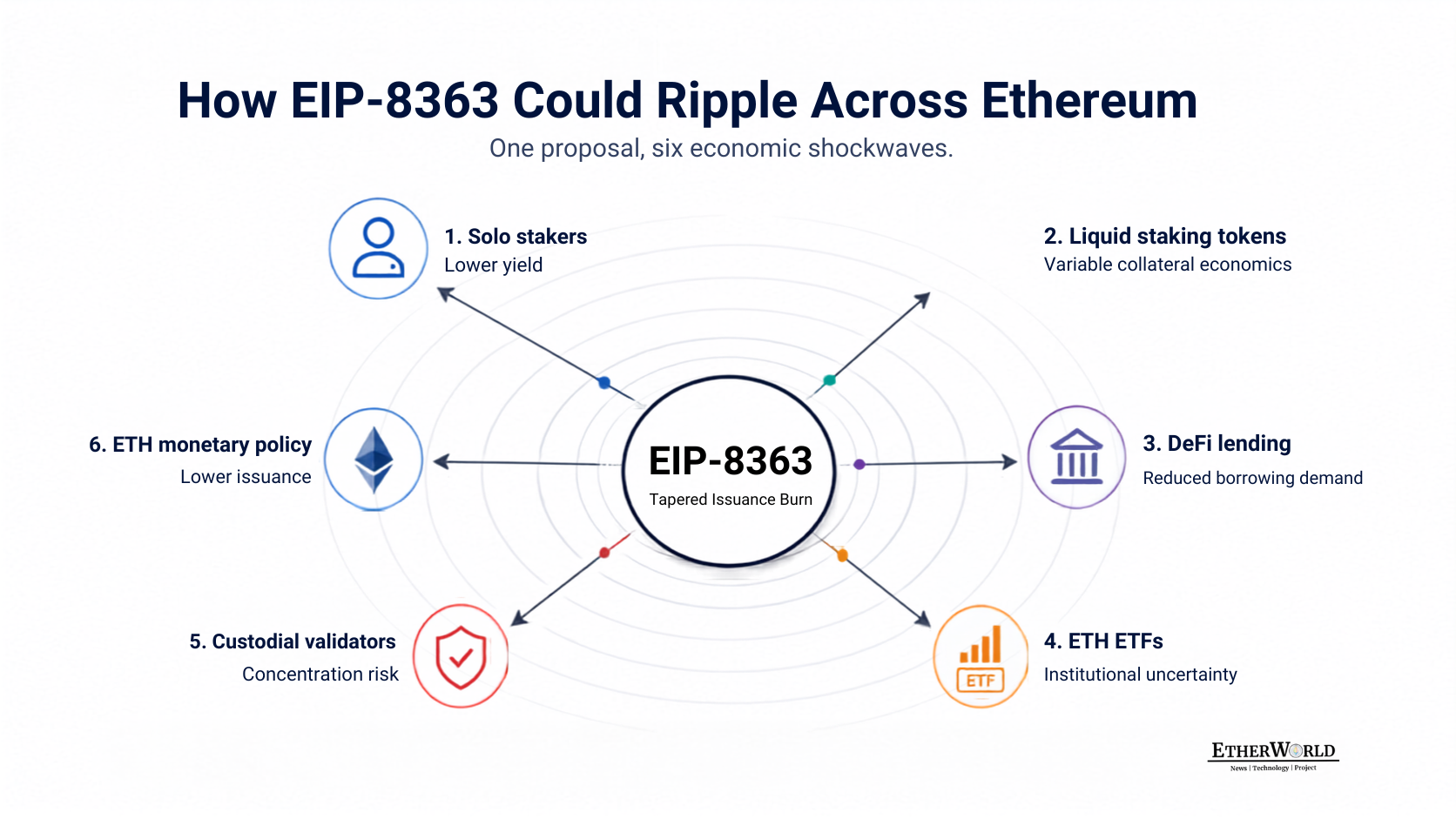
At the proposed limit, the protocol-issued staking reward for a validator performing correctly would be fully cancelled out by the burn. That does not necessarily mean validators would earn nothing. They could still receive transaction priority fees, MEV and other external income. The main change is that Ethereum would no longer issue additional net rewards to encourage more ETH to enter staking once the chosen threshold is reached.
Supporters argue that the current system still encourages ETH holders to stake because those who do not stake may see their share of the supply diluted by new rewards. EIP-8363 would gradually weaken that pressure by reducing net staking rewards as more ETH enters the system.
The proposal would not introduce the full change immediately. Instead, it includes an 18-month transition period, giving validators, staking providers and DeFi platforms time to adjust while the burn is slowly phased in. This is meant to avoid a sudden drop in rewards or a rush of validators leaving the network.
However, the “mint and burn” approach has raised questions. Critics ask why Ethereum should first issue rewards and then burn part of them instead of simply issuing less ETH. This could also create tax complications in some countries, where validators may be taxed on the full reward even if part of it is later burned.
So, while the technical change is designed to be relatively simple, its economic effects are much more complicated. It changes how much validators ultimately keep without completely redesigning how rewards, penalties and validator duties are calculated.
Ethereum has previously used carefully scoped mechanisms to change validator economics. The broader importance of validator design can also be seen in How Solo Stakers & FOCIL Strengthen Censorship Resistance on Ethereum, which explains why individual validators contribute more than raw stake. They improve geographic, operational and political diversity.
What the Data Says About Ethereum’s Staking Trajectory
EIP-8363 is being presented as a data-driven response to a rapidly changing staking market. The proposal’s discussion uses a current staking ratio of approximately 33% as a baseline. Its supporters argue that Ethereum has already crossed the point where additional stake provides proportionate security benefits.
The authors also point to the validator activation queue. Entry is rate-limited by Ethereum’s churn mechanism, but when the queue remains saturated, stake continues entering at the maximum rate permitted by the protocol.
According to projections shared by supporters, if validator entry remains saturated and exits stay limited, more than 70 million ETH could be staked by January 1, 2028. That would represent over 55% of supply under the assumptions used by the model.
The proposal’s fixed saturation balance is approximately 60.25 million ETH, representing close to half of current supply. The burn would reach its maximum at that level. These figures explain the authors’ urgency. A gradual 18-month transition introduced while the staking ratio remains below 50% could allow the market to find a lower equilibrium. Introducing the same mechanism after a major overshoot could require substantially more ETH to leave staking.
However, the projection should not be treated as a guaranteed forecast. It assumes continued demand, a persistently saturated entry queue, limited exits and relatively stable supply conditions. Changes in ETH price, validator profitability, regulation, institutional demand, DeFi yields or protocol policy could alter the trajectory.
Ethereum may possess enough direct economic security to make purchasing sufficient ETH for an open-market attack unrealistic. The more probable threats could instead come from validator-key theft, custodial compromise, regulatory coercion, software supply-chain attacks or concentration among professional operators.
Reducing rewards may limit the aggregate staking ratio, but it does not automatically improve operator diversity. If smaller validators have higher fixed costs, lower yields could force them out before larger operators. Ethereum might achieve a lower staking ratio while ending up with a more concentrated validator market.
Institutional products may also respond differently from solo validators. A fund may tolerate lower yields because it monetises management fees or provides regulated exposure. A home staker paying for hardware, bandwidth and maintenance may have less flexibility.
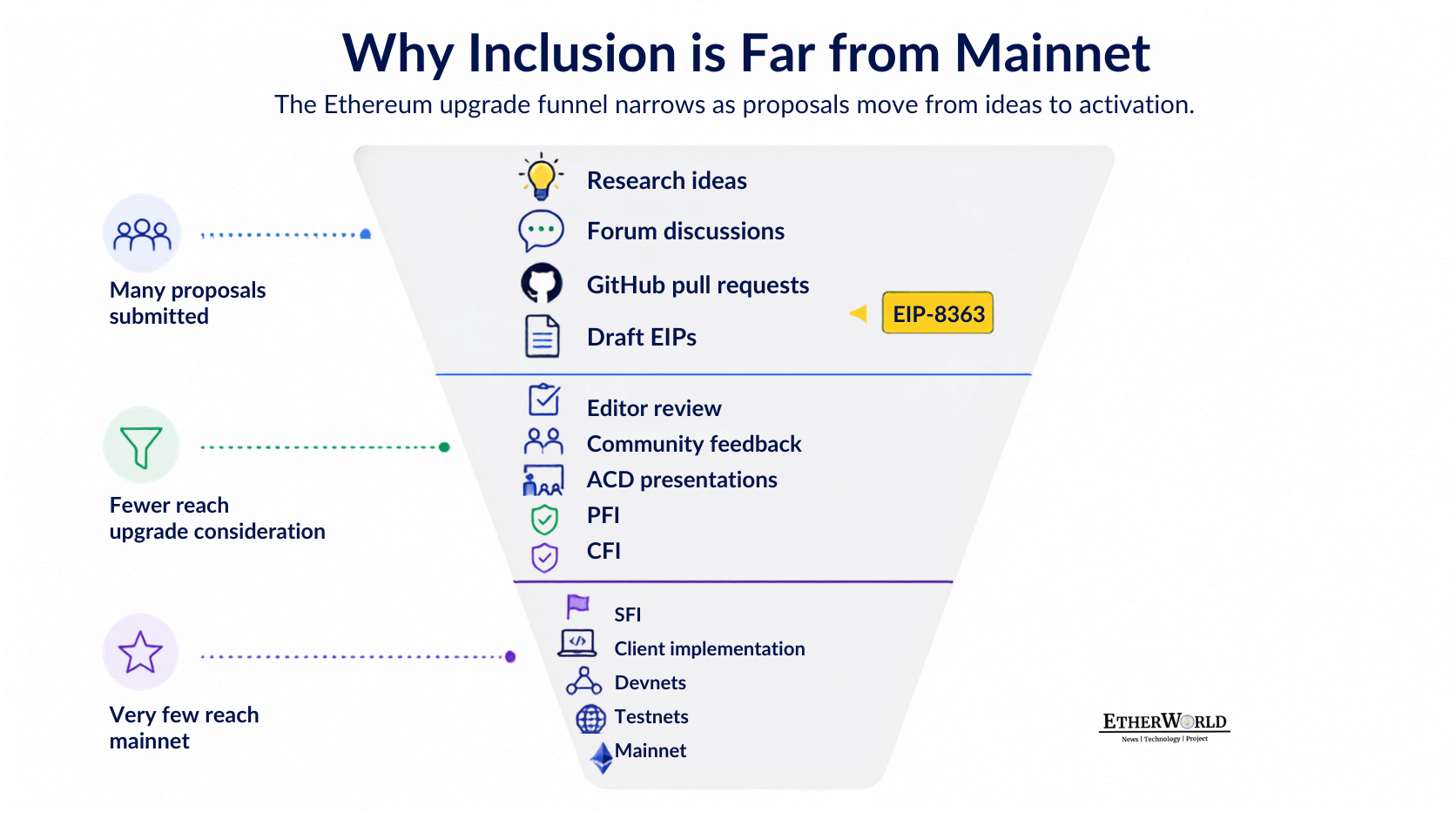
How Ethereum Upgrade Works?
Much of the public reaction to EIP-8363 has treated its submission as though Ethereum were preparing to activate the proposal. That is not how the process works.
An EIP is a technical design document. It describes a proposed change, its rationale and its specification. Submitting a pull request to the Ethereum EIPs repository begins formal review; it does not establish community consensus or guarantee inclusion in a network upgrade.
The initial GitHub pull request for the Tapered Issuance Burn was opened on August 4, 2026. The document was labelled as a new Draft Core EIP and remained subject to editor review. The number correction itself demonstrates the process.
The draft temporarily referred to itself as EIP-8363. Pooja Ranjan noted that proposal numbers cannot be self-assigned and that 8363 had already been allocated. An EIP editor subsequently assigned 8363 and requested corresponding updates to the filename and discussion link.
This may appear administrative, but it highlights an important separation of responsibilities. EIP editors review formatting, completeness and adherence to EIP rules. They do not approve a proposal’s economic merits or decide whether it should enter mainnet.
For a Core EIP, the authors must then attract technical interest, present the proposal to client teams and participate in All Core Developers discussions. Implementers need to assess specification complexity, testing requirements, security risks and interactions with existing consensus rules.
I think this is another reminder of why we need to do a better job explaining the EIP and Ethereum upgrade process to the broader community.
— Pooja Ranjan | ranjan.eth (@poojaranjan19) August 4, 2026
Dear @MikeSilagadze, I understand the concerns, but there’s no need to panic just yet.
A few notes that may help:
- The proposal… https://t.co/MCGJ9cId2P
A separate upgrade pipeline determines whether a Core EIP becomes part of a particular fork. Read more about how inclusion works. PFI is therefore not approval. It means the authors are asking core developers to discuss the proposal for a particular upgrade.
EtherWorld’s Tracking the Glamsterdam Upgrade on EIPsInsight shows how proposals can move between these stages, face delays or leave an upgrade’s scope after testing. The All You Need to Know About Ethereum Glamsterdam Upgrade hub also documents how scope evolved through repeated developer decisions rather than a single vote.
Even an SFI proposal must pass implementation work, specification review, devnets, test vectors, client interoperability testing, public testnets and fork-readiness checks. EtherWorld’s coverage of ACDE Call #205 showed how proposals approaching activation can still face system-contract, client-release and testing dependencies. More recent reporting from ACDE Call #237 similarly illustrates how developers evaluate implementation readiness alongside broader upgrade priorities.
Community Sentiment on EIP-8363
The early response to EIP-8363 has been unusually intense because the proposal touches the revenue of nearly every participant in Ethereum’s staking economy. Supporters frame the proposal as a preventive security measure.
Jérôme de Tychey argues that Ethereum should protect solo stakers from a system in which continuously rising stake lowers nominal yield, creates dilution pressure and strengthens custodial intermediaries. In this view, the taper gives Ethereum’s staking market a natural stopping point without slashing honest validators or abruptly changing the network.
Stani Kulechov of Aave presented a sharply different assessment. He argued that reducing rewards toward zero would make Ethereum staking yield unpredictable and potentially uneconomic for many participants. That uncertainty could weaken ETH’s attractiveness to institutional buyers seeking predictable cash flows.
Unfortunately this proposal doesn't achieve the outcome it tries to achieve and is actually hurtful for Ethereum.
— Stani (@StaniKulechov) August 4, 2026
It caps Ethereum staking rewards to 0% when over 50% of supply staked.
What this mean is that Ethereum staking yield becomes unpredictable and even fully… https://t.co/IYUst52Dt3
Lefteris Karapetsas argued that Ethereum already has more urgent usability and ecosystem problems and that issuance is not the area where limited political and development energy should be spent.
Other critics focused on solo stakers. A flat taper affects each validator according to the global ratio. It cannot distinguish between an independent home validator and a custodial service controlling thousands of validators. If the desired outcome is reduced concentration, critics argue that a mechanism based on total stake may be too blunt.
The Ethereum Magicians discussion further raised concerns about taxation, reflexivity and the proposal’s scope. Once yield depends on a measured global ratio, staking products may attempt to predict or game movements around the curve. Capital may shift into wrappers, off-chain substitutes or alternative yield structures rather than disappear.
Ethereum has serious issues we need to handle. Both as a protocol and an ecosystem for users and developers.
— Lefteris Karapetsas (@LefterisJP) August 4, 2026
Issuance aint it.
Everybody has already given arguments why issuance does not need to be touched.
Let's spend our energy where it matters please. It's a finite resource
There is also disagreement over timing. The proposal was submitted roughly 48 hours before the Hegotá PFI deadline. Critics argue that a monetary-policy redesign should receive substantial public review before being connected to a particular fork.
Supporters respond that PFI only opens the discussion. They maintain that months of research, modelling and debate would still occur before any inclusion decision. Pooja Ranjan’s public response attempted to clarify this distinction. A pull request is not an accepted EIP, PFI is not mainnet approval and even an upgrade candidate must pass discussion, implementation, testing and community feedback.
What to Expect Next for EIP-8363 & Hegotá
EIP-8363 now faces several separate tests.
- The first is editorial and specification review. The proposal must remain technically complete, internally consistent and aligned with the EIP process. The correction from 8361 to 8363 has already shown that even basic metadata is governed by a formal editorial workflow.
- The second is economic modelling. The community is likely to request clearer data on validator profitability, exit behaviour, tax treatment, liquid staking, lending markets and institutional staking products. Aggregate projections alone may not resolve concerns about who bears the cost.
- The third is security analysis. Supporters must show that limiting the staking ratio materially improves capture resistance and decentralisation. Critics will continue asking whether lower rewards could instead consolidate stake among highly efficient professional operators.
- The fourth is upgrade prioritisation. Hegotá already has competing proposals covering execution efficiency, censorship resistance, validator design and long-term protocol simplification. Core developers must consider EIP-8363 against limited implementation, review and testing capacity.
- The fifth test is community legitimacy. Ethereum does not use a simple tokenholder vote to approve Core EIPs. Its legitimacy comes from an open process involving proposal authors, researchers, client developers, application teams, validators and users.
That model is slower and less definitive than corporate decision-making. It is also designed to expose disagreement before code becomes mandatory. For EIP-8363, disagreement is not a failure of governance. It is the governance process working visibly.
The proposal may advance unchanged, be narrowed into a high-stake contingency mechanism, move to a later upgrade, inspire an alternative issuance curve or fail to attract sufficient implementation support.
The next All Core Developers discussions should therefore be watched for signals on scope rather than binary acceptance or rejection. Readers can follow the wider upgrade through EtherWorld’s State of Upgrade — Hegotá Edition #1 and ongoing Hegotá coverage. These resources help distinguish proposals entering public discussion from those receiving implementation commitments.
To promote your Web3 articles, events, and projects, you may reach out anytime via EtherWorld PR for submissions and collaboration.
Related Articles
- Ethereum's 1% Issuance Plan Sparks Staking Debate
- An Overview of Validator Redirected Revenue
- Ethereum Introduces “Strawmap”: A Strawman Roadmap for Ethereum’s L1 Future
- How Solo Stakers and FOCIL Strengthen Censorship Resistance on Ethereum
- Hegotá Should Complete the Holy Trinity of Censorship Resistance
To follow blockchain news, track Ethereum protocol progress, and read our latest stories, subscribe to our weekly today.
Join the EtherWorld & Avarch Internship Program and build your career in blockchain, content, social media, video, podcast editing, or operations. Send your resume and brief introduction to contact@etherworld.co.
Disclaimer: The information contained in this website is for general informational purposes only. The content provided on this website, including articles, blog posts, opinions, & analysis related to blockchain technology & cryptocurrencies, is not intended as financial or investment advice. The website & its content should not be relied upon for making financial decisions. Read full disclaimer & privacy policy.
To stay updated on blockchain news, Ethereum protocol progress, and our latest stories, subscribe to our weekly digest and YouTube channel for ELI5 content.
To promote your Web3 articles, events, project updates, and Press Releases, reach out anytime via EtherWorld PR for submissions and collaboration. For other queries, email contact@etherworld.co.
If you’d like to support our work, share the content and consider donating at avarch.eth.
Join our community on Discord and follow us on Twitter, Facebook, LinkedIn & Instagram.

 ×
×

Author

Yash Kamal Chaturvedi is a Blockchain Content & Ops Specialist at Avarch LLC, writing on Ethereum & governance since 2021. Covers ACD/ACDE calls, EIPs, upgrades, staking, security & ecosystem trends.