Crypto Fundamentals Outpacing Prices: Is the Market Missing Adoption?
Crypto veterans say fundamentals now lead prices. This piece explores whether stablecoins, tokenisation, and adoption are being undervalued.

With more than 8 years of experience in the cryptocurrency space, Bitwise's Hunter Horsley recently noted that substance had surpassed price for the first time. Moonrock Capital's Simon Dedic concurred, i.e., in previous cycles, hype led while substance either trailed or never materialised; this time, fundamentals lead, and the market has just not caught up.
A developing tension is captured in their remarks. While many token values are lagging, institutional infrastructure, real-world asset tokenisation, and stablecoin rails continue to grow. Whether markets are accurately pricing token holders' weak value capture or are missing true adoption is the question.
The Growing Disconnect Between Prices & Progress
The history of crypto is filled with instances when narrative took precedence over delivery. 2026 seems inverted. While institutional pilots, regulated product launches, and on-chain activities continue to develop, secondary-market prices for many native tokens continue to be muted in comparison. This is not the typical pattern of enthusiasm and then disillusionment. It has already attained a considerable scale and is a quieter construction.
Dollar-pegged stablecoins and tokenised traditional assets, which now serve as actual infrastructure rather than experiments, are the two instances where the discrepancy is most evident. Both exhibit increasing institutional participation and utilisation. Higher prices for a wider range of cryptocurrency tokens are not always the result of either of these factors.
Stablecoins as Real Payment Infrastructure
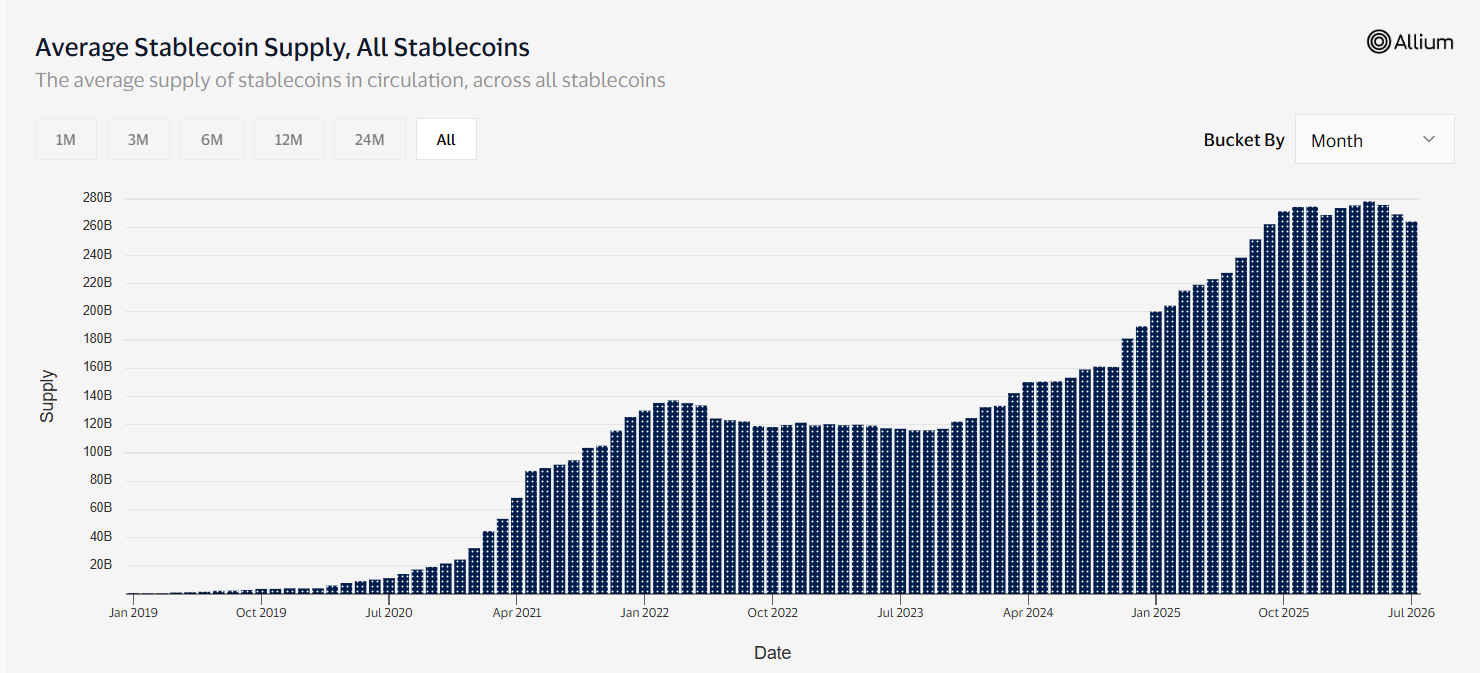
The clearest proof of product-market fit is now stablecoins. After reaching a peak of more than $320 billion earlier in 2026, the overall market capitalisation is currently about $300 billion. Throughput is more crucial than supply. In June of 2026 alone, adjusted transaction volumes hit a record $1.79 trillion. Volumes reached almost $33 trillion for the entire year of 2025. While USDT continues to hold the top spot in several trading and remittance corridors, USDC has accounted for the majority of adjusted economic volume in 2026, frequently close to 70%.
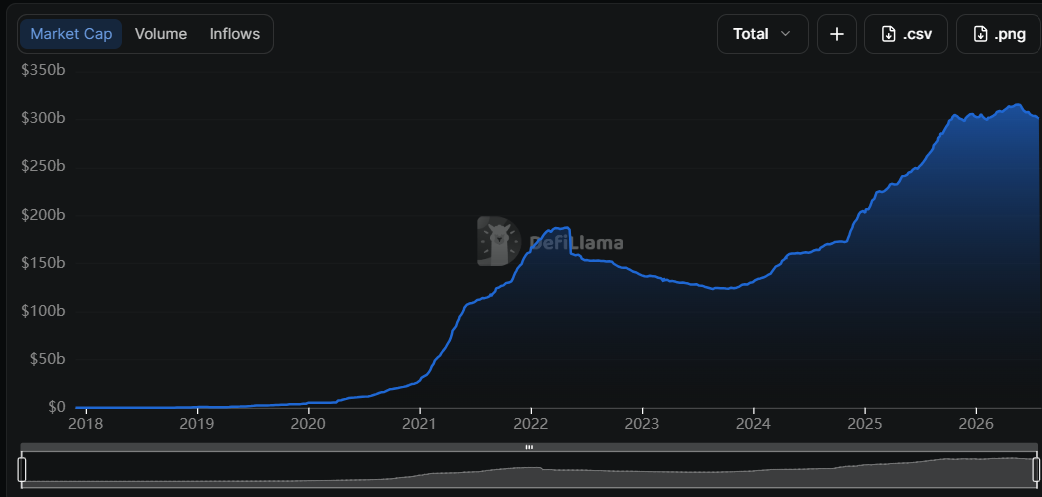
These figures show real settlement and payment activity rather than just internal exchange transfers. Stablecoins are increasingly being used by banks, payment networks, and corporations as settlement rails for treasury management and cross-border transactions. According to several reports, B2B usage and card-linked spend are still growing more quickly than the underlying float. Value can be swiftly and affordably transferred across boundaries due to the technology's scalability.
However, holders of unrelated protocol tokens may not always benefit economically from the issuers and traditional financial institutions integrating the rails. The reason stablecoins are successful is that they reduce volatility and increase usability. Speculative upside in the surrounding token ecosystem is not necessary for that success, and it frequently does not result in it.
Source: Visa
Tokenization Moves Beyond Experimental Pilots
The trajectory of tokenised real-world assets has been similar. By mid-2026, the on-chain value, which does not include stablecoins, had risen to the $30–36 billion area, several times greater than it had been in early 2025. The core consists of tokenised U.S. Treasuries and money-market funds, with BlackRock's BUIDL fund being one of the biggest single products at about $2–3 billion. Alongside them, tokenised stocks, commodities, and private credit have all grown. Certain tokenised stock and gold products have seen substantial increases in trading volume in brief periods of time.
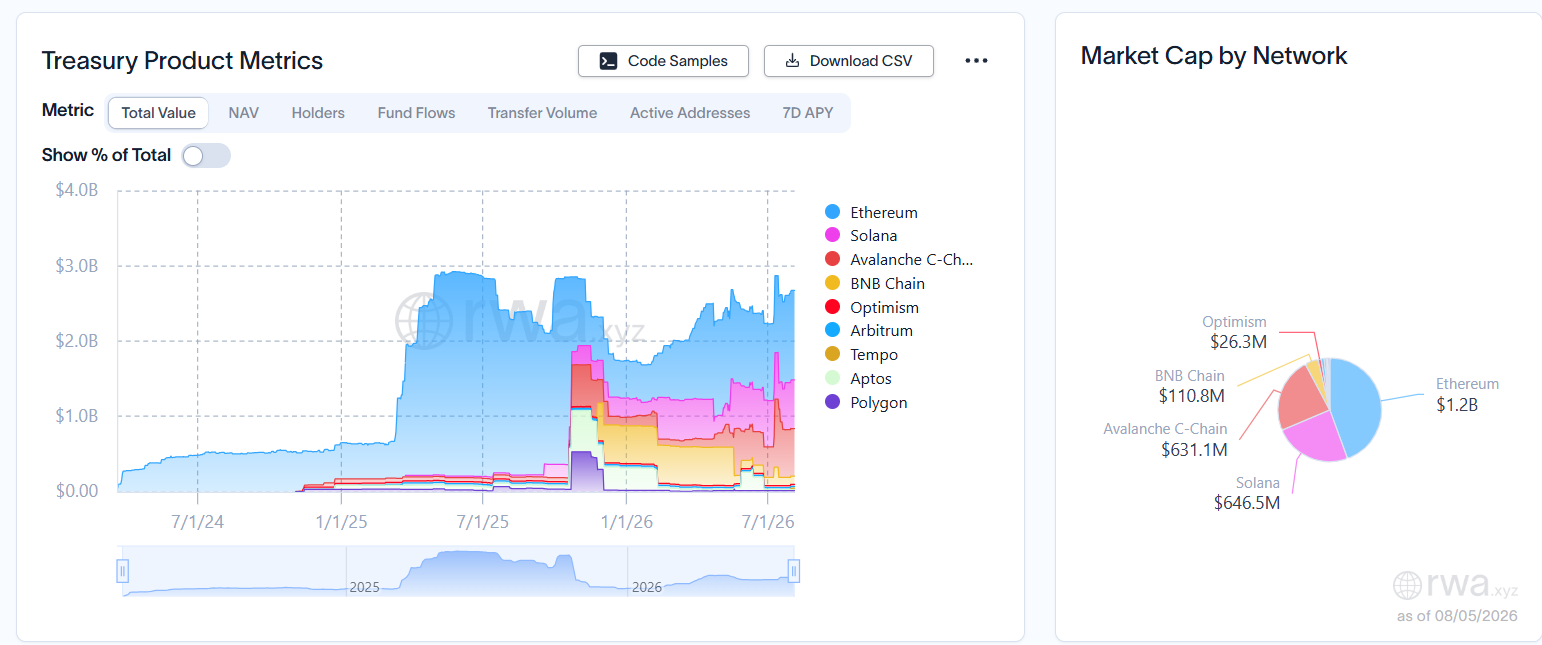
Banks and major asset managers are no longer conducting isolated experiments. They are employing public and permissioned chains for record-keeping and settlement, releasing regulated items, and submitting extra structures. There is a real transition from experiment to production. The majority of activity continues to occur through institutional channels, secondary markets for many tokenised assets are still emerging, and liquidity is still concentrated. The infrastructure is still active and expanding.
Once more, the platforms, asset managers, and custodians who issue and maintain the products frequently retain the value created. The yield of those assets is captured by the tokens that stand in for the underlying Treasuries or credit holdings. Increased on-chain activity may benefit broader protocol tokens indirectly, but direct capture is constrained.
Institutions Want Blockchain, But Do They Need Crypto Tokens?
Blockchain technology is being used by institutions for efficiency, transparency, and round-the-clock settlement. The speculative token layer that characterised previous cryptocurrency cycles is less important to them. Tokenised funds, regulated stablecoins, and permissioned systems can provide operational benefits without the need for high-beta assets or public-chain governance tokens.
This difference is important. While token holders' residual claim remains weak, blockchain usage and business or protocol revenue may increase. Instead of investing in risky cryptocurrency assets, many institutional flows end up in stablecoins or tokenised cash equivalents. The equity-like upside is not inherently linked to every native token; the rails are being constructed.
I've been in crypto for 8+ years.
— Hunter Horsley (@HHorsley) August 5, 2026
For the first time ever — substance has gotten ahead of price.
It's happening. Crypto is going to update the system.
Not done, but can't be stopped now.
Bravo to the relentless teams in this space. Keep going.
Why Adoption Is Not Automatically Bullish for Prices?
For three structural reasons, increasing use of blockchain infrastructure does not ensure greater token prices. First, a large portion of the new activity is yield-seeking and dollar-denominated rather than speculative. Second, the underlying traditional assets themselves or the equity holders of the company producing the products frequently gain value. Third, a lot of protocols still have trouble delivering significant fees or cash flows to token holders in a long-lasting, non-dilutive manner.
Participants were educated to view rising measures as leading indicators for price in previous cycles. When the measures show the usefulness of stable, regulated instruments instead of the desire for rare, volatile tokens, that relationship is weaker.
Well said and same to you sir! https://t.co/H6opffdY1Y
— Brian Armstrong (@brian_armstrong) August 5, 2026
The Crypto Value-Capture Problem
Value capture is the key problem. Large quantities can be processed by blockchain networks, but only a small portion of the economic surplus is captured by utility tokens or governance. There are a few changes, buybacks, and staking awards, but they are sometimes diluted by ongoing issuance or are small in comparison to the volume of activity. Tokenisation platforms and stablecoin issuers can make a significant amount of money without giving it to holders of unrelated Layer-1 or application tokens.
This is not a short-term mistake. It is a reality of design and market structure. Open settlement layers are provided by public blockchains, and the profitable applications and regulated products developed on top often maintain the economics closer to traditional finance.
What Investors Should Measure Beyond Token Prices?
These days, useful measures include actual fee revenue maintained by protocols after incentives, an increase in tokenised asset AUM and secondary trading, institutional product launches and registrations, and adjusted stablecoin transfer volumes that exclude noise. Total value locked and on-chain holder numbers are still important, but they shouldn't be interpreted as automatic bullish signals; instead, they should be evaluated for quality and stickiness.
The price itself is still an independent or lagging variable. As much as present adoption, it represents anticipated future financial flows to token holders, scarcity dynamics, and macro liquidity.
Crypto was born an underdog — dismissed, doubted, disliked.
— Hunter Horsley (@HHorsley) August 5, 2026
Underdog energy has returned in 2026.
Embrace it. https://t.co/pHWKTRFDSN
Is the Market Missing the Real Adoption Cycle?
Adoption in the market is not completely absent. Infrastructure use and token holder value capture are priced differently. Substance has progressed, institutions are incorporating the technology, tokenisation has entered production, and stablecoins process trillions. That development is long-lasting and mostly irreversible.
However, the market is right to exercise caution as well. Adoption of rails does not guarantee that every coin will be enhanced. Prices may finally reflect the fundamentals when protocols are effective in converting usage into long-term, non-dilutive rewards for holders. When they don't, prices and usage may still differ.
Horsley and Dedic are correct that the old hype-first pattern has changed and that building quality has increased. Reflexive optimism and disdain are not the rational responses. While the larger infrastructure continues to develop, value-capture issues are resolved by giving selective attention to a small number of initiatives. We're updating the system. Economics, not alone adoption, determines whether token prices fully participate.
Strongly agree.
— Simon Dedic (@sjdedic) August 5, 2026
Been in crypto since 2017, and for the first time ever it genuinely feels like price is the thing lagging, not the fundamentals.
Every other cycle it was the opposite. Hype first, substance never. This time the substance is already here and the market simply… https://t.co/QdNY58nuyq
If you find any issues in this article or notice missing information, please feel free to reach out at team@etherworld.co for clarifications or updates.
To promote your Web3 articles, events, and projects, you may reach out anytime via EtherWorld PR for submissions and collaboration.
Related Articles
- BitMart Is Shutting Down, Trading Ends August 26
- Coinbase Wins $150K SEC Settlement Over Missing Gensler Texts
- BitMEX to Shut Down After 11 Years
- Why did Malaysia Shut Down Balaji Network School Hub?
- Telegram Launches Gram Wallet for 1 Billion Users
To follow blockchain news, track Ethereum protocol progress, and read our latest stories, subscribe to our weekly today.
Join the EtherWorld & Avarch Internship Program and build your career in blockchain, content, social media, video, podcast editing, or operations. Send your resume and brief introduction to contact@etherworld.co.
Disclaimer: The information contained in this website is for general informational purposes only. The content provided on this website, including articles, blog posts, opinions, & analysis related to blockchain technology & cryptocurrencies, is not intended as financial or investment advice. The website & its content should not be relied upon for making financial decisions. Read full disclaimer & privacy policy.
To stay updated on blockchain news, Ethereum protocol progress, and our latest stories, subscribe to our weekly digest and YouTube channel for ELI5 content.
To promote your Web3 articles, events, project updates, and Press Releases, reach out anytime via EtherWorld PR for submissions and collaboration. For other queries, email contact@etherworld.co.
If you’d like to support our work, share the content and consider donating at avarch.eth.
Join our community on Discord and follow us on Twitter, Facebook, LinkedIn & Instagram.

 ×
×

Author

Nidhi Kumari is a Web3 content writer at EtherWorld.co, tracking ecosystem developments, funding activity, and market trends shaping the crypto space.