Ethereum Protocol Update: ACDC #188
ACDC #188 keeps Glamsterdam on track for Sepolia while advancing key Hegotá EIPs and narrowing the upgrade’s scope.
For Glamsterdam, developers maintained the October 6 Sepolia activation at 13:53 UTC, with Hoodi tentatively following on October 27 if Sepolia performs as expected. Client teams are also formalizing incident-response responsibilities before the fork.
Hegotá produced a more aggressive round of filtering. EIP-8198, which explores reducing Ethereum's slot time from 12 seconds to 10 seconds, moved to CFI, although the shorter timing still needs validation before SFI. A reduced version of EIP-8365 also moved forward.
Glamsterdam Keeps October 6 Sepolia Target
Glamsterdam will activate on Sepolia on October 6 at 13:53 UTC, while Hoodi remains tentatively targeted for October 27 pending the Sepolia outcome.
The decision keeps Ethereum's immediate upgrade schedule intact as Glamsterdam moves beyond isolated development networks and into public-testnet deployment. A Sepolia shadow fork was expected to run shortly before the activation, giving client teams one final environment for observing the fork transition before the actual public testnet moves to Glamsterdam.
Developers confirmed the Sepolia target during ACDC #187, following months of devnet testing and interoperability work. What ACDC #188 provided was confidence that the rollout could continue without another schedule adjustment.
Earlier in the cycle, Glamsterdam Devnet 7 marked a shift toward specification stability. By ACDC #183, developers had ratified the Devnet 7 EIPs as Scheduled for Inclusion, moving the emphasis from choosing features toward proving that the chosen package worked across clients.
ACDC #185 showed why additional testing was still required after Platåberget Devnet 8 exposed client and fork-transition issues. Rather than treating those failures as reasons to delay indefinitely, developers used subsequent devnets to isolate bugs and increase adversarial testing.
The stakes are also higher because Sepolia will test more than the fork itself. During ACDE #246, developers agreed to signal toward a 200 million gas limit alongside the Glamsterdam Sepolia activation, intentionally creating a demanding environment where performance problems can surface before mainnet.
All Consensus Layer client teams must nominate an incident-response coordinator. Pari and Barnabas were identified for DevOps, Mario Vega with Justin Traglia as backup for testing, and Nikos for security.
Hoodi remains the next checkpoint. Its tentative October 27 activation depends on Sepolia performing successfully and is expected to receive further confirmation through the ACD process.
The broader testing history can be followed through EtherWorld's Glamsterdam upgrade hub and the earlier State of Upgrade: Glamsterdam Edition #1.
EIP-8198 & EIP-8365 Advance for Hegotá
EIP-8198 and the narrowed version of EIP-8365 moved to Considered for Inclusion for Hegotá, but neither decision should be read as unconditional approval of the complete original designs.
EIP-8198, or Quick Slots, proposes reducing Ethereum's slot time from the current 12 seconds to 10 seconds. Changing slot time affects block propagation, attestations, networking, validator timing assumptions and the amount of time clients have to perform work before the next slot arrives.
Concerns were also raised around testing and interactions with Ethereum's longer-term post-quantum direction. Despite those uncertainties, three of five Consensus Layer client teams were reported as supporting or accepting the proposal's direction. Developers therefore moved EIP-8198 to CFI.
The proposed 12-to-10-second reduction must still demonstrate that it can operate safely before the proposal moves to Scheduled for Inclusion. This reflects the increasingly strict filtering being applied to Hegotá. The Ethereum Foundation Protocol Cluster recently ranked 62 EIPs associated with the Hegotá selection process, making it clear that client attention and testing capacity are scarce resources.
EIP-8365 advanced for a different reason: its scope became smaller. The Hegotá candidate now focuses on guarding new 0x00 validators. The original force-exit component has been removed and converted into the standalone EIP-8433, which can be considered for a later fork.
Developers moved the reduced EIP-8365 to CFI. The decision illustrates one way Ethereum can keep upgrades manageable. Instead of deciding whether to accept or reject an entire multi-part proposal, developers can isolate the part that has enough support and maturity to continue while leaving the rest for future work.
This same focus on tighter scope has appeared on the Execution Layer. ACDE #246 advanced several Hegotá proposals while rejecting or delaying others rather than allowing the candidate list to grow indefinitely. Hegotá is therefore moving from proposal collection toward scope compression.
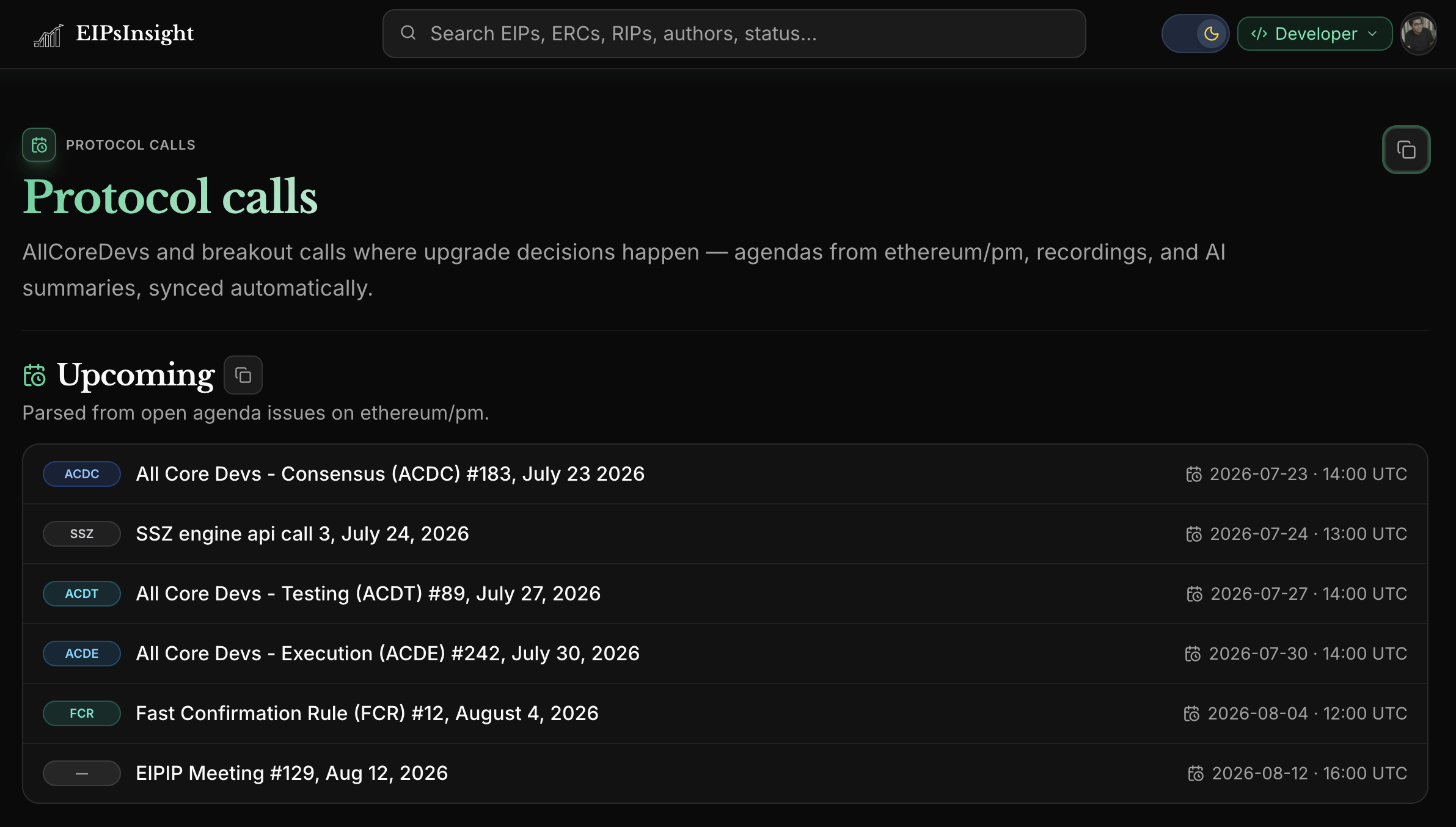
Follow all Ethereum protocol calls and updates here.
EIP-8363, EIP-8333 & EIP-8379 Leave Hegotá
EIP-8363, EIP-8333 and EIP-8379 moved out of Hegotá's active scope, while EIP-8383 and EIP-8025 remain unresolved.
The most consequential removal is EIP-8363, Tapered Issuance Burn. The proposal would progressively reduce the amount of protocol issuance validators ultimately retain as Ethereum's staking ratio increases. EtherWorld previously examined the economic arguments in Ethereum's Issuance Debate: Could Staking Rewards Fall to Zero?.
ACDC #184 treated EIP-8363 as a proposal for evaluation rather than an accepted upgrade component. ACDC #187 then moved the discussion toward a broader community process rather than forcing an inclusion decision through the normal fork-scoping timeline.
The Protocol Cluster subsequently gave the proposal DFI treatment in its Hegotá EIP rankings, arguing that issuance policy affects validators, ETH holders and Ethereum's long-term economic model too broadly to be resolved solely through one upgrade-selection process.
The recent EF Protocol AMA reinforced the same distinction: EIP-8363 may be out of Hegotá, but the issuance debate itself can continue through wider ecosystem discussion.
EIP-8333 left for a different reason. Its authors withdrew the proposal after reconsidering it against Ethereum's longer-term decoupled-consensus and 3SF direction.
EIP-8333 sought to align checkpoints with epoch-boundary blocks. But if Ethereum moves toward slot-based checkpointing, implementing EIP-8333 could force Consensus Layer clients to modify checkpoint-state handling and fork-choice behavior only for those mechanisms to be redesigned again.
EIP-8379, Top-up Sync, also moved to DFI after receiving limited client support. However, its Engine API concepts can still be explored experimentally outside the fork.
Two proposals remain open.
- EIP-8383, which would reduce the Consensus Layer block-retention window, was deferred so client teams can review it before the next ACDC.
- No inclusion decision was made on EIP-8025, optional execution proofs, after concerns around gas repricing and zkVM committee selection.
The broader implication is that Hegotá is no longer simply collecting possible features. Developers are asking which changes deserve scarce implementation and testing capacity now, which need more evidence and which make more sense outside this fork entirely.
Ethereum Explores a Faster Hard-Fork Pipeline
Ethereum did not adopt a faster hard-fork schedule during ACDC #188, but developers opened a concrete discussion about the bottlenecks preventing upgrades from shipping more frequently.
Nethermind raised an ambitious long-term target: potentially reaching at least four hard forks of roughly the current size per year. The proposal was motivated partly by implementation progress. Nethermind said it had already prototyped the CFI'd Hegotá EIPs across roughly 120 pull requests and could begin broader Hegotá testing while Glamsterdam was still moving through deployment.
Fork delivery also depends on specification maturity, cross-client interoperability, security analysis, DevOps, test infrastructure and coordination across teams. The discussion therefore focused on identifying those bottlenecks before attempting to shorten the upgrade cycle.
Potential areas for automation included generating testing drafts, producing draft fixes, creating per-EIP devnets, detecting specification gaps and assisting with security-audit drafts.
Ethereum is already experimenting with more parallel upgrade planning. Glamsterdam and Hegotá have overlapped for months, with Hegotá selection beginning while Glamsterdam was still progressing through devnets. EtherWorld tracked that transition as ACDC #183 began defining Hegotá while Glamsterdam approached Devnet 8.
Longer-term designs such as 3SF are already influencing which intermediate changes developers consider worthwhile. Earlier roadmap discussions around Hegotá's Consensus Layer direction, including FOCIL's selection as a major upgrade priority, demonstrate why future architecture increasingly affects present fork decisions.
If you find any issues in this blog or notice any missing information, please feel free to reach out at yash@etherworld.co for clarifications or updates.
To promote your Web3 articles, events, and projects, you may reach out anytime via EtherWorld PR for submissions and collaboration.
Related Articles
- Ethereum Protocol Update: ACDE #245
- Ethereum Protocol Update: ACDC #187
- State of Upgrade: Hegotá Edition #1
- All You Need to Know About Ethereum Hegotá Upgrade
- Hegotá Should Complete the Holy Trinity of Censorship Resistance
To follow blockchain news, track Ethereum protocol progress, and read our latest stories, subscribe to our weekly today.
Join the EtherWorld & Avarch Internship Program and build your career in blockchain, content, social media, video, podcast editing, or operations. Send your resume and brief introduction to contact@etherworld.co.
Disclaimer: The information contained in this website is for general informational purposes only. The content provided on this website, including articles, blog posts, opinions, & analysis related to blockchain technology & cryptocurrencies, is not intended as financial or investment advice. The website & its content should not be relied upon for making financial decisions. Read full disclaimer & privacy policy.
To stay updated on blockchain news, Ethereum protocol progress, and our latest stories, subscribe to our weekly digest and YouTube channel for ELI5 content.
To promote your Web3 articles, events, project updates, and Press Releases, reach out anytime via EtherWorld PR for submissions and collaboration. For other queries, email contact@etherworld.co.
If you’d like to support our work, share the content and consider donating at avarch.eth.
Join our community on Discord and follow us on Twitter, Facebook, LinkedIn & Instagram.

 ×
×

Author

Yash Kamal Chaturvedi is a Blockchain Content & Ops Specialist at Avarch LLC, writing on Ethereum & governance since 2021. Covers ACD/ACDE calls, EIPs, upgrades, staking, security & ecosystem trends.