7 Things EF Protocol’s AMA Revealed About Ethereum’s Future
EF Protocol’s latest AMA reveals Ethereum’s thinking on staking, EIP-8363, Hegotá, post-quantum accounts, validator decentralization, client funding & protocol governance.

On September 16, members of the Ethereum Foundation’s Protocol Cluster returned to Reddit for their 15th AMA, answering questions around staking economics, Hegotá, post-quantum security, validator decentralization, client funding and how major protocol decisions should actually be made.
The discussion arrived just days after the Ethereum Foundation published its unified assessment of 62 EIPs proposed for Hegotá, placing FOCIL and Frame Transactions at the top while declining several other proposals from the immediate fork scope.
Ethereum’s Staking Model Is Being Questioned
One of the AMA’s strongest exchanges started with a simple question: does Ethereum have a problem if the percentage of ETH being staked keeps rising?
Ethereum Foundation researcher Justin Drake stressed that he was sharing his personal view rather than an official EF Protocol position, but described the current staking incentives as problematic and unsustainable. His concern is that Ethereum continues issuing ETH to validators at every staking ratio, creating persistent incentives for ETH to move into staking.
Drake cited roughly 43.2 million ETH already staked and net staking inflows of around 20,000 ETH per day. The problem, in his view, extends beyond issuance.
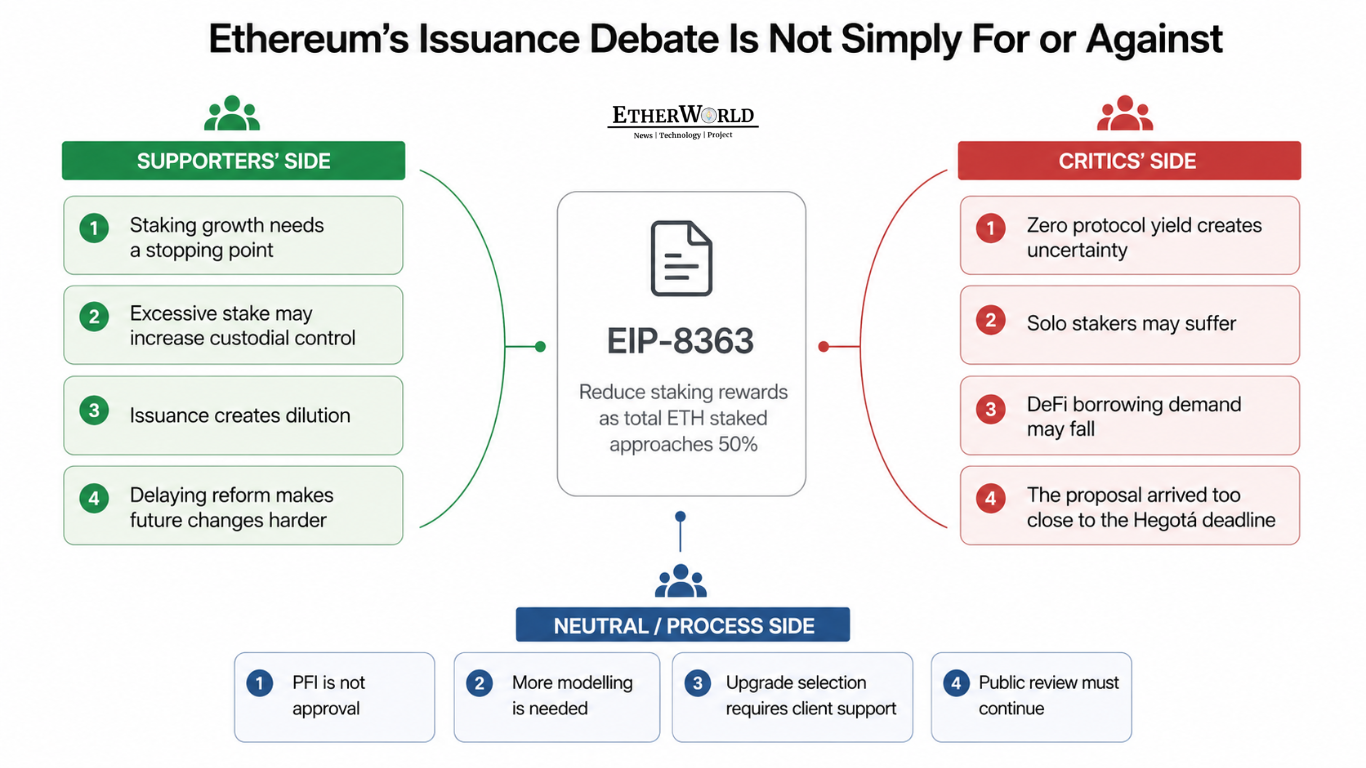
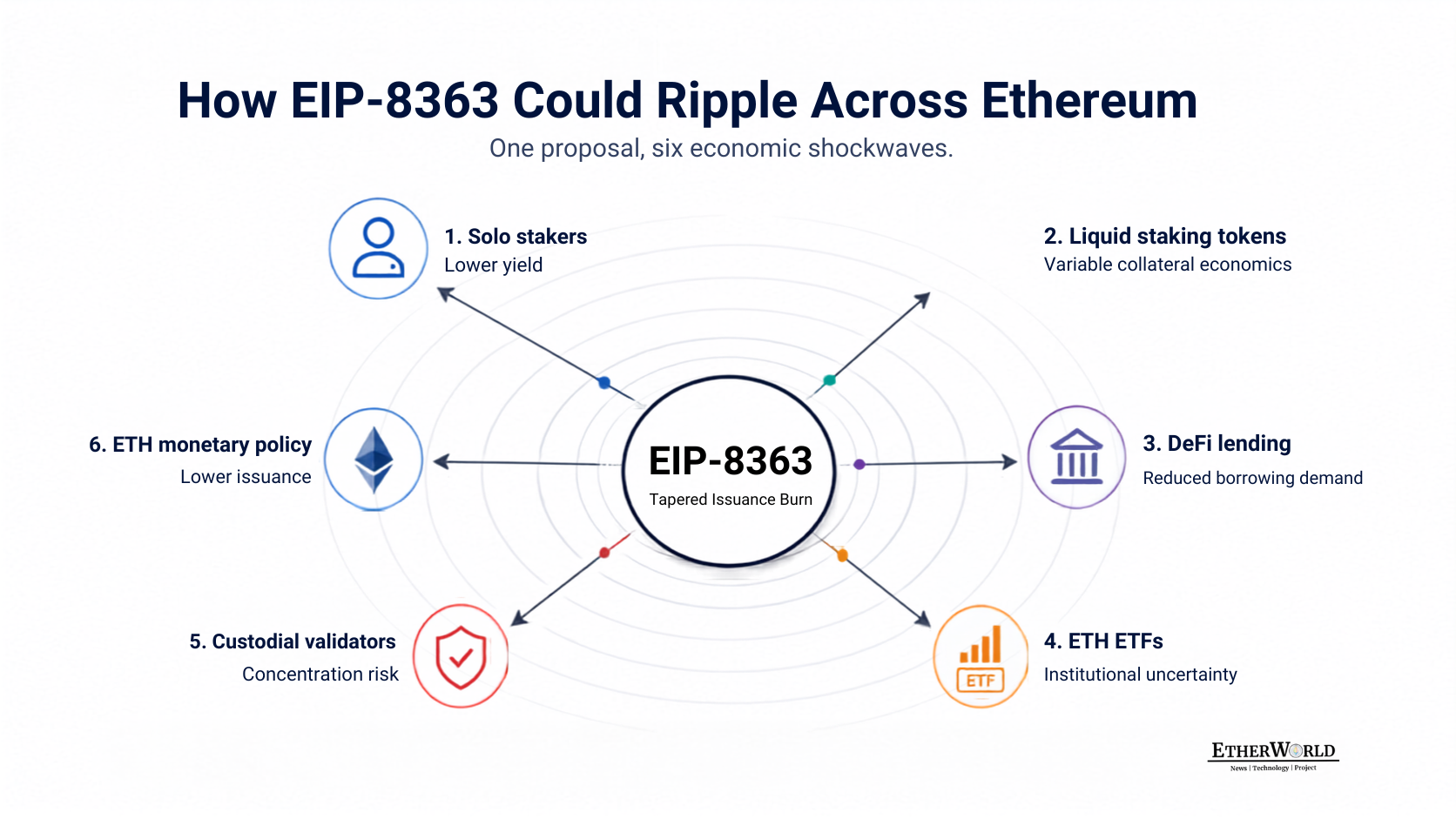
Higher staking ratios can increase dilution pressure on non-stakers, funnel users toward liquid staking providers, strengthen special-interest groups built around staking revenue and reduce the optionality of simply holding ETH without staking it. These concerns overlap with EtherWorld’s earlier look at Ethereum’s issuance debate, where EIP-8363 proposed gradually reducing net protocol-issued staking rewards as the staking ratio rises.
EIP-8363 Is Out of Hegotá, Not the Debate
EIP-8363, Tapered Issuance Burn, became one of the most controversial proposals submitted during the Hegotá proposal window. The proposal would gradually reduce the amount validators ultimately retain from consensus issuance as more ETH becomes staked.
EF Protocol later gave EIP-8363 a Declined for Inclusion classification for Hegotá. Importantly, that decision was presented as a question of process rather than a rejection of the proposal’s economic arguments. A Reddit user therefore asked an obvious follow-up: if the Hegotá process is not the right place to decide issuance policy, who actually convenes the wider process?
Alex Stokes argued that no single party should control such a decision. Researchers, client teams, staking operators and other ecosystem participants should debate issuance through venues including Ethresearch, Ethereum Magicians and core developer calls.
He also rejected the idea that the discussion must start again from EIP-8363. Ethereum’s issuance debate predates the proposal, and EIP-8363 is only one possible design.
Hegotá Starts Ethereum’s Post-Quantum Account Migration
The AMA also clarified why EIP-8141 Frame Transactions has become so important. Frame Transactions were recently confirmed as Hegotá’s execution-layer headliner, alongside FOCIL on the Consensus Layer.
Frames make account validation programmable at the protocol level. Instead of permanently tying Ethereum accounts to one signature scheme, accounts could eventually adopt newer authentication systems.
Thomas Coratger described the key benefit as cryptographic agility. That matters because Ethereum cannot know with certainty which post-quantum signature scheme will ultimately prove best.
Rather than hardcoding one answer now, Frames could create an account architecture where authentication methods can evolve. This also explains why post-quantum research is beginning to shape upgrades years before a full migration.
EtherWorld has been tracking that transition through the broader Hegotá upgrade roadmap and Ethereum’s emerging Lean Ethereum vision.
Frames Alone Cannot Replace secp256k1
During the AMA, Coratger highlighted EIP-8298 and EIP-8151 as additional pieces needed to give existing accounts a practical migration path. Nicolas Consigny similarly explained that combining these mechanisms with Frames could eventually allow an EOA to move into a new account structure where the old private key no longer controls it.
Post-quantum signatures also introduce an efficiency problem because some alternatives can be significantly more expensive than today’s ECDSA signatures. That means the roadmap needs more than new account logic.
Ethereum also needs ways to make future cryptographic operations efficient enough for ordinary users. Frames may still bring immediate benefits before the full post-quantum transition.
As EtherWorld recently explored, the design could also support stablecoin gas payments, batching and improved wallet recovery. The bigger point is that Ethereum’s post-quantum migration will likely be a sequence of upgrades rather than one dramatic hard fork.
Validator Decentralization Still Competes for Roadmap Space
Another AMA exchange focused on EIP-7716, which proposes stronger penalties for correlated missed attestations. A community member challenged EF Protocol’s initial description of the proposal and argued that preventing validator concentration should remain a priority.
Ethereum Foundation researcher Jihoon Song acknowledged that there had been internal miscommunication around the wording, and the description was modified. Song still argued that EIP-7716 needs more research around its impact on staking concentration, multi-client setups and other edge cases.
His conclusion was that it may be a good idea without necessarily being a high priority for Hegotá. Hegotá already has FOCIL as its Consensus Layer headliner, and developers are deliberately limiting additional consensus-layer complexity.
FOCIL itself is closely tied to validator decentralization. EtherWorld previously explored how solo stakers and FOCIL can strengthen censorship resistance and why Hegotá could complete a broader censorship-resistance architecture.
Ethereum Has a Client Funding Problem to Solve
Ethereum’s multi-client architecture is one of its major decentralization advantages. Different execution and consensus clients reduce dependence on a single implementation and help protect Ethereum against software failures.
EtherWorld has previously explained why this matters in its overview of Ethereum client diversity. But Will Corcoran pointed to an unresolved tension: how do client teams receive sustainable funding while remaining credibly independent?
A centralized funding source may provide predictability, but the organization controlling that funding can also gain influence over teams that are supposed to remain neutral. Corcoran said several client teams are experiencing genuine pressure and that EF Protocol is actively working with them.
Ethereum has explored alternative public-goods models as well. One example covered by EtherWorld is Validator Redirected Revenue, which examines whether validator revenue could contribute to ecosystem funding. The AMA made clear that maintaining client diversity is not only a technical problem.
EF Protocol Wants Its Roadmap Process to Be Clearer
Finally, the AMA raised a deceptively simple question: who actually makes up EF Protocol? A participant asked for an updated organizational chart for the Protocol Cluster.
Justin Drake said he maintains a minimal internal version and would discuss whether something clearer could be published. Will Corcoran added that a new protocol.ethereum.foundation website is coming.
Ethereum intentionally does not have a central protocol authority. Upgrade decisions pass through EIP authors, researchers, client teams, core developer calls and wider ecosystem discussions.
That decentralization is valuable, but it can also make the roadmap difficult to follow from the outside. The recent Hegotá ranking exercise offers one example of how this coordination works.
Roughly 60 researchers and engineers across multiple Protocol teams participated in evaluating the proposed EIPs before FOCIL and Frames emerged as the highest-priority features. The AMA suggests that EF Protocol increasingly recognizes the need to make not only the roadmap public, but also the process and people behind it easier to understand.
Ethereum’s next era will involve more than choosing EIPs. Staking economics, quantum-resistant accounts, validator concentration, censorship resistance, client sustainability and protocol governance are beginning to overlap.
To promote your Web3 articles, events, and projects, you may reach out anytime via EtherWorld PR for submissions and collaboration.
Related Articles
- Ethereum’s Issuance Debate: Could Staking Rewards Fall to Zero?
- Ethereum Foundation Ranks 62 EIPs for Hegotá
- Ethereum Protocol Update: ACDE #244
- Vitalik Buterin Outlines Ethereum's Lean Vision
- Ethereum’s Funding Debate Raises Bigger Questions for Protocol Sustainability
To follow blockchain news, track Ethereum protocol progress, and read our latest stories, subscribe to our weekly today.
Join the EtherWorld & Avarch Internship Program and build your career in blockchain, content, social media, video, podcast editing, or operations. Send your resume and brief introduction to contact@etherworld.co.
Disclaimer: The information contained in this website is for general informational purposes only. The content provided on this website, including articles, blog posts, opinions, & analysis related to blockchain technology & cryptocurrencies, is not intended as financial or investment advice. The website & its content should not be relied upon for making financial decisions. Read full disclaimer & privacy policy.
To stay updated on blockchain news, Ethereum protocol progress, and our latest stories, subscribe to our weekly digest and YouTube channel for ELI5 content.
To promote your Web3 articles, events, project updates, and Press Releases, reach out anytime via EtherWorld PR for submissions and collaboration. For other queries, email contact@etherworld.co.
If you’d like to support our work, share the content and consider donating at avarch.eth.
Join our community on Discord and follow us on Twitter, Facebook, LinkedIn & Instagram.

 ×
×

Author

Yash Kamal Chaturvedi is a Blockchain Content & Ops Specialist at Avarch LLC, writing on Ethereum & governance since 2021. Covers ACD/ACDE calls, EIPs, upgrades, staking, security & ecosystem trends.