Ethereum Protocol Update: ACDE #247
ACDE #247 confirms Glamsterdam's Hoodi fork date, advances eight Hegotá EIPs, & debates post-quantum readiness & AI-driven development.
Ethereum developers confirmed October 26 as the target for Glamsterdam's Hoodi activation, advanced eight additional EIPs for Hegotá, and declined three others during All Core Developers Execution Call #247 on October 8, 2026.
The meeting also exposed a growing tension in Ethereum's upgrade process. While AI-assisted implementation and automated assessments could make protocol development faster, the expanding Hegotá scope continues to raise questions about testing capacity, security, and coordination.
Glamsterdam Hoodi Fork Scheduled for October 26
Ethereum developers agreed to schedule Glamsterdam's Hoodi activation for October 26 at 17:42 UTC, following the upgrade's successful Sepolia deployment on October 6. Client teams will target October 16 for compatible releases, leaving approximately ten days for network operators to upgrade.
The decision moves Hoodi one day ahead of the previously tentative October 27 date discussed during ACDC #187. Developers preferred the earlier activation because many client teams will be traveling to Mumbai ahead of Devcon.
However, the release timeline generated concerns. Unlike Sepolia, Hoodi includes a broader set of staking operators and infrastructure participants. Some developers argued that ten days might be insufficient, particularly if clients require last-minute patches.
The discussion recalled Sepolia's preparation, where several client teams published updated releases shortly before activation. Developers questioned whether repeating that process on Hoodi would introduce unnecessary operational risk.
Despite these concerns, the October 26 target remained in place. The successful Sepolia transition provided confidence. Developers described the activation as largely uneventful, with the testnet's gas limit subsequently reaching 200 million.
This follows the decision in ACDE #246 to test a substantially higher gas limit alongside Glamsterdam. The activation also brings EIP-7732, enshrined proposer-builder separation, into a public-testnet environment.
However, builder participation remains limited. Developers reported approximately five active builders before one exited, while many blocks continued to be built locally. This leaves important questions about how the new builder market will behave under broader participation.
The gas-limit change was confirmed to take effect at the fork epoch for Hoodi and mainnet. A separate mainnet shadow-fork experiment successfully passed through the Glamsterdam transition, although its gas-limit configuration behaved unexpectedly. Developers plan to repeat the benchmarking experiment.
Eight More EIPs Advance for Hegotá as Three Are Declined
Ethereum developers moved eight additional execution-layer proposals to Considered for Inclusion (CFI) and declined three others for Hegotá. The decisions further narrow the upgrade's remaining proposal set, although CFI does not guarantee eventual deployment.
The proposals advancing to CFI were:
- EIP-5920: PAY opcode
- EIP-8151: ecRecover improvements
- EIP-8298: SETCODEFROM
- EIP-8360: TCREATE opcode
- EIP-4758: Deactivate SELFDESTRUCT
- EIP-7709: Read BLOCKHASH from storage
- EIP-8077: Transaction propagation improvements
- EIP-8116: Replace cumulative receipt fields
Among these, EIP-8151 and EIP-8298 received particular attention because developers consider them complementary components of Ethereum's potential post-quantum account migration path. Supporters argued that existing externally owned accounts need a way to transition toward new authentication mechanisms without losing control of their funds and positions.
Although some clients assigned lower priority to SETCODEFROM, they did not oppose advancing the paired proposals. Developers also agreed to advance EIP-8360 and EIP-4758 together. TCREATE offers transaction-scoped contract creation, while deactivating SELFDESTRUCT would remove legacy behavior that developers have been working to phase out.
EIP-7709 advanced after developers highlighted its potential benefits for light clients using Block-Level Access Lists. The proposal could reduce the need to retrieve historical block headers separately.
EIP-8077 initially faced possible rejection because client support was mixed. Its champion argued that increased execution capacity also requires more efficient transaction propagation, particularly for nodes that fall behind.
Additional client feedback moved it to CFI, although developers requested further work on transaction filtering and fee-related considerations. EIP-8116 advanced with relatively low priority because its principal benefits involve reducing technical debt and network overhead.
Three proposals were declined:
- EIP-7666: EVM-ify the identity precompile
- EIP-8355: ML-DSA verification precompiles
- EIP-8374: Persist warm access sets across reverts
EIP-7666 initially appeared likely to advance, but objections concerning gas costs, compatibility, and limited practical benefits resulted in DFI. EIP-8374 also lacked sufficient support, with developers questioning whether the change justified its implementation complexity.
The decisions continue the selection process established in ACDE #245, when EIP-8141, Frame Transactions, became Hegotá's execution-layer headliner.
The next scoping call is expected to revisit EIP-7907, which proposes metering related to contract size. With the candidate set already substantial, developers will increasingly need to prioritize implementation and testing rather than simply advancing every proposal with reasonable support.
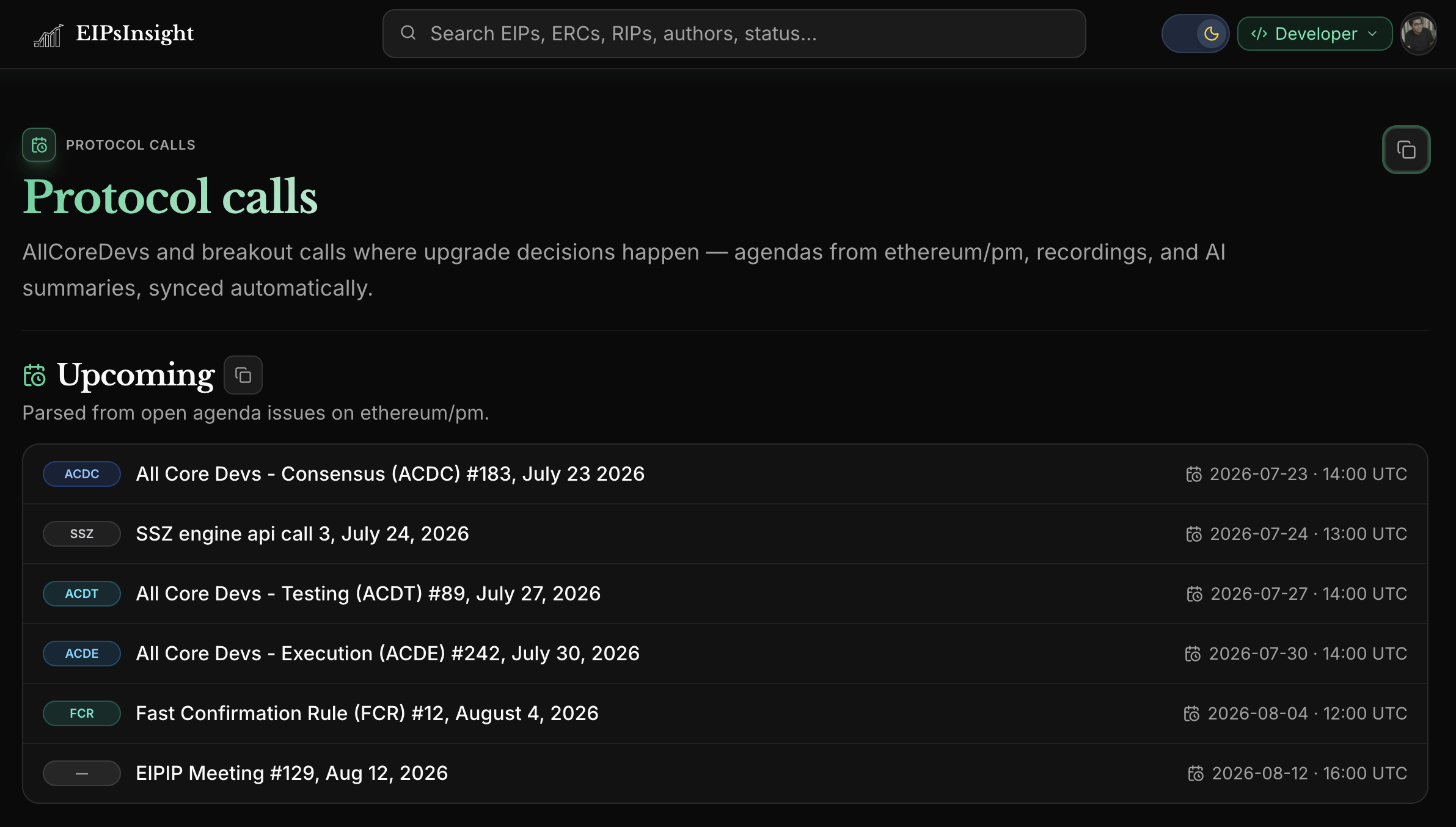
Follow all Ethereum protocol calls and updates here.
ML-DSA Precompiles Rejected as Post-Quantum Debate Continues
Ethereum developers declined EIP-8355 for Hegotá after failing to reach agreement on introducing precompiles for ML-DSA signature verification. The disagreement was not about whether Ethereum should prepare for quantum computing.
Instead, developers questioned which cryptographic approaches deserve protocol-level support and when they should be introduced. Supporters argued that Ethereum needs cryptographic agility rather than reliance on a single post-quantum signature family.
They highlighted the high cost of performing ML-DSA verification directly in EVM bytecode, estimated during the call at approximately one million gas after optimization. That exceeds validation limits used by major account abstraction approaches, potentially restricting practical adoption without a dedicated precompile.
One suggested compromise was to standardize the proposed precompile interface and reserve addresses without immediately activating it on Ethereum mainnet. This could allow Layer 2 networks to experiment with the implementation while preserving a potential future adoption path.
However, other developers opposed introducing lattice-based cryptographic assumptions at this stage. Researchers pointed to ongoing work on hash-based signature schemes, including experiments with aggregation, as a potentially more scalable alternative.
Concerns also included the proposed precompile's long-term gas costs, compatibility with future zkEVM architectures, and whether supporting several ML-DSA variants was necessary. Ultimately, developers found insufficient consensus to advance EIP-8355.
This decision contrasts with the advancement of EIP-8151 and EIP-8298, which developers viewed as useful for enabling future account migration without immediately committing Ethereum to a particular post-quantum signature scheme.
Developers Back AI-Assisted Workflows Without Committing to Faster Forks
Ethereum developers expressed support for exploring AI-assisted specification reviews, implementations, and testing workflows, but did not agree to a fixed acceleration target for future hard forks. The discussion followed a presentation of an AI-assisted EIP complexity-assessment framework designed to estimate execution-layer implementation and testing effort.
The framework examines criteria including new opcodes, gas-accounting changes, cross-EIP dependencies, security considerations, and implementation complexity. Historical assessments were used to compare proposed fork complexity with development timelines.
However, developers cautioned that such scores cannot reliably predict delivery dates. Much of the actual work comes from unexpected edge cases, incomplete specifications, and interactions between proposals.
Instead, the presentation suggested that AI tooling could provide greater immediate value by identifying inconsistent specifications and flagging dependencies when one EIP changes. For example, modifications to Frame Transactions could trigger automated checks against dependent proposals, reducing the risk of different specifications becoming incompatible.
Lukasz Rozmej argued that improvements in tooling could eventually allow Ethereum to develop more upgrades in parallel. Nethermind reported approximately 150 Hegotá-related pull requests, many already merged, illustrating how quickly some implementation work can progress.
However, other developers questioned whether faster implementation automatically justifies more frequent forks. One idea discussed was moving toward four hard forks annually, but participants warned against treating an arbitrary schedule as a target.
Testing, security reviews, coordination, and decision-making remain significant constraints, even when AI reduces the time required to produce initial implementations. Developers also emphasized the importance of preserving independent client review and human responsibility for protocol decisions.
For Glamsterdam, the next milestone is Hoodi's October 26 activation. For Hegotá, the challenge is deciding how much additional functionality can be implemented and tested safely alongside its existing headliners.
If you find any issues in this blog or notice any missing information, please feel free to reach out at yash@etherworld.co for clarifications or updates.
If you find any issues in this blog or notice any missing information, please feel free to reach out at yash@etherworld.co for clarifications or updates.
To promote your Web3 articles, events, and projects, you may reach out anytime via EtherWorld PR for submissions and collaboration.
Related Articles
- Ethereum Protocol Update: ACDE #245
- Ethereum Protocol Update: ACDC #187
- State of Upgrade: Hegotá Edition #1
- All You Need to Know About Ethereum Hegotá Upgrade
- Hegotá Should Complete the Holy Trinity of Censorship Resistance
To follow blockchain news, track Ethereum protocol progress, and read our latest stories, subscribe to our weekly today.
Join the EtherWorld & Avarch Internship Program and build your career in blockchain, content, social media, video, podcast editing, or operations. Send your resume and brief introduction to contact@etherworld.co.
Disclaimer: The information contained in this website is for general informational purposes only. The content provided on this website, including articles, blog posts, opinions, & analysis related to blockchain technology & cryptocurrencies, is not intended as financial or investment advice. The website & its content should not be relied upon for making financial decisions. Read full disclaimer & privacy policy.
To stay updated on blockchain news, Ethereum protocol progress, and our latest stories, subscribe to our weekly digest and YouTube channel for ELI5 content.
To promote your Web3 articles, events, project updates, and Press Releases, reach out anytime via EtherWorld PR for submissions and collaboration. For other queries, email contact@etherworld.co.
If you’d like to support our work, share the content and consider donating at avarch.eth.
Join our community on Discord and follow us on Twitter, Facebook, LinkedIn & Instagram.

 ×
×

Author

Yash Kamal Chaturvedi is a Blockchain Content & Ops Specialist at Avarch LLC, writing on Ethereum & governance since 2021. Covers ACD/ACDE calls, EIPs, upgrades, staking, security & ecosystem trends.