Ethereum Protocol Update: ACDC #185
Ethereum targets September for Glamsterdam’s Sepolia fork as developers plan more testing, drop EIP-7610 & begin ranking Hegotá proposals.
Ethereum developers are preparing to move the Glamsterdam upgrade toward established public testnets, with September 28 proposed for Sepolia and October 26 proposed for Hoodi. However, these dates remain provisional after Platåberget Devnet 8 exposed client issues during the fork transition.
During All Core Developers Consensus Call #185 on August 20, developers agreed that additional devnet testing is needed before confirming the rollout. The call also resulted in the removal of EIP-7610 from Glamsterdam and established a clearer process for ranking Hegotá proposals.
Glamsterdam Needs Another Testing Round
Ethereum developers will conduct additional testing before approving Glamsterdam’s public-testnet rollout. The next step could include a smaller, longer-running devnet for ecosystem integrations and a separate large-scale network designed to operate without finality.
This decision followed an unstable Platåberget Devnet 8 fork that exposed how different clients handled a queue of approximately 16,000 builder deposits. Platåberget had operated normally until the Glamsterdam changes activated, after which Lighthouse, Prysm and Teku experienced different processing problems.
The network temporarily stopped finalising because affected clients struggled to process the first post-fork slot. Other clients completed the transition successfully, and finality eventually returned after developers investigated the failures.
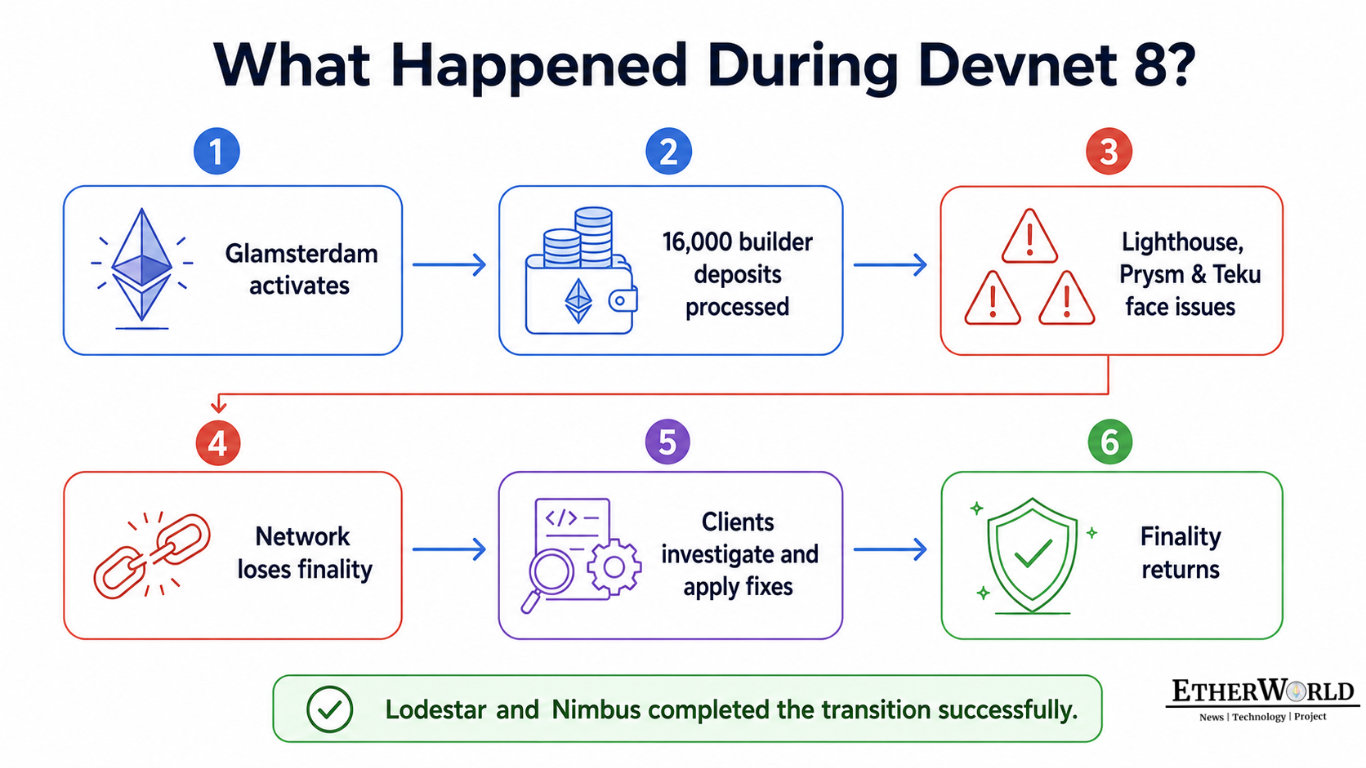
Lighthouse had implemented builder-deposit caching, but the relevant update was merged shortly before the fork. Deposits received before the new logic became active were not properly cached, slowing the transition. Prysm’s testing branch did not contain the expected cache, while Teku encountered a slow data-availability check that delayed subsequent block processing.
Lodestar and Nimbus reported much stronger performance. A Lodestar optimisation reduced processing time from around 20 seconds to approximately 500 milliseconds, while Nimbus completed the transition without a significant issue.
EtherWorld’s earlier overview of the Platåberget testnet explained that the network was created to expand testing beyond basic client interoperability. Its purpose is to give validators, builders, wallets, dApps and infrastructure providers an opportunity to test Glamsterdam before it reaches long-lived networks.
That broader participation is now shaping the next testing phase. Lido asked for enough time to deploy its oracles, seed validators and test operational tooling before another fork. Optimism also expressed interest in testing its infrastructure on a suitable network.
Developers are therefore considering two different environments. A smaller network could remain active long enough for applications and infrastructure teams to test the normal upgrade path. A separate non-finality devnet, potentially involving around 1,000 nodes, would test how Ethereum behaves when finality is deliberately withheld.
Operating such a large network for a week would be expensive, so the non-finality test may run for only one or two days. Client teams must also move Glamsterdam changes from temporary development branches into the code they expect to ship publicly.
Sepolia Could Fork on September 28
Ethereum developers proposed September 28, 2026, for Glamsterdam’s Sepolia activation, followed by Hoodi on October 26. Neither date is final, and both will depend on the outcome of the next testing round.
The proposed Sepolia activation is scheduled for epoch 351232 at slot 11239424. Developers selected Sepolia as the likely first public testnet because Glamsterdam contains gas-cost repricings that could affect smart contracts, wallets and application infrastructure.
Sepolia is widely used by dApp developers, making it a useful environment for identifying incorrect gas assumptions and contract-compatibility problems. Activating Glamsterdam there first would give the application ecosystem time to adjust before the upgrade reaches a more validator-focused testnet.
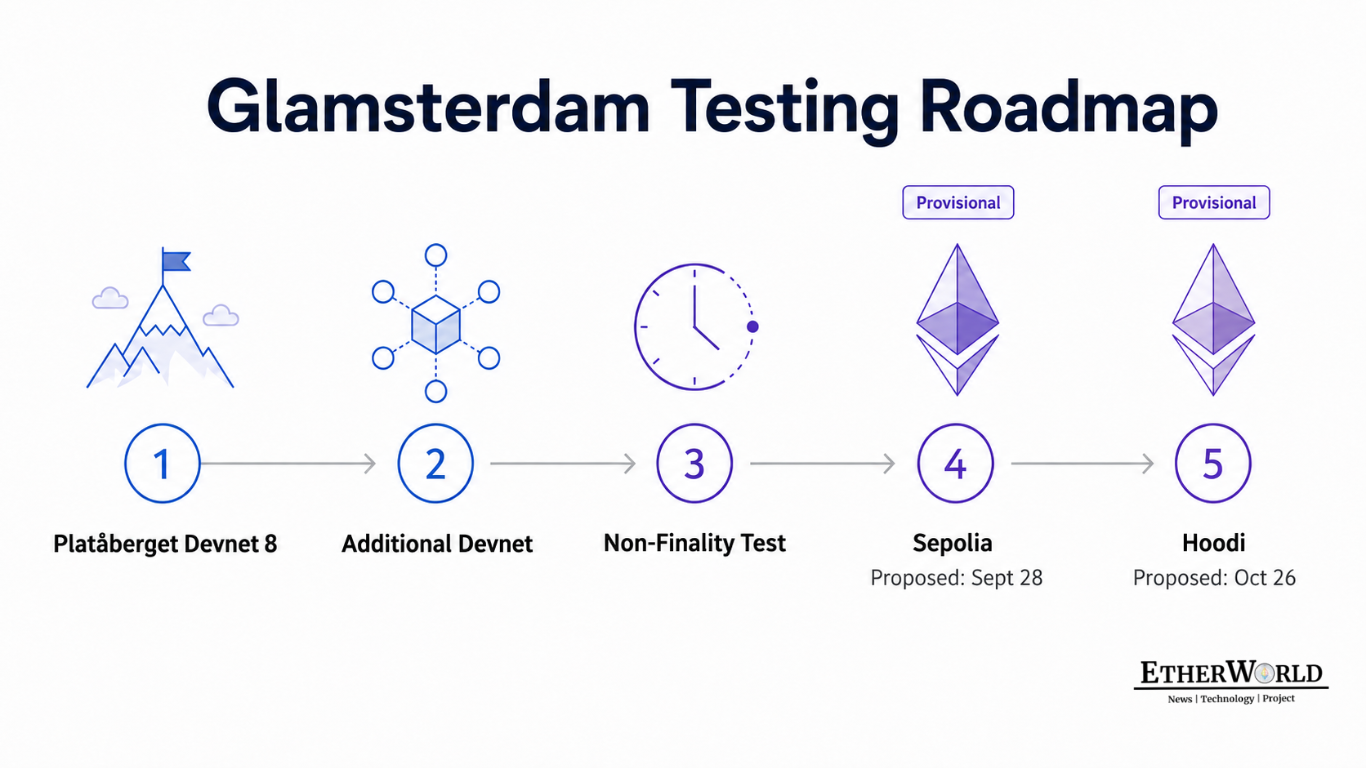
Hoodi would follow at epoch 132352, slot 4235264, under the proposed October 26 schedule. Hoodi provides a more mainnet-like environment for staking providers, validators and protocol infrastructure. EtherWorld previously covered Ethereum’s Hoodi launch and its role in replacing Holesky for large-scale validator testing.
The gap between Sepolia and Hoodi would give developers approximately one month to monitor the first activation, investigate failures and prepare updated client releases. This staged strategy resembles the approach used during Fusaka, when Ethereum separated its major testnet forks to create remediation windows between activations.
Some participants requested that both Glamsterdam dates be moved approximately one week later to provide more time for devnet testing. Developers did not approve or reject that suggestion during the call. Instead, they agreed to evaluate client readiness and return to the schedule at a future ACDC meeting.
The first date could be confirmed in approximately two weeks, provided the planned devnets remain stable. Before approval, developers want fixes merged into primary development branches, updated remote-signer support and a successful fork involving ecosystem infrastructure.
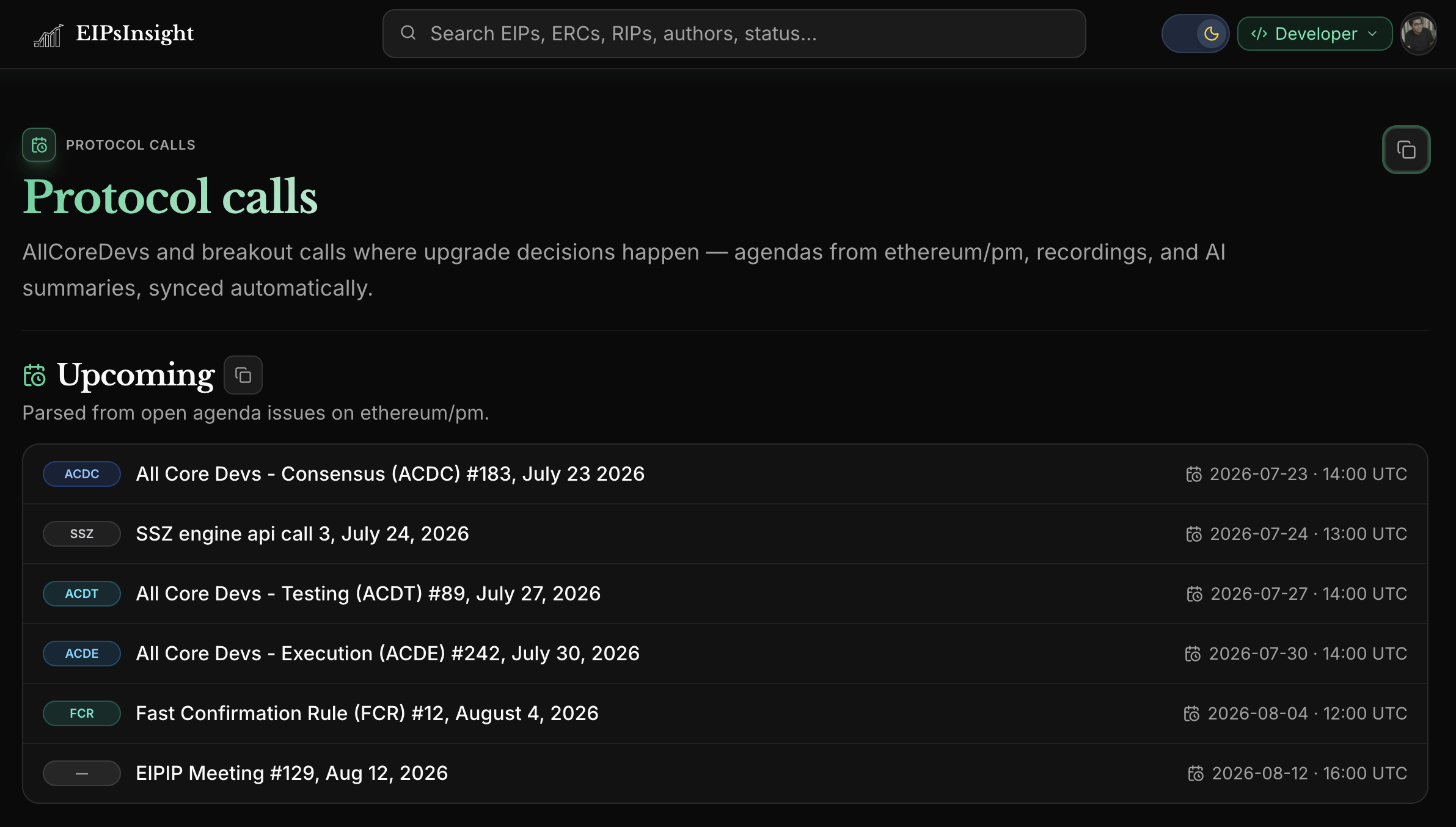
Follow all Ethereum protocol calls and updates here.
EIP-7610 Dropped From Glamsterdam
Ethereum developers agreed to remove EIP-7610 from Glamsterdam and do not currently plan to postpone it to a later upgrade. EIP-7610 would revert contract creation if the destination already contained non-empty storage.
It was designed as a defensive rule for an unusual state condition, but developers concluded that implementing the check would introduce client overhead without delivering enough practical value. The targeted condition should not occur under normal protocol behaviour.
EIP-7610 was excluded from Devnet 6, as covered in EtherWorld’s summary of ACDE #238. Earlier discussions during ACDE #229 also highlighted disagreements over whether its defensive benefits justified the performance implications.
Developers pointed to EIP-8253 as a more direct solution to the underlying issue. Proposed for Hegotá, EIP-8253 would prevent the problematic account state from entering Ethereum’s state tree rather than requiring clients to check for it during contract creation.
The immediate implication is a smaller and clearer Glamsterdam scope. Removing EIP-7610 allows client teams to concentrate on ePBS, block-access lists, gas repricing and the other changes already being tested.
Before the removal becomes official, contributors must advance the Glamsterdam Meta-EIP from Draft to Review and merge the corresponding removal pull request.
Hegotá Ranking Begins Before Devcon
Ethereum client teams are expected to publish their first Hegotá proposal rankings by mid-September, with developers aiming to establish a shared view of the upgrade’s likely scope before Devcon. The initial ranking process will focus on proposals that have either strong support or clear opposition.
Proposals may be organised into priority tiers, while DFI will identify changes that teams recommend declining for inclusion. Teams are also encouraged to explain what their rankings mean because one client’s definition of a top-tier proposal may differ from another’s.
No Hegotá inclusion decisions were made during ACDC #185. Instead, developers completed presentations for proposals that had been submitted before the deadline but were not discussed during the previous call.
EIP-8333 proposes aligning checkpoint roots with the boundary block before a checkpoint epoch. Supporters describe Ethereum’s current calculation as an off-by-one mismatch because it uses the first block of the new epoch.
The change could improve target-vote accuracy when a late block arrives during the first slot. It may also work well with proposals for shorter slot times by relaxing timing pressure around target voting.
A separate proposal would add clearer execution-client sync information to the Engine API. The objective is to let the consensus layer coordinate network recovery more effectively, particularly on unstable or highly forked networks where execution and consensus clients must both locate compatible peers.
These proposals will now move into the ranking phase rather than receiving immediate approval. EtherWorld’s Hegotá upgrade guide provides the broader roadmap, while the Ethereum ACD Monitor tracks changes across the proposal pipeline.
Hegotá could eventually combine validator improvements, faster confirmations, protocol simplification and stronger censorship resistance. EtherWorld has explored this direction through its analysis of FOCIL and encrypted mempools and its deeper look at Ethereum’s encrypted mempool roadmap.
If you find any issues in this blog or notice any missing information, please feel free to reach out at yash@etherworld.co for clarifications or updates.
To promote your Web3 articles, events, and projects, you may reach out anytime via EtherWorld PR for submissions and collaboration.
Related Articles
- Platåberget Testnet Brings Glamsterdam Closer to Mainnet
- Ethereum Protocol Update: ACDC #184
- Ethereum Protocol Update: ACDC #183
- Tracking the Glamsterdam Upgrade on EIPsInsight
- All You Need to Know About Ethereum Hegotá Upgrade
To follow blockchain news, track Ethereum protocol progress, and read our latest stories, subscribe to our weekly today.
Join the EtherWorld & Avarch Internship Program and build your career in blockchain, content, social media, video, podcast editing, or operations. Send your resume and brief introduction to contact@etherworld.co.
Disclaimer: The information contained in this website is for general informational purposes only. The content provided on this website, including articles, blog posts, opinions, & analysis related to blockchain technology & cryptocurrencies, is not intended as financial or investment advice. The website & its content should not be relied upon for making financial decisions. Read full disclaimer & privacy policy.
To stay updated on blockchain news, Ethereum protocol progress, and our latest stories, subscribe to our weekly digest and YouTube channel for ELI5 content.
To promote your Web3 articles, events, project updates, and Press Releases, reach out anytime via EtherWorld PR for submissions and collaboration. For other queries, email contact@etherworld.co.
If you’d like to support our work, share the content and consider donating at avarch.eth.
Join our community on Discord and follow us on Twitter, Facebook, LinkedIn & Instagram.

 ×
×

Author

Yash Kamal Chaturvedi is a Blockchain Content & Ops Specialist at Avarch LLC, writing on Ethereum & governance since 2021. Covers ACD/ACDE calls, EIPs, upgrades, staking, security & ecosystem trends.