Tracking the Glamsterdam Upgrade on EIPsInsight
Learn how to track Ethereum's Glamsterdam upgrade on EIPsInsight with live EIP status updates, proposal timelines, email alerts, & detailed upgrade insights.
Ethereum upgrades are not decided in a single meeting. Each major network upgrade moves through months of proposal discussions, All Core Developers calls, client implementation work, devnets, testing cycles, and final coordination before activation. For anyone trying to follow this process closely, the information can feel scattered across GitHub, Ethereum Magicians, ACD call notes, EIP pages, and community discussions.
This is where EIPsInsight becomes useful. It gives users a dedicated upgrade dashboard where they can track the full progress of Ethereum network upgrades in one place. For the upcoming Glamsterdam upgrade, EIPsInsight provides a structured view of all related Ethereum Improvement Proposals, their current inclusion status, historical movement, and supporting research.
Instead of manually checking every EIP or waiting for summaries after each developer call, users can follow how Glamsterdam is evolving directly from the dashboard. This makes it easier to understand which proposals are gaining momentum, which ones are still being discussed, and which proposals have been removed from the upgrade scope.
Glamsterdam itself has already gone through several important stages. EtherWorld previously covered how the upgrade began taking shape in State of Upgrade – Glamsterdam Edition #1, while later reporting explained how developers continued narrowing the scope in Glamsterdam at Crossroads: What’s In, What’s Out & What’s Still Uncertain. EIPsInsight now brings that same upgrade journey into a visual, trackable format for anyone who wants to follow the process more closely.
- Open the Glamsterdam Dashboard on EIPsInsight
- Understand Glamsterdam EIP Buckets
- Use the Timeline, Search & Email Update Features
- Why EIPsInsight Makes Ethereum Upgrade Tracking Easier
Open the Glamsterdam Dashboard on EIPsInsight
To begin tracking the upgrade, users can visit the dedicated Glamsterdam page on EIPsInsight. The page is designed as a complete upgrade dashboard rather than a simple list of proposals. At the top, users can see the upgrade name, its category as a network upgrade, and the related Meta EIP: EIP-7773.
This is important because Meta EIPs help define the overall structure of an Ethereum upgrade. Instead of treating each proposal separately, the dashboard groups all Glamsterdam-related proposals under one upgrade view. This helps users understand the upgrade as a complete package.
The dashboard also includes an introductory section explaining what Glamsterdam is and why it matters. Glamsterdam combines the names Amsterdam and Gloas, reflecting its focus on both execution layer and consensus layer changes. For readers who want more technical context on how Ethereum developers discuss these changes, EtherWorld’s coverage of Highlights from the All Core Developers Consensus (ACDC) Call #181 is a useful companion piece.
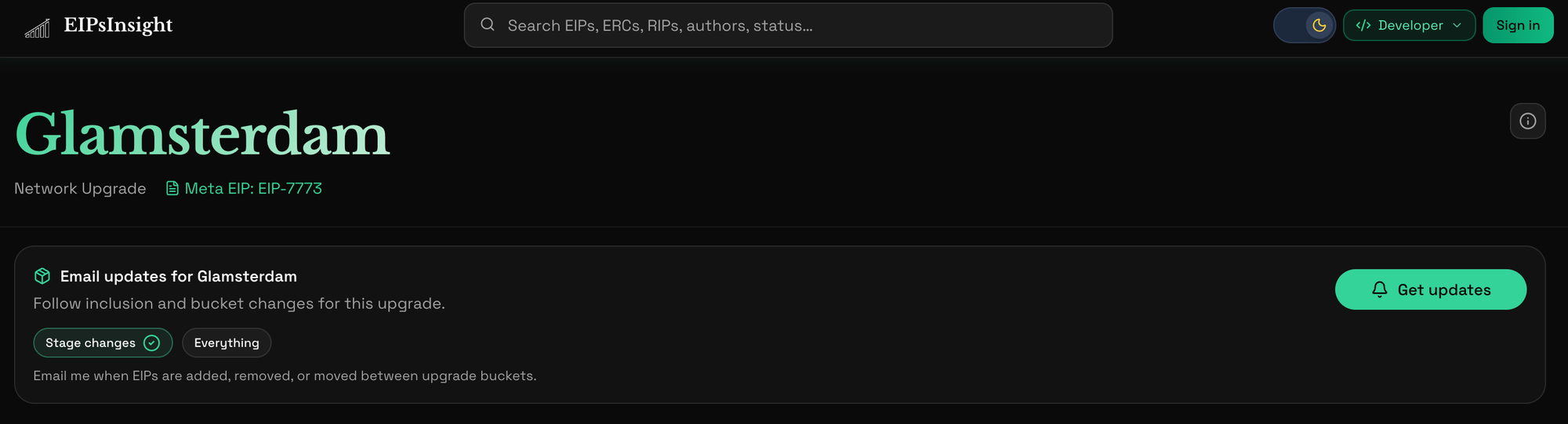
At the top of the dashboard, users will also find a global search bar. This allows them to search EIPs, ERCs, RIPs, authors, and statuses directly. For example, if a user wants to check the latest position of EIP-7732 or EIP-7928, they do not need to scroll manually through every section. They can simply search for the proposal and open its details.
EIPsInsight is especially helpful because Glamsterdam’s scope has changed several times. EtherWorld has already reported on how Glamsterdam Devnet-2 advanced as developers finalized the CFI scope, showing how proposals move from early discussion toward more serious consideration. The dashboard turns this movement into a clear visual workflow.
Understand Glamsterdam EIP Buckets
The most important part of the Glamsterdam dashboard is the proposal bucket system. Instead of showing all EIPs in one long list, EIPsInsight separates them based on their current inclusion stage. This makes it easier to understand where each proposal stands in the Ethereum upgrade process.
The first major category is Proposed For Inclusion (PFI). These are proposals that have been suggested for Glamsterdam but have not yet received strong agreement from core developers. They are early candidates and may still need more discussion, specification work, or implementation review before moving forward.
The next stage is Considered For Inclusion (CFI). Proposals in this category have moved beyond early suggestion and are being seriously evaluated by developers. This usually means client teams, researchers, and contributors are discussing whether the proposal is technically practical, safe, and aligned with the upgrade’s goals. EtherWorld’s Glamsterdam EIP review coverage provides a good example of how this evaluation process works before proposals are promoted or deferred.
After that comes Scheduled For Inclusion (SFI). These are proposals that developers intend to include in the upgrade, assuming testing and implementation continue successfully. EIPsInsight currently shows several Glamsterdam proposals in this category, including proposals related to execution-layer improvements, consensus changes, and protocol cleanup.
EtherWorld has covered similar coordination challenges in Highlights from the All Core Developers Consensus (ACDC) Call #180, where developers reviewed multiple upgrade-related proposals and implementation concerns.
The dashboard also includes Declined For Inclusion (DFI). This section is just as important as the included proposals because it shows what did not make the cut. Some EIPs may be declined because they need more research, create too much complexity, miss the upgrade timeline, or are better suited for a future fork. By keeping declined proposals visible, EIPsInsight helps users understand Ethereum governance as a decision-making process rather than a simple approval pipeline.
This is especially useful for following complex roadmap topics like proposer-builder separation, encrypted mempools, or censorship resistance. For example, EtherWorld’s article on Ethereum Encrypted Mempool: Progress, Challenges & the Road to Hegota shows how some ideas may require multiple upgrade cycles before becoming mature enough for inclusion.
Use the Timeline, Search & Email Update Features
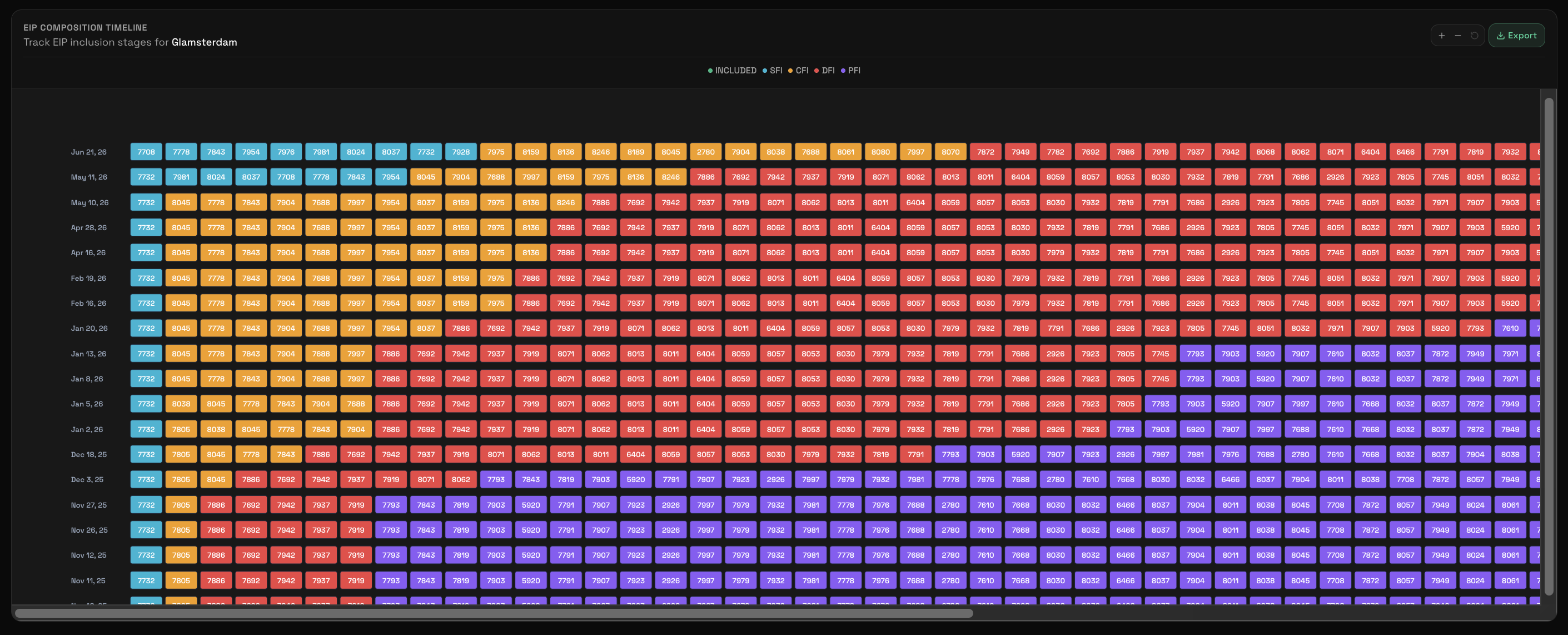
Beyond proposal buckets, EIPsInsight also provides tools that make upgrade monitoring easier over time. The most useful feature is the EIP Composition Timeline, which shows how Glamsterdam’s proposal set changed across different dates.
This timeline helps answer questions like: when did an EIP enter the upgrade discussion, when did it move from CFI to SFI, when was it declined, and how did the overall upgrade scope change after developer meetings? Instead of reading several weeks of meeting notes separately, users can visually track the movement of proposals across the upgrade lifecycle.
This feature is particularly useful because Ethereum upgrade planning often changes gradually. A proposal may begin as an early candidate, move into serious consideration, get scheduled for inclusion, and then still face delays if testing reveals issues. In some cases, proposals may be pushed to a later upgrade. EtherWorld’s analysis of Hegota Should Complete the Holy Trinity of Censorship Resistance shows how long-term Ethereum roadmap ideas can continue evolving beyond one upgrade cycle.
The dashboard also includes an Email Updates option.
The notification system becomes even more valuable when combined with EtherWorld’s ongoing upgrade reporting. For example, readers tracking protocol safety improvements can pair EIPsInsight alerts with articles like Ethereum Introduces Clear Signing for Safer Crypto Transactions. Similarly, readers interested in validator economics and future governance models can use the dashboard alongside EtherWorld’s explainer on Validator Redirected Revenue.
EIPsInsight also provides a Related Articles section at the bottom of the page. This connects dashboard users with deeper EtherWorld coverage about Glamsterdam, Ethereum upgrades, and proposal analysis. Instead of only seeing that a proposal moved, readers can understand why developers discussed it, what trade-offs were raised, and how it fits into Ethereum’s broader roadmap.
For users who want to follow the full EIPsInsight content archive, EtherWorld’s EIPsInsight tag page collects related explainers, updates, and tracking resources in one place.
Why EIPsInsight Makes Ethereum Upgrade Tracking Easier
Ethereum’s governance process is open, but openness does not always mean simplicity. Information is spread across many platforms, and each source serves a different purpose. GitHub is useful for technical specification changes, Ethereum Magicians is useful for community discussion, All Core Developers calls are useful for coordination, and EIP pages are useful for proposal status. But for a reader who simply wants to know what is happening with an upgrade, this can be difficult to follow.
EIPsInsight solves this by turning the upgrade process into a structured dashboard. Users can see the current Glamsterdam proposal set, compare proposal stages, follow historical movement, and jump into related research without needing to collect information manually.
This is valuable for several groups. Developers can use it to monitor which EIPs need attention. Validators can follow proposals that may affect consensus behavior or staking operations. Researchers can track how ideas move through Ethereum governance. Journalists and educators can use it to explain upgrade progress more clearly. General Ethereum users can understand what changes may be coming to the network before they reach mainnet.
The Glamsterdam dashboard is also useful because it shows that Ethereum upgrades are not just technical events. They are coordination processes. Every proposal must pass through discussion, review, implementation, testing, and agreement across multiple client teams.
As Ethereum continues moving from Glamsterdam toward later upgrades like Hegota, this kind of tracking will become even more important. Topics such as encrypted mempools, inclusion lists, proposer-builder separation, and validator workflow improvements will require long-term visibility. For anyone serious about tracking Ethereum’s next major network upgrade, EIPsInsight is one of the easiest places to start.
To promote your Web3 articles, events, and projects, you may reach out anytime via EtherWorld PR for submissions and collaboration.
Related Articles
- ICYMI: New Features on EIPsInsight
- The EIP Proposal Builder: Simplify, Streamline & Succeed
- Unveiling the Analytics Tool on EIPsInsight
- Boosting EIP Contributions: Unleashing the Power of Editors Leaderboard and EIP Board
- Introducing EIP Board: Simplifying Pull Request Management for EIP Editors
To follow blockchain news, track Ethereum protocol progress, and read our latest stories, subscribe to our weekly today.
Disclaimer: The information contained in this website is for general informational purposes only. The content provided on this website, including articles, blog posts, opinions, & analysis related to blockchain technology & cryptocurrencies, is not intended as financial or investment advice. The website & its content should not be relied upon for making financial decisions. Read full disclaimer & privacy policy.
To stay updated on blockchain news, Ethereum protocol progress, and our latest stories, subscribe to our weekly digest and YouTube channel for ELI5 content.
To promote your Web3 articles, events, project updates, and Press Releases, reach out anytime via EtherWorld PR for submissions and collaboration. For other queries, email contact@etherworld.co.
If you’d like to support our work, share the content and consider donating at avarch.eth.
Join our community on Discord and follow us on Twitter, Facebook, LinkedIn & Instagram.

 ×
×

Author

Yash Kamal Chaturvedi is a Blockchain Content & Ops Specialist at Avarch LLC, writing on Ethereum & governance since 2021. Covers ACD/ACDE calls, EIPs, upgrades, staking, security & ecosystem trends.