Mislav Javor Joins Ethlabs to Build Ethereum
Ethereum builder Mislav Javor joins Ethlabs to work on account abstraction, interoperability, scaling and Hegotá as the nonprofit expands its Ethereum R&D efforts.
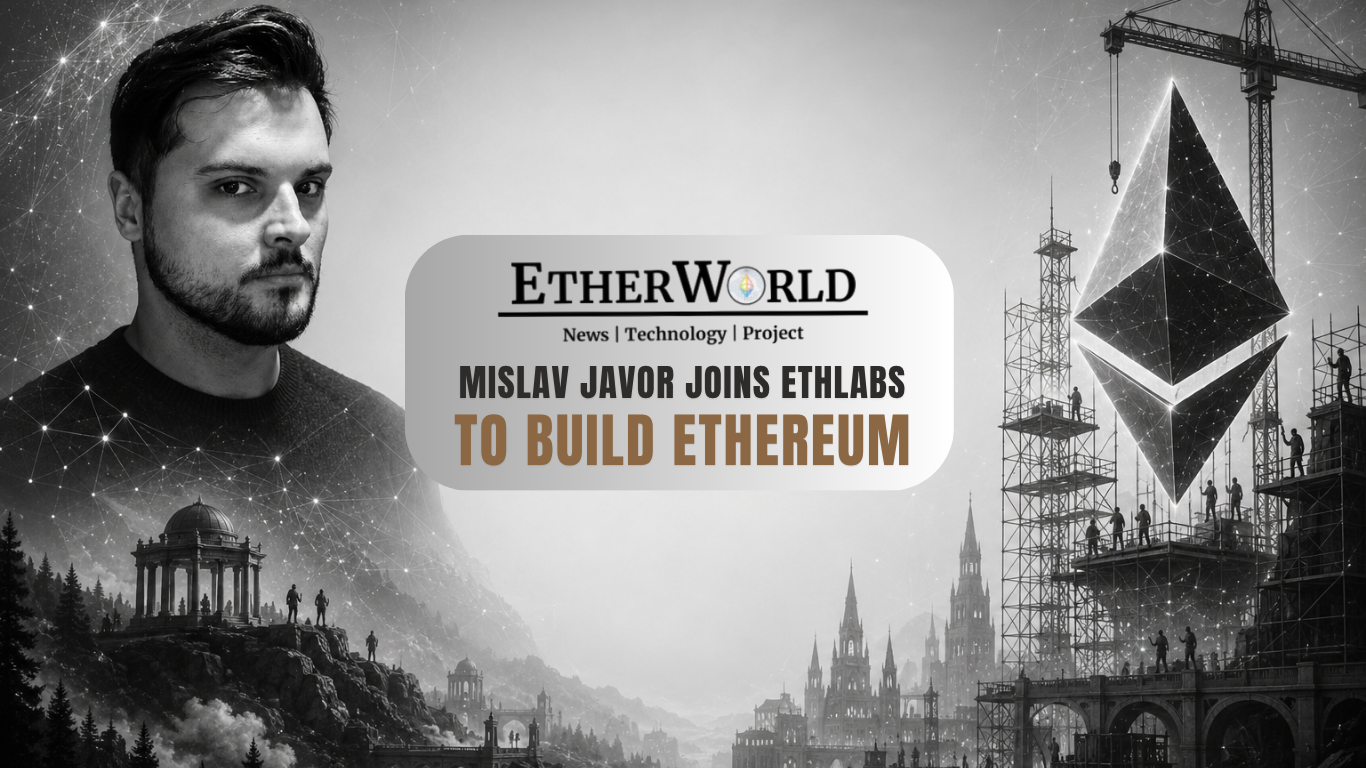
Ethereum builder Mislav Javor has joined Ethlabs, bringing nearly a decade of work across account abstraction, interoperability and Ethereum infrastructure into one of the ecosystem’s newest research and development organizations. Javor announced the move on August 24, saying that after years of building “on and for Ethereum,” joining a team focused on making Ethereum the settlement layer for global finance felt like coming home.
Mislav Javor’s Ethereum Journey
Javor has been involved with Ethereum since around 2016, building across both the technical and commercial sides of the ecosystem. His public profile lists experience including co-founding Klaster, serving as a former VP of Product at Biconomy, and co-authoring an early Developer’s Guide to Ethereum.
More recently, much of his work has centered around account infrastructure, abstraction and improving the way users interact with Ethereum. That background is increasingly relevant as Ethereum’s roadmap shifts from solving individual protocol bottlenecks toward making different pieces of the network work together more effectively.
Account abstraction is a useful example. Ethereum has explored the concept for years. EtherWorld’s early overview of Ethereum account abstraction traced the idea through proposals such as EIP-86, EIP-2938 and ERC-4337.
Ethereum increasingly needs contributors who understand both layers. The same applies to interoperability. Ethereum’s scaling roadmap created a large ecosystem of L2 networks, but that success also introduced fragmentation. Users, assets and applications may now exist across multiple execution environments.
EtherWorld previously explored this challenge in Ethereum Foundation Redraws the Map Between L1 & L2, where Ethereum’s evolving architecture was described less as L2s simply providing additional capacity and more as a multi-layer ecosystem in which Ethereum L1 serves as the neutral settlement and liquidity hub.
Why Javor’s Background Fits Ethlabs
In its announcement, Ethlabs highlighted his combination of technical expertise and commercial instincts. Rather than treating protocol research as an isolated activity, the organization wants to work across protocol changes, product development, research and adoption.
Ethereum already has a deep research culture. The harder challenge is often getting improvements through implementation, ecosystem coordination and eventually into wallets, applications and infrastructure.
In a July update, the organization said it was exploring asynchronous interoperability using zero-knowledge technology, while also looking at faster L1-to-L2 communication through mechanisms such as the Fast Confirmation Rule.
Scaling can increase capacity, but users do not necessarily benefit if moving between chains remains confusing, slow or dependent on fragmented infrastructure. Vitalik Buterin has argued that Ethereum L1 itself can scale substantially while L2s increasingly differentiate through specialized functionality rather than simply offering cheaper execution.
EtherWorld recently covered another part of that direction in Vitalik’s Bitcoin-Inspired Plan for Ethereum, examining how different state models could coexist while preserving decentralization.
Hegotá, Account Abstraction and Faster Ethereum
For native account abstraction, Ethlabs currently supports EIP-8141, Frame Transactions, while acknowledging that deploying account abstraction successfully requires much more than changing Ethereum’s execution rules. Wallets, RPC providers, L2s, developer tooling and applications all need to adopt the new architecture.
Ethlabs specifically says it intends to help coordinate that rollout. That makes account abstraction both a protocol problem and a product-distribution problem.
Hegotá itself has become one of Ethereum’s most important active roadmap discussions. EtherWorld’s State of Upgrade – Hegota Edition #1 tracked the upgrade as developers began moving from early proposals toward scope evaluation.
During ACDC #183, several proposals entered the Hegotá pipeline, while ACDC #184 marked the closing of a major proposal window and the beginning of deeper client-team evaluation. Execution developers have also discussed how account abstraction fits within Hegotá.
EtherWorld’s coverage of ACDE #241 noted that native account abstraction was being considered without automatically tying the entire upgrade schedule to its inclusion. Meanwhile, censorship resistance remains another major pillar.
FOCIL has emerged as Hegotá’s headline feature, aiming to strengthen transaction inclusion guarantees. EtherWorld previously examined the broader objective in Hegotá Should Complete the Holy Trinity of Censorship Resistance.
Ethlabs strongly supports FOCIL and is also advocating for shorter slot times, arguing that faster blocks could improve user experience, market efficiency, finality and some forms of censorship resistance. Together, these priorities show that Ethlabs is not focusing on a single Ethereum problem.
From Protocol Research to Real Users
Ethereum may increase gas limits, improve data propagation, introduce better account structures and create stronger interoperability mechanisms. But users experience Ethereum through wallets, applications, bridges and products rather than EIPs.
The Ethereum Foundation itself has recently placed stronger emphasis on maintaining self-sovereignty while scaling adoption. EtherWorld covered that broader direction in Ethereum Foundation Reveals Its New Playbook for Ethereum’s Future, where privacy, censorship resistance, decentralization and user control emerged as recurring themes.
Its funding structure also reflects that positioning. Ethlabs says it operates as an independent nonprofit supported by ecosystem participants, with BitMine, SharpLink and Joe Lubin listed among its anchor funders while neutrality and independence remain part of its stated structure.
The organization has also been expanding quickly. In July it said it intended to reach roughly 10 members in the near term and around 20 over the medium term, while receiving hundreds of applications.
Glamsterdam is currently testing the next set of protocol changes, while Hegotá is becoming the venue for decisions around censorship resistance, account abstraction and continued L1 scaling. For readers following those changes, EtherWorld’s broader Hegotá tracker provides a running overview of the proposals and governance process shaping the upgrade.
To promote your Web3 articles, events, and projects, you may reach out anytime via EtherWorld PR for submissions and collaboration.
Related Articles
- All You Need to Know About Ethereum Hegotá Upgrade
- State of Upgrade – Hegota Edition #1
- An Overview of Account Abstraction in Ethereum Blockchain
- Ethereum Foundation Redraws the Map Between L1 & L2
- The Future of Ethereum L2s: Base Sequencing, Interoperability & Sustainability
To follow blockchain news, track Ethereum protocol progress, and read our latest stories, subscribe to our weekly today.
Join the EtherWorld & Avarch Internship Program and build your career in blockchain, content, social media, video, podcast editing, or operations. Send your resume and brief introduction to contact@etherworld.co.
Disclaimer: The information contained in this website is for general informational purposes only. The content provided on this website, including articles, blog posts, opinions, & analysis related to blockchain technology & cryptocurrencies, is not intended as financial or investment advice. The website & its content should not be relied upon for making financial decisions. Read full disclaimer & privacy policy.
To stay updated on blockchain news, Ethereum protocol progress, and our latest stories, subscribe to our weekly digest and YouTube channel for ELI5 content.
To promote your Web3 articles, events, project updates, and Press Releases, reach out anytime via EtherWorld PR for submissions and collaboration. For other queries, email contact@etherworld.co.
If you’d like to support our work, share the content and consider donating at avarch.eth.
Join our community on Discord and follow us on Twitter, Facebook, LinkedIn & Instagram.

 ×
×

Author

Yash Kamal Chaturvedi is a Blockchain Content & Ops Specialist at Avarch LLC, writing on Ethereum & governance since 2021. Covers ACD/ACDE calls, EIPs, upgrades, staking, security & ecosystem trends.