ENS DAO Voters Reject Security Council Renewal in Whale-Driven Vote
ENS DAO rejected the Security Council renewal after a whale-driven on-chain vote, reigniting debates over token-weighted governance, decentralization, and the future of ENS governance.
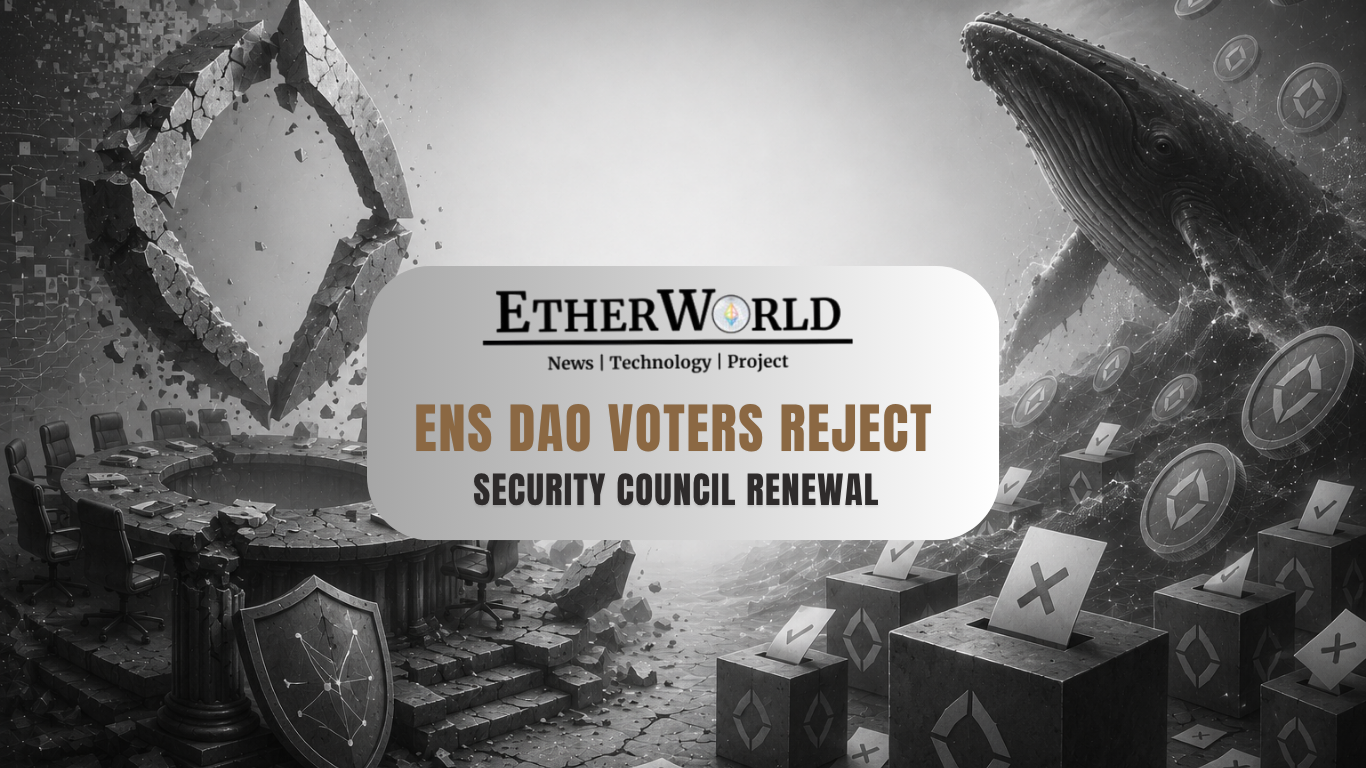
The ENS DAO has entered a fresh governance controversy after an on-chain proposal to renew its Security Council for another two-year term failed decisively. The vote became controversial because ENS co-founder Nick Johnson used a large voting position to vote against the executable proposal, even though the earlier off-chain Snapshot stage had shown support for renewal.
- Security Council Renewal Fails On-Chain
- Why Nick Johnson Voted Against Renewal
- Whale Voting Reignites ENS Governance Debate
- New Proposal Seeks Stricter Council Rules
Security Council Renewal Fails On-Chain
The proposal, titled “Renewal of the Security Council (Term 2)”, aimed to extend the ENS DAO Security Council for another two years. The council acts as an emergency safety mechanism for ENS governance. Its role is not to run the protocol on a day-to-day basis, but to serve as a backstop if a malicious or unconstitutional governance proposal threatens ENS.
The renewal had already passed through earlier governance steps, including discussion and off-chain signalling. However, the final executable vote produced a very different result. Johnson’s large vote against the proposal pushed the outcome heavily toward rejection. Reports noted that the on-chain vote stood at around 82% against, with Johnson’s vote accounting for the overwhelming majority of opposition.
This is important because the Security Council’s authority was set to expire in July 2026. Without renewal or replacement, ENS would lose one of its most visible emergency governance safeguards. For a protocol that manages critical Web3 identity infrastructure, this raised immediate questions about how ENS should balance speed, decentralization, accountability, and protocol safety.
ENS has long been one of Ethereum’s most important identity systems. EtherWorld previously covered ENS adoption in ENS celebrates 5th anniversary with a million registered .eth addresses, where ENS was described as a naming layer that makes Ethereum addresses easier for users to understand. That user-facing importance makes its governance model more than an internal DAO matter.
Why Nick Johnson Voted Against Renewal
Johnson’s vote was not framed as opposition to having a Security Council at all. Instead, his concern was about the mandate and behaviour of the existing council structure.
According to Johnson, the Security Council should exist only as a narrow emergency defence mechanism. In his view, it should be used to block governance attacks, protocol compromise, or actions that violate the ENS Constitution. It should not become a political body that can block ordinary proposals simply because council members disagree with them.
This distinction matters because ENS is already debating a broader governance restructuring. A separate proposal, covered by EtherWorld in ENS DAO Weighs Major Governance Shift to Empower ENS Foundation, suggests giving the ENS Foundation more responsibility over treasury management, grants, operations, and long-term capital strategy while preserving tokenholder control over protocol-level decisions.
Supporters of the Foundation shift argue that ENS needs a more practical operating structure. Critics argue that moving operational and treasury powers closer to the Foundation could reduce the DAO’s real control. Against that background, the Security Council became more politically sensitive. If council members viewed the Foundation proposal as a governance attack, they might attempt to block it. Johnson’s concern appears to be that such use would go beyond the council’s intended emergency role.
This is why the failed vote is not only about one council renewal. It is part of a larger argument over what DAO governance should mean when tokenholders, delegates, founders, foundations, and emergency councils all claim different kinds of legitimacy.
Whale Voting Reignites ENS Governance Debate
The most controversial part of the vote was not simply that the proposal failed. It was how it failed.
Several community members criticized the fact that one large voting position could override the rest of the active voting base. Lefteris Karapetsas, a well-known Ethereum community member and ENS delegate, argued that Johnson’s voting power showed the weakness of ENS DAO’s token-weighted governance. Brantly Millegan, another long-time ENS figure, also criticized the direction of ENS governance and warned about centralization risks.
This debate is familiar across DAOs. Token voting can be transparent and simple, but it often gives more influence to large holders. That can create tension between formal legitimacy and social legitimacy. A vote may be valid according to the rules, but still feel unacceptable to community members who believe the result does not reflect wider sentiment.
EtherWorld has explored this wider question in Is DAO more efficient than corporations?, where the core tension is whether DAOs can remain decentralized while still making efficient decisions. The ENS dispute shows how difficult that balance becomes when a protocol controls meaningful assets and infrastructure.
Other Ethereum governance examples also show that decentralization is not only about voting. In 100 Office Hours of Open Governance, EtherWorld highlighted the importance of public discussion, education, and contributor participation in Ethereum’s standards process. Similarly, Ethereum Governance Sets Course for Glamsterdam EIP Selection shows how Ethereum protocol changes rely on open review rather than simple token-weighted decisions.
ENS is different from Ethereum core governance because it has a token-based DAO. But the same principle applies: governance depends on trust. If participants believe outcomes are being driven by concentrated power rather than shared process, legitimacy weakens.
This is why the ENS vote has attracted attention beyond the ENS community. It adds to broader questions about how Ethereum-aligned projects should design governance checks, emergency powers, treasury control, and dispute resolution.
New Proposal Seeks Stricter Council Rules
Soon after the failed vote, Katherine Wu introduced a new Security Council proposal with stricter rules. The revised framework reportedly includes clearer limits on when the council can act, higher thresholds for intervention, and additional eligibility requirements for members.
The goal appears to be preserving the Security Council while addressing concerns that it could become a political veto body. In simple terms, ENS is now trying to separate two questions:
- Should ENS have an emergency council?
- What exactly should that council be allowed to do?
The answer to the first question may still be yes for many stakeholders. Emergency councils can be useful when a protocol faces a critical exploit, malicious proposal, or governance attack. The answer to the second question is harder. If the council’s mandate is too weak, it may fail to protect the protocol. If it is too broad, it can become a centralised gatekeeper.
Ethereum’s wider ecosystem has faced similar governance and safety debates. EtherWorld’s coverage of Taiko Unveils Its DAO: A New Era of Decentralized Governance discussed how DAO structures often combine community governance with security mechanisms such as multisigs. Meanwhile, TheDAO Security Fund’s First Funding Round Goes Live with Over $1M for Ethereum Security and An Introduction to Ethereum’s DAO-Funded Security Model show how DAO-linked security funding is becoming a recurring Ethereum theme.
The ENS controversy also connects to Ethereum’s wider identity and usability stack. ENS is used across wallets, applications, and sign-in flows. EtherWorld covered this relationship in ERC-4361 Finalized: What Sign-In with Ethereum Means for Ethereum, where ENS appears as part of the user identity layer. EtherWorld also reported on ENS usability and ownership questions in Uniswap Founder Pays $29K to Reclaim ENS.
That is why this governance fight matters. ENS is not just another DAO token. It is a naming and identity protocol deeply linked to Ethereum’s user experience. Any breakdown in governance confidence can affect how the ecosystem views ENS as public infrastructure.
For now, the immediate focus shifts to the revised Security Council proposal. If it succeeds, ENS may preserve its emergency defence layer under stricter rules. If it fails, the DAO could face a more uncertain governance path at the same time that it debates a major shift toward the ENS Foundation.
Either way, the message from this vote is clear: ENS governance is entering a more difficult phase where decentralization cannot be measured only by having a token vote. It must also be measured by whether the community believes the process is fair, accountable, and resilient enough to protect Ethereum’s identity layer.
To promote your Web3 articles, events, and projects, you may reach out anytime via EtherWorld PR for submissions and collaboration.
Related Articles
- ENS DAO Weighs Major Governance Shift to Empower ENS Foundation
- ENS celebrates 5th anniversary with a million registered .eth addresses
- Is DAO more efficient than corporations?
- Taiko Unveils Its DAO: A New Era of Decentralized Governance
- Uniswap Founder Pays $29K to Reclaim ENS
To follow blockchain news, track Ethereum protocol progress, and read our latest stories, subscribe to our weekly today.
Disclaimer: The information contained in this website is for general informational purposes only. The content provided on this website, including articles, blog posts, opinions, & analysis related to blockchain technology & cryptocurrencies, is not intended as financial or investment advice. The website & its content should not be relied upon for making financial decisions. Read full disclaimer & privacy policy.
To stay updated on blockchain news, Ethereum protocol progress, and our latest stories, subscribe to our weekly digest and YouTube channel for ELI5 content.
To promote your Web3 articles, events, project updates, and Press Releases, reach out anytime via EtherWorld PR for submissions and collaboration. For other queries, email contact@etherworld.co.
If you’d like to support our work, share the content and consider donating at avarch.eth.
Join our community on Discord and follow us on Twitter, Facebook, LinkedIn & Instagram.

 ×
×

Author

Yash Kamal Chaturvedi is a Blockchain Content & Ops Specialist at Avarch LLC, writing on Ethereum & governance since 2021. Covers ACD/ACDE calls, EIPs, upgrades, staking, security & ecosystem trends.