100 Office Hours of Open Governance
A look back at the journey from the first EIP Editors’ Apprenticeship Meetings in 2021 to the 100th EIP Editing Office Hour in 2026, highlighting key milestones in Ethereum’s standards process to the future of EIP-8133.
Ethereum’s standards process (EIP process) is one of the ecosystem’s most important yet underrated public goods. Every network upgrade, token standard, wallet feature, and protocol improvement begins as an idea that is discussed, reviewed, refined, and coordinated through the evolution process. In this post, I look back at some of the key milestones from the past few years, from the first EIP Editing Office Hours to the 100th session, the EIP Summit, community-led tooling, and governance initiatives and my latest EIP-8133.
Unlike any other Tuesday, this week was special for me and many others involved in the EIP editing process. We celebrated the 100th EIP Editing Office Hour. From the outside, it may have looked like just another weekly call, but for me, it carried the weight of everything that came before it.
2022: The First Office Hour
In September 2022, EthCatHerders, organized the first EIP Editing Office Hour. The idea was to bring EIP authors and EIP editors together in the same room, on a regular schedule, so authors could get instant answers instead of waiting weeks for a response on a pull request.
That first session had a handful of attendees: EIP Editor Sam Wilsn, Victor Zhou, myself and a few guest authors. The agenda was to walk through open pull requests, answer questions, help proposals move forward.
The incoming EIP had grown and hundreds of proposals were in different stages of review. Many of them were by first-time authors who had limited understanding why their proposal was stuck or what exactly an editor needed to see before moving it along. The timing of Office Hour was just right.
2021: EIP Editors' Apprenticeship Meetings
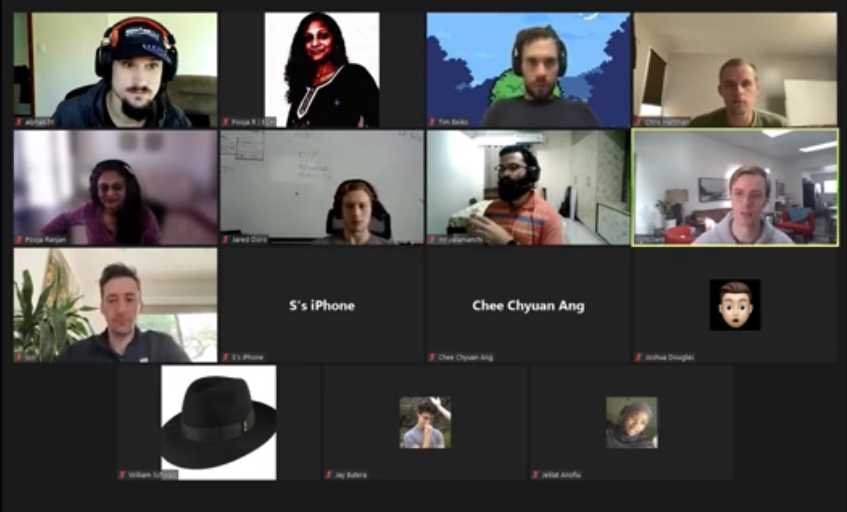
Prior to Office Hours launch, there had been an earlier initiative, the EIP Editors' Apprenticeship Meetings, started in November 2021, where Matt Garnett mentored people interested in becoming EIP Editors. That effort was the beginning of adding more editors to support the ecosystem. The Office Hours were the next step focused on supporting authors.
When the EIP Editing Office Hour was first introduced, the idea was simple: create a place where proposal authors could talk directly with editors, get help resolving issues, and move promising proposals closer to becoming official Ethereum standards. It was to make the EIP process more approachable, collaborative, and efficient.
The meetings were scheduled every other Tuesday, with agendas published in advance so anyone in the community could add a proposal for discussion. Over time, these sessions became a regular gathering point for authors, editors, reviewers, and curious community members.
The Process, Proposals & People
To understand why Office Hours mattered, it helps to understand what an EIP actually is.
An Ethereum Improvement Proposal is a formal document that proposes a change or standard for the Ethereum network. The process is defined in EIP-1. Proposals move through statuses: Draft, Review, Last Call, Final, and each step requires specific actions from authors and editors.
ERC-4361: Sign-In with Ethereum, co-authored by Brantly Millegan (brantly.eth), Wayne Chang, Nick Johnson, and others, was finalized in one of the Office Hours in August 2025.
Brantly put it simply:
"Sign-In with Ethereum is the future of login for every app on the Internet, crypto-related or not. Not just an idea, it's already the norm for web3 and will spread. No corporation or centralized system involved in this entire set-up, user (not corp) owned, therefore credibly neutral."
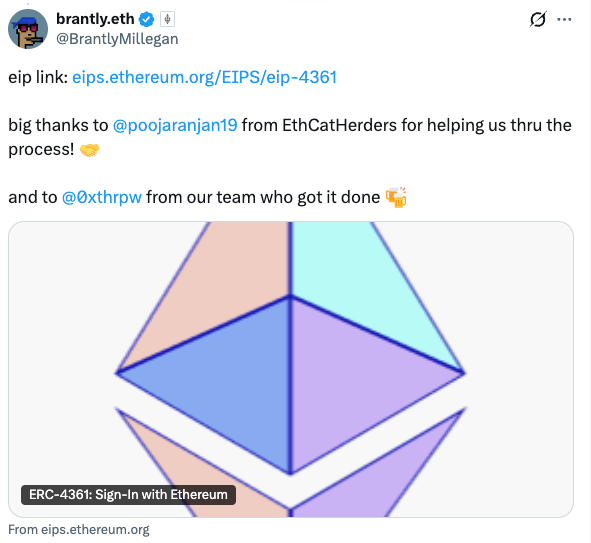
That is what the Office Hours offers to authors.
EIP-5069: EIP Editor Handbook
EIP editors are crucial to the EIP process, and having more editors was a necessity at the time. Back in the days, I documented the "EIP editor "apprentice" handbook". It was intended to document the process and expectations that, at the time, were held by only a few people heavily engaged in the process. This was later documented as a formal guideline in EIP-5069.
Initially, co-authored by myself, Gavin John, EIP-5069: EIP Editor Handbook describes the roles and responsibilities of EIP editors. About a year later, if was updated by Sam Wilson with Charter to include Organizational structure, decision-making process, and other EIP Editor odds and ends. EIP Editors do not decide whether a proposal is a good idea technically, but rather help keep the process clean, the repository consistent, and the community able to participate.
2023: The EIP/ERC Split
The conversation about splitting the EIP repo into separate tracks for core protocol EIPs and application-layer ERCs (Ethereum Request for Comments) had been ongoing for years. It was first formally discussed at EIPIP Meeting 29, and the arguments were that editors who focused on core protocol changes were being flooded with notifications from ERC submissions they had no expertise in reviewing, and vice versa. The increased number of mixed pull requests was one of the main reasons cited by the Core Devs behind the repo split, with the hope that separate repositories could reduce pull request wait times and improve review efficiency.
EIP-7329 documents the repo split, creating a new ethereum/ERCs repository dedicated to application standards. This allowed each repo to have its own editors, its own submission process, and its own community of reviewers. The Office Hours have now adapted to the change and organize EIP only and (EIP + ERC) review sessions, covering proposals from both repositories.
2025: The Halfway Point
The 50th Office Hour
Years passed. We had completed 49 hours of online review. With the EIP editor Gajendra Singh, we celebrated the 50th EIP editing Office Hour. Over the period, Gajendra Singh lead EIP-only editing session to address a growing PR backlog in the EIPs repository.
What made it special was not just the number. It was the fact that the office hours are welcomed, the community shows up for these open calls and editors are supporting the decentralized Governance ethos.
The EIP Editors' Workshop

In January 2025, alongside the 50th Office Hour milestone, the ECH Institute organized a dedicated EIP Editors' Workshop, a live training session for people interested in learning how to become EIP editors and reviewers.
The workshop covered the full EIP lifecycle, the roles of editors, reviewers, and authors, and included a hands-on walkthrough with Sam Wilson demonstrating how to review an EIP on GitHub, including checking formatting, structure, and compliance with EIP-1; using the Fellowship of Ethereum Magicians for discussions; applying labels and managing pull requests. The educational focus mirrored EtherWorld's broader coverage of Ethereum governance and contributor participation across the ecosystem.
As a result, the ecosystem gets Jochem Brouwer, who joined the EIP Editor team after years of active engagement with the process, participating in sessions, reviewing proposals, asking questions, and understanding how decisions got made. That kind of organic progression is exactly what a healthy open-source governance process looks like. Roles are not assigned; they are earned through consistent, visible contribution. The Office Hours and better processes created the conditions for that kind of growth.
The First ERC Blitz
The first ERC Blitz was conceived by editor Sam Wilson and was organized by ECH Institute on June 10, 2025. It was a focused two-hour session specifically for clearing ERC pull requests, a live dashboard built by EIPsInsight to track what was being reviewed in real time.
The Blitz format was different from a standard Office Hour. Instead of walking through a curated list, the goal was to move as many proposals as possible, reviewing formatting, checking compliance, merging what was ready, and flagging what needed author attention. It was higher energy and more output-focused, with authors present on the call. The idea worked. Many authors showed up with their proposals. The editor reviewed them in sequence. The EIPsInsight dashboard made the activity visible to anyone watching the livestream, something the community could follow.
The first Blitz set a template that the 100th Office Hour replicated.
2025: EIP Summit

Another big EIP event in the year was EIP Summit 2025, in Devconnect Argentina. This was an in-person gathering of EIP authors, editors, researchers, client developers, and ecosystem contributors to explore how Ethereum standards evolve from ideas to network upgrades. The event featured sessions covering the EIP process, proposal lifecycle, upgrade readiness, testing infrastructure, gas repricing, AI-related ERCs, governance standards, and the role of EIP editors. My talk From Research to Reality - An EIP’s Journey captures my imagination of looking at Ethereum upgrades as a musical concert. Read more.
2026: The 100th Hour (Special EIP/ERC Blitz)

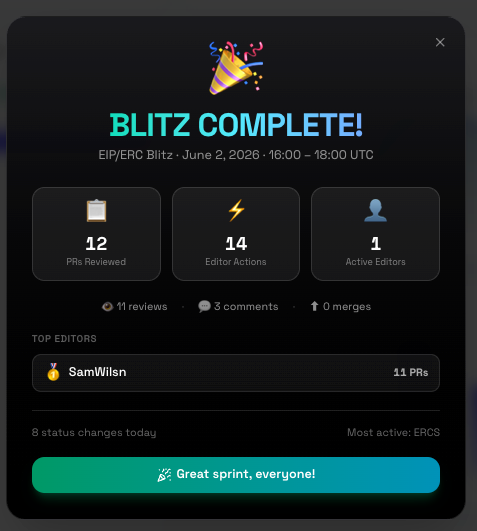
And then comes the 100th Editing Office Hour. Celebrated on June 2nd, 2026, with EIP editor Sam Wilson, multiple authors in the live call, and the ECH team to support as usual, I was excited to see where we have arrived. The agenda included proposals across the full pipeline - Final, Last Call, Review, Draft, and miscellaneous. The EIPsInsight team built a dedicated live dashboard at eipsinsight.com/EIPOH100 that tracked every PR review, editor action, and status transition in real time, refreshing every 60 seconds throughout the two-hour sprint. Anyone watching the YouTube stream could follow exactly what was happening in real time.
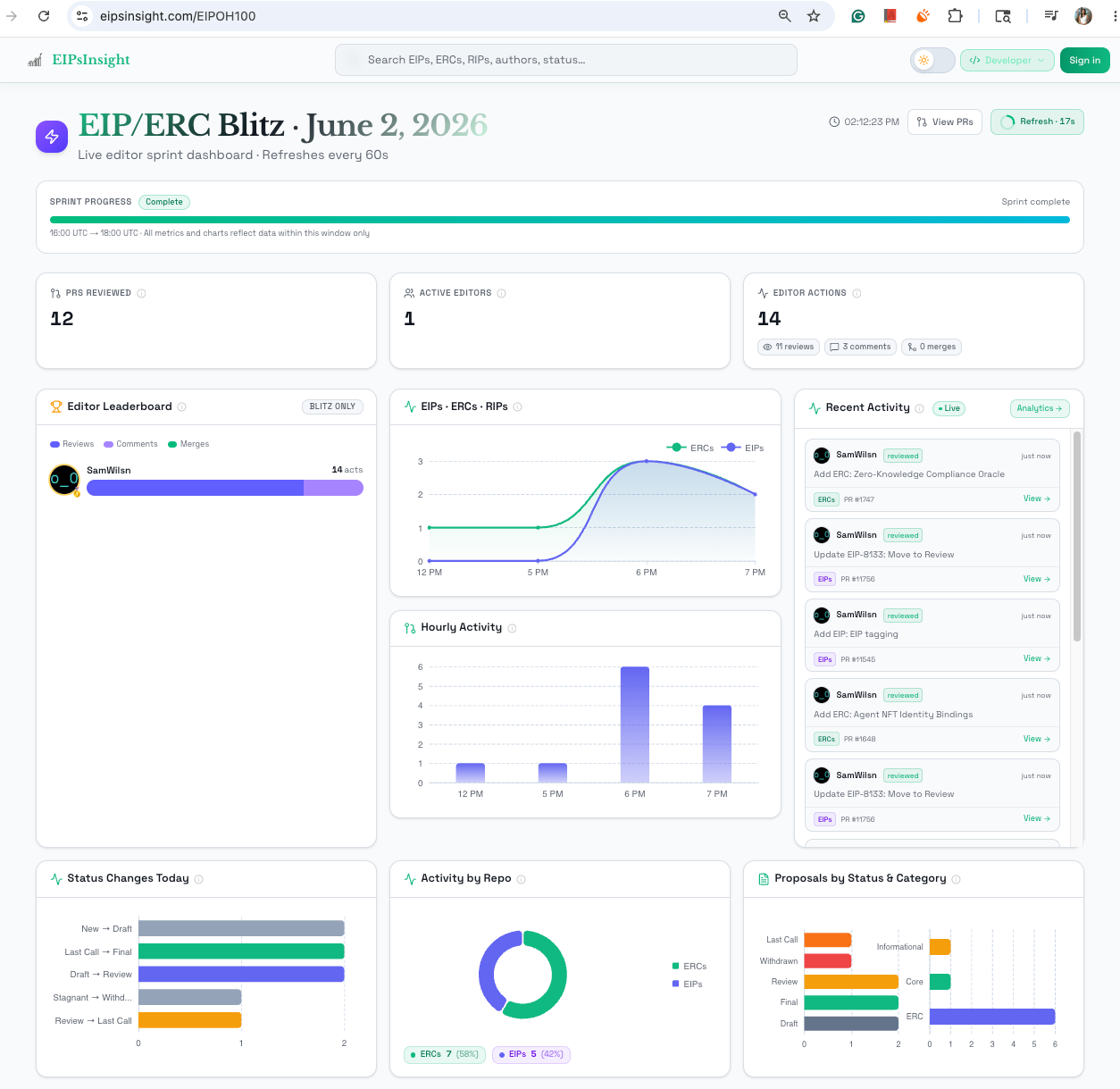
The results from the sprint window of 16:00–18:00 UTC:
- 12 proposals reviewed
- Multiple status promotions across EIPs and ERCs
- Direct engagement with authors across time zones
The 100th Office Hour generated a quiet but meaningful wave of acknowledgment from across the Ethereum ecosystem. On the GitHub issue for the meeting, community members left notes that captured something the numbers alone do not:
"Happy 100th Office Hours @poojaranjan and ECH Team! Thank you for such contributions
to the space!"
— ariutokintumi
"Happy 100th office hours! I am also watching the YouTube stream but cannot join the zoom
call."
— SirSpudlington
"Happy 100th office hours, would have loved to join live but caught the stream. Thanks for all
that you do. These very community efforts helped erc8001 get to where it is. My gratitude goes
out to the whole team."
— KBryan
ERC-8126 and ERC-4337 Reach Final
Two proposals reached Final status during the session.
ERC-8126: AI Agent Verification finished Last Call and was promoted to Final. ERC-8126 establishes a standardized framework for verifying AI agents on Ethereum through multi-layer security checks, privacy-preserving proofs, and unified trust scoring. A reference standard for agentic builders across the ecosystem.
ERC-4337: Account Abstraction Using Alt Mempool was the biggest surprise to the broader community. Proposed by Vitalik Buterin, Yoav Weiss, Dror Tirosh, Shahaf Nacson, Alex Forshtat, Kristof Gazso, and Tjaden Hess back in September 2021, ERC-4337 introduced a way to bring smart contract wallet functionality to Ethereum without requiring changes to the core protocol. Rather than waiting for a hard fork, it introduced a parallel mempool of "UserOperations," a singleton EntryPoint contract, and off-chain bundlers, enabling wallets to be programmable, recoverable, and flexible. Since launching on Ethereum mainnet, ERC-4337 has enabled multiple smart accounts and powered over million transactions.
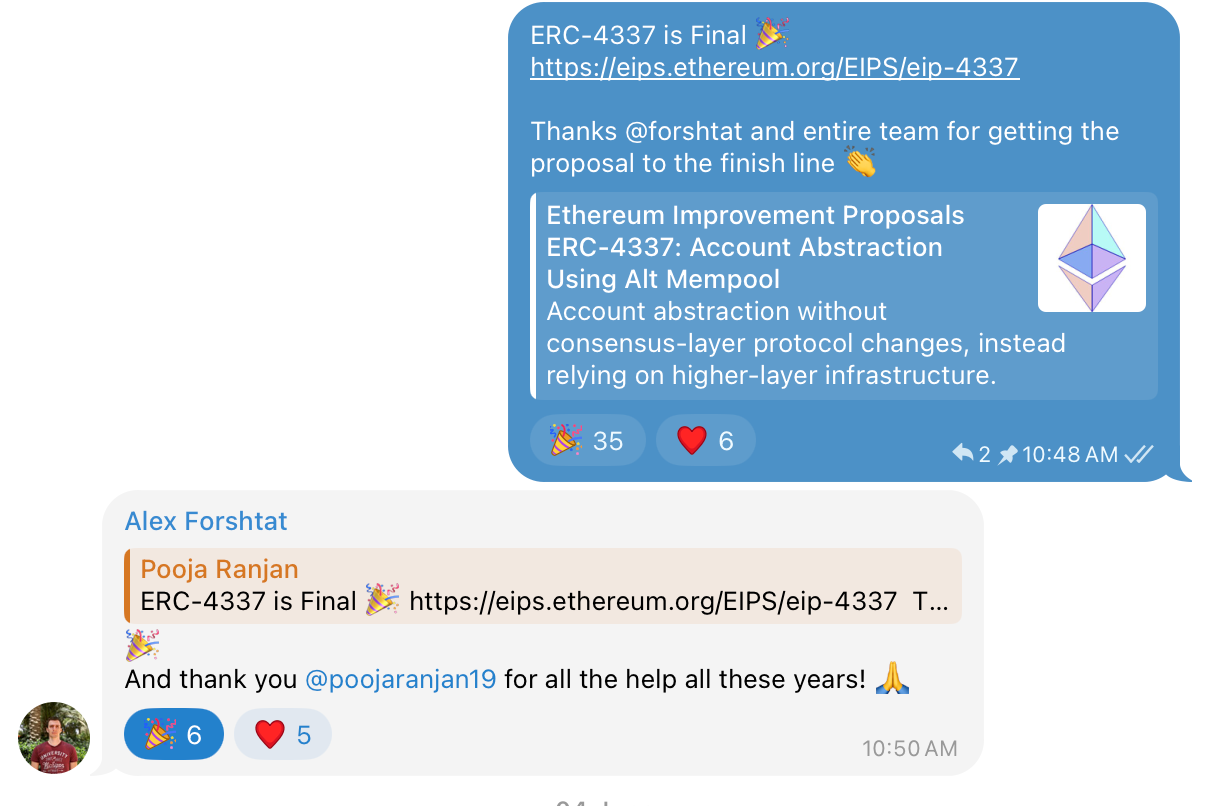
Seeing it reach Final status during the 100th Office Hour was the cherry on the top. It was not just a milestone for account abstraction team, it was the closing of a chapter for everyone for who spent years pushing it forward - a five-year journey from idea to finalized standard.
EIP-8133 Promoted to Review
Then there was EIP-8133: Network Upgrade Naming, an effort to document what the Ethereum community had long treated as shared knowledge. During the 100th Office Hour Blitz, EIP-8133 was promoted to Review status.
Authored in January 2026, EIP-8133 establishes a canonical naming convention for Ethereum network upgrades across the Execution Layer, Consensus Layer, combined upgrades, and Blob-Parameter-Only (BPO) upgrades. While names such as Frontier, Homestead, Istanbul, The Merge, Shapella, Pectra, Fusaka and Glamsterdam are widely used throughout the ecosystem, there had never been a formal reference explaining the patterns behind them.
EIP-8133 captures these conventions: Execution Layer upgrades are named after Devcon and Devconnect host cities, Consensus Layer upgrades follow an alphabetical sequence of star names, combined upgrades use portmanteau names such as Shapella and Dencún, and BPO upgrades use sequential numbering. By documenting these conventions in a single reference, EIP-8133 makes Ethereum’s upgrade nomenclature easier to understand, something you can link to when explaining to a new contributor, an enterprise partner, or a journalist why the next upgrade is called what it is called.
The Open Question: EIP-8133 as Living or Final
There is still an open question about the long-term future of EIP-8133. As Ethereum continues to introduce new upgrades, should upgrade nomenclature be maintained in a single Living document that evolves alongside the protocol, or should EIP-8133 become a Final specification with future naming conventions captured in separate proposals?
The current editor preference leans toward moving the EIP to Final, which provides a stable, immutable reference and aligns with how most standards are maintained. My view is different. Since upgrade naming is an ongoing process rather than a one-time specification, I believe a Living document would better serve the ecosystem by providing a single canonical reference that can evolve over time without requiring new EIPs for each extension or convention. It also reduces fragmentation and makes it easier for contributors, implementers, enterprises, and community members to find the latest guidance in one place.
The discussion remains open on the EIP-8133 Ethereum Magicians thread and Call For Input. If you have an opinion on how Ethereum’s upgrade nomenclature should be maintained, I encourage you to join the conversation and share your perspective.
A personal note
One hundred sessions of an open community call, sustained over nearly four years, is possible. It just requires dedicated scheduling, hosting, and a community willing to keep showing up.
I’d like to take this opportunity to thank all past and present EIP editors who have contributed their time and expertise, tooling teams for building the dashboards and analytics, and everyone at ECH Institute who helped coordinate, document, livestream, and support the series.
Most importantly, I want to thank every author, reviewer, and community member who participated in an Office Hour. Your continued engagement made this milestone possible.
If you are working on an EIP or ERC and want guidance, the Office Hours are still running. Agendas are posted publicly. You can add your proposal in the comments and show up.
The EIP process is not just technical infrastructure. It is how the Ethereum community decides, together, what Ethereum becomes.
For upcoming Office Hours, agendas, recordings, and proposal dashboards:
- Follow ethereum/pm
- Track proposals at EIPsInsight
- See the Office Hour
Calendar - Join the ECH Discord → #eip-editors
This post is part of our new “Stories” collection - a space to share Web3 experiences through personal journeys.
To promote your Web3 articles, events, and projects, you may reach out anytime via EtherWorld PR for submissions and collaboration.
Related Articles
- Firsts, Conversations and AI - EthDenver
2026 - The Bug of Solving Bugs
- The Silent Upgrade
- The Change of Scenery
To follow blockchain news, track Ethereum protocol progress, and read our latest stories, subscribe to our weekly today.
Disclaimer: The information contained in this website is for general informational purposes only. The content provided on this website, including articles, blog posts, opinions, & analysis related to blockchain technology & cryptocurrencies, is not intended as financial or investment advice. The website & its content should not be relied upon for making financial decisions. Read full disclaimer & privacy policy.
To stay updated on blockchain news, Ethereum protocol progress, and our latest stories, subscribe to our weekly digest and YouTube channel for ELI5 content.
To promote your Web3 articles, events, project updates, and Press Releases, reach out anytime via EtherWorld PR for submissions and collaboration. For other queries, email contact@etherworld.co.
If you’d like to support our work, share the content and consider donating at avarch.eth.
Join our community on Discord and follow us on Twitter, Facebook, LinkedIn & Instagram.

 ×
×

Author

Pooja Ranjan is a long-time Ethereum contributor. She founded EtherWorld.co and EIPsInsight, co-founded WiEP, and serves as President of ECH Institute, leading education, governance, and community coordination across Ethereum. Follow @poojaranjan19