Is India Quietly Nudging UPI Users Toward CBDC?
India’s new UPI MDR could give the digital rupee its first real merchant advantage, raising fresh questions about whether CBDC adoption may accelerate.
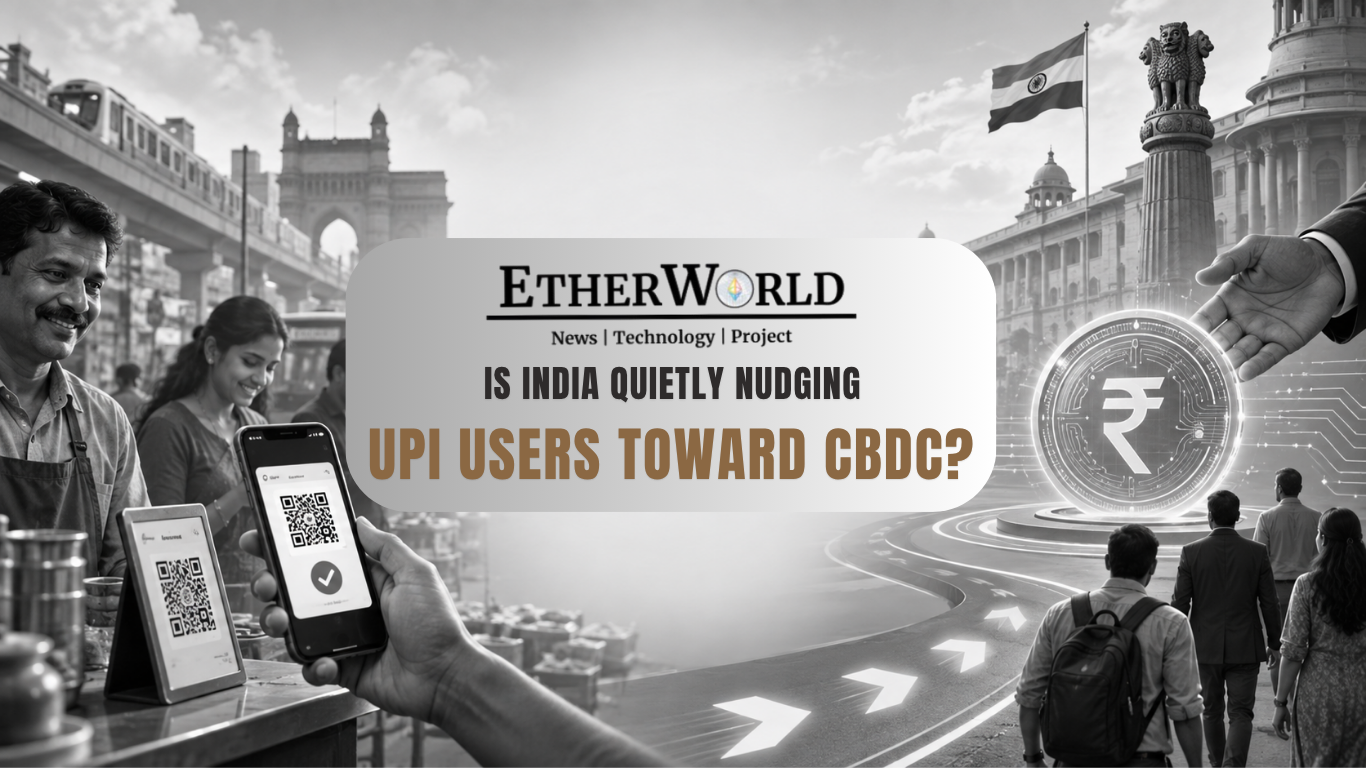
India built one of the world's most successful digital payment systems by making the experience almost invisible. For hundreds of millions of Indians, UPI has become so normal that the underlying payment infrastructure barely matters.
That simplicity is precisely why every alternative digital payment system in India faces an uncomfortable question: why would anyone switch? The Reserve Bank of India's retail Central Bank Digital Currency, or e₹, has struggled with exactly that problem.
UPI Was Almost Too Good for the Digital Rupee
CBDC may offer sovereign settlement, programmability, offline payment possibilities & a digital equivalent of central bank money. But for an ordinary user standing at a checkout counter, UPI already works extraordinarily well.
From October 15, select person to merchant UPI transactions above ₹2,000 will attract a 0.4% Merchant Discount Rate, subject to exemptions & a ₹300 maximum per transaction. Consumers themselves are not supposed to pay this charge, person to person payments remain free & the government says roughly 96% of merchant transactions will remain unaffected.
Former RBI Deputy Governor R. Gandhi recently suggested that merchants looking to avoid MDR on larger transactions could potentially accept payments through CBDC, where there may not be a similar charge. That possibility deserves more attention than it is receiving.
Retail CBDCs are often discussed internationally as a way to modernise payments, lower settlement costs, expand digital access or reduce dependence on private payment networks. India entered that debate from a completely different starting point.
UPI had already made instant digital payments cheap, interoperable & accessible before the digital rupee arrived. EtherWorld previously explored the same contradiction while asking whether India even needs stablecoins when UPI already works.
An Indian user can already move money directly from a bank account, across different banks & apps, using a QR code within seconds. Merchants from neighbourhood shops to large retailers already accept the system.
That infrastructure helped create the much broader digital adoption environment covered in EtherWorld's State of Crypto Adoption in India. For most retail payments, the digital rupee has struggled to demonstrate that difference.
India's experience with private digital assets reinforces the point. Despite massive crypto adoption, domestic payments remain overwhelmingly comfortable with conventional digital rails. Even Chainalysis data examined by EtherWorld in India Records $19B in Taxable Crypto Activity showed the scale of blockchain related payment activity without suggesting that crypto has displaced UPI for ordinary commerce.
Are they slowly pushing India from UPI towards CBDC?
— Kashif Raza (@simplykashif) September 16, 2026
Now this is interesting. pic.twitter.com/xmSF1ZuoXF
MDR Changes the Merchant Calculation
A 0.4% charge sounds tiny. For many transactions, it is. But payment networks are shaped by incentives at enormous scale. Imagine a retailer processing ₹50,000 through UPI. At 0.4%, the merchant cost would be ₹200. At ₹75,000, it reaches the ₹300 cap under the new framework.
One transaction will not transform a business. Thousands might. This is where CBDC suddenly becomes more interesting. The customer may still prefer UPI. The merchant now has a reason to prefer something else.
India has seen similar economic incentives reshape crypto behaviour. High taxation, TDS & compliance requirements have affected trading patterns since the framework described in EtherWorld's Cryptocurrency Taxation in India was introduced.
Those constraints remained broadly unchanged in Budget 2026, while reporting requirements have continued expanding through India's new crypto tax rules. The digital rupee becomes substantially easier to promote if merchants can tell customers, "UPI is accepted, but e₹ costs us less."
CBDC has already been made interoperable with UPI QR infrastructure. The QR code may look familiar even though settlement happens differently underneath.
The Real CBDC Debate Is About Control, Not QR Codes
UPI & CBDC may look similar at checkout, but economically they are fundamentally different. UPI is a payment mechanism moving commercial bank money between accounts.
Retail CBDC is central bank money in digital form. That distinction becomes especially important when programmability enters the picture. There are obvious advantages.
- Subsidies could potentially reach intended beneficiaries more efficiently.
- Payments could work offline in areas with weak connectivity.
- Settlement could become more direct.
- Government programmes could potentially reduce leakage.
EtherWorld has tracked how 49 crypto exchanges registered with FIU, while regulators have also increased scrutiny of large OTC crypto transactions. At the same time, Parliament continues examining India's wider digital asset framework.
The RBI has maintained a cautious stance toward privately issued crypto, as covered in India's RBI Rejects Crypto Legal Status Before Finance Panel. India remains sceptical of privately issued digital currencies while continuing to experiment with state backed digital money.
India May Be Building a Two Rail Payment System
The wrong conclusion would be that UPI is being replaced. UPI is deeply embedded into India's economy & the new MDR framework deliberately protects most everyday transactions.
UPI could remain India's dominant payment interface while CBDC becomes an increasingly important settlement alternative underneath that interface. That possibility also explains why stablecoins remain relevant despite UPI's dominance.
India's recent USDT premium above 8.5% illustrated how strong demand can emerge when access to dollar liquidity tightens. EtherWorld later examined the same relationship while analysing RBI intervention in the rupee & its impact on stablecoin premiums.
CBDC occupies another part of this emerging stack. UPI solves domestic payment distribution. Stablecoins increasingly serve global digital settlement. CBDC could become the state's programmable digital settlement layer. India's broader regulatory review, covered in India Studies Global Crypto Regulation Models Amid Growing Capital Outflow, suggests policymakers increasingly have to think about these systems together rather than as isolated technologies.
UPI became dominant partly because its economics made saying "yes" incredibly easy for both merchants & customers. CBDC has never had that advantage.
Now, for certain higher value payments, the economics may begin moving in its favour. That does not prove India is secretly pushing users from UPI toward the digital rupee.
If merchants gradually discover that accepting e₹ reduces payment costs, customers may begin using CBDC not because they suddenly became interested in central bank digital money, but because the shopkeeper asked them to.
To promote your Web3 articles, events, and projects, you may reach out anytime via EtherWorld PR for submissions and collaboration.
Related Articles
- Does India Need Stablecoins When UPI Already Works?
- India Records $19B in Taxable Crypto Activity
- Cryptocurrency Taxation in India: Things to Keep in Mind
- No Tax Relief for Crypto in India’s Budget 2026
- India Issues New Crypto Tax Rules From 2026
To follow blockchain news, track Ethereum protocol progress, and read our latest stories, subscribe to our weekly today.
Join the EtherWorld & Avarch Internship Program and build your career in blockchain, content, social media, video, podcast editing, or operations. Send your resume and brief introduction to contact@etherworld.co.
Disclaimer: The information contained in this website is for general informational purposes only. The content provided on this website, including articles, blog posts, opinions, & analysis related to blockchain technology & cryptocurrencies, is not intended as financial or investment advice. The website & its content should not be relied upon for making financial decisions. Read full disclaimer & privacy policy.
To stay updated on blockchain news, Ethereum protocol progress, and our latest stories, subscribe to our weekly digest and YouTube channel for ELI5 content.
To promote your Web3 articles, events, project updates, and Press Releases, reach out anytime via EtherWorld PR for submissions and collaboration. For other queries, email contact@etherworld.co.
If you’d like to support our work, share the content and consider donating at avarch.eth.
Join our community on Discord and follow us on Twitter, Facebook, LinkedIn & Instagram.

 ×
×

Author

Yash Kamal Chaturvedi is a Blockchain Content & Ops Specialist at Avarch LLC, writing on Ethereum & governance since 2021. Covers ACD/ACDE calls, EIPs, upgrades, staking, security & ecosystem trends.