EIPsInsight Just Changed How You Track Ethereum Upgrades
EIPsInsight’s new Upgrade Explorer brings Ethereum’s entire fork pipeline into one view, making it easier to track which EIPs are proposed, progressing, declined, or actually shipping.
Ethereum upgrades are built in public, but following them has never been simple. A proposal might begin as an idea on Ethereum Magicians, become an EIP, appear in an ACD discussion, move through multiple inclusion stages, enter a devnet, and eventually become part of a mainnet fork.
Anyone trying to answer a basic question like “Which EIPs actually shipped in this upgrade?” may end up searching through EIP repositories, GitHub threads, Meta EIPs, meeting notes, and several months of developer calls.
Why Following Ethereum Upgrades Is Still Difficult
Ethereum’s protocol development process is intentionally distributed. There is no single committee that writes an upgrade specification and announces a finished package. Instead, researchers propose changes, EIP authors develop specifications, editors review documents, client teams evaluate implementation complexity, and core developers coordinate upgrade scope through the ACD process.
An EIP’s normal standards status, such as Draft, Review, Last Call, or Final, does not by itself tell a reader whether the proposal will ship in a particular network upgrade. Core proposals additionally move through a separate upgrade inclusion process as developers decide the scope of future forks.
EtherWorld’s coverage of Ethereum’s All Core Developers process has shown how testing requirements, specification readiness, client support, and implementation work increasingly influence whether proposals advance toward inclusion. That means understanding an upgrade such as Glamsterdam requires more than opening an EIP page.
For example, Glamsterdam’s scope changed repeatedly as developers assessed validator proposals, ePBS dependencies, implementation risks, and proposals that could instead move to Hegota. The same process previously played out through Fusaka. EtherWorld’s Fusaka upgrade tracker documented everything from early preparation and devnets to the set of EIPs eventually scheduled for inclusion.
The challenge is therefore not a lack of public information. It is that the information exists across different layers of Ethereum’s development process. EIPsInsight’s new explorer attempts to connect those layers.
One Explorer for EIPs, Forks, Layers & Inclusion Stages
The upgrade explorer presents Ethereum proposals in a table that can be filtered around the question a user actually wants to answer: what happened in a particular fork? Users can navigate across historical and upcoming Ethereum network upgrades rather than manually identifying the relevant EIPs one by one.
The interface exposes information including the EIP number, proposal title, associated network upgrade, upgrade date where available, upgrade inclusion stage, normal EIP status, and protocol layer. A proposal can be technically active within the EIP repository while still being only a candidate for a specific upgrade. Likewise, an EIP may be declined for one fork without the underlying proposal itself disappearing.
The explorer makes those relationships easier to see. Users can also filter by protocol layer, allowing them to separate Execution Layer changes from Consensus Layer proposals instead of treating every Core EIP as part of one undifferentiated list.
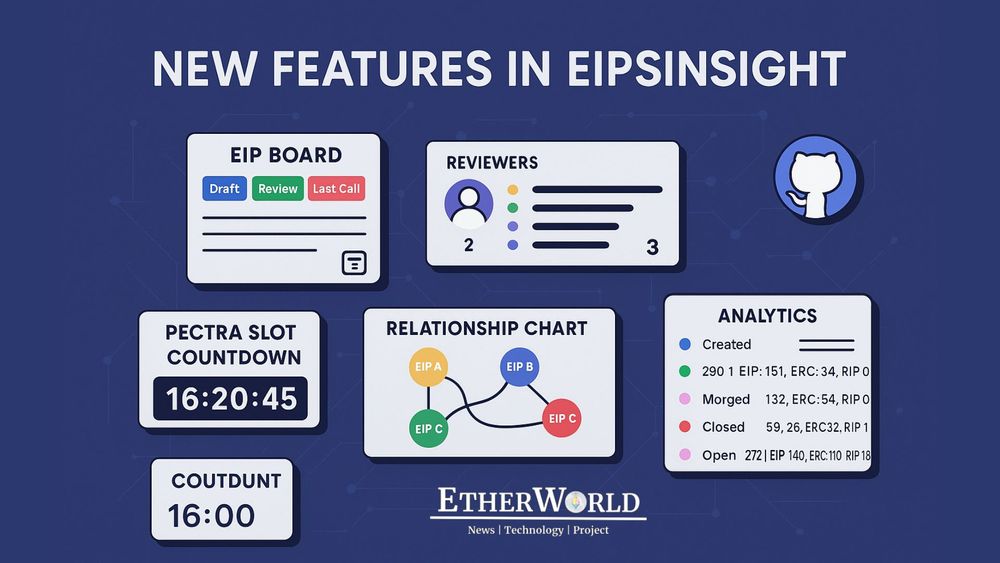
The feature expands on EIPsInsight’s existing effort to make Ethereum standards activity more observable. Earlier versions of the platform introduced proposal dashboards, status-change visualizations, GitHub PR analytics, editor activity tracking, downloadable reports, and tools for identifying long-pending EIP reviews.
EtherWorld covered many of those features in its original introduction to EIPsInsight and a later overview of new EIPsInsight features. The upgrade explorer takes that idea a step further by organizing protocol development around network forks themselves.
For someone studying Ethereum historically, that makes it possible to move from earlier upgrades toward the current roadmap without reconstructing each fork manually. For someone following Ethereum development today, the more useful capability may be filtering proposals according to their current upgrade stage and seeing how the candidate set changes over time.
figuring out which EIPs actually shipped in a given fork means digging through ACD notes, meta-EIPs, and three github threads.
— EIPsInsight (@EIPsInsight) August 11, 2026
so we built the thing that does it.
every EIP, every upgrade, frontier through the forks still in progress. filter by fork, layer, inclusion stage.… pic.twitter.com/gZ9gx0wI8Q
Why Live Upgrade Tracking Matters
Glamsterdam has moved through repeated proposal reviews, CFI decisions, devnets, implementation discussions, and testing milestones. EtherWorld has been documenting this process through its Glamsterdam upgrade resource hub, which brings together roadmap updates, governance developments, testing coverage, and individual proposal discussions.
EIPsInsight already provides a dedicated way to track Glamsterdam, showing proposal buckets, status movement, timelines, search functionality, and upgrade information in a structured dashboard. Testing itself continues to reshape the fork. Earlier this year, Glamsterdam Devnet-2 helped developers narrow its CFI scope while implementation and ePBS work progressed across client teams.
EtherWorld’s Ethereum Protocol Update from ACDC #183 documented Glamsterdam progressing toward later devnets and its first public testnet while Hegota proposals were already entering active discussion. That overlap makes static upgrade lists increasingly insufficient.
Individual proposals can shift significantly during this journey. FOCIL, for example, previously received strong support as a censorship-resistance mechanism. EtherWorld covered EIP-7805’s earlier CFI discussion before subsequent upgrade planning changed where the feature would most appropriately fit.
Turning Ethereum Governance Into Usable Data
Ethereum already has extensive public documentation. The larger opportunity is turning that documentation into information that people can navigate quickly. A client developer may want to find Consensus Layer proposals currently being considered for Hegota.
A researcher may want to compare how many proposals were included across several upgrades. A journalist may need to verify whether an EIP is merely proposed or actually scheduled. A validator may want to identify changes that could affect staking operations. A new contributor may simply want to understand how Ethereum moved from one fork to the next.
It also reflects a broader shift in how Ethereum’s roadmap is being documented. As the ecosystem moves toward more frequent upgrades, development increasingly resembles a continuous pipeline rather than a sequence of isolated hard forks. Glamsterdam can be undergoing devnet testing while Hegota is simultaneously receiving new candidates.
Instead of starting with several GitHub searches and months of meeting notes, users can begin with an upgrade, filter its EIPs, identify their current position, and then investigate the proposals that matter to them. For a protocol whose development happens almost entirely in public, making that public process easier to navigate is increasingly valuable.
To promote your Web3 articles, events, and projects, you may reach out anytime via EtherWorld PR for submissions and collaboration.
Related Articles
- Tracking the Glamsterdam Upgrade on EIPsInsight
- All You Need to Know About Ethereum Glamsterdam Upgrade
- Upgrade Watch #3: Glamsterdam Devnet 7 Nears Final Launch
- State of Upgrade – Hegota Edition #1
- All You Need to Know About Ethereum Hegota Upgrade
To follow blockchain news, track Ethereum protocol progress, and read our latest stories, subscribe to our weekly today.
Join the EtherWorld & Avarch Internship Program and build your career in blockchain, content, social media, video, podcast editing, or operations. Send your resume and brief introduction to contact@etherworld.co.
Disclaimer: The information contained in this website is for general informational purposes only. The content provided on this website, including articles, blog posts, opinions, & analysis related to blockchain technology & cryptocurrencies, is not intended as financial or investment advice. The website & its content should not be relied upon for making financial decisions. Read full disclaimer & privacy policy.
To stay updated on blockchain news, Ethereum protocol progress, and our latest stories, subscribe to our weekly digest and YouTube channel for ELI5 content.
To promote your Web3 articles, events, project updates, and Press Releases, reach out anytime via EtherWorld PR for submissions and collaboration. For other queries, email contact@etherworld.co.
If you’d like to support our work, share the content and consider donating at avarch.eth.
Join our community on Discord and follow us on Twitter, Facebook, LinkedIn & Instagram.

 ×
×

Author

Yash Kamal Chaturvedi is a Blockchain Content & Ops Specialist at Avarch LLC, writing on Ethereum & governance since 2021. Covers ACD/ACDE calls, EIPs, upgrades, staking, security & ecosystem trends.