Lloyds, NatWest & Barclays Execute First Tokenized Deposits
UK banks complete first live tokenized deposit transactions through the Great British Tokenised Deposit initiative, with production and digital bonds planned for 2027.
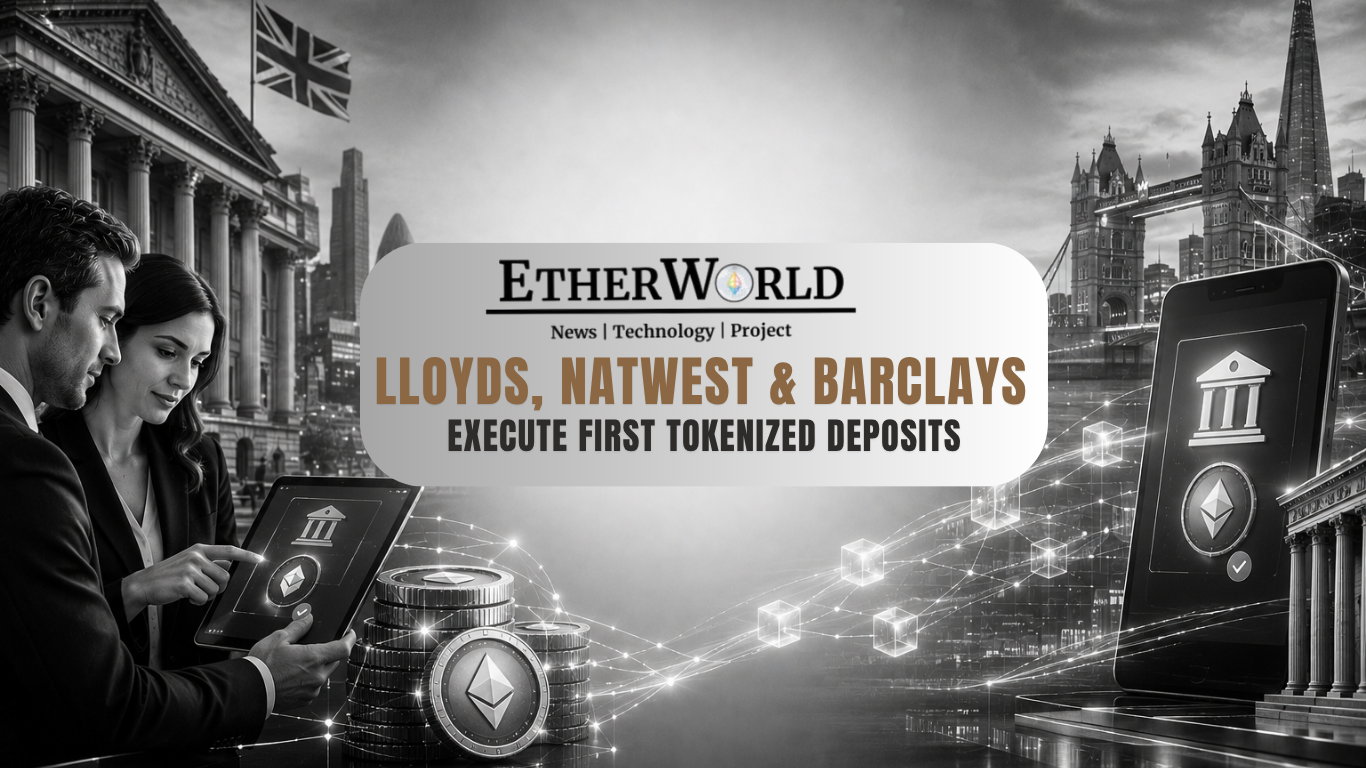
UK banks have completed live customer transactions using tokenised sterling deposits through the Great British Tokenised Deposit initiative. Lloyds, NatWest and Barclays completed two remortgage transactions, while HSBC and other participating banks tested a programmable marketplace payment.
The transactions show how commercial bank money can be programmed to move when certain conditions are met by connecting banks using Quant's shared infrastructure. Tokenised debt instruments and digital asset settlement are the next steps in the project's expansion into widespread production.
Banks Test Real Payment Use Cases
Remortgages and an online marketplace purchase were the main emphasis of the initial live use cases. Deposit funds were locked before the completion of the two remortgage transactions and automatically released upon fulfilment of the necessary conditions. This could cut settlement delays and lessen the need for manual checks. Customers can also continue to earn interest on their money while it is still in their account before completion due to this agreement.
Additionally, the pilots looked at how virtual communication with HM Land Registry could eventually enhance the entire remortgage process.
The marketplace test focused on an alternative payment issue. When a customer purchases a product from a private seller, the payment may be locked in their account, and the tokenised deposit will be released only following the completion of the arranged transaction. Although the test was simulated and no physical products were exchanged, it showed how payment might be directly linked to fulfilment requirements.
Quant Provides Shared Banking Infrastructure
The Great British Tokenised Deposit platform, which Quant created as a shared infrastructure for tokenised commercial bank money, was used to carry out the transactions.
This is important since several banks are involved in the project, as opposed to just a single bank testing its own technological devices. The initiative includes participation from Barclays, HSBC UK, Lloyds Banking Group, Monzo, Nationwide, NatWest, and Santander.
Through a shared, interoperable infrastructure, tokenised deposits can be transferred across institutions thanks to the platform. Linklaters created the rulebooks and offered legal advice, while EY handled project management.
The deposits themselves continue to be representations of money from commercial banks. They provide features like programmability and conditional settlement while maintaining the safeguards of traditional deposits.
UK banks have completed the first live customer transactions using tokenised sterling deposits, and they ran on the #GBTD platform built by Quant.
— Quant (@quantnetwork) September 24, 2026
Delivered through the Great British Tokenised Deposit initiative, convened by @UKFtweets with @Barclays, @HSBC_UK, @LloydsBank,… pic.twitter.com/oJjQpU2cys
Programmable Money Targets Payment Friction
The project gets a hands-on test of what programmable deposits can truly accomplish due to the live transactions.
In a traditional payment process, different instructions, checks, and confirmations may be required for the money transfer and the event that initiates it. The GBTD pilots connect those components. Money may be locked until a predetermined condition is met, at which point it may be automatically released.
In addition to reducing fraud and boosting trust between buyers and sellers, this strategy might allow consumers more choice over when their money flows.
Alongside this effort, the Bank of England, HM Treasury, the Financial Conduct Authority, and the Payment Systems Regulator are working on the future of payments in the UK. Therefore, the emphasis is on adding programmable functionality while maintaining the current features of commercial bank money rather than just integrating bank deposits into digital infrastructure.
GBTD Expands Into Digital Assets
At this point, the project is going beyond the initial customer transactions. In Q1 2027, additional tests are expected to test digital asset settlement by linking tokenised customer funds with digital assets for concurrent exchange.
Tokenised deposits will be used to settle and exchange digital debt instruments issued by the participating institutions. Tokenised deposits are also anticipated to be used for the payment of coupons on those securities.
This will link the movement of an asset with the equivalent movement of money and reserves, enabling the project to evaluate delivery versus payment versus reserves.
Digital asset settlement, remortgage transactions, and person-to-person marketplace payments are the three targeted areas of use covered by the larger GBTD program. Therefore, rather than being a stand-alone banking trial, its current live transactions are the starting point of a larger infrastructure initiative.
If you find any issues in this article or notice missing information, please feel free to reach out at team@etherworld.co for clarifications or updates.
To promote your Web3 articles, events, and projects, you may reach out anytime via EtherWorld PR for submissions and collaboration.
Related Articles
- Stripe Closures Push Startups Toward Stablecoins
- BlackRock Sees AI Creating New Crypto Demand
- How SBF Lost the Domain Uniswap Refused to Buy
- Safari Zero Day Puts iPhone Crypto Keys at Risk
- Apple & Google Push Deeper Into Tokenziation & Stablecoins
To follow blockchain news, track Ethereum protocol progress, and read our latest stories, subscribe to our weekly today.
Join the EtherWorld & Avarch Internship Program and build your career in blockchain, content, social media, video, podcast editing, or operations. Send your resume and brief introduction to contact@etherworld.co.
Disclaimer: The information contained in this website is for general informational purposes only. The content provided on this website, including articles, blog posts, opinions, & analysis related to blockchain technology & cryptocurrencies, is not intended as financial or investment advice. The website & its content should not be relied upon for making financial decisions. Read full disclaimer & privacy policy.
To stay updated on blockchain news, Ethereum protocol progress, and our latest stories, subscribe to our weekly digest and YouTube channel for ELI5 content.
To promote your Web3 articles, events, project updates, and Press Releases, reach out anytime via EtherWorld PR for submissions and collaboration. For other queries, email contact@etherworld.co.
If you’d like to support our work, share the content and consider donating at avarch.eth.
Join our community on Discord and follow us on Twitter, Facebook, LinkedIn & Instagram.

 ×
×

Author

Nidhi Kumari is a Web3 content writer at EtherWorld.co, tracking ecosystem developments, funding activity, and market trends shaping the crypto space.