Highlights from the All Core Developers Consensus (ACDC) Call #171
Ethereum core devs finalize Glamsterdam scope, retain Trustless Payments, CFI key EIPs & move FOCIL to HEKA after an intense governance debate.
ACDC #171 on 11 December 2025 ended up being one of those calls where routine status updates slowly turned into bigger questions about how Ethereum should move forward. What began as a simple post-Fusaka review quickly opened into a wider conversation about upgrade pacing, how closely the community should adhere to the new process rules, & how to balance expectations that have been building across the ecosystem for months.
During the call, developers walked through Fusaka’s early behaviour on mainnet, tied up the last loose ends for the Glamsterdam fork, debated the path forward for FOCIL, & set the timeline for choosing headliners for the upcoming Heka/Bogotá upgrade.
Fusaka Updates
The call opened with a retrospective on Fusaka’s mainnet rollout, which core devs described as “smooth overall,” reinforced by successful testing during BPO1 just days earlier. But not everything was frictionless. Prysm users reported attestation drops tied to disk-write bottlenecks.
Prysm shipped a quick-fix hotpatch (7.0.1) along with feature updates, while Teku developers signalled more refinements coming in the next week.
Prysm v7.1.0 is now live
If you're still on v7.0.0, move to v7.0.1 or later and drop the flag --disable-last-epoch-targets
Highlights:
1. Backfill for Fulu
Checkpoint sync now backfills data columns. Turn it on with --enable-backfill.
2. Semi supernode mode… pic.twitter.com/2NC7yJWVtI— Prysm Ethereum Client (@prylabs) December 10, 2025
Glamsterdam Updates
A key agenda item was Trustless Payments, a critical part of the ePBS design for Glamsterdam. Across several ACDC calls and breakout discussions, builders and raised concerns about how the feature would operate in practice, especially with respect to staked relays and their churn behaviour.
Despite the concerns, no one identified a security issue serious enough to justify removing the feature. With that in mind, developers confirmed that Trustless Payments will remain in the Glamsterdam upgrade.
Core developers also noted the community fatigue created by the long debate, but said that the wide range of feedback ultimately strengthened their confidence in keeping the feature. One of the more technical discussions centered on whether builders should continue to operate as validators.
Builder teams suggested a different model where they would keep their stake but not act as validators. This would let them enter the system more quickly without churn delays, while still ensuring they have funds at risk if they behave incorrectly.
Removing validator duties, however, comes with clear tradeoffs.
- It would help avoid churn bottlenecks and create a cleaner protocol surface, and in some cases it would simplify parts of the design.
- But it would also remove the ability for validators to submit bids, weaken the fallback guarantees that rely on self building, and force changes to several parts of the ePBS architecture.
Because this idea touches core assumptions about how block production stays decentralized, developers agreed that it needs deeper examination in dedicated ePBS breakout calls.
The longest segment of ACDC #171 revolved around FOCIL. FOCIL has strong support from L2s, intent-protocol designers, & censorship-resistance researchers. But the process for including it in Glamsterdam or HEKA created intense disagreement. FOCIl strengthens guarantees for protocols that rely on timely inclusion:
- Optimistic rollups
- Intent settlement layers
- Prediction markets
- Exit windows in staking & bridging protocols
- Any system with challenge periods or fraud-proof timers
Analysis cited during the call suggested FOCIL improves censorship-resistance economics by roughly an order of magnitude in certain attack models, by making it far more expensive for an attacker to keep censoring a target transaction compared to the honest user’s cost to fight back.
Ethereum recently adopted a structured headliner-first upgrade process. Short-circuiting that process by pre-declaring FOCIL’s inclusion risked undermining the very governance reforms that were meant to stabilize the upgrade pipeline.
Some participants argued that “credible commitments” to ship a feature must not override the shared rules of decision-making. After an extended debate, the room converged on a compromise:
- FOCIL is DFI for Glamsterdam (Deferred for Inclusion, not shipped in this fork).
- FOCIL is CFI for HEKA (Considered for Inclusion in the next upgrade).
By the end of the call, Glamsterdam’s scope was essentially locked.
CFI for Glamsterdam
- Trustless Payments (retained as originally specified within ePBS)
- EIP-7688 addresses the issue of Ethereum's consensus data structures becoming incompatible across forks due to changes in Simple Serialize (SSZ) merkleization, requiring frequent updates to verifier implementations.
- EIP-8061 addresses exit queue congestion and slow validator set consolidation in Ethereum, improving staking liquidity and network responsiveness to operational changes.
- EIP-8080 – Consolidated validator withdrawal fix
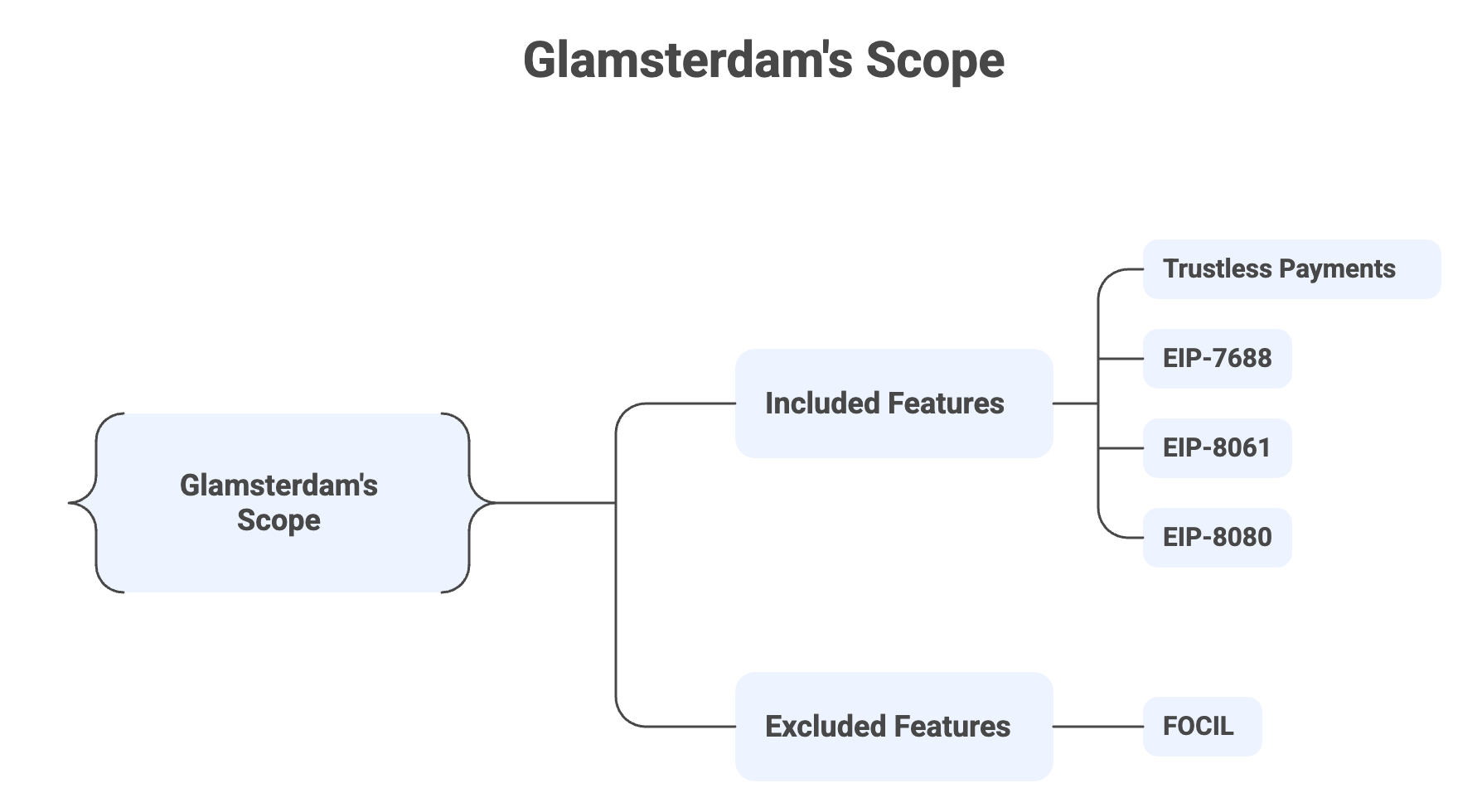
This marks the completion of Glamsterdam’s scoping phase. The next milestones are Devnets, starting with intense focus on EPBS stability, performance & cross-client interoperability.
Heka/Bogotá Updates
With Glamsterdam’s scope set, Ethereum’s next upgrade, i.e., Heka/Bogotá enters the framing stage. The call outlined a structured workflow:
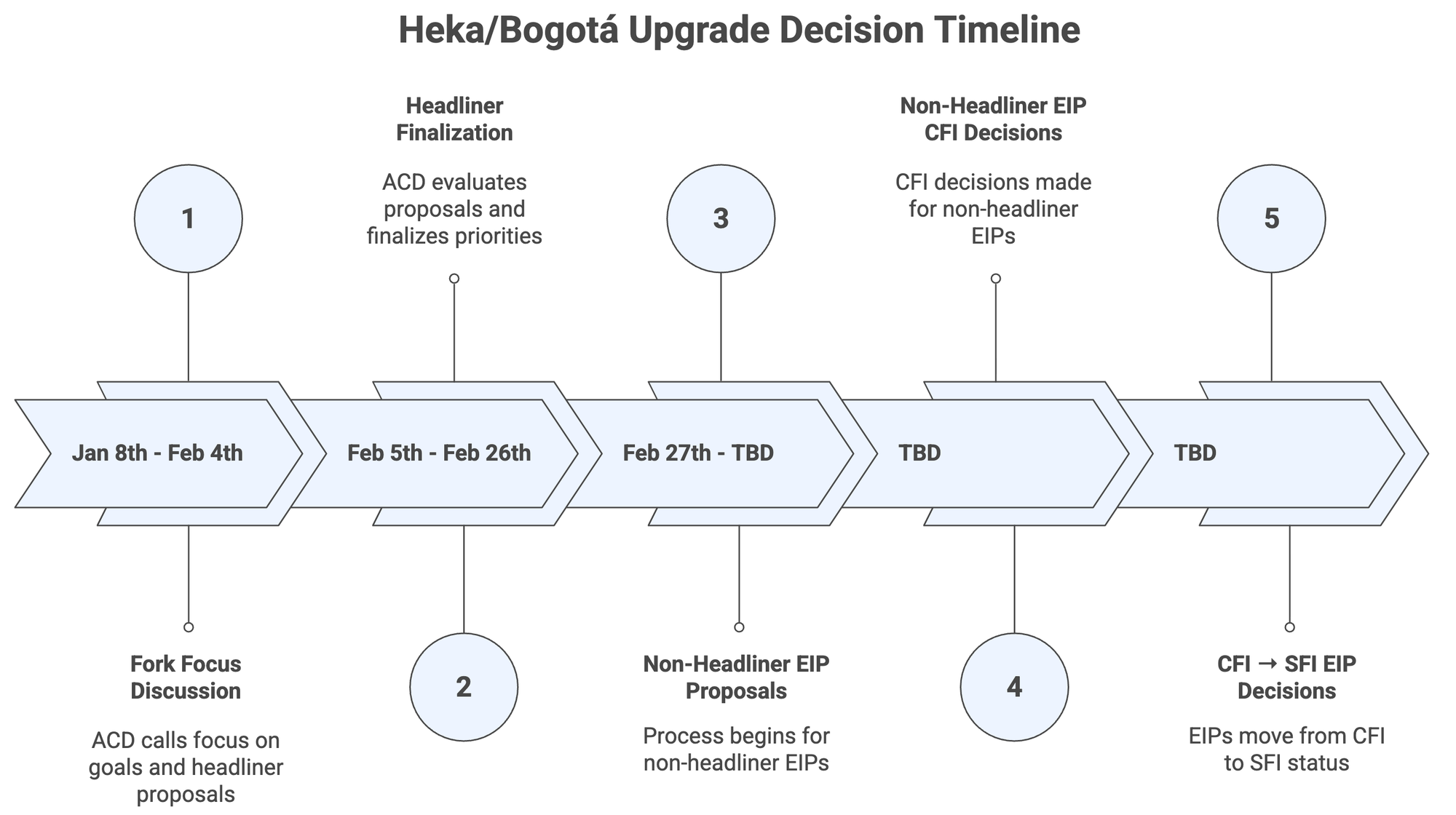
This structured workflow was praised for giving developers breathing room & ensuring major EIPs receive ecosystem-wide scrutiny before inclusion. It also offers a clear narrative for the wider community about when & how big protocol decisions are made.
Glamsterdam remains focused enough to ship on time. FOCIL is not rejected but routed into the Heka headliner process, giving it a credible path forward. Trustless Payments, stable containers and staking improvements continue as planned, while the broader community, from institutions to L2 teams, played a visible role in shaping the outcome.
The call made it clear that Ethereum’s path is no longer defined only by technical ambition. It now depends just as much on a process that is predictable, transparent and able to carry the ecosystem with it, even when that means delaying a widely supported feature to preserve trust in how upgrades are chosen and delivered.
If you find any issues in this blog or notice any missing information, please feel free to reach out at yash@etherworld.co for clarifications or updates.
Related Articles
- Highlights of Ethereum's All Core Devs Meeting (ACDC) #153
- Highlights of Ethereum's All Core Devs Meeting (ACDE) #207
- Highlights of Ethereum's All Core Devs Meeting (ACDC) #152
- Highlights of Ethereum's All Core Devs Meeting (ACDE) #206
- Highlights of Ethereum's All Core Devs Meeting (ACDE) #205
Disclaimer: The information contained in this website is for general informational purposes only. The content provided on this website, including articles, blog posts, opinions, & analysis related to blockchain technology & cryptocurrencies, is not intended as financial or investment advice. The website & its content should not be relied upon for making financial decisions. Read full disclaimer & privacy policy.
For Press Releases, project updates & guest posts publishing with us, email contact@etherworld.co.
Subscribe to EtherWorld YouTube channel for ELI5 content.
Share if you like the content. Donate at avarch.eth.
You've something to share with the blockchain community, join us on Discord!

 ×
×

Author

Yash Kamal Chaturvedi is a Blockchain Content & Ops Specialist at Avarch LLC, writing on Ethereum & governance since 2021. Covers ACD/ACDE calls, EIPs, upgrades, staking, security & ecosystem trends.