Gnosis & Zisk Launch Ethereum Economic Zone
Gnosis & Zisk, funded by the Ethereum Foundation propose a framework to connect Ethereum’s L2's through Ethereum Economic Zone.

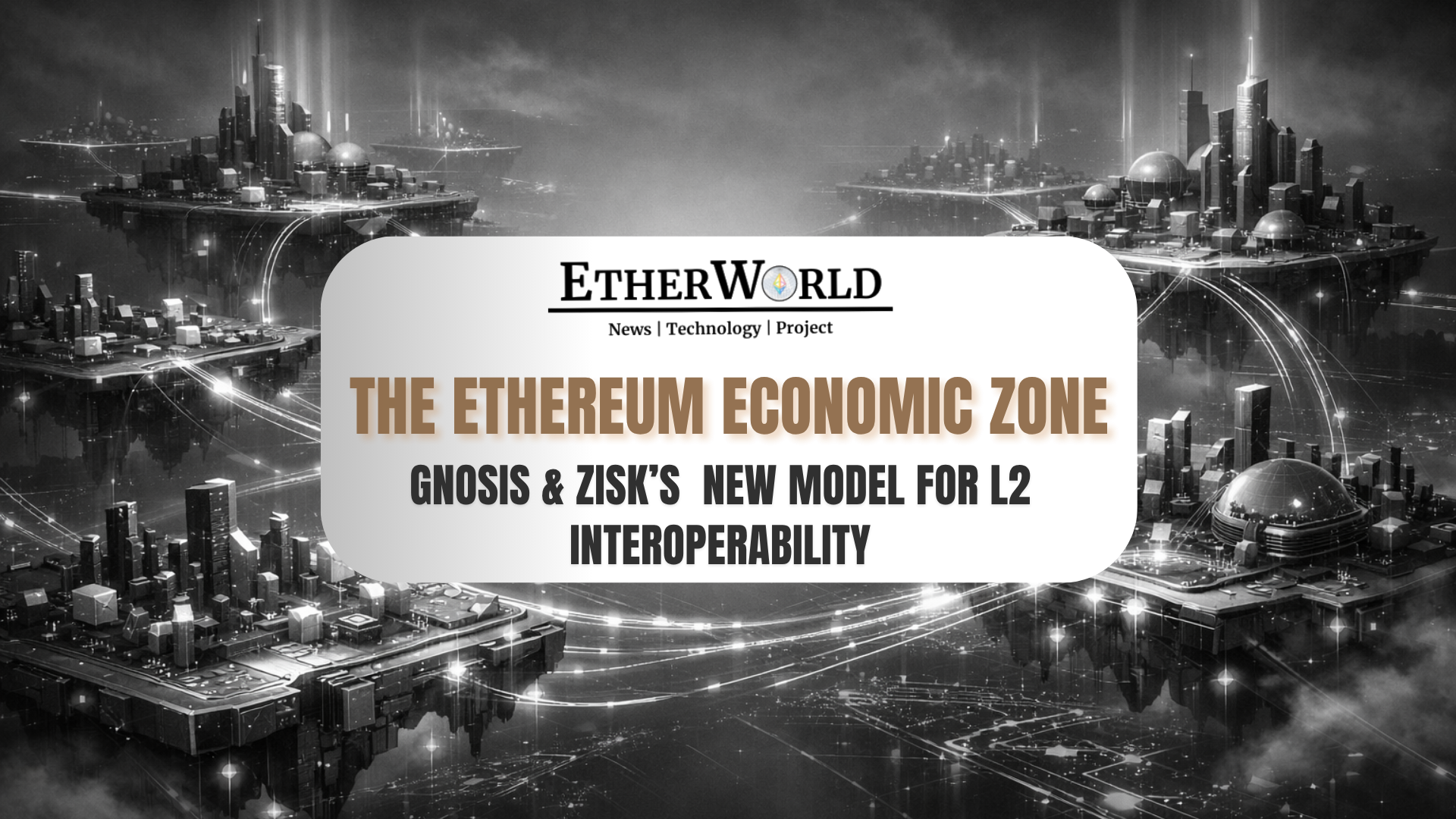
Ethereum scaling worked, transactions got cheaper, throughput went up & a L2s launched to meet demands. Each one became its own island, separate liquidity, separate deployments, separate bridges that take a cut every time you try to move between them. Gnosis & Zisk, with co-funding from the Ethereum Foundation, announced the Ethereum Economic Zone Rollup Framework at EthCC in Cannes on March 29, 2026. The pitch is to stop building more islands & start connecting the ones already there.
- The Fragmentation Problem EEZ Is Built to Solve
- How Synchronous Composability Actually Works
- The Alliance Behind It
- Where This Sits in the Broader Ethereum Landscape
The Fragmentation Problem EEZ Is Built to Solve
If you have ever tried moving assets between two L2s, you already understand the problem better than any whitepaper can explain it. You find a bridge, you approve something, you wait, you wait again on the other side & you end up with slightly less than you started with & no clear sense of where the rest went. Itsn't really a great experience.
For protocols, it is more of a structural headache where Every L2 deployment is a fresh start: new liquidity pools, new bootstrap effort, same users spread thinner across more chains. The deep liquidity sitting on Ethereum mainnet might as well be on a different planet if your users are on a rollup & there is a bridge standing between the two.
https://t.co/4KE6zrZpfq— Gnosis (@gnosis_) March 29, 2026
Gnosis co-founder Friederike Ernst put it well at EthCC: Ethereum does not have a scaling problem, it has a fragmentation problem. EEZ is the attempt to fix it not by creating yet another isolated environment, but by connecting existing ones into something that actually behaves like a single DeFi economy.
How Synchronous Composability Actually Works
The core idea here is synchronous composability. A smart contract on an EEZ rollup can call a contract on Ethereum mainnet or on another EEZ rollup,inside one atomic transaction. Everything either goes through or everything reverts. No partial outcomes, no bridge exploits in the gap between chains, no wrapped assets carrying extra risk.
Today's bridges are asynchronous, meaning that a transaction on one chain kicks off a separate transaction on another, with a window in between where things can go sideways. Synchronous composability closes that entirely. Same block & same security model as deploying natively on L1.
The ZK proving layer that makes this possible comes from Zisk, founded by Jordi Baylina, who built Circom & was a core contributor to Polygon zkEVM. Zisk's real-time ZK proving stack handles the cross-chain verification without adding any new trust assumptions. ETH is the gas token throughout, so there is no new network token you need to hold to use any of this.
What this looks like in practice: a protocol on an EEZ rollup calls into Uniswap's mainnet liquidity pools in the same transaction as a local operation.
The Alliance Behind It
EEZ will be governed as a credibly neutral Swiss non-profit with fully open-source software. The goal over time is to reduce governance to a minimum & eventually make the framework non-upgradable. That is the right structure for something that needs competing protocols to trust it, nobody adopts an interoperability standard if the entity running it could change the rules.
The founding EEZ Alliance includes Aave, Flashbots, Nethermind, Centrifuge, Safe, CoW Swap, Titan, Beaver Build, Monerium & xStocks. That covers DeFi lending, block building, core infrastructure, real-world assets and tokenised equities.
Gnosis being involved is a slightly interesting detail. They run their own L1, so advocating for a framework that strengthens Ethereum L2s is not very obvious. The team has been upfront about it & they see EEZ as complementary to Gnosis Chain, & there are open community discussions about how Gnosis Chain might integrate with the framework, including roles for GNO token holders & validators.
Where This Sits in the Broader Ethereum Landscape
This is not the first attempt at the fragmentation problem. Optimism's Superchain, Polygon's AggLayer & several Ethereum Foundation interoperability workstreams are all working on versions of it. The Ethereum Foundation's ongoing commitment to protocol security & scalability which is evident in initiatives like the $2 million Fusaka audit contest & discussions at All Core Developers calls, shows the kind of research-level seriousness that co-funding EEZ signals. What EEZ is claiming is a stronger guarantee, synchronous atomicity with real-time ZK proofs & no additional trust assumptions beyond Ethereum L1. Whether that claim holds up will become clearer when the technical specs land in the coming weeks.
Worth being clear: this was an announcement & not quite a launch just yet. No live rollups, no mainnet deployment yet. Technical architecture, benchmarks, & developer tooling are all coming. But the problem is genuinely unsolved, the people involved know the stack deeply, & starting with an alliance that already includes Aave & Flashbots is not a bad position to be in.
If you find any issues in this article or notice missing information, please feel free to reach out at team@etherworld.co for clarifications or updates.
To promote your Web3 articles, events, & projects, you may reach out anytime via EtherWorld PR for submissions & collaboration.
Related Articles
- Ethereum Foundation Redraws the Map Between L1 & L2
- Ethereum Foundation's First-Ever Treasury Policy Explained
- Ethereum Launches $2 Million Fusaka Audit Contest to Fortify Protocol Security
- Highlights from the All Core Developers Execution (ACDE) Call #218
- MetaMask's Stablecoin Earn Goes Live With Aave
To follow blockchain news, track Ethereum protocol progress, and read our latest stories, subscribe to our weekly today.
Disclaimer: The information contained in this website is for general informational purposes only. The content provided on this website, including articles, blog posts, opinions, & analysis related to blockchain technology & cryptocurrencies, is not intended as financial or investment advice. The website & its content should not be relied upon for making financial decisions. Read full disclaimer & privacy policy.
To stay updated on blockchain news, Ethereum protocol progress, and our latest stories, subscribe to our weekly digest and YouTube channel for ELI5 content.
To promote your Web3 articles, events, project updates, and Press Releases, reach out anytime via EtherWorld PR for submissions and collaboration. For other queries, email contact@etherworld.co.
If you’d like to support our work, share the content and consider donating at avarch.eth.
Join our community on Discord and follow us on Twitter, Facebook, LinkedIn & Instagram.

 ×
×