Ethereum Plans Quantum Safe Cryptography by 2029
Ethereum Foundation doubles its protocol security team as AI and quantum threats accelerate plans for hash based signatures and a 2029 security upgrade.

The Ethereum Foundation is expanding its protocol security team as it prepares the network for threats from artificial intelligence and quantum computing. The Foundation has doubled the team responsible for protocol security, making cryptographic protection a priority across Ethereum's infrastructure.
While quantum computers remain a major long term concern, the Foundation considers rapidly advancing AI a more immediate risk. Its plan involves replacing vulnerable cryptographic systems with hash based alternatives, with a target of completing the transition by 2029.
Ethereum Foundation Doubles Protocol Security Team
The Ethereum Foundation has doubled the size of its protocol security team to accelerate preparations for a post AI and post quantum environment. The decision follows growing concerns that artificial intelligence models are becoming capable of identifying software vulnerabilities faster than human developers can review them.
The Foundation has also warned that AI systems are beginning to improve established algorithms, raising questions about the long term reliability of mathematical assumptions used in cryptography.
According to its November 23 announcement, AI has become a more urgent security concern than quantum computing. This does not mean AI can already break Ethereum's cryptography. Instead, the Foundation wants to strengthen the network before increasingly capable models create new risks.
Ethereum Plans Hash Based Signatures Using Keccak 256
A central part of Ethereum's security plan is replacing elliptic curve cryptography with hash based cryptography. The proposed changes cover three important areas of the network.
Validators will move towards hash based keys so that consensus finality no longer depends on elliptic curves. User accounts and wallets will receive support for migrating to hash based signatures, while data blobs will transition to hash based commitments.
On November 24, Ethereum Foundation researchers recommended Keccak 256 as the preferred hash function for this transition. The selection followed an assessment of five candidates, including Poseidon, BLAKE3, BLAKE2 and SHA2 256.
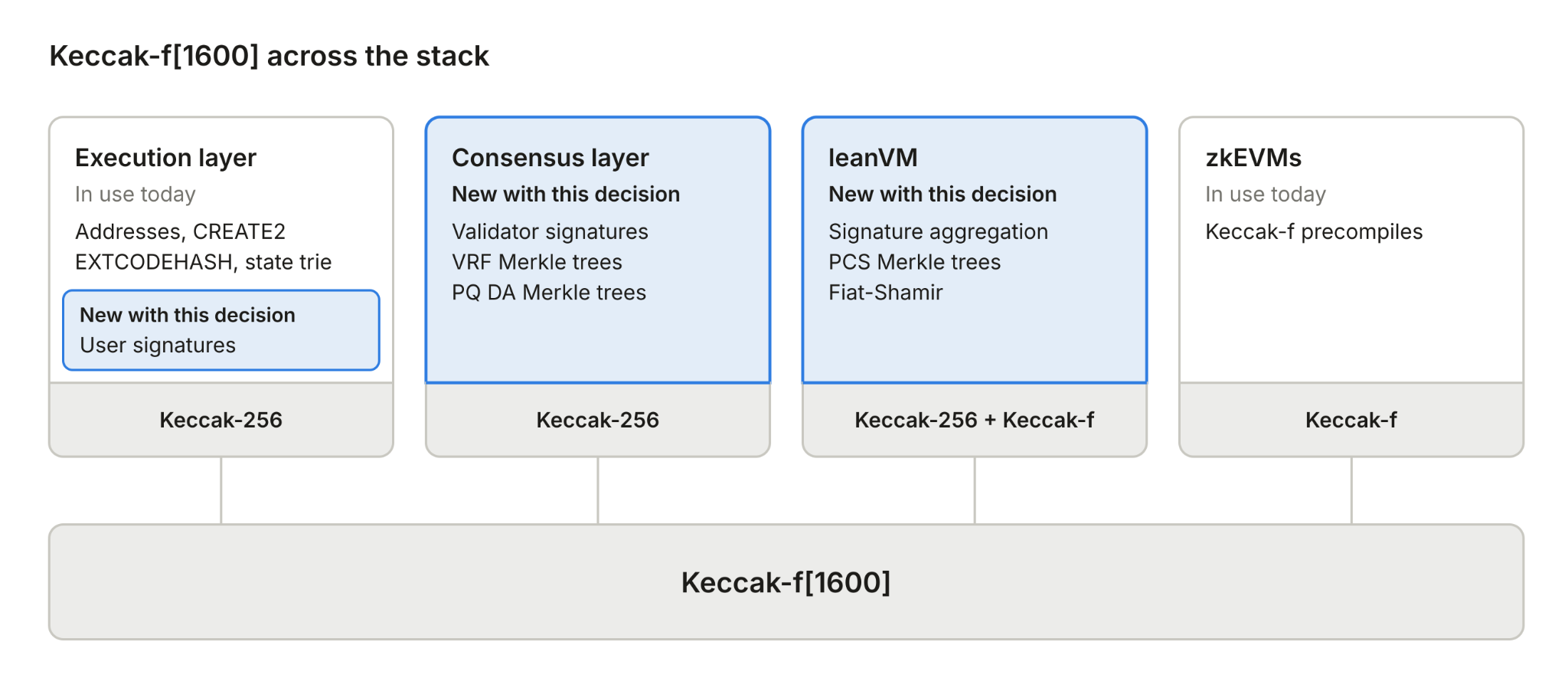
Researchers favoured Keccak 256 because of its extensive cryptanalysis history, security margin and existing use across Ethereum. This approach also avoids introducing another general purpose hash function into the protocol.
Ethereum Targets December 2028 & 2029 for the Upgrade
Ethereum's post quantum transition is expected to require several years of engineering and testing. During Devcon in Mumbai, researcher Justin Drake proposed December 2028 as a target for completing the major changes.
The Ethereum Foundation currently maintains 2029 as its internal deadline, with a timeline review planned for January 2027.
The transition is expected to be more complicated than The Merge in September 2022. That upgrade replaced Ethereum's consensus mechanism while keeping the network operational. The upcoming security overhaul involves changes to validators, wallets, staking pools, smart contracts and data infrastructure.
The Foundation also needs to manage the impact of larger signatures on hardware requirements. Its objective is to introduce stronger cryptography without making it significantly harder for independent participants to operate Ethereum nodes.
Swift & Algorand Highlight the Need for Cryptographic Agility
Ethereum's preparations reflect a wider concern across the financial technology industry. Financial infrastructure providers, including Swift, have highlighted the importance of cryptographic agility, which allows systems to replace vulnerable cryptographic methods without disrupting essential operations.
The concern is particularly relevant for financial networks that depend on long term data protection and secure transactions. Maintaining trust requires systems to adapt as computing capabilities and security threats change.
Q-Day is coming. Are we ready?
Quantum computing could reshape the foundations of financial security as we know them.
Preparing for that future starts now, and it will take the financial community working together.
In the latest article in our Perspectives series, Michael Manos explores how organisations can understand their exposure, build cryptographic agility and work collectively to protect trust. https://t.co/dVLJ9h2N1V
QuantumComputing
— Swift (@swiftcommunity) November 24, 2026
Algorand has also moved ahead with post quantum cryptography in its production network, providing an example of how blockchain projects can introduce quantum resistant technology before large scale quantum computers become available.
For Ethereum, the challenge is considerably broader because the transition must cover the consensus layer, user accounts and data commitments across a decentralised ecosystem.
If you find any issues in this article or notice missing information, please feel free to reach out at team@etherworld.co for clarifications or updates.
To promote your Web3 articles, events, and projects, you may reach out anytime via EtherWorld PR for submissions and collaboration.
Related Articles
- Vitalik’s Bitcoin-Inspired Plan for Ethereum
- Vitalik Buterin Explains Diamond iO for Ethereum
- Ethereum’s Roadmap Just Changed. Here’s What’s Next
- AGI Could Change Humanity Forever, Says Vitalik Buterin
- Vitalik Buterin Outlines Ethereum's Lean Vision
To follow blockchain news, track Ethereum protocol progress, and read our latest stories, subscribe to our weekly today.
Join the EtherWorld & Avarch Internship Program and build your career in blockchain, content, social media, video, podcast editing, or operations. Send your resume and brief introduction to contact@etherworld.co.
Disclaimer: The information contained in this website is for general informational purposes only. The content provided on this website, including articles, blog posts, opinions, & analysis related to blockchain technology & cryptocurrencies, is not intended as financial or investment advice. The website & its content should not be relied upon for making financial decisions. Read full disclaimer & privacy policy.
To stay updated on blockchain news, Ethereum protocol progress, and our latest stories, subscribe to our weekly digest and YouTube channel for ELI5 content.
To promote your Web3 articles, events, project updates, and Press Releases, reach out anytime via EtherWorld PR for submissions and collaboration. For other queries, email contact@etherworld.co.
If you’d like to support our work, share the content and consider donating at avarch.eth.
Join our community on Discord and follow us on Twitter, Facebook, LinkedIn & Instagram.

 ×

Author

Nidhi Kumari is a Web3 content writer at EtherWorld.co, tracking ecosystem developments, funding activity, and market trends shaping the crypto space.