Bitcoin's New Quantum Defense Starts With BIP-361
Bitcoin's BIP-361 proposes blocking quantum-vulnerable wallets, retiring legacy signatures, and introducing a recovery path after a five-year transition.

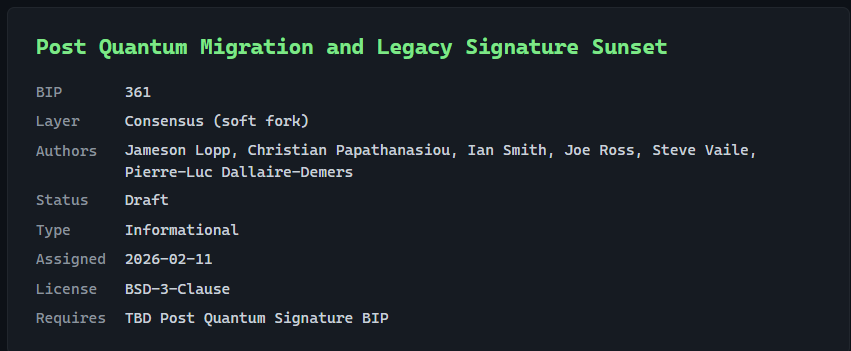
BIP-361, a draft proposal by Bitcoin developers, aims to gradually phase out unsecured wallet types in order to safeguard the network against potential threats from quantum computing in the future. The idea sets a defined migration plan for consumers holding bitcoin in legacy addresses rather than waiting for quantum attacks to become a serious concern. Three significant modifications are included, i.e., retiring legacy ECDSA and Schnorr signatures after five years, preventing new Bitcoin from being transmitted to quantum-vulnerable addresses, and investigating a recovery mechanism for users who neglect to relocate their assets on time.
Protecting Quantum Vulnerable Wallets
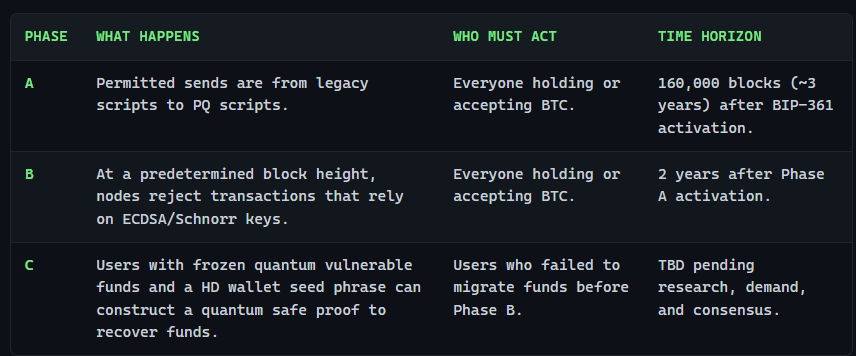
The primary goal of BIP-361's first step is to prevent the issue from getting more serious. The plan would prevent users from transmitting newly generated bitcoin outputs to addresses that use quantum-vulnerable cryptography once it is activated. Future post-quantum (PQ) address types, which are intended to fight against attacks from advanced quantum computers, are anticipated to replace current ones.
This restriction would only apply to the generation of new outputs for quantum-vulnerable address types. Bitcoin, which is already established, would not be frozen right away. Rather, users would still have five years to relocate their holdings into quantum-resistant addresses before the legacy spending restrictions are lifted.
The proposal states that this method speeds up the adoption of quantum-resistant wallets throughout the Bitcoin ecosystem and gradually lowers the amount of susceptible UTXOs. It gives wallet providers, exchanges, and users time to upgrade their infrastructure while progressively shifting all new transactions toward safer address formats rather than requiring an instant conversion.
Source: BIP-361
Legacy Signatures Face Sunset
The proposal's intended sunsetting of Bitcoin's existing signature systems is the largest improvement. Transactions that rely on outdated ECDSA and Schnorr signatures for vulnerable outputs will no longer be permitted under the new regulations following the five-year transition period introduced by BIP-361.
According to the proposal, users would have several years to transfer their Bitcoin into quantum-safe addresses before the pre-announced "flag day." Developers believe that rather than allowing upgrades to be open-ended perpetually, a set schedule provides a solid reason to migrate.
Rather than being a voluntary recommendation, the proposal characterises this move as a consensus rule revision. Transactions attempting to spend from legacy quantum-vulnerable outputs using the retired signature schemes would be rejected by nodes following the new rules after the transition period.
According to the proposal, this is a defensive mechanism meant to protect Bitcoin from a future situation in which sufficiently powerful quantum computers may steal funds from unprotected wallets by obtaining private keys from exposed public keys. The proposal aims to eliminate such attack channels before it becomes feasible by explicitly stating the expiration date for legacy signatures.
Recovery Mechanism Under Consideration
A hypothetical third phase centred on fund recovery is also outlined in BIP-361, acknowledging that some users might not migrate before the deadline.
The recovery mechanism is still up for community consensus and additional investigation before it is implemented. A zero-knowledge proof linked to a matching BIP-39 seed phrase is one potential way that the proposal proposes for enabling users to demonstrate ownership of their wallets in a quantum-safe manner.
In order to avoid reopening quantum-vulnerable spending mechanisms, this phase is meant to offer a route for legal owners who miss the migration window. The authors stress that the recovery idea is currently being discussed and will be developed independently.
Source: BIP-361
What Happens Next for BIP-361?
BIP-361 believes that the network would be unnecessarily at risk if action were postponed until quantum computers could decrypt Bitcoin's present cryptography. As a result, the proposal incorporates three related measures, i.e., prohibiting new funds from entering vulnerable addresses, setting a five-year deadline for retiring legacy signatures, and investigating a safe recovery mechanism for users who do not move on time.
Before the draft is incorporated into Bitcoin, community discussion and consensus are needed. If implemented, it would be one of the biggest long-term security migrations for Bitcoin, providing users with a clear roadmap for transitioning to a wallet architecture that is resistant to quantum computing while reducing vulnerability to potential cryptographic threats.
If you find any issues in this article or notice missing information, please feel free to reach out at team@etherworld.co for clarifications or updates.
To promote your Web3 articles, events, and projects, you may reach out anytime via EtherWorld PR for submissions and collaboration.
Related Articles
- Linux Foundation Launches x402 AI Payments Foundation
- Coinbase AI Coding Hits 100% as Base Leadership Shifts
- Robinhood Fees Expose Ethereum’s Revenue Dilemma
- Polygon Labs Layoffs as Payments Push Accelerates
- Gauntlet Raises $125M Series C Led by SBI Holdings
To follow blockchain news, track Ethereum protocol progress, and read our latest stories, subscribe to our weekly today.
Join the EtherWorld & Avarch Internship Program and build your career in blockchain, content, social media, video, podcast editing, or operations. Send your resume and brief introduction to contact@etherworld.co.
Disclaimer: The information contained in this website is for general informational purposes only. The content provided on this website, including articles, blog posts, opinions, & analysis related to blockchain technology & cryptocurrencies, is not intended as financial or investment advice. The website & its content should not be relied upon for making financial decisions. Read full disclaimer & privacy policy.
To stay updated on blockchain news, Ethereum protocol progress, and our latest stories, subscribe to our weekly digest and YouTube channel for ELI5 content.
To promote your Web3 articles, events, project updates, and Press Releases, reach out anytime via EtherWorld PR for submissions and collaboration. For other queries, email contact@etherworld.co.
If you’d like to support our work, share the content and consider donating at avarch.eth.
Join our community on Discord and follow us on Twitter, Facebook, LinkedIn & Instagram.

 ×
×

Author

Nidhi Kumari is a Web3 content writer at EtherWorld.co, tracking ecosystem developments, funding activity, and market trends shaping the crypto space.