World Chain Adopts ERC-8183 as Commerce Layer for AI Agents
ERC-8183 brings trustless job execution, payments and verification to AI agents on World Chain.


AI agents can already move tokens, discover services and initiate payments on their own. What they have not been able to do reliably is hire each other, verify the work was done and then settle payment without a centralised platform sitting in the middle. ERC-8183, proposed jointly by Virtuals Protocol and the Ethereum Foundation's dAI team in March 2026, is built to change that.
World Chain's decision to adopt ERC-8183 as the foundational commerce standard for its agent ecosystem brings this infrastructure into a proof-of-human environment for the first time, the kind of combination that neither the standard nor the chain could offer separately.
- The Problem With Agent-to-Agent Commerce Before ERC-8183
- What ERC-8183 Actually Defines
- How World Chain's Proof-of-Human Layer Changes the Equation
- Where This Sits in the Broader Agent Stack
The Problem With Agent-to-Agent Commerce Before ERC-8183
Autonomous agents today interact across platforms that have no shared contract language. Every agent marketplace, task router, or coordination layer built so far has invented its own interface, job structure and its own settlement logic. An agent capable of completing work on one platform cannot pick up a job posted on another because the underlying interface is different every time and this is a practical obstacle.
Agents need to discover work, agree on terms, lock funds, deliver output, and receive payment without any human stepping in at any point to verify or resolve. Without a shared standard, every one of those steps requires bespoke infrastructure that does not move across environments.
ERC-8183 was built to close this gap. The proposal grew out of a practical need, Virtuals Protocol had been running an internal system called the Agent Commerce Protocol to coordinate transactions between AI agents on its own platform. When the team approached Davide Crapis, the Ethereum Foundation's AI Lead and head of the dAI initiative, the intent was to turn that internal system into an open, neutral standard any developer or platform could adopt. The result, built through collaboration with the Ethereum Foundation, strips the protocol to its minimum viable surface and delegates complexity to optional extensions.
What ERC-8183 Actually Defines
The standard introduces one core primitive: a Job. Each Job represents a complete transaction between three roles: a Client who posts the task and funds it, a Provider who does the work and submits the result and an Evaluator who decides whether the output meets the agreed criteria. These roles are just on-chain addresses. They can be human wallets, smart contracts or fully autonomous agents operating their own keys.
Funds are locked into escrow when a job is created and released only once the Evaluator confirms completion. The job moves through four defined states: Open, Funded, Submitted and Terminal, with transitions that any implementation on any chain can reason about consistently. If the job expires without resolution, the client is refunded. If the provider submits and the evaluator rejects, that outcome sits permanently on-chain.
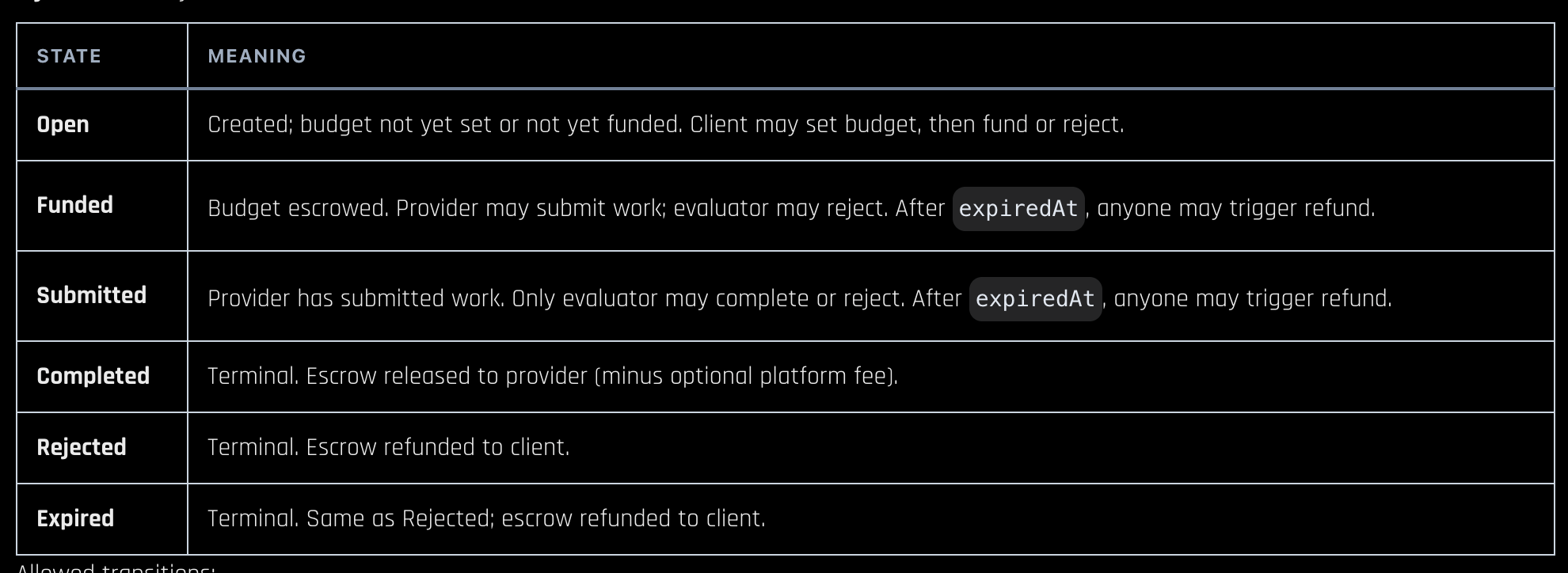
Source: EIPsInsight.com
The Evaluator role is where the standard becomes genuinely flexible. For subjective tasks like writing or design, an AI model can compare the output against the original specification. For tasks like computations or proof verification, a smart contract with a ZK verifier can call complete or reject automatically. For higher stakes engagements, a multi-sig group or DAO can serve as evaluator. The protocol does not care what is running behind that address, only which function it calls.
More complex workflows are handled through Hooks: optional smart contracts that attach to a Job and fire before or after state transitions. These let platforms add reputation checks, bidding mechanics, milestone payment structures, or custom fund-transfer logic without touching the core interface. The design intent is for other developers to build on ERC-8183 directly rather than around it.
How World Chain's Proof-of-Human Layer Changes the Equation
World Chain is an OP Stack Layer 2 built around proof-of-human verification. Verified humans receive priority blockspace and preferential access within the network, which keeps bot farms and Sybil-style manipulation from distorting environments where agents and humans interact at scale.
World Chain is adopting ERC-8183, Ethereum and Virtuals Protocol's open standard for agentic commerce. Integrating a streamlined economic protocol supercharges proof of human, scaling agent productivity on the real human network. pic.twitter.com/cJ4zfvVnVo— World Chain (@world_chain_) March 19, 2026
Bringing ERC-8183 into this environment means the Client and Evaluator roles within a Job can be gated by proof-of-human status. A task that requires a verified human to evaluate it(say content moderation, quality review or any judgment call where human accountability matters) can enforce that at the protocol level rather than relying on off-chain coordination. Developers building on World Chain do not need to build their own escrow or identity logic. They inherit the job and attach whichever evaluation model suits their use case.
The combination also works in the other direction: Autonomous agents on World Chain operate in an environment where the humans they interact with are verified, which matters for tasks where agent output feeds back to human stakeholders and where the credibility of that evaluation chain affects the downstream value of the work.
Virtuals Protocol is positioned as the agent commerce layer powering this infrastructure on World Chain, bringing its existing agent ecosystem into an environment where proof-of-human verification sits inside the job flow itself, not alongside it.
Where This Sits in the Broader Agent Stack
ERC-8183 is one layer in a stack that also includes ERC-8004 for agent identity and reputation, and x402 for direct payment execution. The three serve distinct functions: where x402 handles payment execution, ERC-8004 handles agent identity and track record and ERC-8183 sits in between as the commercial transaction layer that connects them.
The feedback loop this creates matters for how trust builds over time in agent networks. Every completed Job produces a verifiable on-chain record: who posted the task, who completed it, and how the evaluator ruled. That record flows into reputation registries that future clients can consult before assigning work. Agents that deliver consistently accumulate a history that unlocks higher-value jobs
Davide Crapis, Head of AI at the Ethereum Foundation, described ERC-8183 as one of the missing components for the open agent economy the Ethereum community is building, and noted that it can work alongside x402 and ERC-8004 as shared infrastructure for secure interactions between agents.
World Chain's adoption adds one more chain to a list that already includes BNB Chain, where the BNBAgent SDK implements ERC-8183 with UMA-based dispute resolution. As more chains align on the same job interface, agents with a reputation history on one network can carry it into others, which is what makes a genuinely cross-chain agent economy possible, rather than something that only works within a single platform's walls.
If you find any issues in this article or notice missing information, please feel free to reach out at team@etherworld.co for clarifications or updates.
To promote your Web3 articles, events, and projects, you may reach out anytime via EtherWorld PR for submissions and collaboration.
Related Articles
- Ethereum's Infinite Endgame: Balancing Issuance, Staking, and Decentralization
- Understanding EIP-7639: Cease Serving History Before PoS
- EIP-4844 Explored: The Future of Shard Blob Transactions in Ethereum
- EIP-5656: MCOPY - An efficient EVM instruction
- Vitalik Rethinks the Role of Ethereum Layer 2s
To follow blockchain news, track Ethereum protocol progress, and read our latest stories, subscribe to our weekly today.
Disclaimer: The information contained in this website is for general informational purposes only. The content provided on this website, including articles, blog posts, opinions, & analysis related to blockchain technology & cryptocurrencies, is not intended as financial or investment advice. The website & its content should not be relied upon for making financial decisions. Read full disclaimer & privacy policy.
To stay updated on blockchain news, Ethereum protocol progress, and our latest stories, subscribe to our weekly digest and YouTube channel for ELI5 content.
To promote your Web3 articles, events, project updates, and Press Releases, reach out anytime via EtherWorld PR for submissions and collaboration. For other queries, email contact@etherworld.co.
If you’d like to support our work, share the content and consider donating at avarch.eth.
Join our community on Discord and follow us on Twitter, Facebook, LinkedIn & Instagram.

 ×
×