Ethereum Foundation Redraws the Map Between L1 & L2
Ethereum shifts from a rollup-centric model to a multi-layer system where L1 anchors security and L2s drive differentiation and innovation.

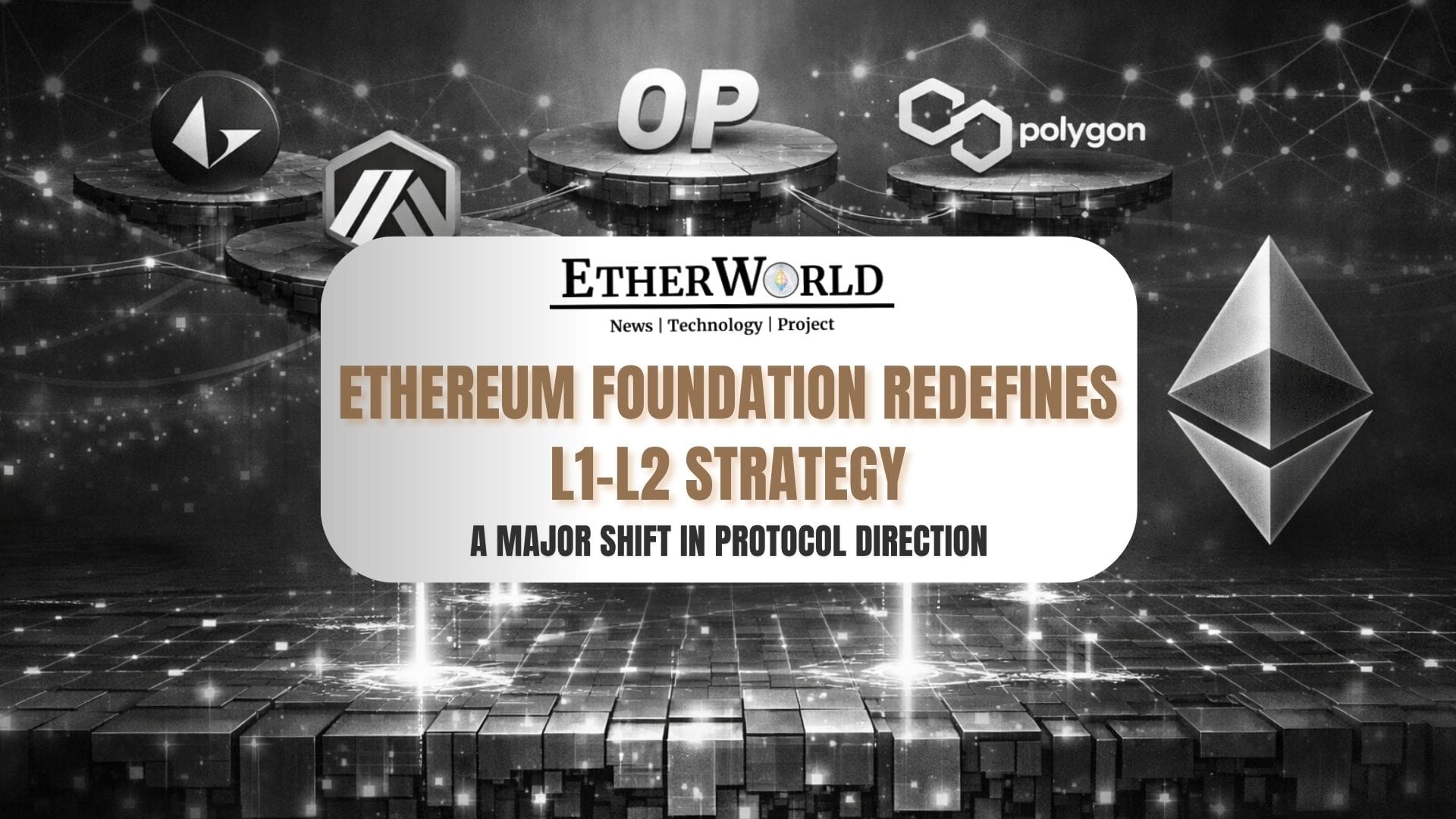
Five years is a long time in Ethereum. The rollup-centric roadmap proposed in 2021 reshaped how the entire ecosystem thought about scaling: Layer 2s were the answer to Ethereum's capacity problem & the job of L2s was essentially to take pressure off the L1 while keeping users within the same trust environment. That was the right framing then. It is no longer the complete picture, & the Ethereum Foundation has now said so officially.
On March 23, 2026, the EF's Platform team published a blog post titled How L1 & L2s can build the strongest possible Ethereum, authored by Josh Rudolf, Julian Ma & Josh Stark. It is the most direct statement the foundation has made about the evolving relationship between the two layers since the rollup-centric roadmap itself.
- What Has Actually Changed
- What L1 Becomes in This Model
- What the EF Is Asking of L2s
- What the EF Is Committing to in Return
What Has Actually Changed
The original rollup-centric roadmap gave L2s one primary job: scale Ethereum. Everything else was secondary. The model worked well enough as a starting point, but the ecosystem that grew out of it looks very different from what was imagined in 2021.
1/ How L1 & L2s can build the strongest possible Ethereum
— joshrudolf.eth (@rudolf6_) March 23, 2026
tldr: we should continue to lean into the unique capabilities of each layer, & make sure all users have a clear path to securely & seamlessly benefit from the core properties of Ethereum pic.twitter.com/jUPNscgSix
L2s like Arbitrum, Base, OP Mainnet, Starknet, Linea are no longer just scaling mechanisms. These are ecosystems in their own right, with their own communities, developer tooling, GTM strategies & economic activity. Some have built features that Ethereum L1 simply cannot offer: ultra-low latency, application-specific sequencing, additional privacy guarantees, compliance-oriented architecture. The value they provide to users is no longer primarily about cheaper transactions it is about capabilities that a single chain cannot provide regardless of how much it scales.
The EF's post acknowledges this shift directly. The primary objective of L2s has moved from scaling to differentiation, control & innovation. Scaling is still valuable but it is no longer the biggest lever. The biggest lever now is what an L2 can do that no other environment can.
What L1 Becomes in This Model
The blog describes it as a truly permissionless & maximally resilient global hub for settlement, shared state, liquidity, & DeFi.
This is not a diminished role but a more demanding one, because it requires L1 to be something that no individual L2 can replace: the neutral, trust-minimised foundation that every chain in the ecosystem can anchor to. The depth of DeFi liquidity on L1, the security guarantees, the decentralisation, these properties are what make it worth being an L2 on Ethereum rather than a standalone chain. The EF is explicit that a stronger L1 provides a better foundation for every L2 sitting above it.
ZK technology is what makes this model viable at scale. The post notes that ZK acceleration has moved faster than anticipated & that Ethereum L1 now has a credible path to scaling by several orders of magnitude while preserving decentralisation & security. Blobs currently sit at roughly 30% capacity with significant headroom to grow. The infrastructure for a much larger Ethereum is being laid & the foundation believes it can grow that infrastructure without compromising the properties that define what Ethereum is.
What the EF Is Asking of L2s
The post contains specific recommendations rather than vague encouragement, which is worth noting. L2s are asked to differentiate in ways that are genuinely complementary to L1 rather than in competition with it. Application-specific chains, privacy-preserving environments, compliance-oriented designs, novel GTM approaches are all framed as healthy & desirable forms of differentiation.
On trust & security, the EF is direct. L2s working toward trust-minimisation should reach at least Stage 1 & pass what the post calls the walkaway test, meaning users should be able to exit safely to L1 even if operators behave maliciously or the security council fails. This is the minimum bar. L2s that want the tightest possible integration with L1 are encouraged to push further: toward Stage 2, synchronous composability, & ultimately native rollups — a model where L2 chains are fully & trustlessly verified by L1 without requiring a security council at all.
Transparency is treated as non-negotiable. The post calls on L2s to be clear with the ecosystem about their actual security properties & their real relationship to L1, with L2Beat named explicitly as the accountability mechanism. The line between claimed security & actual security has been a persistent issue in the L2 space, & the EF is making its position clear: vibes should match substance.
What the EF Is Committing to in Return
The post is not a one-sided ask. The EF outlines concrete commitments in exchange for L2s embracing this vision.
The Platform team, led by Josh Rudolf, was announced in February 2026 as a dedicated interface between L2s & the core protocol roadmap, its purpose is to ensure that L2 needs are reflected in protocol priorities rather than being addressed after the fact. The EF commits to scaling blobs substantially, improving L1 finality & withdrawal speeds, investing in native rollup technology, & working with the ecosystem on interoperability solutions that address the UX & developer fragmentation that multi-chain environments inevitably create.
The fragmentation point is acknowledged honestly. A multichain ecosystem is genuinely more complicated for users & developers to navigate than a single chain would be. The EF does not pretend otherwise. But the argument is that the specialisation & customisation that L2s enable is worth that complexity — provided the foundational interoperability work is done well enough to make the experience feel coherent.
The post closes with a vision of a global, permissionless onchain economy. What the March 23 post adds is a more precise account of how the two-layer architecture gets there by letting each layer do what it is actually best at & building the bridges between them well enough that users do not have to think about where they are.
If you find any issues in this article or notice missing information, please feel free to reach out at team@etherworld.co for clarifications or updates.
To promote your Web3 articles, events, & projects, you may reach out anytime via EtherWorld PR for submissions & collaboration.
Related Articles
- Vitalik Rethinks the Role of Ethereum Layer 2s
- Ethereum has Deployed Another $7.6M Into Morpho! Here's Why
- Ethereum Foundation's First-Ever Treasury Policy Explained
- Ethereum Foundation’s New Research Engine, A Tweet That Changed Everything
To follow blockchain news, track Ethereum protocol progress, and read our latest stories, subscribe to our weekly today.
Disclaimer: The information contained in this website is for general informational purposes only. The content provided on this website, including articles, blog posts, opinions, & analysis related to blockchain technology & cryptocurrencies, is not intended as financial or investment advice. The website & its content should not be relied upon for making financial decisions. Read full disclaimer & privacy policy.
To stay updated on blockchain news, Ethereum protocol progress, and our latest stories, subscribe to our weekly digest and YouTube channel for ELI5 content.
To promote your Web3 articles, events, project updates, and Press Releases, reach out anytime via EtherWorld PR for submissions and collaboration. For other queries, email contact@etherworld.co.
If you’d like to support our work, share the content and consider donating at avarch.eth.
Join our community on Discord and follow us on Twitter, Facebook, LinkedIn & Instagram.