Ethereum has Deployed Another $7.6M Into Morpho! Here's Why
Ethereum Foundation deploys 3,400 ETH into Morpho, highlighting immutable, open-source DeFi aligned with its defipunk treasury framework.

When most organizations move millions of dollars, they put out a press release with a number and a quote from their CFO. The Ethereum Foundation did something different on Wednesday. It deployed another 3,400 ETH, roughly $7.6 million into a DeFi lending protocol called Morpho, and then explained the philosophy behind it. That alone tells you this is a different kind of story.
- What Actually Happened
- The Checklist Behind the Cash
- Ethereum Is Done Selling. Now It's Investing.
- Not Everyone's Convinced
What Actually Happened
The Ethereum Foundation has announced it has deposited another 3,400 ETH, around $7.6 million into Morpho, a lending protocol that lives on Ethereum. Foundations deploy treasury funds all the time. But the way EF explained this one is worth a second look.
0/ The Ethereum Foundation continues to explore DeFi as part of its treasury strategy.
In Oct 2025, EF deployed 2,400 ETH + ~$6M in stablecoins into @Morpho Vaults V1.https://t.co/JC9qOUt76V
Today: another 3,400 ETH into Morpho, where 1,000 ETH in Morpho Vaults V2.
Why Morpho?…— Ethereum Foundation (@ethereumfndn) March 18, 2026
"The underlying question is less about allocation, and more about direction," they wrote in a six-part thread on X. "What kind of DeFi ecosystem is Ethereum aiming to support?"
That's a strange thing to say when you're announcing a multimillion-dollar deposit. Most treasury managers, especially ones sitting on over $820 million in assets, talk about returns, diversification, risk. The Ethereum Foundation is out here asking what kind of world they want to live in. And increasingly, they're putting real money behind the answer.
Most DeFi protocols, even well-intentioned ones, have backdoors: admin keys, upgrade mechanisms, emergency pause buttons. In theory these exist for safety. In practice they mean you're still trusting someone, even if the code is open source. The team could flip a switch. A governance vote could change the rules. A regulator could apply pressure in the right place. Morpho Vaults V2 has none of that. The contracts are immutable. Nobody can touch them, including the Morpho team itself. EF called that "not a limitation" but "the point."
"The true cypherpunk infrastructure doesn't ask you to trust its builders and it removes the need entirely."
— Ethereum Foundation, March 18, 2026
The Checklist Behind the Cash
The other thing that tipped the scales was licensing. Morpho V2 runs on GPL-2.0, a so-called copyleft license that legally requires any future version of the code to stay open source forever. It sounds like a footnote, but it matters more than most people realize. Plenty of protocols launch with open code and good intentions, then quietly close the gates once there's commercial pressure to do so. A competitor emerges, a company acquires the team, or the founders simply decide it's time to monetize. GPL makes that legally impossible, not just unlikely, impossible.
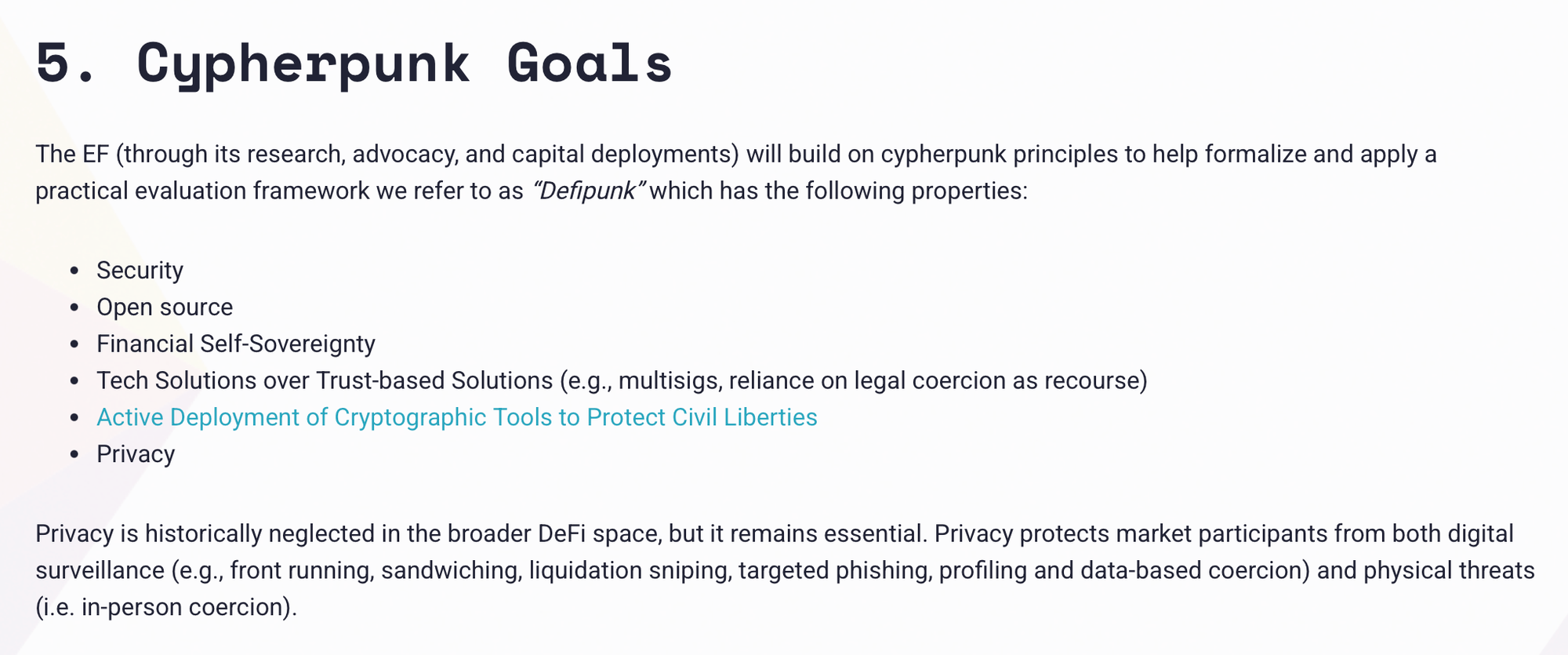
Image source: Ethereum Foundation Blog
This is all part of what EF calls its defipunk framework: a published checklist they use to decide where treasury money goes. The criteria aren't complicated, but they are deliberate: open source code that can never be closed, smart contracts no one can secretly alter, privacy protections baked in from the start, and permissionless access that doesn't require anyone's approval to use. Morpho V2 ticked every box.
The framework was introduced publicly in June 2025 and this is now the second time EF has deployed capital under it. The consistency matters. It signals that this isn't just a philosophy document that sits on a blog, it's an actual decision-making tool with real money attached to it. As one community observer put it: "EF is building a filter that will shape which protocols get legitimacy and liquidity for the next decade."
As for the money itself: 1,000 of the 3,400 ETH went into Morpho Vaults V2 specifically, with the rest going into Morpho's existing V1 infrastructure. This is EF's second Morpho deposit. They put in 2,400 ETH plus around $6M in stablecoins back in October 2025, which was itself the first major deployment under the new defipunk policy. Total commitment to Morpho is now roughly $19 million, sitting inside a broader $112 million DeFi strategy that also includes Aave (~64% of allocation) and Spark (~20%). Morpho now accounts for roughly 17% of that total.
Morpho Vaults V2, launched in late 2025, is not just an upgraded version of the original. It introduces flexible curator and allocator roles, risk caps, optional compliance features for institutional depositors, and what the team calls "in-kind redemptions": a mechanism that allows users to exit their position without waiting for liquidity, using flash loans under the hood. The core contracts, as EF emphasised, remain immutable throughout all of this. The design philosophy, according to Morpho's own documentation, is to give depositors "absolute certainty", a phrase that maps almost word-for-word onto EF's defipunk criteria.
Ethereum Is Done Selling. Now It's Investing.
The EF is quietly changing how it funds itself, and this deposit is the clearest sign yet of how far that shift has gone. For the last few years, the Foundation sold ETH periodically to cover operating costs: salaries, grants, developer events, research. It was the path of least resistance, but it made EF an easy target whenever the market dipped. Every sale looked like a vote of no-confidence in their own asset. Critics weren't entirely wrong to notice.
By deploying into yield-generating DeFi protocols, EF generates operating income without touching the principal. The ETH stays in the ecosystem. The yield covers costs. And perhaps more importantly, the message it sends is the opposite of selling: it says Ethereum's own leadership believes in the long-term value of what they've built, enough to put their treasury to work inside it rather than cashing out.
The @ethereumfndn just allocated 3,400 ETH into Morpho Vaults!
Their reasoning: Morpho is open source and immutable. A deliberate choice we made from day one, not just because we believe in DeFi's ethos, but because it's the only way to build real trust over time.
In DeFi, the… https://t.co/qYO4rZzSMj— Merlin Egalite 🦋 (@MerlinEgalite) March 18, 2026
The community response has been largely positive, with Morpho's own co-founders publicly welcoming the alignment. "In DeFi, the most trustworthy systems are the ones that do not ask you to trust anyone at all," Morpho co-founder Merlin Egalite wrote in response to the announcement, echoing EF's language almost exactly.
Not Everyone's Convinced
A community member posted a fairly pointed thread arguing that Fluid, another lending protocol that grew from an Indian hackathon project into the second-largest DEX and money market on Ethereum, keeps getting passed over despite its rapid growth and deep roots in the Ethereum builder community. His frustration wasn't with Morpho. It was with the pattern: EF doubling down on a protocol they've already backed while a newer, scrappier one with strong Ethereum values gets nothing. The post got nearly 100 likes and kicked off a real argument about whether the defipunk framework is a principled filter or just cover for playing favorites.
The answer to that depends almost entirely on what you think about licensing. Fluid uses BUSL, a more restrictive license that limits commercial copying and gives the issuing team more control over how others can build on their code. Morpho uses GPL, which doesn't. If EF is being taken at their word, that single difference is the deciding factor. Whether it should carry that much weight, whether a licensing choice alone should determine which protocol gets $19 million in institutional backing, is a different and genuinely open debate.
What isn't debatable is that EF has now made their criteria public, applied them twice in a row, and shown they're willing to pass over fast-growing alternatives to stay consistent. That kind of discipline is rare. Whether it's wisdom or stubbornness probably depends on how Morpho performs over the next few years and whether the protocols it didn't pick end up mattering more.
If you find any issues in this article or notice missing information, please feel free to reach out at team@etherworld.co for clarifications or updates.
To promote your Web3 articles, events, and projects, you may reach out anytime via EtherWorld PR for submissions and collaboration.
Related Articles
- Ethereum Foundation's First-Ever Treasury Policy Explained
- Ethereum Foundation's New Research Engine, A Tweet That Changed Everything
- Ethereum Foundation Backs ZKnox for Post-Quantum Security
- "Reconfiguring AllCoreDevs": Tim Beiko's 'Divide and Conquer' Strategy
To follow blockchain news, track Ethereum protocol progress, and read our latest stories, subscribe to our weekly today.
Disclaimer: The information contained in this website is for general informational purposes only. The content provided on this website, including articles, blog posts, opinions, & analysis related to blockchain technology & cryptocurrencies, is not intended as financial or investment advice. The website & its content should not be relied upon for making financial decisions. Read full disclaimer & privacy policy.
To stay updated on blockchain news, Ethereum protocol progress, and our latest stories, subscribe to our weekly digest and YouTube channel for ELI5 content.
To promote your Web3 articles, events, project updates, and Press Releases, reach out anytime via EtherWorld PR for submissions and collaboration. For other queries, email contact@etherworld.co.
If you’d like to support our work, share the content and consider donating at avarch.eth.
Join our community on Discord and follow us on Twitter, Facebook, LinkedIn & Instagram.

 ×
×