ZKsync Brings Private Blockchain Settlement to US Banks
Five U.S. banks are now settling payments on a private Ethereum Layer 2, without leaving the regulated banking system.


Banks have spent over a decade trying to make blockchain work for institutional payments. The problem was that no existing architecture could simultaneously offer privacy, compliance and interoperability on the go. ZKsync's Prividium, developed by Matter Labs, is the attempt to finally solve all three at once.
The announcement came at the DC Blockchain Summit 2026 in Washington D.C., where Matter Labs CEO Alex Gluchowski introduced Prividium alongside the launch of the Cari Network: the first real world deployment of this infrastructure, involving five US regional banks and targeting full production rollout later this year.
- The Problem Banks Could Never Get Around
- What a Prividium Actually Is
- Cari Network and the Tokenised Deposit Distinction
- Who Is Already Involved and Where This Goes
The Problem Banks Could Never Get Around
Public chains like Ethereum expose everything by default. For an institution that cannot afford to reveal its trade positions, client balances, or counterparty relationships, that is simply not workable. Private chains solved the visibility problem but created a different one instead: liquidity trapped inside closed environments with no way to move across banks without bringing in intermediaries and the risk that comes with them.

Source: Zksync
Consortium chains tried to sit in between but never fully delivered on any of the three requirements. The result is that most institutional blockchain activity over the past decade stayed in pilot territory, without ever making it to production at scale.
This is the gap Prividium was built to close. Each bank gets its own private execution environment with full data sovereignty, while all settlement flows through Ethereum mainnet via zero-knowledge proofs. The bank controls its own data completely. Ethereum provides the finality and the ZKsync Elastic Network connects every Prividium to every one natively, without bridges.
The trade off that kept regulated institutions on the sidelines no longer has to exist.
What a Prividium Actually Is
A Prividium runs on a bank's own servers. Transactions are processed privately within that environment and never published to any public chain in readable form. Instead, the system generates a zero-knowledge proof(a compact cryptographic output that confirms all transactions are valid without disclosing what they actually are).
That proof is what gets posted to Ethereum. Regulators can be granted selective read access to verify compliance without any data being visible to competitors or the publicand this is how the architecture delivers privacy and auditability at the same time, rather than treating them as opposites.
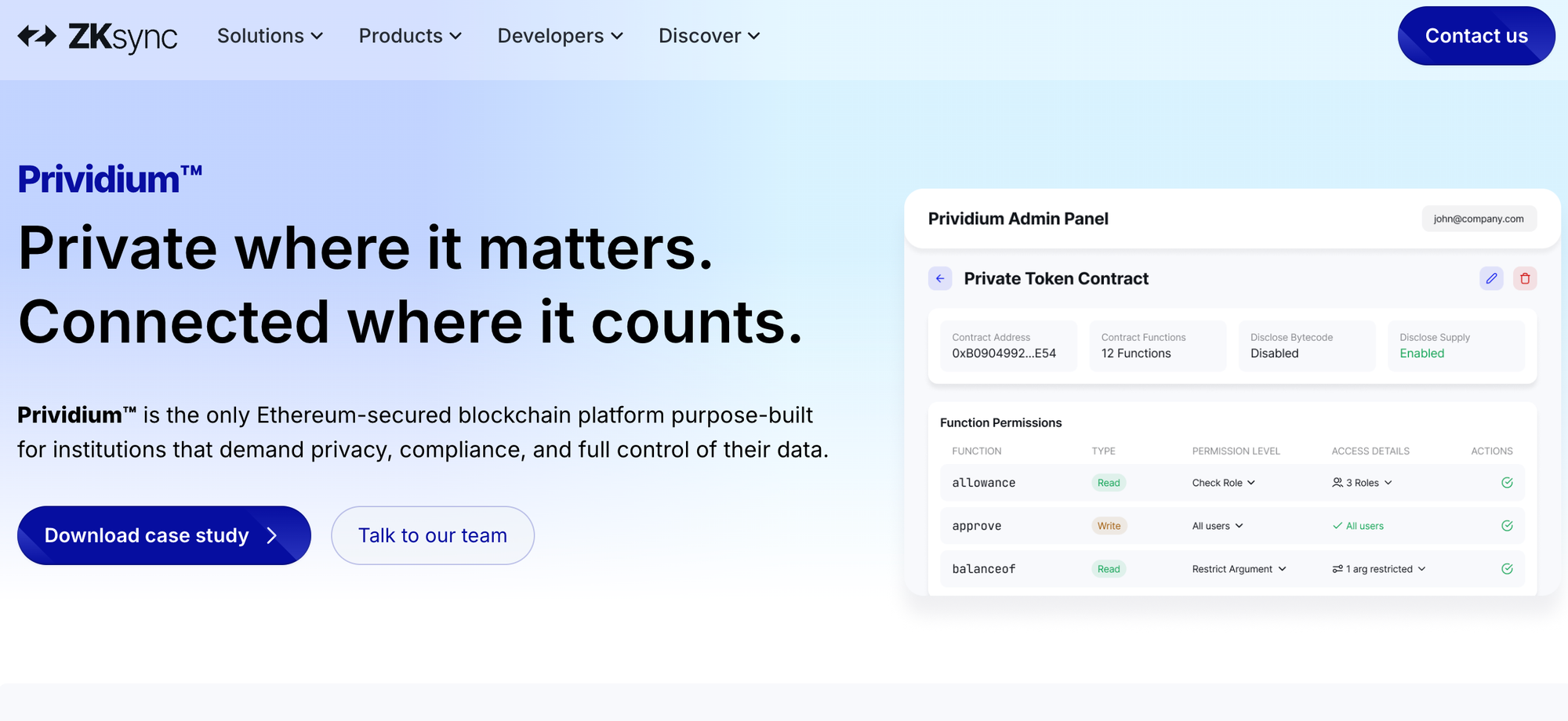
On the performance side, the system supports over 10,000 transactions per second at sub-second latency, with proving costs under $0.0001 per transaction. It is fully EVM-compatible, which means banks can use existing Solidity toolinghttps://etherworld.co/tag/banks/ without rebuilding from the ground up.
Inter-bank transactions across different Prividiums settle atomically: either both sides of a trade go through, or neither does. Gluchowski described the end state at the DC Blockchain Summit as Ethereum becoming the functional equivalent of SWIFT or Fedwire, except open, neutral, and cryptographically enforced rather than built on institutional trust.
Cari Network and the Tokenised Deposit Distinction
The Cari Network is the first production deployment of Prividium. Five U.S. regional banks joined as design partners: Huntington Bancshares, First Horizon, M&T Bank, KeyCorp, and Old National Bancorp. Together with the broader Mid-Size Bank Coalition of America, these institutions manage around $8.3 trillion in assets.
Cari converts customer deposits into digital tokens that can move between banks in real time and around the clock. What matters here is what those tokens actually are. They remain liabilities of the issuing bank, stay on the bank's balance sheet, and continue to be FDIC-insured. There is no stablecoin issuer in the middle, no separate reserve structure and no exit from the regulated banking system.
This is the distinction that separates tokenised deposits from USDC or USDT. Stablecoins are liabilities of their issuers, if Circle fails, the exposure sits outside the banking framework entirely. Tokenised deposits on Cari carry none of that separation. The funds stay inside the regulated perimeter while gaining the speed and programmability of blockchain infrastructure.
Gluchowski has called this programmable, interoperable cash and not a new type of money, but existing bank money that moves faster and can be composed into more complex settlement flows. The American Bankers Association has backed testing of issuance, transfer and the redemption flows on the network, with full production rollout targeted for later in 2026.
Who Is Already Involved and Where This Goes
The Cari announcement's framework has already been validated through live demonstrations with more than 35 financial institutions, with testing across cross-border payments and intraday repo use cases. Citi, Deutsche Bank, Mastercard, and two undisclosed central banks have engaged with the architecture.
Deutsche Bank's involvement through Project DAMA is the clearest example of what this infrastructure can do in practice. A multi-custodian fund launch that would have ordinarily taken several months was completed in days using the Prividium stack.
The broader ZKsync 2026 roadmap places Prividium at the centre of what the team describes as a full bank stack for Ethereum. The ZK Stack handles coordinated multi-chain liquidity, and the Airbender proving system provides fast zero-knowledge execution on commodity hardware. A 40-page design paper titled Beyond Public vs Private Chains, published alongside the Cari launch, lays out the quantitative case, covering cost benchmarks, settlement time comparisons, and the intraday repo use case that could unlock significant idle capital.
ZKsync Foundation executives have indicated publicly that more bank partnerships are expected within the next three to four months. The Cari launch is being positioned as the first in a series of announcements rather than a standalone event, and the infrastructure appears to be in the early stages of a broader institutional onboarding cycle.
If you find any issues in this article or notice missing information, please feel free to reach out at team@etherworld.co for clarifications or updates.
To promote your Web3 articles, events, and projects, you may reach out anytime via EtherWorld PR for submissions and collaboration.
Related Articles
- Ethereum Foundation Backs ZKnox for Post-Quantum Security
- Linea Achieves Full Ethereum Compatibility with Zero-Knowledge Proofs
- Vitalik Rethinks the Role of Ethereum Layer 2s
- Linea Achieves Full Ethereum Compatibility with Zero-Knowledge Proofs
- Polygon Emerges as a Hub for AI Agent Payments
To follow blockchain news, track Ethereum protocol progress, and read our latest stories, subscribe to our weekly today.
Disclaimer: The information contained in this website is for general informational purposes only. The content provided on this website, including articles, blog posts, opinions, & analysis related to blockchain technology & cryptocurrencies, is not intended as financial or investment advice. The website & its content should not be relied upon for making financial decisions. Read full disclaimer & privacy policy.
To stay updated on blockchain news, Ethereum protocol progress, and our latest stories, subscribe to our weekly digest and YouTube channel for ELI5 content.
To promote your Web3 articles, events, project updates, and Press Releases, reach out anytime via EtherWorld PR for submissions and collaboration. For other queries, email contact@etherworld.co.
If you’d like to support our work, share the content and consider donating at avarch.eth.
Join our community on Discord and follow us on Twitter, Facebook, LinkedIn & Instagram.

 ×
×