CoinDCX Founders Granted Bail in Alleged Fraud Case
Court finds no evidence against CoinDCX founders, confirming fraud was carried out by impersonators using fake identities.
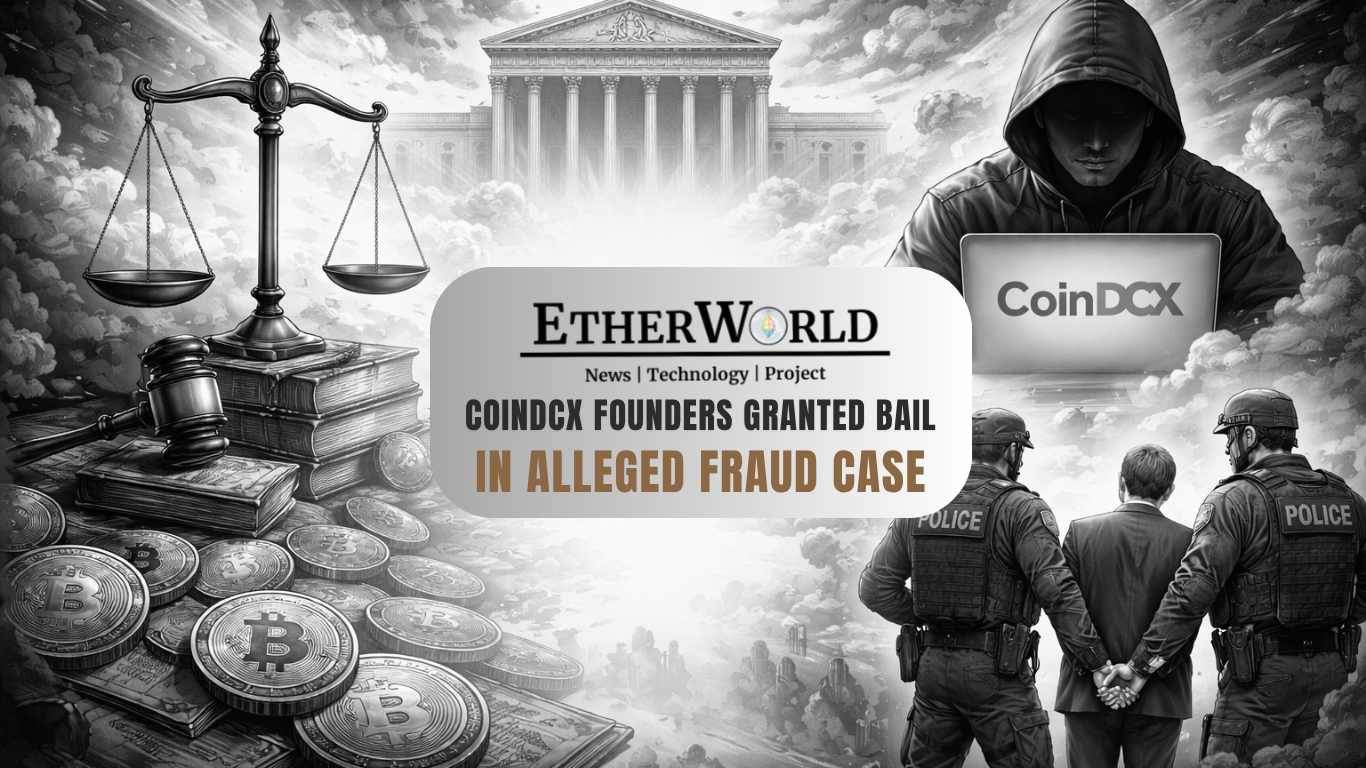
This week, the court confirmed that CoinDCX’s founders were not responsible for the alleged wrongdoing. Although the situation initially appeared unfavorable for CoinDCX, the greater concern now is the rise of impersonators creating fake websites and misusing trusted crypto brands like CoinDCX to deceive users.
This situation highlights the risks reputable crypto platforms face. The case is significant not only for CoinDCX but also as evidence of a broader issue in India’s digital asset sector. As crypto platforms gain recognition, they increasingly become targets for fraudsters who exploit established names to deceive users.
- What the Bail Order Actually Says
- The Role of Impersonation in the Fraud
- Why the Fake Domain Detail Matters
- A Wider Warning for India’s Crypto Users
According to CoinDCX the court did not find any proof that involves Sumit Gupta and Neeraj Khandelwal. The clarification hinges on two pivotal facts.
- First, the investigating officer confirmed that another individual impersonated the accused to deceive the informant.
- Second, the complainant explicitly stated he had no contact with Sumit Gupta or Neeraj Khandelwal.
Together, these facts substantially undermine the claim of direct involvement by the CoinDCX leadership. It reflects the kind of confusion that can arise when fraudsters misuse known names in high-trust sectors like crypto. A brand can become the face of a case even when the actual wrongdoing was executed by unrelated bad actors hiding behind that brand’s identity.
What the Bail Order Actually Says
The court document that was shared gives us an idea of what the judge was thinking. The order made on March 23, 2026, considered whether the accused should be released on bail and whether there was evidence to keep them in jail while the investigation was ongoing.
The order notes that the applicants had no criminal history. It also records that they were promoters or directors of the company, which the court viewed as reducing the likelihood of fleeing.
The investigating officer reportedly had no objection to their release on bail. The court further observed that there was no real question of tampering with evidence or witnesses in light of the facts already presented.
This is a significant point because public conversation around fraud cases often collapses the distinction between accusation & proof. A name appearing in a complaint can trigger headlines, outrage, & reputational damage.
But courts examine whether the evidence actually connects the named individuals to the conduct in question. In this case, the court appears to have concluded that such a link was not shown.
Important announcement pic.twitter.com/aDvTRN80G0— CoinDCX : India Ka Crypto Coach (@CoinDCX) March 24, 2026
The Role of Impersonation in the Fraud
The court material suggests that unknown individuals posed as the accused & cheated the complainant. CoinDCX, in its own summary, framed the matter as one arising from third-party impersonation rather than wrongdoing by the company or its founders.
Fraud today is often less about hacking code & more about hacking trust. Scammers increasingly mimic exchange names, executive identities, websites, app interfaces, customer support channels, & even social profiles.
Their goal is to create just enough legitimacy for the victim to lower their guard. In this case, the complainant reportedly stated that he had not met the founders.
The officer who was looking into the matter did not have a problem with the people being let out on bail. The court also said that there was no worry that the people would try to change the evidence or scare the witnesses because of the facts that were already known.
This is a thing to think about because when people talk about fraud cases they often forget that there is a big difference between saying someone did something wrong and actually proving it. If someones name is mentioned in a complaint it can lead to headlines people getting angry and the persons reputation being hurt.
The fraud cases are an example of this, where the fraud cases can damage someones reputation even if they are not proven guilty. The people should remember that the fraud cases are serious and the distinction between accusation and proof, in fraud cases is very important.
Why the Fake Domain Detail Matters
Another major detail in the CoinDCX clarification is the reference to a third-party website called coindcx[.pro]. The company stressed that this domain has no connection to CoinDCX or its official entities, while also reminding users that its official platform is coindcx.com.
This might seem like a small detail but it is really important when we talk about financial scams. Scammers like to register website names that're very similar to well known brand names.
They are already comfortable signing up through websites, receiving links, or interacting with online support. That makes them more vulnerable to domain-based impersonation if they are not careful.
The fake-domain issue also shows why exchanges need to keep investing in user education. Even if a company is not directly involved in a fraud, users harmed by an impersonation scam may still associate that pain with the brand whose identity was misused.
A Wider Warning for India’s Crypto Users
The CoinDCX episode is also a warning sign for the broader Indian market. It shows how quickly a fraud case can intersect with the names of major industry players, even when the alleged criminal conduct was carried out by unrelated persons.
India’s crypto sector has already been moving through a period of rising regulatory scrutiny, tax complexity, enforcement actions, & public trust issues. Against that backdrop, impersonation scams create an additional layer of instability.
For users, the practical takeaway is straightforward.
- Verify the exact domain.
- Cross-check official handles.
- Be cautious of anyone claiming to represent an exchange outside official channels.
- Avoid investment promises made through informal groups or unknown websites.
- Do not assume that a known logo automatically means legitimacy.
For CoinDCX, the court clarification offers an opportunity to reset the narrative. The exchange has positioned itself not as a participant in the fraud, but as a brand whose identity was unlawfully exploited by bad actors. It also stated that trading, deposits, & withdrawals remain fully operational, while emphasizing proof of reserves, independent audits, & ongoing cooperation with authorities.
If you find any issues in this blog or notice any missing information, please feel free to reach out at yash@etherworld.co for clarifications or updates.
To promote your Web3 articles, events, and projects, you may reach out anytime via EtherWorld PR for submissions and collaboration.
Related Articles
- CoinDCX Founders Questioned in Fraud Case, Company Blames Impersonation Scam
- 49 Crypto Exchanges Register With FIU in FY 2024–25
- India’s Crypto TDS Crosses ₹511 Crore in FY25
- India to Change Crypto Strategy as Global Trends Shift
- An Indian bank enabling crypto services with UNICAS
To follow blockchain news, track Ethereum protocol progress, and read our latest stories, subscribe to our weekly today.
Disclaimer: The information contained in this website is for general informational purposes only. The content provided on this website, including articles, blog posts, opinions, & analysis related to blockchain technology & cryptocurrencies, is not intended as financial or investment advice. The website & its content should not be relied upon for making financial decisions. Read full disclaimer & privacy policy.
To stay updated on blockchain news, Ethereum protocol progress, and our latest stories, subscribe to our weekly digest and YouTube channel for ELI5 content.
To promote your Web3 articles, events, project updates, and Press Releases, reach out anytime via EtherWorld PR for submissions and collaboration. For other queries, email contact@etherworld.co.
If you’d like to support our work, share the content and consider donating at avarch.eth.
Join our community on Discord and follow us on Twitter, Facebook, LinkedIn & Instagram.

 ×
×

Author

Yash Kamal Chaturvedi is a Blockchain Content & Ops Specialist at Avarch LLC, writing on Ethereum & governance since 2021. Covers ACD/ACDE calls, EIPs, upgrades, staking, security & ecosystem trends.