Starknet Targets April Launch for STRK20 Privacy Layer
Starknet plans an April launch for STRK20, introducing a privacy layer that keeps transactions composable while enabling selective disclosure for compliance.

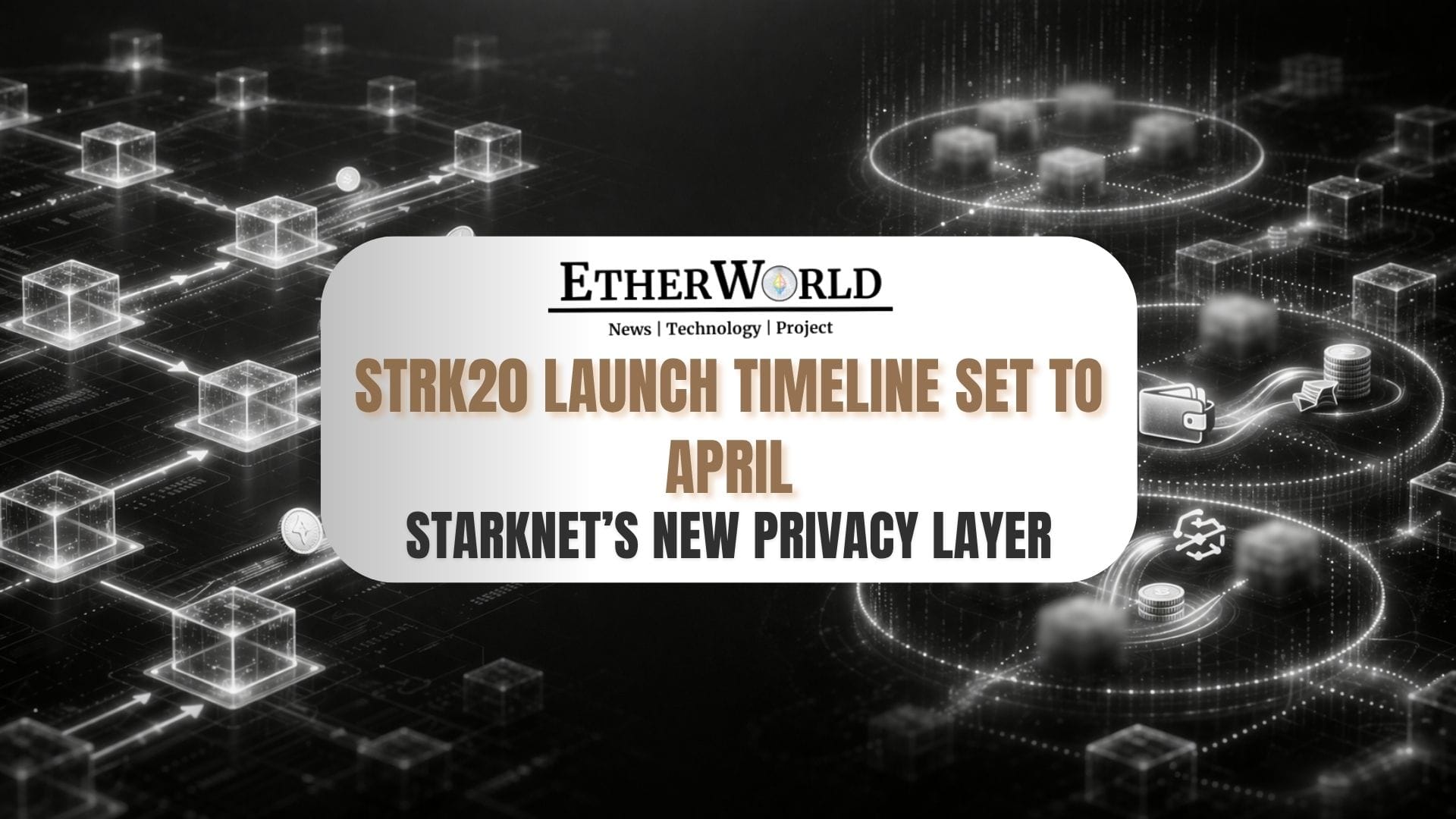
Starknet is moving around its upcoming privacy framework. On March 31, Starknet shared a statement addressing “recent press coverage” which confirming that STRK20 is expected to go live by the end of April. It also shared ongoing work with DeFi protocols to ensure integrations are ready at launch.
Privacy is coming to Starknet sooner than expected & it is being built to work across the entire ecosystem from day one.
- What STRK20 Is Designed to Do
- How Privacy Works Without Breaking Composability
- Why Starknet Is Emphasizing Compliance
- What This Means for Starknet’s Position in Ethereum
What STRK20 Is Designed to Do
STRK20 is not a new token standard in the traditional sense. It is a privacy layer designed to work with any ERC-20 token already deployed on Starknet.
Instead of requiring a separate privacy coin or wrappers, the system introduces a shared “privacy pool”, where assets can be deposited & transacted privately. Once inside, transfers are shielded using zero-knowledge proofs, hiding sender & receiver addresses, transaction amounts, & even the type of token being used.
Regarding recent press coverage. pic.twitter.com/ICDnc7SeRZ
— Starknet (Privacy arc) 🥷 (@Starknet) March 31, 2026
The goal is straightforward: bring privacy to existing assets without fragmenting liquidity or breaking how tokens already function.
This is a notable shift from earlier privacy approaches, which often relied on isolated systems that made integration with broader Ethereum ecosystems more difficult.
How Privacy Works Without Breaking Composability
One of the more difficult challenges in blockchain privacy is the ability for different protocols to interact seamlessly while hiding transaction data. Starknet’s approach attempts to balance both.
Assets can move between public & private states depending on user needs. Inside the privacy pool, transactions remain shielded but they are still compatible with DeFi applications which enables use cases like private swaps or staking where the logic remains visible to protocols but user-level details stay hidden.
Instead of splitting activity across private & public versions of the same token, everything exists within a unified system.
This is where Starknet’s architecture plays a role. As a Layer 2 built around zero-knowledge proofs, it already operates within a proving framework that makes this type of integration more feasible than on base-layer systems.
Why Starknet Is Emphasizing Compliance
Privacy features in crypto tend to raise immediate regulatory questions & Starknet’s messaging suggests it is trying to address that directly.
STRK20 includes a selective disclosure mechanism. Users can generate encrypted viewing keys that allow specific entities such as auditors or regulators to access their transaction history without exposing the entire privacy pool.
The system is described as enabling compliance without introducing a global backdoor. Access remains usercontrolled & disclosure is granular rather than systemic.
This reflects a broader trend across the ecosystem: privacy is increasingly being designed with institutional participation in mind, not just individual anonymity.
What This Means for Starknet’s Position in Ethereum
Starknet’s initial announcement in early March positioned STRK20 as a long-term development. Moving that timeline up to an end of April launch suggests a higher level of readiness or at least a stronger push to bring the feature into production sooner.
If it delivers as described, STRK20 could position Starknet as one of the first major environments where privacy is but a default capability across tokens & applications.
That matters in the broader context of Ethereum scaling. As more activity moves to Layer 2 networks. Features like privacy, composability, & institutional readiness are starting to define how these ecosystems compete.
This is still a timeline update & not yet a launch. The system is expected by the end of April, but detailed technical specifications & live deployment will ultimately determine how it performs in practice.
For now, Starknet is preparing to make privacy a native part of its network & is doing it sooner than expected.
If you find any issues in this article or notice missing information, please feel free to reach out at team@etherworld.co for clarifications or updates.
To promote your Web3 articles, events, & projects, you may reach out anytime via EtherWorld PR for submissions & collaboration.
Related Articles
- Linea Is Changing How Its Network Works Behind the Scenes
- Gnosis and Zisk Want to Turn Ethereum’s L2s Into One Unified Economy
- ZKsync and BitGo Bring Bank Deposits Onchain
To follow blockchain news, track Ethereum protocol progress, and read our latest stories, subscribe to our weekly today.
Disclaimer: The information contained in this website is for general informational purposes only. The content provided on this website, including articles, blog posts, opinions, & analysis related to blockchain technology & cryptocurrencies, is not intended as financial or investment advice. The website & its content should not be relied upon for making financial decisions. Read full disclaimer & privacy policy.
To stay updated on blockchain news, Ethereum protocol progress, and our latest stories, subscribe to our weekly digest and YouTube channel for ELI5 content.
To promote your Web3 articles, events, project updates, and Press Releases, reach out anytime via EtherWorld PR for submissions and collaboration. For other queries, email contact@etherworld.co.
If you’d like to support our work, share the content and consider donating at avarch.eth.
Join our community on Discord and follow us on Twitter, Facebook, LinkedIn & Instagram.