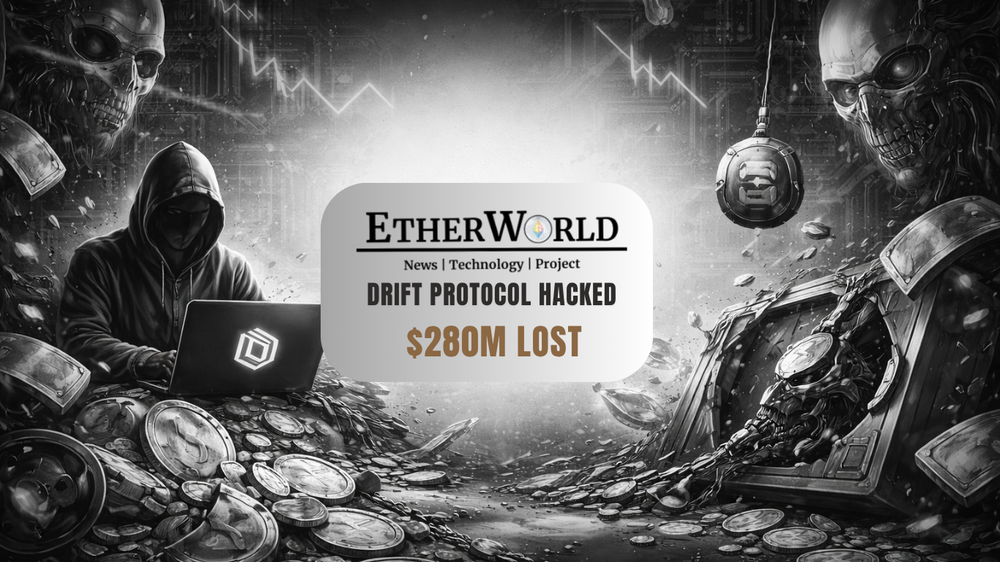
North Korean Hackers Behind $285M Drift Protocol Hack
North Korean-linked hackers drain $285M from Drift Protocol using sophisticated social engineering, exposing a major weakness in DeFi security.
The most recent Drift Protocol hack is not just another DeFi weakness; rather, it represents a change in the level of sophistication with which threat actors target crypto infrastructure. The offenders completely circumvented smart contract defences by taking advantage of human trust rather than attacking code. Within hours, the attackers reduced Drift's total value almost in half by draining $285 million through an array of social engineering and operational precision.
This event draws attention to a more serious weakness in decentralised systems, i.e., while protocols may be designed without trust, their human layers are nonetheless extremely vulnerable.
- A Precision Strike on Drift's Core Vaults
- Social Engineering Over Smart Contract Exploits
- Tracing the Attack: DPRK Patterns Emerge
- Crisis Response & the Fight for Recovery
A Precision Strike on Drift's Core Vaults
This attack's size and targeting point to meticulous planning rather than hasty exploitation. The GLB Delta Neutral vault and Super Staking Sol, two essential liquidity pools to Drift's capital efficiency program, were the hackers' primary targets. Not only did they take money out of these vaults, but they also undermined the protocol's fundamental framework.
The effect was striking right away. Overnight, Drift's entire value locked fell from almost $550 million to almost half of that amount. This was a systemic shock that affected trade trust, liquidity provisioning, and overall protocol stability, not just a loss of user cash.
This attack does not alter the protocol's code, in contrast to standard DeFi attacks that take advantage of smart contract weaknesses. This distinction is important because it changes the story to show that the problem was operational rather than technological.
Social Engineering Over Smart Contract Exploits
This breach is unique because of the method utilised. According to reports, the attackers interacted with insiders over time by pretending to be reputable dealers and developers. In the end, they compromised the devices of multisig signers by distributing a phoney program and sharing seemingly innocuous code snippets.
They were able to get around multisignature authorisation, one of DeFi's most reliable security features, thanks to their strategy. After a sufficient number of signers were hacked, the attackers were able to obtain legitimate access to vault controls, giving the impression that the transactions were legitimate rather than malevolent.
This strategy is part of a larger trend in cyberwarfare, where technical brute-force attacks are losing ground to human manipulation. Additionally, it highlights a crucial weakness in DeFi security frameworks, i.e., although protocols make significant investments in audits and code security, the user interface is frequently left unprotected.
Tracing the Attack: DPRK Patterns Emerge
Blockchain intelligence companies like Elliptic, TRM Labs, and SEALS 911 started tracking down the pilfered money immediately. Their research reveals trends that are consistent with state-affiliated hacking groups in North Korea, which are frequently tied to advanced persistent threats in the cryptocurrency industry.
Rapid fund transfers between several wallets, the use of obfuscation techniques, and routing via mixers and cross-chain bridges are examples of these patterns. In order to buy time for laundering activities, these tactics are intended to make tracing more difficult and postpone recovery efforts.
Attribution to actors connected to the DPRK is noteworthy. It highlights how decentralised finance and geopolitical conflict are increasingly intertwined. Once thought of as impartial financial instruments, crypto protocols are now being targeted by state-sponsored cyber tactics meant to finance sanctioned regimes.
— Drift (@DriftProtocol) April 5, 2026
Crisis Response & the Fight for Recovery
Following the incident, Drift Protocol responded quickly to halt operations in order to stop additional losses. But this decision also ceased trading, which increased user concern. Although such efforts have previously had little success, the team is currently collaborating with forensic firms to trace funds and investigate recovery prospects.
The mindset of users has rapidly changed in favour of accountability. Drift is under pressure to lay out a compensation plan as calls for reimbursement become more frequent. This is a challenging problem, i.e., how can centralised expectations of responsibility be handled by a decentralised protocol?
This incident, however, may force a more thorough industry review. Multisig security, which was once considered the gold standard, is currently under scrutiny. Protocols may need to incorporate more advanced safeguards, such as hardware isolation, behavioural monitoring, and stricter operational rules, to guard against such attacks.
The Drift exploit is more than simply a financial catastrophe; it is a stress test for the entire DeFi ecosystem. It highlights the reality that decentralisation only redistributes trust rather than eliminates it, and challenges long-held notions about security.
If you find any issues in this article or notice missing information, please feel free to reach out at team@etherworld.co for clarifications or updates.
To promote your Web3 articles, events, and projects, you may reach out anytime via EtherWorld PR for submissions and collaboration.
Related Articles
- X Introduces Crypto Account Locks to Curb Phishing
- Surf Liquid Launched AI-Powered Stablecoin Savings on Polygon
- ERC-8183 Introduces Onchain Commerce for the AI Agent Economy
- Dogecoin’s “LLC Era” Blurs Joke & Reality
- Quantum Just Got Closer to Breaking Crypto
To follow blockchain news, track Ethereum protocol progress, and read our latest stories, subscribe to our weekly today.
Disclaimer: The information contained in this website is for general informational purposes only. The content provided on this website, including articles, blog posts, opinions, & analysis related to blockchain technology & cryptocurrencies, is not intended as financial or investment advice. The website & its content should not be relied upon for making financial decisions. Read full disclaimer & privacy policy.
To stay updated on blockchain news, Ethereum protocol progress, and our latest stories, subscribe to our weekly digest and YouTube channel for ELI5 content.
To promote your Web3 articles, events, project updates, and Press Releases, reach out anytime via EtherWorld PR for submissions and collaboration. For other queries, email contact@etherworld.co.
If you’d like to support our work, share the content and consider donating at avarch.eth.
Join our community on Discord and follow us on Twitter, Facebook, LinkedIn & Instagram.
Author

Content Writer