Vitalik Buterin on Why Ethereum Must Stay Neutral
Vitalik Buterin reiterates that Ethereum’s core is neutrality, censorship resistance & permissionless access, not alignment with his personal views.
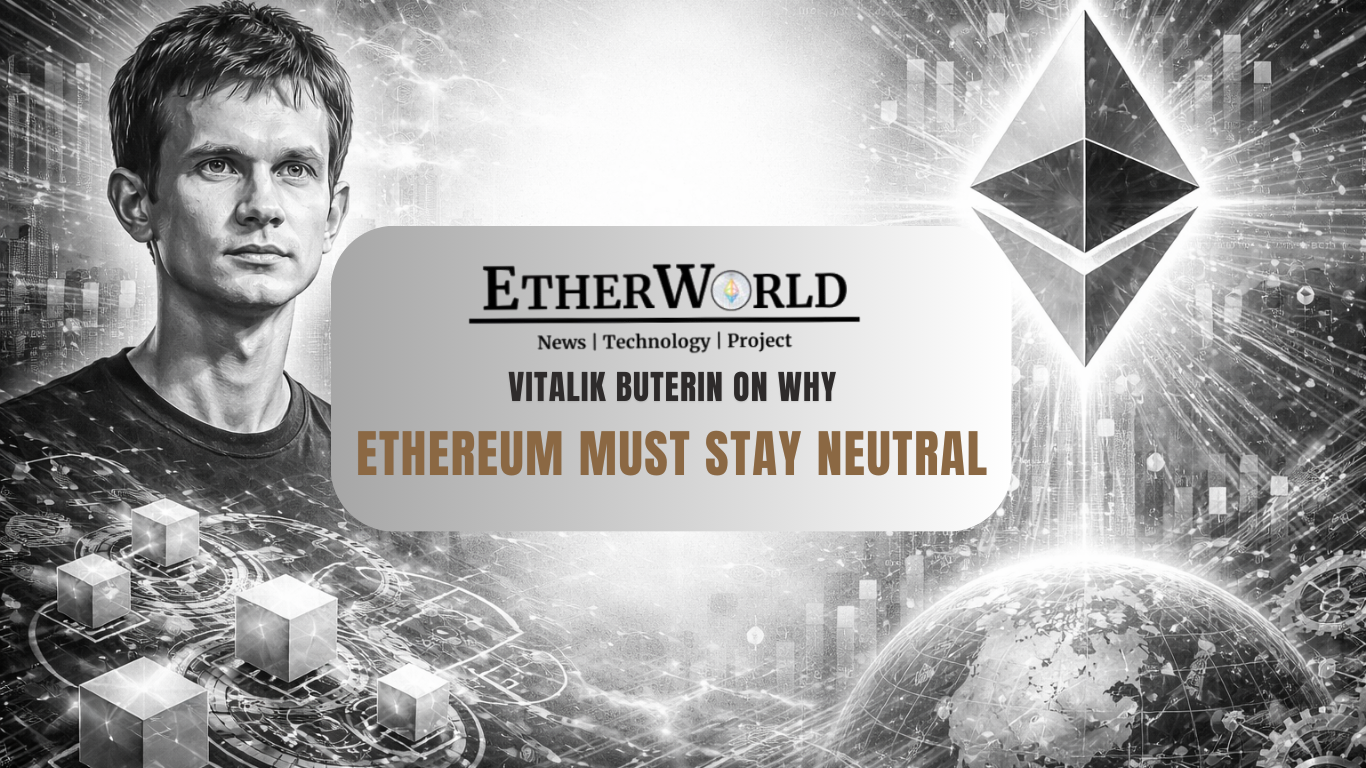
Vitalik Buterin recently restated what many in the blockchain community already know, but few express so eloquently: Ethereum is about protecting freedom of thought, censorship resistance, and permissionless access, not about agreeing with one person's views.
Vitalik asserts that you can support Ethereum's technical and philosophical underpinnings even if you disagree with his views on trust assumptions, decentralised finance, social media, privacy, artificial intelligence, or even cuisine. His reasoning demonstrates why neutrality and decentralisation are more important than ever.
- Why Neutrality Matters in Ethereum's Design?
- Permissionlessness: The Heart of Ethereum Freedom
- Disagreement is not Censorship
- Ecosystem vs. Corporation
- Freedom with Technical Boundaries
Why Neutrality Matters in Ethereum's Design?
The core principle of Vitalik's speech is that Ethereum's basic layer must remain impartial. Users of a decentralised network shouldn't be forced to adhere to a single philosophy or perspective. It should be permitted for all individuals to bring their own opinions and beliefs.
He illustrates this by pointing out that protocols like HTTP and TCP have no concern with what you're watching; they just deliver it. The same principles should apply to Ethereum: transparency, objectivity, and the absence of concealed ambitions.
Vitalik believes that true innovation is made possible by this neutrality. People with extremely different goals can nevertheless work together to grow Ethereum if the basis remains unbiased, transforming it into a common area where multiple visions coexist.
Buterin highlighted principles including decentralisation, censorship resistance, and open global involvement in a December 2023 article titled "Make Ethereum Cypherpunk Again." He added that the underlying layers should be designed so that anyone can independently confirm neutrality. This implies that Ethereum can be used in any way by anybody, regardless of whether they prioritise DeFi, social apps, privacy tools, or completely non-financial services.
Permissionlessness: The Heart of Ethereum Freedom
Vitalik frequently reminisces about one important concept: Ethereum's power stems not from consensus but rather from the fact that anyone can use it without authorisation. That's what really sets it apart. Regarding DAOs, zero-knowledge cryptography, governance frameworks, and trust assumptions, users are under no obligation to agree with him.
Ethereum only provides open access; it makes no demands regarding ideological affinity. Building, trading, experimenting, and innovating are all possible with an internet connection. The most significant is the freedom to act.
Permissionlessness, according to Vitalik, is about real-world freedom rather than intellectual conformance. It is precisely because it permits multiple visions to coexist, even when they conflict.
In the Trustless Manifesto, he reaffirmed this idea and warned against centralising by easy shortcuts. The fundamental underpinnings that give decentralised systems their significance are gradually weakened by centralised controls or intermediaries, even though they may temporarily speed up growth.
Vitalik believed that independence should never be sacrificed for adoption. Ethereum needs to continue to be a place where creativity is unrestricted and where freedom is inherent in the system.
Disagreement is not Censorship
The notion that criticism equates to censorship is one fallacy Vitalik challenges. According to him, calling an app "corposlop," a term used to characterise apps that seem unduly centralised or corporate, is not censorship; rather, it is free criticism, which is a necessary component of the development of a healthy community.
Vitalik bases this on the idea of free speech, which states that you cannot repress someone by simply disagreeing with them. In the same way that individuals are free to create tools that support their ideas about privacy, finance, or social interaction, others are free to criticize initiatives that, in their opinion, stray from the principles of decentralisation.
This supports the notion that a variety of applications, including those that represent opposed ideologies, are made possible by neutral protocols.
You do not have to agree with me on which applications are and are not corposlop to use Ethereum.
— vitalik.eth (@VitalikButerin) February 16, 2026
You do not have to agree with me on what trust assumptions are acceptable in which situations to use Ethereum.
You do not have to agree with me on political topics to use Ethereum.…
Ecosystem vs. Corporation
The fact that Ethereum is not a business is something Vitalik consistently emphasises. There isn't a corporate roadmap dictating what everyone should build, no stockholders waiting for profits, and no CEO sitting at the top. With thousands of developers and users worldwide, Ethereum is meant to be a shared ecosystem.
He discusses this from both a technical and philosophical standpoint. He discusses in his blogs on Ethereum's Layer-2 roadmap that rollups and community-driven innovation are the best ways to scale, rather than centralising control just to speed things up. Growing responsibly without losing decentralisation is the fundamental concept.
Consider it this way: businesses often prioritise efficiency, profit margins, and growth rates. Openness, equity, and long-term participation are important to a decentralised network. Vitalik asserts that Ethereum would lose its entire function if it ever began acting like a company.
Rather, Ethereum has the feel of a communal garden. With no one in charge of the process, several teams create tools, wallets, and apps in their own unique ways. It can be slow and chaotic at times, but that freedom is precisely what sustains invention. Because everyone has the opportunity to contribute, Ethereum is genuinely decentralised.
Freedom with Technical Boundaries
Furthermore, according to Vitalik, embracing freedom does not entail denying the reality of technology. What can be constructed on top is invariably influenced by decisions taken at the protocol level, such as trust assumptions, consensus design, or block validation. Discussions on how some applications could impose higher trust assumptions, making them less permissive or decentralised, are related to this.
Instead of viewing this as a weakness, Vitalik presents it as an essential tension since decentralised systems naturally raise issues of philosophical, political, and technical trade-offs. This covers discussions about the future of social media platforms, privacy, and even the integration of AI. Maintaining the basic layer's neutrality while recognising the actual effects of design choices is crucial.
Neutrality, in his opinion, allows for the growth of many visions, including opposing ones, without excluding anyone.
If you find any issues in this article or notice missing information, please feel free to reach out at team@etherworld.co for clarifications or updates.
To promote your Web3 articles, events, and projects, you may reach out anytime via EtherWorld PR for submissions and collaboration.
Related Articles
- Vitalik’s ZK API Proposal Aims to Make Ethereum the Home for AI
- Vitalik Rethinks the Role of Ethereum Layer 2s
- Vitalik Buterin Explains What Creator Coins Got Wrong
- Vitalik Buterin Bets on Privacy Pools, A New Chapter for Ethereum Privacy?
- Vitalik Buterin Reframes Ethereum Scaling Strategy After 60M Gas Breakthrough
To follow blockchain news, track Ethereum protocol progress, and read our latest stories, subscribe to our weekly today.
Disclaimer: The information contained in this website is for general informational purposes only. The content provided on this website, including articles, blog posts, opinions, & analysis related to blockchain technology & cryptocurrencies, is not intended as financial or investment advice. The website & its content should not be relied upon for making financial decisions. Read full disclaimer & privacy policy.
To stay updated on blockchain news, Ethereum protocol progress, and our latest stories, subscribe to our weekly digest and YouTube channel for .
To promote your Web3 articles, events, project updates, and Press Releases, reach out anytime via EtherWorld PR for submissions and collaboration. For other queries, email contact@etherworld.co.
If you’d like to support our work, share the content and consider donating at avarch.eth.
Join our community on Discord and
Author

Content Writer