The Bug of Solving Bugs
A bug fix turned into a personal comeback story of coding, parenting, and a small contribution to the open-source world.
Once upon a time, I loved hands-on development work. That was when I was working at Accenture as part of the PMO team. After my kids were born, my energy naturally shifted toward them. I limited myself to overseeing project management and high-level code review responsibilities.I remained interested, but never quite found my way back to coding for years. I stayed interested, but for years I never really returned to coding. I remained a keen observer from a distance until a few days ago, when a little free mental space and my passion for improving processes pulled me back to something I once truly enjoyed.
Another reason for returning may be motherhood itself and my belief in leading by example.
My son will be heading to college soon and, like many at his age, is still unclear about the career direction. He’s curious about technology but hasn’t felt ready to step into open-source contributions. For now, he works part-time at a renouned US nonprofit outside tech and says Ethereum feels complex and something to explore later.
I do not think he lacks skills or readiness. In fact, I believe kids of his generation are far more prepared for technology than I ever was at his age.
Working with ECH and WiEP has placed me in a unique position. I am often approached by young contributors from diverse backgrounds who share their interests and explore ways to enter the Ethereum ecosystem. Some feel overwhelmed early on, but others show remarkable resilience and refuse to give up. I always tell them that there are many ways to contribute, but one of the most accessible paths is through development.
So I decided to practise what I preach.
I have been deeply interested in improving the Ethereum Improvement Proposal (EIP) process since the day I joined Ethereum Cat Herders back in 2019. Many of the day-to-day activities and projects I am involved in revolve around EIPs — the PEEPanEIP podcast, facilitating monthly EIPIP meetings, hosting the weekly EIP Editing Office Hours, and contributing to data analytics improvements through EIPsInsight. There is an Ethereum official site to follow standards and like any long-running project, it has had a few simple but persistent issues over the years. These are listed in the Issues section so that anyone interested in open-source contributions can pick them up and try to resolve them.
That is the beauty of open source - anyone, anywhere in the world, can step forward and help the community in their spare time.
With recent organisational changes at the Ethereum Foundation, some of the traditional “cat herding” responsibilities are now handled by the Ethereum Protocol Support team. This freed up some of my time and gave me the opportunity to look beyond protocol support. It also brought me closer to the EIPs GitHub repository, where I could review open pull requests and issues and contribute beyond facilitating EIP-related meetings.
While reviewing the issues, I noticed one related to a “Citation” bug that I had mentioned during one of the EIPIP meetings. I decided to work on it and test my development skills. The bug had been there for years, possibly since 2020. It was not breaking any proposals, but it represented a small oversight in the Web3 world’s most widely used standards repository.
So I started digging the repo, this time beyond the "EIPs folder" :)
The bug itself was not very complex. With a few targeted changes, I was able to fix the original problem and also add proper page status handling for Living and Final EIPs. The code was nearly ready for a pull request, with just a little more work left.
Context matters here. I am a mother of two, and when kids are hungry, everything else pauses. MOM (Make Our Meal) mode activates.
By the time I finished making the changes, my son was home and needed dinner, so I stepped away and headed to the kitchen. But my mind was still on the code, like a child who wants to finish homework and go out to play, I could not wait to test the changes and submit the pull request.
When I looked into the repository, I felt encouraged seeing the clear documentation left by earlier contributors on how beginners can set up a local testing environment. The steps included things like installing Ruby 3.1.4 (since later versions are not supported) and following the setup process.
Since I was busy cooking, I and asked my son if he could help set up the testing environment. I hoped that once dinner was done, I could test my changes and submit the PR the same day. I was genuinely excited.
He agreed and set everything up. We finished dinner quickly, and returned straight back to the desk. I ran the tests.
It worked.
My first bug fix to Ethereum’s EIPs repository was successful. 🎉
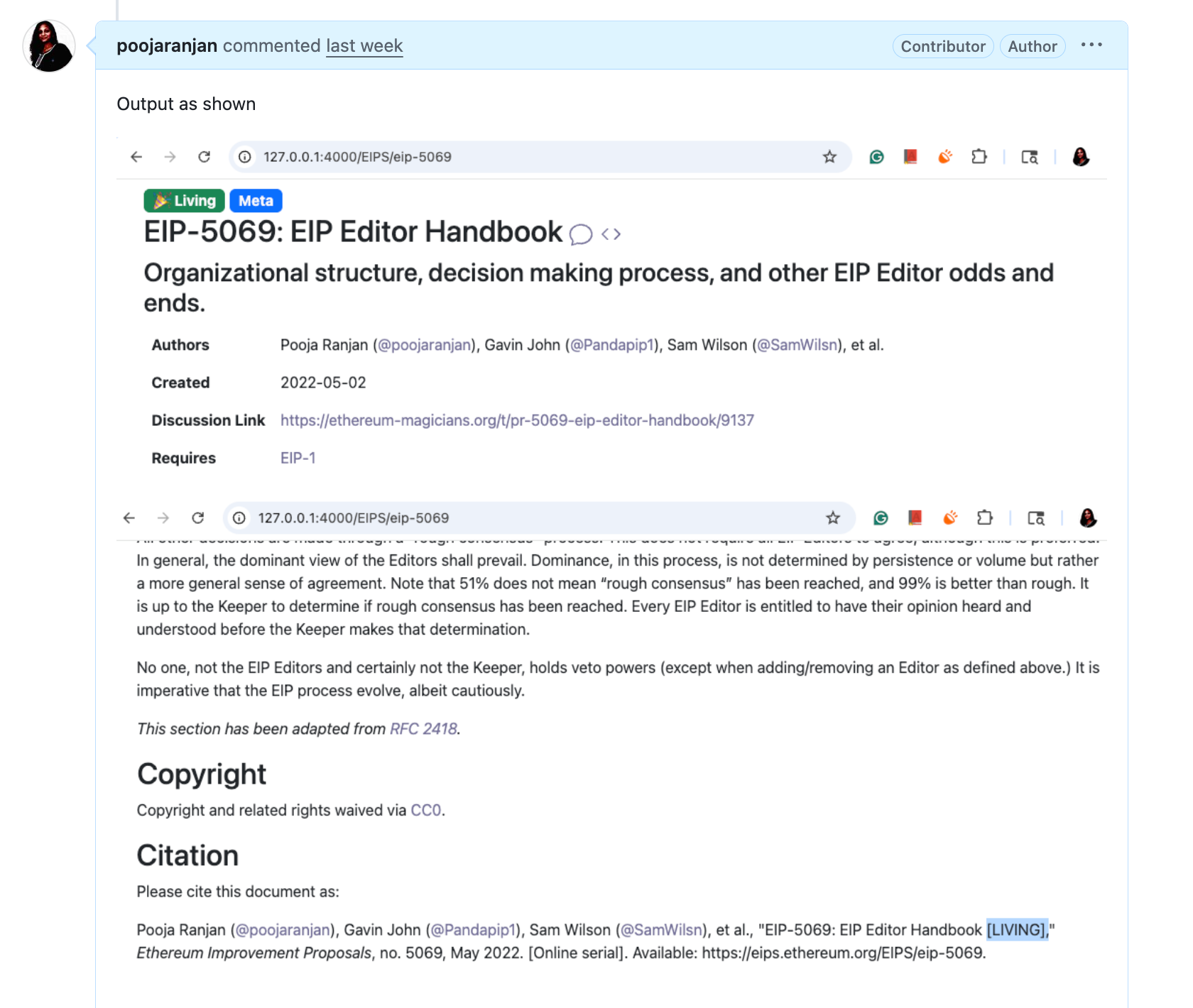
I submitted the Pull Request and immediately went back to the Issues section. The bug-fixing itch had started. I wanted to solve more.
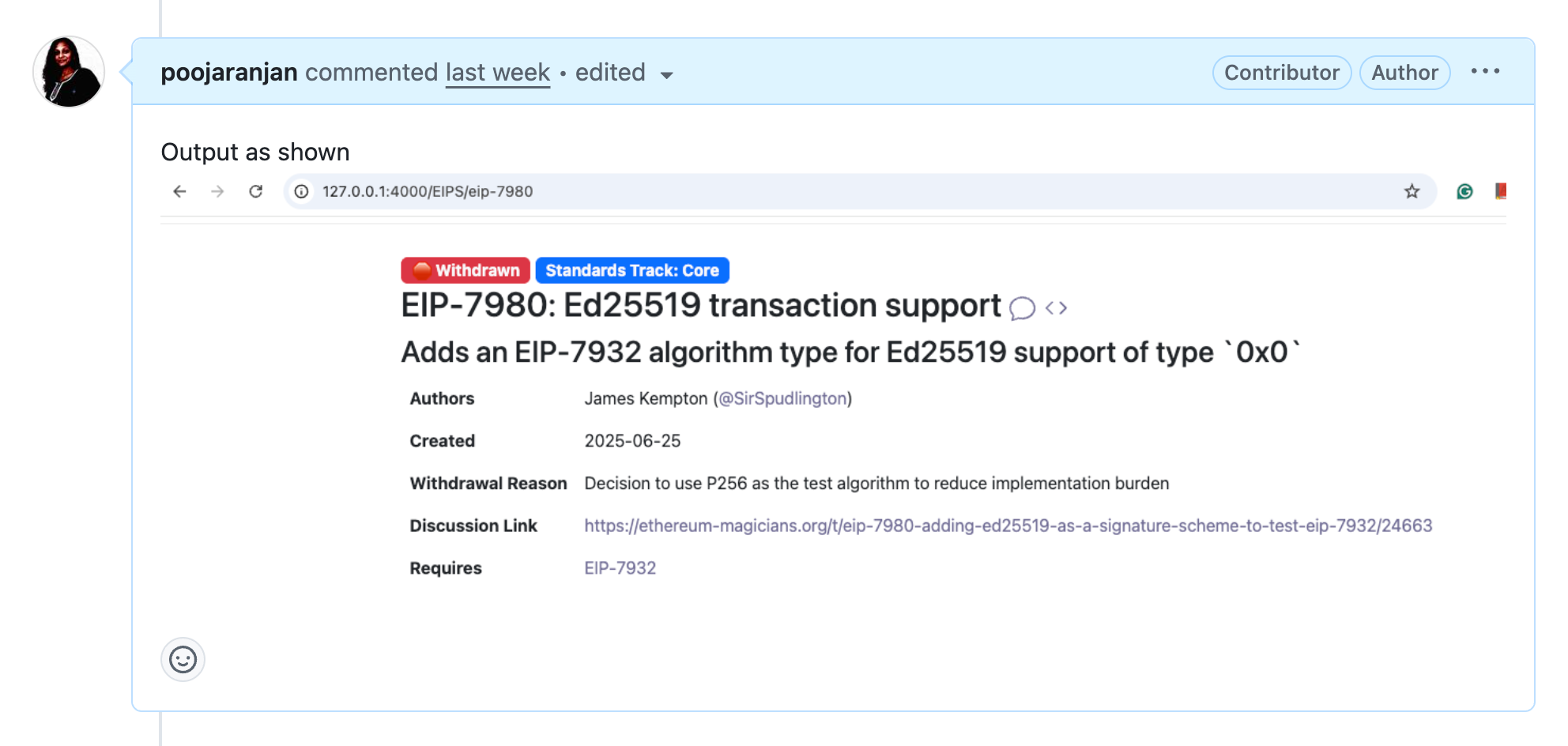
That same night, I picked up another straightforward issue: “withdrawal-reason not appearing in rendered output”. It may have been missing since the “Withdrawn” as a status was introduced, a few years ago. Eventhough it was reported less than six months ago. I added the fix and prepared to test it.
This time, I asked my son to stay nearby, observe my work, and help if needed. It worked again. I opened the second Pull Request, feeling incredibly accomplished.
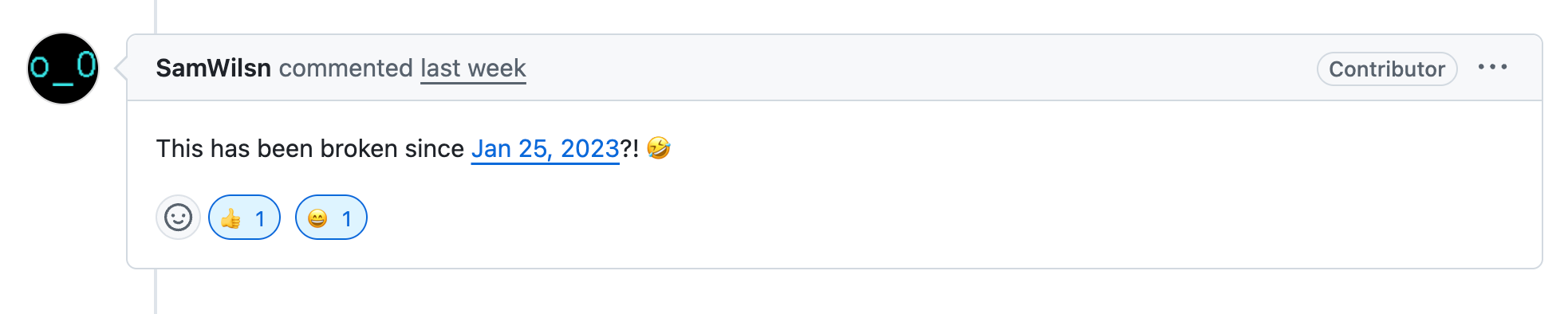
My son looked at me and said, “Mom, you could be a developer.”
I smiled and replied, “Yes, that is what I used to do in my previous life.”
It was the perfect moment to share a little wisdom — MOM mode activated again. I told him, “If I can solve these, I’m sure kids your age can do it - maybe even faster.” Perhaps not many people were aware of these issues, which is why they had been waiting so long to be fixed.
What I did was just a drop in the ocean of code that makes up the Ethereum protocol. Still, I wanted to share this story to show that opportunities to contribute to open source are everywhere.
I hope this story motivates my son, and perhaps someone else out there who has a little time and is considering helping fix other bugs.
That is all for today. I hope these pull requests get merged soon.
If you have encountered similar bugs and feel ready to join the Web3 world, many open issues are waiting for help. Come, join me in the wonderful world of open source. Ethereum welcomes your contribution.
Ethereum is not an end product. It is a living process, and everyone has a role to play.
This story is part of a new series of short Ethereum stories. Until next time, cheers!
PS: Spotted an issue or missing information? Please write to us at team@etherworld.co and we’re happy to review and make updates where needed.
Disclaimer: The information contained in this website is for general informational purposes only. The content provided on this website, including articles, blog posts, opinions, & analysis related to blockchain technology & cryptocurrencies, is not intended as financial or investment advice. The website & its content should not be relied upon for making financial decisions. Read full disclaimer & privacy policy.
To stay updated on blockchain news, Ethereum protocol progress, and our latest stories, subscribe to our weekly digest and YouTube channel for .
To promote your Web3 articles, events, project updates, and Press Releases, reach out anytime via EtherWorld PR for submissions and collaboration. For other queries, email contact@etherworld.co.
If you’d like to support our work, share the content and consider donating at avarch.eth.
Join our community on Discord and
Author

Pooja Ranjan is a long-time Ethereum contributor. She founded EtherWorld.co and EIPsInsight, co-founded WiEP, and serves as President of ECH Institute, leading education, governance, and community coordination across Ethereum. Follow @poojaranjan19