New QR Code Scam Drains Hardware Wallet Funds
Scammers are mailing fake security letters with QR codes to hardware wallet users, tricking victims into revealing recovery phrases and draining their crypto funds.
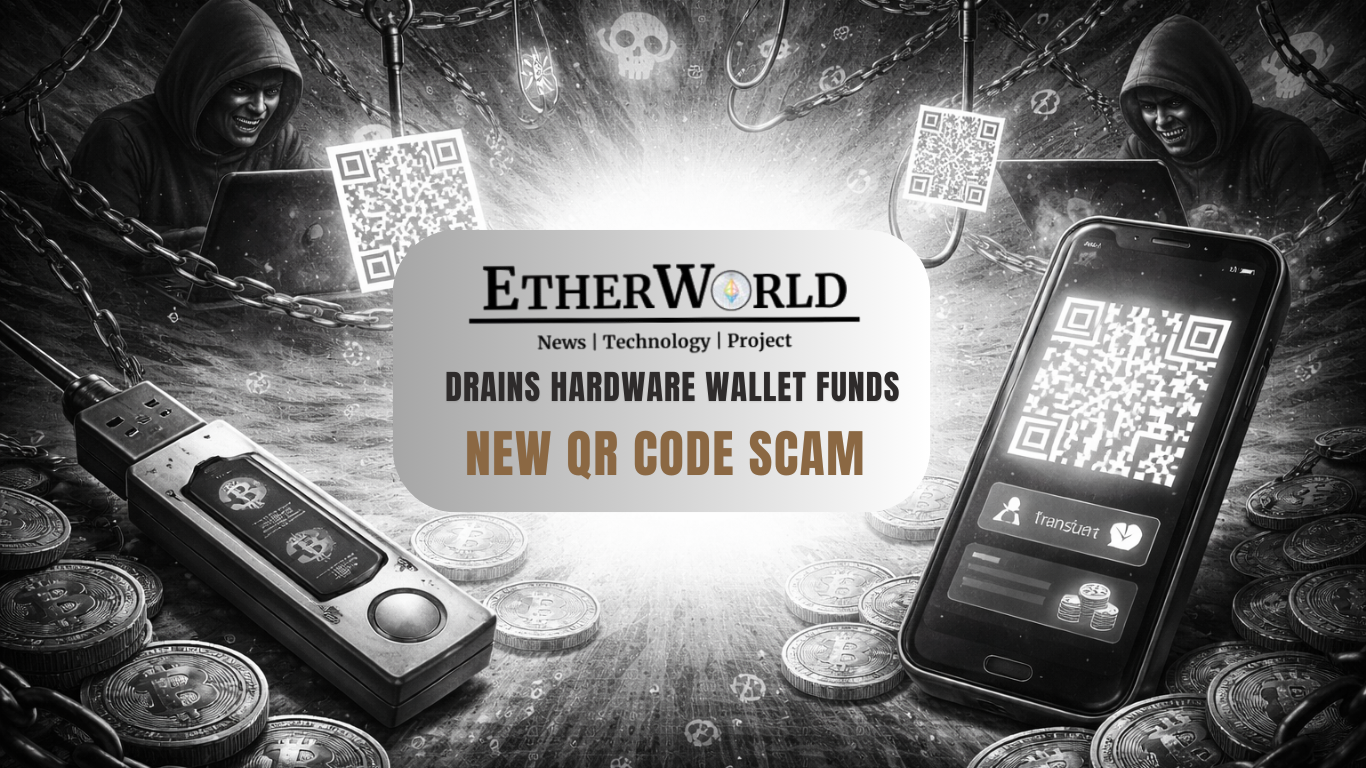
Scams concerning cryptocurrency are becoming more and more frightening, and this time the attackers are taking a novel approach by mailing actual letters. Users of hardware wallets are getting official-looking emails requesting that they scan a QR code as part of a "mandatory security check." Although it appears true, it is a trap.
The QR code directs you to fraudulent websites that, in a matter of minutes, can drain your cash by stealing your recovery phrase. With phishing already at record highs worldwide, this shows how scammers are now merging old-school approaches with internet tricks to dupe crypto users.
- How the QR Letter Scam Tricks Hardware Wallet Users?
- From Personalisation to Billions in Losses: A Growing Threat
- Phishing is Exploding & Crypto is Paying the Price
- A Growing Wave of Cyber Fraud Across India & Beyond
- Awareness Is the Strongest Line of Defence
How the QR Letter Scam Tricks Hardware Wallet Users?
Typically, it begins with a professionally produced letter that is addressed to users of well-known hardware wallets like Trezor and Ledger receiving in your mailbox. The mail asserts that in order to safeguard your wallet, an urgent firmware update or security verification is required. There is a QR code provided, and readers are urged to take immediate action, often with a warning that they risk losing access to their money if they do not.
After scanning the QR code, users are directed to a fraudulent website that closely resembles the interface of the actual wallet. Their recovery seed phrase, which is usually 12 or 24 words, is then requested to be entered. That is the crucial time. This phrase gives offenders the ability to retrieve the wallet on their own device and empty it.
Crypto platforms have stated time and time again that recovery words will never be requested by hardware wallets via physical letters, emails, QR codes, or websites.
From Personalisation to Billions in Losses: A Growing Threat
The sense of personal connection in this deception adds to its convincing nature. It is a common suspicion among victims that scammers are utilising hacked customer data from prior security breaches to make these messages appear authentic. Your information is a lot easier to trust when it shows up in something that comes to your door, and that is precisely what hackers are hoping for. This goes beyond a small number of isolated victims, though. It is a reflection of a much larger issue in the crypto community.
As per the Chainalysis 2025 report, it estimates that crypto scams generated almost $17 billion, primarily through phishing. In addition to this, the average amount stolen per victim has increased exponentially from $782 to $ 2,764, and impersonation schemes have a rapid increase of 1400% in just 1 year. These figures show that the scammers are not only growing in quantity, but they are also working on their efficiency.
Phishing is Exploding & Crypto is Paying the Price
This QR-code wallet scam is a part of a larger global phishing attack wave. The recent 2025 statistics by the Anti-Phishing Working Group demonstrate how dire the situation has become. As per this report, the first half of 2025 saw over 1 million phishing attacks, which is one of the largest numbers ever recorded. Almost one-third of these scams are consistently rising because it is difficult for users to determine where those links are actually leading.
At the same time, as per the FBI’s 2024 Internet Crime Report, phishing and spoofing continue to be the most frequently reported cybercrimes globally. This report shows that cryptocurrency investment schemes resulted in losses of over $6.5 billion.
Collectively, these numbers show that phishing is getting smarter, more convincing, and more reliable and far more expensive for the victims.
A Growing Wave of Cyber Fraud Across India & Beyond
Crypto users have previously fallen victim to ingeniously planned schemes. In order to deceive individuals into sending money or sharing important information, fraudsters have used realistic-looking phishing techniques, impersonation websites, and false update alerts over the years.
According to the Federal Trade Commission, in early 2024, Bitcoin ATM scams alone resulted in losses of tens of millions of dollars. The scammers utilized fictitious identities and QR codes to coerce victims into sending money.
In India, the National Technical Research Organisation found more than 1,172 phishing domains in just 6 months, demonstrating the speed at which scam networks are increasing rapidly. Meanwhile, the PIB reports that the total number of cybercrime cases in India has doubled from 10.29 lakh in 2022 to 22.68 lakh in 2024.
When taken as a whole, these statistics demonstrate that fraudsters aren’t slowing down; rather, they’re always evolving and coming up with new strategies to trick individuals.
Awareness Is the Strongest Line of Defence
The majority of scams are successful because they manipulate people’s emotions rather than being technically sound. Scammers are skilled in instilling fear, anxiety, sense of urgency to get victims to act without a second thought. Be it a letter at your doorstep, a fake website, or an email, the objective of scammers is always the same: to make you fall into the trap.
There is only one way before being victimised, i.e., never share your recovery phrase. Always remember that no genuine wallet company will ever ask for it. Using dual-factor authentication, confirming messages via legitimate channels and being cautious with unexpected QR codes can all help. As scams are becoming more personal and convincing in nature, staying vigilant and alert isn’t just smart but a demand of the hour.
If you find any issues in this article or notice missing information, please feel free to reach out at team@etherworld.co for clarifications or updates.
To promote your Web3 articles, events, and projects, you may reach out anytime via EtherWorld PR for submissions and collaboration.
Related Articles
- Ether Scam Alert!!
- WhatsApp x Polygon: Dyadnum Redefines Retail DeFi
- Global Digital Finance War: How 7 Nations Are Redrawing the Digital Economy Map
- ₹26.54 Crore Fraud Case: ED Freezes ₹10.86 Crore in Land & Crypto Assets
- Gemini Steps Into Smart Wallet Arena
To follow blockchain news, track Ethereum protocol progress, and read our latest stories, subscribe to our weekly today.
Disclaimer: The information contained in this website is for general informational purposes only. The content provided on this website, including articles, blog posts, opinions, & analysis related to blockchain technology & cryptocurrencies, is not intended as financial or investment advice. The website & its content should not be relied upon for making financial decisions. Read full disclaimer & privacy policy.
To stay updated on blockchain news, Ethereum protocol progress, and our latest stories, subscribe to our weekly digest and YouTube channel for .
To promote your Web3 articles, events, project updates, and Press Releases, reach out anytime via EtherWorld PR for submissions and collaboration. For other queries, email contact@etherworld.co.
If you’d like to support our work, share the content and consider donating at avarch.eth.
Join our community on Discord and
Author

Content Writer