India Needs Clear Crypto Rules, Says GNLU Report
A new GNLU report urges India to establish clear crypto regulations and outlines five models to protect investors and support Web3 innovation.
India’s crypto policy debate may have just received one of its most structured legal reference points yet. A new report from Gujarat National Law University says India needs rules for crypto assets.
The report, titled "Crypto Assets in India: Assessing the Case for Regulation," urges India to adopt a forward-thinking approach to crypto. This can help investors reduce confusion about laws and create space for developers in India.
India has already taxed Digital Assets, made some crypto entities comply with anti-money laundering rules, and discussed the need for global coordination through the G20 process. The report wants to make crypto work in India.
- Why GNLU Says India Needs Crypto Regulation Now
- The Real Risks: Investors, Offshore Migration, & Brain Drain
- Five Regulatory Paths India Can Consider
- What This Means for India’s Web3 Future
Why GNLU Says India Needs Crypto Regulation Now
India is now a crypto market, with many people using it. The rules around crypto are still unclear. The government has been careful about crypto. They do not want people to get too carried away with it.
So they have imposed taxes on crypto. Made sure people follow the rules. The government is waiting for other countries to decide on crypto rules so it can make a plan that works for India. They want to ensure people can use crypto safely.
The government is trying to balance the use of crypto with the need to protect people. They are taking a step-by-step approach to make sure that crypto works well in India. The goal is to make a system that's fair and safe for everyone.
That may have bought time, but it has not delivered clarity. GNLU’s research suggests that the status quo creates a vacuum where both users & builders operate without confidence.
Investors do not have a clearly defined protection regime. Platforms face uncertainty over permissible activity. Developers lack policy visibility. And regulators still do not have a unified framework through which risks can be addressed coherently.
That is why the report positions regulation not as a concession to the industry, but as a state capacity issue. In its view, India now needs rules not because crypto has “won,” but because ambiguity has become costly.
One of the most useful parts of the report is that it does not pretend India has done nothing. Instead, it acknowledges that India has already taken partial steps to bring crypto-related activity into a compliance perimeter.
These include the 30% tax on VDA income, the 1% TDS on certain crypto transactions, & the extension of anti-money laundering obligations to crypto exchanges & intermediaries. In policy terms, this reflects a model of controlled deterrence rather than legalization.
Taxation can collect revenue. AML obligations can monitor suspicious flows. But neither of those answers bigger structural questions such as:
- What kinds of crypto assets exist under Indian law?
- Which agency should oversee them?
- How should custody, disclosure, dispute resolution, consumer safeguards, stablecoins, tokenized assets, & platform conduct be handled?
This is where the report becomes especially important. It treats crypto not as a single monolithic category, but as a multi-dimensional sector that intersects finance, technology, payments, consumer rights, & law enforcement. That means a simplistic one-line policy will likely fail.
BREAKING: 🇮🇳Gujrat law university says India urgently needs a clear regulatory framework for crypto assets.
— Crypto India (@CryptooIndia) March 11, 2026
They published a report, suggesting five regulatory models for policymakers to protect investors and so developers can build in India. pic.twitter.com/KbZd3G40fI
The Real Risks: Investors, Offshore Migration, & Brain Drain
The GNLU report repeatedly returns to three consequences of policy uncertainty.
- The first is investor vulnerability. In the absence of a structured framework, retail users are left exposed to risks involving platform failures, poor disclosures, manipulation, misleading promotion, weak custody standards, & limited recourse when things go wrong.
- The second is offshore migration. When domestic rules remain unclear or overly deterrent, users & businesses often move to unregulated foreign platforms. That weakens enforcement visibility, reduces tax effectiveness, & makes consumer harm harder to address.
- The third is developer brain drain. This point also appeared in remarks from the report launch, where speakers noted concern that developers cannot confidently build this technology in India because there is no enabling framework.
For a country that wants to lead in digital infrastructure, this is a strategic issue. If founders, engineers, compliance teams, & product builders find friendlier jurisdictions abroad, India risks losing not just trading activity, but long-term innovation capacity.
Five Regulatory Paths India Can Consider
Instead of prescribing a single formula, the GNLU report examines multiple regulatory models for India.
- SEBI-led model: This approach would make SEBI the primary regulator for crypto assets, particularly where tokens resemble investment instruments or market-traded assets. The strength of this model lies in investor protection, disclosure norms, exchange oversight, & market conduct regulation.
- RBI-led model: This model considers whether the Reserve Bank of India should take the lead, especially for payment-related crypto activity, stablecoins, currency concerns, & systemic financial risks. It is strongest where crypto intersects with monetary policy or payment infrastructure.
- MeitY-led oversight: Because crypto platforms are also digital platforms, the report explores whether the Ministry of Electronics & Information Technology could play a larger role in governing technology standards, platform integrity, cybersecurity, data handling, & online consumer safeguards.
- Self-Regulatory Organization or SRO model:
This approach would rely on an industry-led body to create operational standards, best practices, & conduct requirements for crypto service providers. The report acknowledges the flexibility & technical understanding an SRO can bring, but also notes that self-regulation alone may not be enough without statutory backing. - Dedicated new regulator or hybrid multi-agency coordination: The report also explores the possibility of a new specialized authority for crypto assets, as well as a coordinated structure where multiple regulators divide responsibilities based on domain expertise.
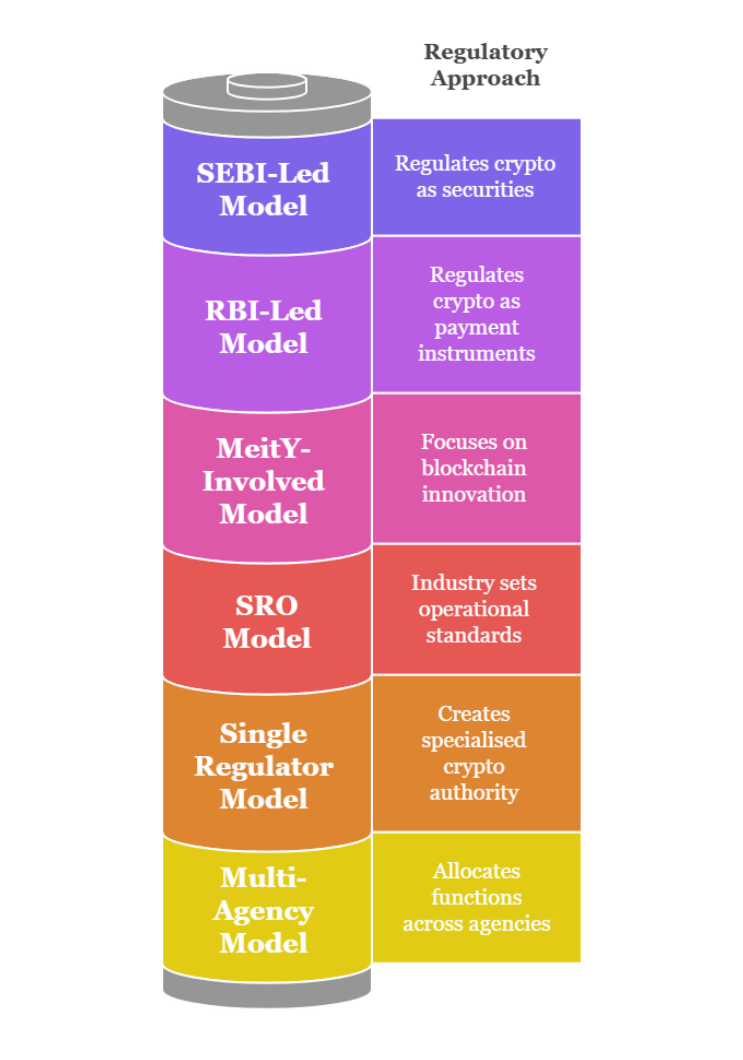
A purely securities-based model may help protect investors, but it may not fully solve payment or currency issues. A central bank-driven model may address systemic risk, but not every market structure or technology concern.
A self-regulatory model may be agile, but may lack enforceability. A new regulator may offer focus, but would take time to build & could overlap with existing agencies.
That is why the report appears to favour a more coordinated & hybrid structure.
What This Means for India’s Web3 Future
For years, India’s crypto discourse has swung between extremes, i.e., ban it, tolerate it, tax it, or wait for the world to decide. This report suggests a more mature alternative.
That does not mean India will suddenly adopt a permissive crypto regime. But it does mean the intellectual groundwork for a serious policy conversation is becoming harder to ignore.
If policymakers take these recommendations seriously, India could shift from reactive deterrence to structured supervision. And that would matter far beyond exchanges or token speculation. It would shape whether India becomes merely a consumer market for global crypto products, or a jurisdiction where legal certainty allows real blockchain innovation to be built domestically.
If you find any issues in this blog or notice any missing information, please feel free to reach out at yash@etherworld.co for clarifications or updates.
To promote your Web3 articles, events, and projects, you may reach out anytime via EtherWorld PR for submissions and collaboration.
Related Articles
- Indian Govt Launches Crypto Task Force Against Darknet Drug Trade
- Indian MP Raghav Chadha Pushes Crypto & Blockchain Reforms
- No Tax Relief for Crypto in India's Budget 2026
- Jio x Aptos: How India’s Giant Is Turning Web3 Into Everyday Utilityt
- Indian MP Flags Crypto Talent Drain Amid Heavy Taxation
To follow blockchain news, track Ethereum protocol progress, and read our latest stories, subscribe to our weekly today.
Disclaimer: The information contained in this website is for general informational purposes only. The content provided on this website, including articles, blog posts, opinions, & analysis related to blockchain technology & cryptocurrencies, is not intended as financial or investment advice. The website & its content should not be relied upon for making financial decisions. Read full disclaimer & privacy policy.
To stay updated on blockchain news, Ethereum protocol progress, and our latest stories, subscribe to our weekly digest and YouTube channel for ELI5 content.
To promote your Web3 articles, events, project updates, and Press Releases, reach out anytime via EtherWorld PR for submissions and collaboration. For other queries, email contact@etherworld.co.
If you’d like to support our work, share the content and consider donating at avarch.eth.
Join our community on Discord and follow us on Twitter, Facebook, LinkedIn & Instagram.
Author

Blockchain Content & Ops Specialist, Avarch LLC.