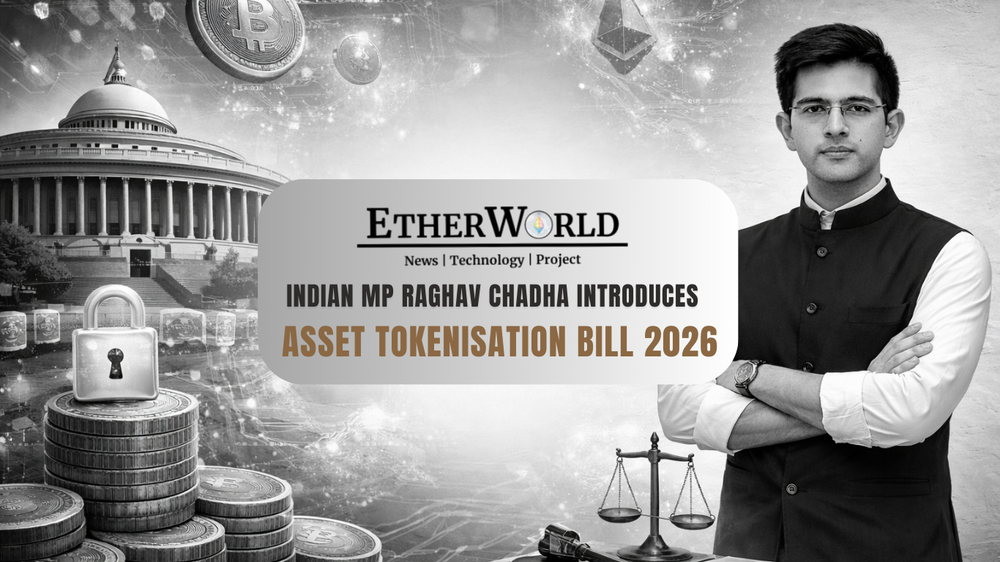
India Needs Asset Tokenisation Law, Says MP Raghav Chadha
India needs an Asset Tokenisation Bill to democratise investment, unlock liquidity in real-world assets & bring global capital onshore, argues MP Raghav Chadha in Parliament.
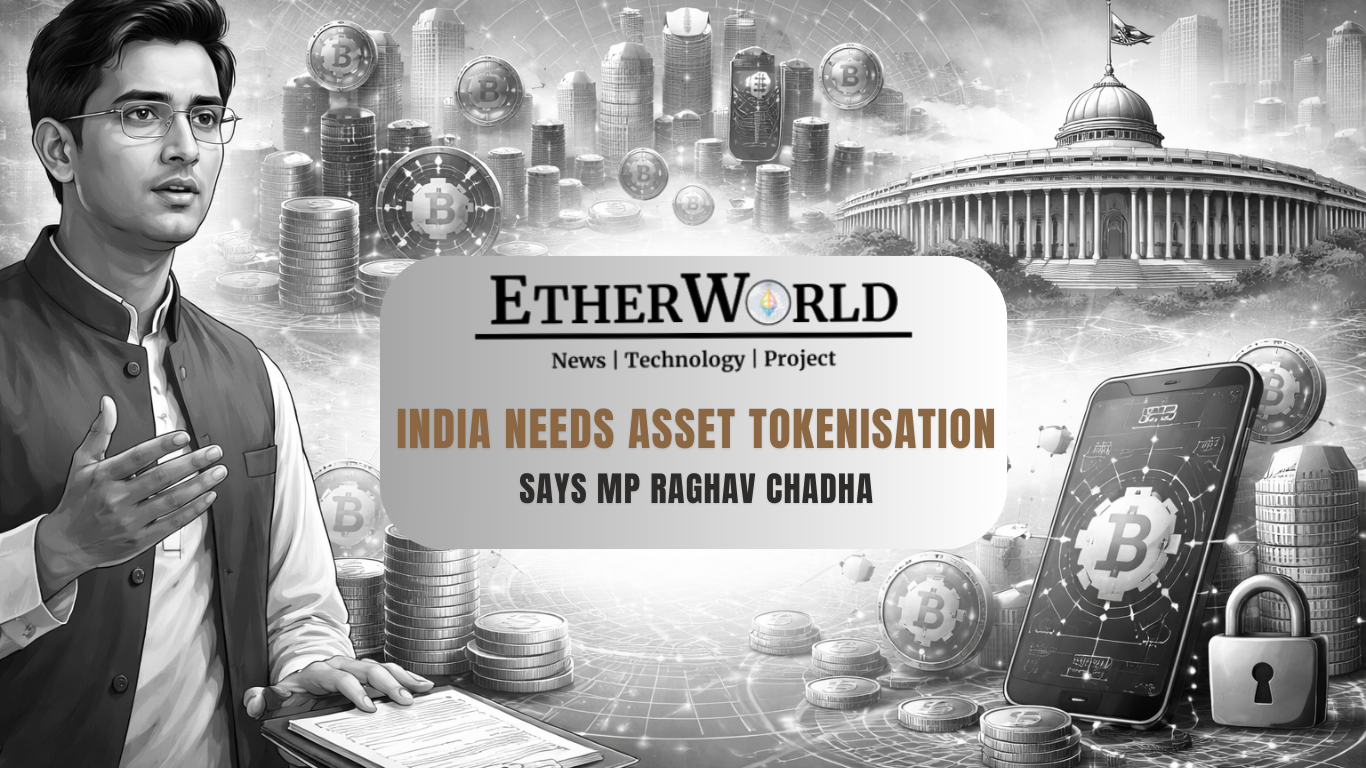
India has made significant progress in digitising payments, identity & banking infrastructure over the last decade. Aadhaar enabled digital identity at scale. UPI transformed peer-to-peer & merchant payments. Account aggregation improved financial data portability.
While millions of Indians can move money instantly, most cannot deploy capital beyond basic instruments like savings accounts, fixed deposits & mutual funds. Speaking in the Rajya Sabha, MP Raghav Chadha argued that this gap is precisely where asset tokenisation legislation becomes essential.
- The Structural Problem with Today’s Investment Landscape
- What Asset Tokenisation Actually Enables
- Why the Middle Class Stands to Gain the Most
- Why Tokenisation Fits India’s Asset Culture
The Structural Problem with Today’s Investment Landscape
Chadha framed his argument through a familiar lens. Just as UPI brought digital payments to street vendors, rickshaw pullers & small traders, tokenisation could make investment & ownership inclusive.
UPI did not invent money. It simply made transfer frictionless, transparent & universally accessible. Tokenisation, Chadha suggested, can do the same for assets that were historically restricted to the wealthy.
India’s investment ecosystem suffers from three structural limitations:
- High entry barriers: Commercial real estate, infrastructure projects & private assets require large ticket sizes.
- Illiquidity: Once invested, capital is often locked for years.
- Complex intermediaries: Brokers, registries, agents & paperwork add cost & friction.
For the middle class, this means capital often remains idle or over-concentrated in low-yield instruments. Chadha pointed out that despite having savings, most Indians simply lack access to productive asset classes.
What Asset Tokenisation Actually Enables
Asset tokenisation involves converting real-world assets into digital tokens on a blockchain, where each token represents fractional ownership. These tokens can be:
- Bought & sold transparently
- Traded without traditional intermediaries
- Settled instantly
- Programmed with compliance rules
Importantly, tokenisation does not eliminate regulation. Instead, it embeds compliance directly into the asset lifecycle, reducing manual oversight while improving transparency.
To explain tokenisation in practical terms, Chadha used a gold analogy. Today, purchasing 10 grams of physical gold may cost over ₹1.3 lakh. A buyer with ₹500 cannot realistically participate. However, digital gold & gold ETFs changed that equation by allowing fractional ownership.
Tokenisation applies the same principle to:
- Real estate projects
- Infrastructure assets
- Commodities
- Intellectual property
- Private market instruments
A large asset is digitally divided, enabling investors to participate at smaller ticket sizes.
A common person needs more representatives in Parliament who can explain #Blockchain technology in simple terms and clearly show how it benefits everyday people.
— Pooja Ranjan | ranjan.eth (@poojaranjan19) December 16, 2025
This kind of communication helps build trust and drives mainstream adoption. #India needs more such voices in… https://t.co/5lyfL7M1m9
Why the Middle Class Stands to Gain the Most
According to Chadha, asset tokenisation disproportionately benefits the middle class by addressing long-standing financial limitations.
Key advantages include:
- Access to higher-yield assets
- Portfolio diversification beyond deposits
- Participation in asset appreciation
- Reduced dependency on speculative instruments
Tokenisation transforms ownership from an all-or-nothing proposition into a graduated financial ladder. One of the strongest arguments presented was liquidity.
Real estate, infrastructure & private assets are notoriously illiquid. Selling them involves months of negotiation, paperwork & cost. Tokenisation introduces secondary markets, enabling partial exits without selling the entire asset.
Chadha noted that investors would no longer need to navigate brokers, property dealers or cumbersome registries to enter or exit positions. Chadha cited several global frameworks:
- United States: Recognition of tokenised securities under SEC-regulated structures
- Singapore: Project Guardian, enabling regulated tokenised asset experiments
- European Union: Markets in Crypto-Assets Regulation (MiCA)
- UAE: Dedicated Virtual Asset Regulatory Authority (VARA)
These jurisdictions treat tokenisation as a regulated financial innovation, not a speculative loophole.
Why Tokenisation Fits India’s Asset Culture
India’s household wealth profile strengthens the tokenisation argument. Approximately 70–80% of household assets are concentrated in real estate & precious metals.
Tokenisation aligns with these preferences rather than forcing adoption of unfamiliar instruments. Fractional ownership allows households to:
- Monetise traditional assets digitally
- Improve liquidity without selling core holdings
- Access yield without cultural displacement
A recurring theme in the speech was capital flight. In the absence of regulatory clarity, tokenisation ventures migrate to Singapore, UAE, Hong Kong & the US.
A clear Indian framework could reverse this flow by:
- Attracting global capital
- Encouraging domestic innovation
- Creating compliant onshore markets
Asset tokenisation is not a speculative trend. It is a structural upgrade to how ownership, liquidity & investment function in a digital economy.
As UPI redefined payments, tokenisation could redefine asset access. Chadha’s intervention reframes the debate from crypto ideology to financial inclusion & capital efficiency.
The question before policymakers is no longer whether tokenisation should exist, but where it should be regulated. India now faces a choice: export this innovation abroad or institutionalise it at home.
If you find any issues in this blog or notice any missing information, please feel free to reach out at yash@etherworld.co for clarifications or updates.
Related Articles
Disclaimer: The information contained in this website is for general informational purposes only. The content provided on this website, including articles, blog posts, opinions, & analysis related to blockchain technology & cryptocurrencies, is not intended as financial or investment advice. The website & its content should not be relied upon for making financial decisions. Read full disclaimer & privacy policy.
For Press Releases, project updates & guest posts publishing with us, email contact@etherworld.co.
Subscribe to EtherWorld YouTube channel for ELI5 content.
Share if you like the content. Donate at avarch.eth.
You've something to share with the blockchain community, join us on Discord!
Author

Blockchain Content & Ops Specialist, Avarch LLC.