How AWS Failure Disrupted Coinbase’s Trading Infrastructure
Coinbase’s AWS outage exposed the hidden centralization risks behind modern crypto trading infrastructure.
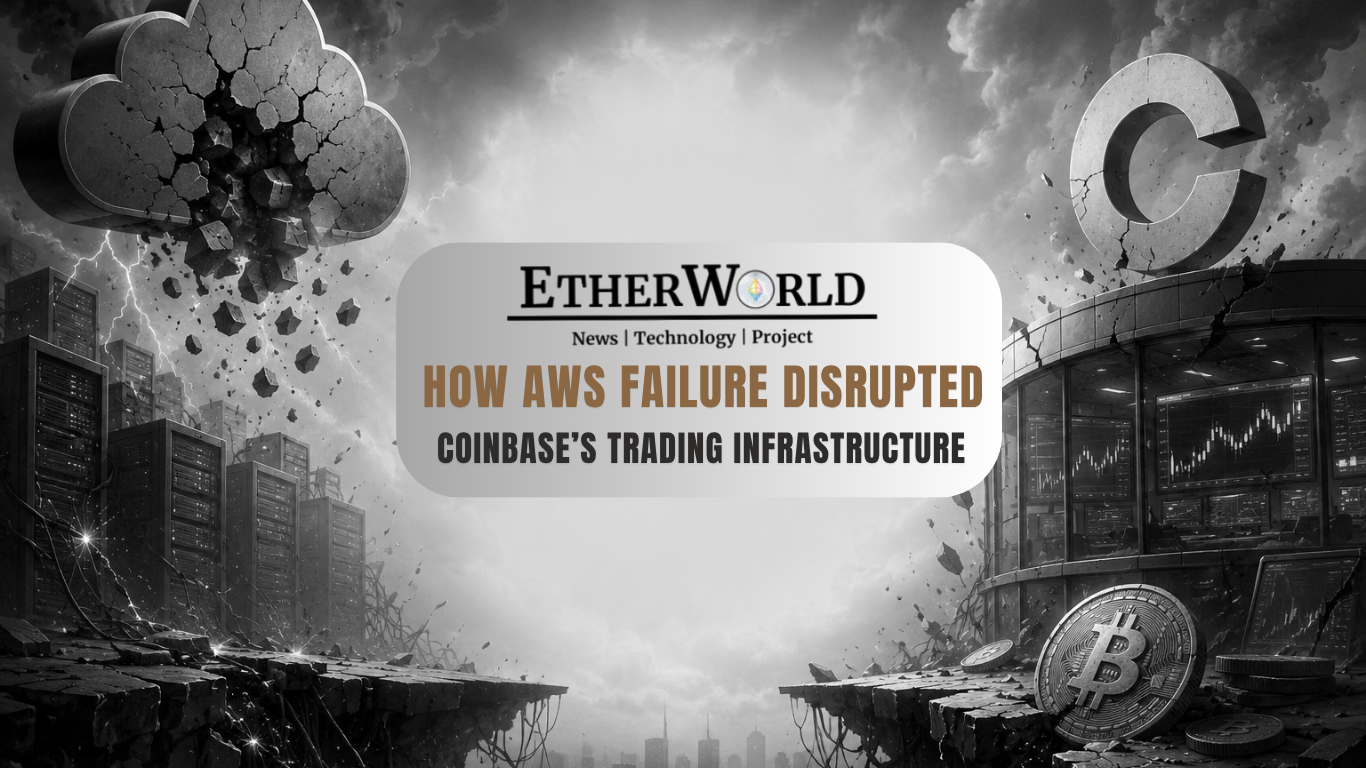
The most recent Coinbase outage demonstrated how heavily controlled cloud systems continue to power cryptocurrency trading infrastructure. Over five hours of trading instability on Coinbase were caused by a disruption within AWS US-EAST-1 availability zone use1-az4, which prevented customers from purchasing, selling, transferring assets, or even viewing cryptocurrency values on web and mobile platforms.
Some leveraged traders apparently had to liquidate as a result of the issue, which also forced Coinbase into "Cancel Only" mode and resulted in missed orders. The downtime swiftly became one of the most talked-about infrastructure issues in the cryptocurrency markets this year, despite Coinbase's repeated assurances that customer cash was secure.
- AWS US-EAST-1 Failure Became the Core Trigger
- Coinbase Entered “Cancel Only” Mode During the Outage
- The Outage Highlighted Crypto’s Centralization Problem
- Coinbase’s AWS Dependency Is Now Under Scrutiny
AWS US-EAST-1 Failure Became the Core Trigger
The issue started when high temperatures inside AWS infrastructure in Northern Virginia negatively impacted performance in the availability zone use1-az4. AWS subsequently verified that during recovery operations, traffic rerouting and partial shutdown procedures were necessary due to overheating. Due to Coinbase's heavy reliance on AWS infrastructure, the degradation quickly spread to trading systems and services that interact with customers.
The location of the breakdown itself was what increased the severity of the incident. One of Amazon's biggest and most important infrastructure centres, US-EAST-1, is more than simply another AWS region.
It is essential for many backend services on the internet for databases, routing, authentication, and operational coordination. Downstream systems linked to Coinbase started exhibiting increased slowness, request failures, and partial data synchronisation when the availability zone began to fail.
User reports began to appear almost instantly. Order execution became uneven, balances stopped updating correctly, and many traders were unable to access trading dashboards. As the site battled to settle, several users also reported that orders were automatically cancelled minutes after they were placed.
Coinbase Entered “Cancel Only” Mode During the Outage
Coinbase placed some of its trading infrastructure in "Cancel Only" status as the interruption grew more severe. Practically speaking, users could cancel current orders, but they couldn't consistently carry out regular spot trading operations. One of the most obvious signs that the exchange's trading engine was under extreme operational stress was this.
The outage was much longer than the brief API disruptions that are usually observed during times of high market volatility, lasting more than 5 hours. During this time, customers of Coinbase encountered:
- Failed buy and sell attempts
- Delayed order confirmations
- Inability to access price feeds
- Transfer request failures
- Missing or frozen portfolio balances
- Mobile and web trading disruptions
Both leveraged market participants and regular traders were impacted by the disruption. Because they were unable to close or handle deals while the platform was still unstable, several users with leveraged holdings reportedly faced liquidations. The issue of operational resilience in centralised exchanges was heightened by this particular aspect.
Later, Coinbase reported that engineers were actively monitoring impaired exchange services through its status infrastructure while collaborating with AWS recovery efforts. Despite massive service disruptions, the business insisted throughout the crisis that customer assets were safe.

The Outage Highlighted Crypto’s Centralization Problem
A long-running discussion inside the cryptocurrency markets was promptly rekindled by the incident, i.e., how decentralised is the sector if significant exchanges continue to rely on a single cloud provider?
This incident showed that centralised infrastructure is still firmly ingrained in trading activities, even though cryptocurrency is positioned around distributed systems and decentralisation. Access to one of the biggest cryptocurrency exchanges in the world was disrupted by a single overheating problem inside one AWS availability zone.
The wider effects went well beyond Coinbase. Other AWS-connected platforms, such as OpenSea, Robinhood, MetaMask-related services, and a number of non-crypto internet apps, also reported interruptions. Because upstream infrastructure providers were concurrently impacted, blockchain-related services occasionally displayed incorrect data, delayed transaction confirmations, and connectivity issues.
Even decentralised applications frequently depend on centralised hosting, API layers, and cloud databases in the background. Only when infrastructure fails on a large scale does this dependency become really apparent.
Concentration concern within US-EAST-1 was a recurring topic in online conversations around the outage. The area has historically been overburdened because so many businesses still use it as their main operational backbone, according to a number of engineers and infrastructure experts.
Coinbase’s AWS Dependency Is Now Under Scrutiny
Coinbase has previously experienced operational difficulties related to cloud infrastructure. Scaling, traffic handling, and service redundancy vulnerabilities had already been revealed by earlier AWS-related disasters. Following the October 2025 AWS outage, Coinbase released a retrospective in which it acknowledged that disruptions in AWS systems affected trading services, operational visibility, and login access.
However, due to its duration and direct effect on active traders, the most recent disruption raised a distinct level of anxiety. This downtime was caused by infrastructure degradation outside of Coinbase's own trading stack, as opposed to traffic surges brought on by cryptocurrency volatility.
This distinction is important because it directs focus away from exchange traffic forecasting and toward dependency management.
There is no proof that the downtime was caused by a cybersecurity attack, and the company has not disclosed any compromise of customer assets. Additionally, AWS revealed that rather than reacting to malicious behaviour, recovery efforts concentrated on rerouting workloads and restoring cooling capacity.
However, discussions over distributed cloud architecture, multi-region redundancy, and whether large cryptocurrency exchanges should lessen their reliance on a single infrastructure provider have become more heated as a result of the outage.
For many traders, the incident became less about temporary outages and more about how vulnerable contemporary cryptocurrency trading infrastructure can become in the event of an unplanned core cloud system failure.
If you find any issues in this article or notice missing information, please feel free to reach out at team@etherworld.co for clarifications or updates.
To promote your Web3 articles, events, and projects, you may reach out anytime via EtherWorld PR for submissions and collaboration.
Related Articles
- U.S. Crypto Bill Faces Turbulence as Coinbase Pushes Back
- Coinbase Launches Coinbase Predict
- Coinbase Introduces USDC-INR Trading for India
- Coinbase CEO Urges a Level Playing Field as Banks Push Back
- Coinbase Pushes Back on Senate Banking Crypto Bill
To follow blockchain news, track Ethereum protocol progress, and read our latest stories, subscribe to our weekly today.
Disclaimer: The information contained in this website is for general informational purposes only. The content provided on this website, including articles, blog posts, opinions, & analysis related to blockchain technology & cryptocurrencies, is not intended as financial or investment advice. The website & its content should not be relied upon for making financial decisions. Read full disclaimer & privacy policy.
To stay updated on blockchain news, Ethereum protocol progress, and our latest stories, subscribe to our weekly digest and YouTube channel for ELI5 content.
To promote your Web3 articles, events, project updates, and Press Releases, reach out anytime via EtherWorld PR for submissions and collaboration. For other queries, email contact@etherworld.co.
If you’d like to support our work, share the content and consider donating at avarch.eth.
Join our community on Discord and follow us on Twitter, Facebook, LinkedIn & Instagram.

 ×
×

Author

Nidhi Kumari is a Web3 content writer at EtherWorld.co, tracking ecosystem developments, funding activity, and market trends shaping the crypto space.