Highlights from the All Core Developers Consensus (ACDC) Call #177
Glamsterdam devnets drive Ethereum’s execution readiness while Hegotá opens the next phase of upgrade proposals & protocol evolution.
Ethereum core developers are currently navigating two tightly connected priorities. The first is execution readiness through Glamsterdam, where devnets, infrastructure fixes, and consensus-level changes are being actively tested. The second is forward planning through Hegotá, where proposal discussions are beginning to shape the next major upgrade.
The stability and outcomes of Glamsterdam will directly influence how quickly Hegotá progresses and what ultimately gets included. This creates a layered roadmap where short term engineering decisions define long term protocol evolution.
At the center of current discussions are Devnet timelines, ePBS restructuring, execution request handling, and a set of EIPs that aim to improve validator behavior and protocol efficiency. At the same time, early stage conversations under Hegotá are beginning to surface proposals that could define Ethereum’s next leap.
Glamsterdam Updates
Glamsterdam is currently the primary focus for Ethereum core developers. The goal is to stabilize key architectural changes while ensuring that execution and consensus layers remain aligned under increasingly complex conditions.
One of the most important milestones is the planned launch of Glamsterdam Devnet 0, which is targeting the first day of Interop. This is devnet iteration represents a consolidation phase where previously separate efforts such as ePBS and FOCIL are being merged into a single testing environment.
This decision follows the failure of ePBS Devnet 1 and the cancellation of Devnet 2. Rather than continuing with isolated experiments, developers have chosen to combine efforts and reduce fragmentation. The idea is simple. Instead of testing parallel paths, bring everything into one coordinated environment and resolve issues together.
A major blocker that shaped this decision is PR-5094, which addresses a fundamental issue in how execution payloads are processed. Under the current design, a single block root could lead to two different states depending on whether the execution payload had been processed.
This creates inconsistencies in multiple areas of the protocol. Fork choice rules become less reliable. Validator balance calculations can diverge. Even weak subjectivity assumptions start to break down. These are not minor bugs. They strike at the core guarantees that Ethereum relies on.
To fix this, the proposed approach is to defer execution payload processing to the next block. In simple terms, payloads are first verified when received, but their effects are only applied during the next state transition. This restores a single canonical state per block and eliminates ambiguity.
This shift also removes the need for maintaining two parallel state systems, often referred to as block states and payload states. By going back to a single unified state model, the protocol regains consistency and predictability.
Another important area of work is execution request handling. Current discussions highlight inefficiencies related to duplication and size constraints. While the theoretical maximum size of execution requests is around 1.5 MB, actual usable capacity is much lower due to gas limits, currently sitting at roughly 489 KB.
This gap between theoretical and practical limits has forced developers to rethink how execution data is structured and transmitted. Optimization proposals are already in progress, including changes that remove unnecessary data from envelopes and reduce redundancy.
Testing is continuing in parallel. BAL Devnet 3 and Devnet 4 are scheduled in close succession. These devnets are focused on validating execution efficiency and ensuring that gas accounting behaves correctly under different scenarios.
Alongside these infrastructure changes, several EIPs are being evaluated for inclusion. One of them is EIP-8136, which is being added to Glamsterdam Devnet 0 as an optional feature. This allows developers to test its impact without making it a strict dependency.
Another key proposal under discussion is EIP-8045, which suggests excluding slashed validators from participating in duties. This is an important step toward improving network safety. By ensuring that penalized validators do not continue influencing the system, Ethereum can reduce risk during periods of instability.
There is also ongoing work around native account abstraction. While not yet finalized, teams are actively reviewing its roadmap and planning breakout sessions to align on future implementation.
On the organizational side, some discussions have been deliberately deferred. For example, the idea of blinding execution requests at the gossip level is being postponed. While it could reduce duplication, it also introduces complexity that developers are not ready to address at this stage.
The timeline is aggressive but structured. Devnet 3 is expected to go live soon, followed by Devnet 0 aligned with Interop. In parallel, teams are preparing for focused discussions on account abstraction and execution optimization.
Hegotá Updates
At the moment, the proposal window for Hegotá is open. Developers are actively encouraged to submit both headliner and non headliner proposals, although final deadlines have not yet been fixed. This flexibility is intentional. Core developers want to see how Glamsterdam progresses before locking in the scope of the next upgrade.
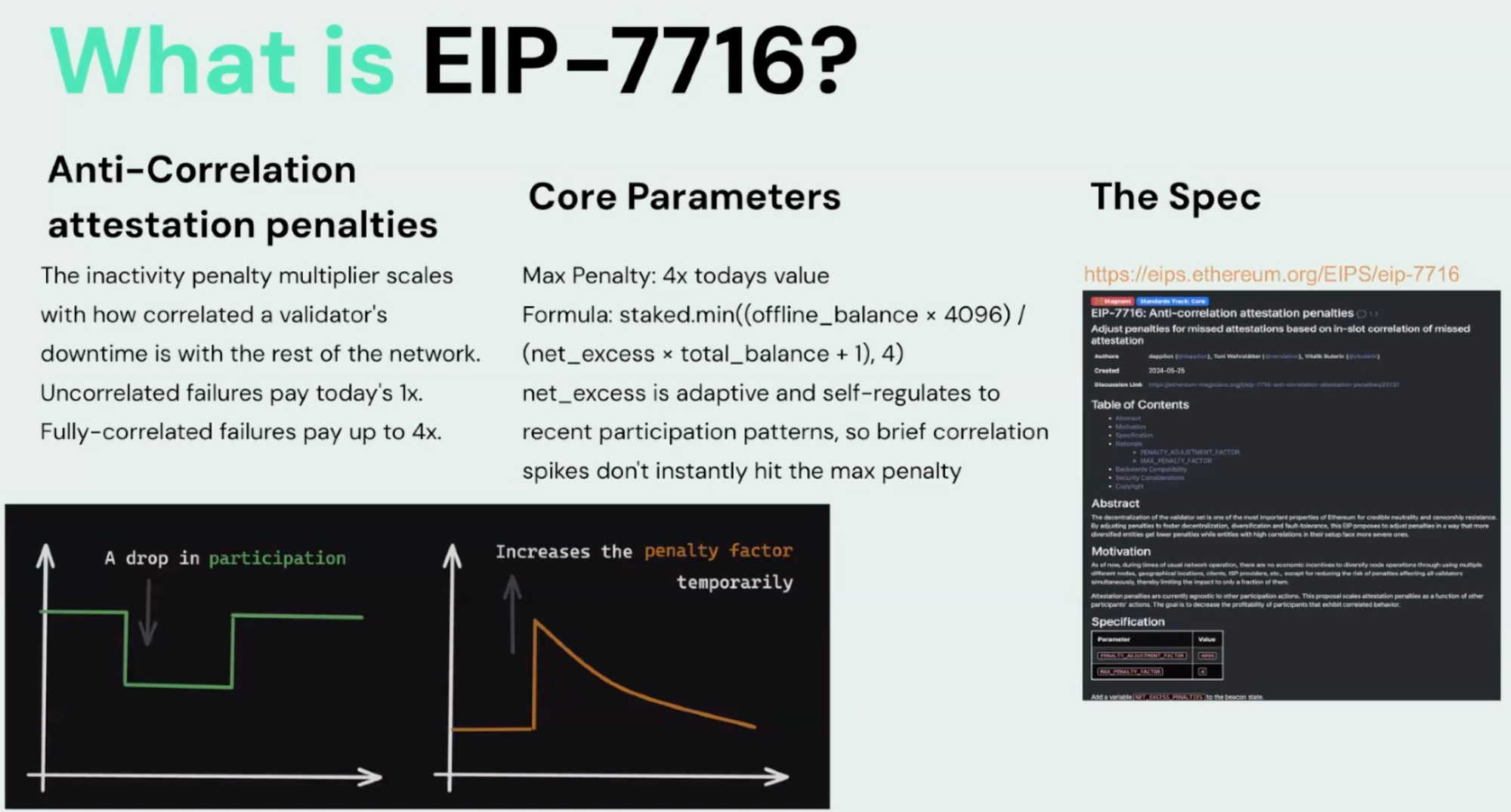
If major issues arise, timelines may shift. If everything stabilizes quickly, Hegotá could move faster than expected. Two proposals currently under discussion are EIP-7716 and EIP-8205. While details are still being debated, their inclusion signals the type of changes developers are considering for the next phase.
These discussions are taking place alongside regular coordination calls, particularly through ACDC meetings. This ensures that both execution and consensus perspectives are aligned before any decisions are made.
One important aspect of Hegotá is the distinction between headliner and non headliner proposals.
- Headliner proposals typically define the core narrative of an upgrade. They introduce major features or architectural changes that require broad consensus and extensive testing.
- Non headliner proposals, on the other hand, focus on incremental improvements. They may enhance efficiency, improve usability, or fix specific issues without fundamentally altering the protocol.
At this stage, non headliner proposals are open for submission, while headliner decisions are still being evaluated. This suggests that developers are prioritizing flexibility and exploration before committing to a specific direction.
The relationship between Glamsterdam and Hegotá is critical here. Hegotá cannot move forward until Glamsterdam proves that its underlying changes are stable. This creates a dependency chain where current testing directly influences future innovation.
For example, if execution request handling or payload processing changes introduce unexpected issues, developers may need to delay or modify proposals planned for Hegotá. On the other hand, if everything works smoothly, it opens the door for more ambitious upgrades.
This dynamic highlights how Ethereum development is evolving. Instead of rigid upgrade cycles, the process is becoming more adaptive. Decisions are made based on real world testing rather than fixed timelines.
Looking ahead, the next few weeks will be crucial. As Glamsterdam Devnet 0 goes live and testing results start coming in, developers will gain a clearer picture of what is possible for Hegotá. Until then, the focus remains on discussion, coordination, and preparation.
If you find any issues in this blog or notice any missing information, please feel free to reach out at yash@etherworld.co for clarifications or updates.
To promote your Web3 articles, events, and projects, you may reach out anytime via EtherWorld PR for submissions and collaboration.
Related Articles
- Highlights of Ethereum's All Core Devs Meeting (ACDC) #153
- Highlights of Ethereum's All Core Devs Meeting (ACDE) #207
- Highlights of Ethereum's All Core Devs Meeting (ACDC) #152
- Highlights of Ethereum's All Core Devs Meeting (ACDE) #206
- Highlights of Ethereum's All Core Devs Meeting (ACDE) #205
To follow blockchain news, track Ethereum protocol progress, and read our latest stories, subscribe to our weekly today.
Disclaimer: The information contained in this website is for general informational purposes only. The content provided on this website, including articles, blog posts, opinions, & analysis related to blockchain technology & cryptocurrencies, is not intended as financial or investment advice. The website & its content should not be relied upon for making financial decisions. Read full disclaimer & privacy policy.
To stay updated on blockchain news, Ethereum protocol progress, and our latest stories, subscribe to our weekly digest and YouTube channel for ELI5 content.
To promote your Web3 articles, events, project updates, and Press Releases, reach out anytime via EtherWorld PR for submissions and collaboration. For other queries, email contact@etherworld.co.
If you’d like to support our work, share the content and consider donating at avarch.eth.
Join our community on Discord and follow us on Twitter, Facebook, LinkedIn & Instagram.

 ×
×

Author

Yash Kamal Chaturvedi is a Blockchain Content & Ops Specialist at Avarch LLC, writing on Ethereum & governance since 2021. Covers ACD/ACDE calls, EIPs, upgrades, staking, security & ecosystem trends.