EtherWorld Bulletin — Edition #103
Digests of the week’s must-know moves for builders, product people, and protocol watchers.

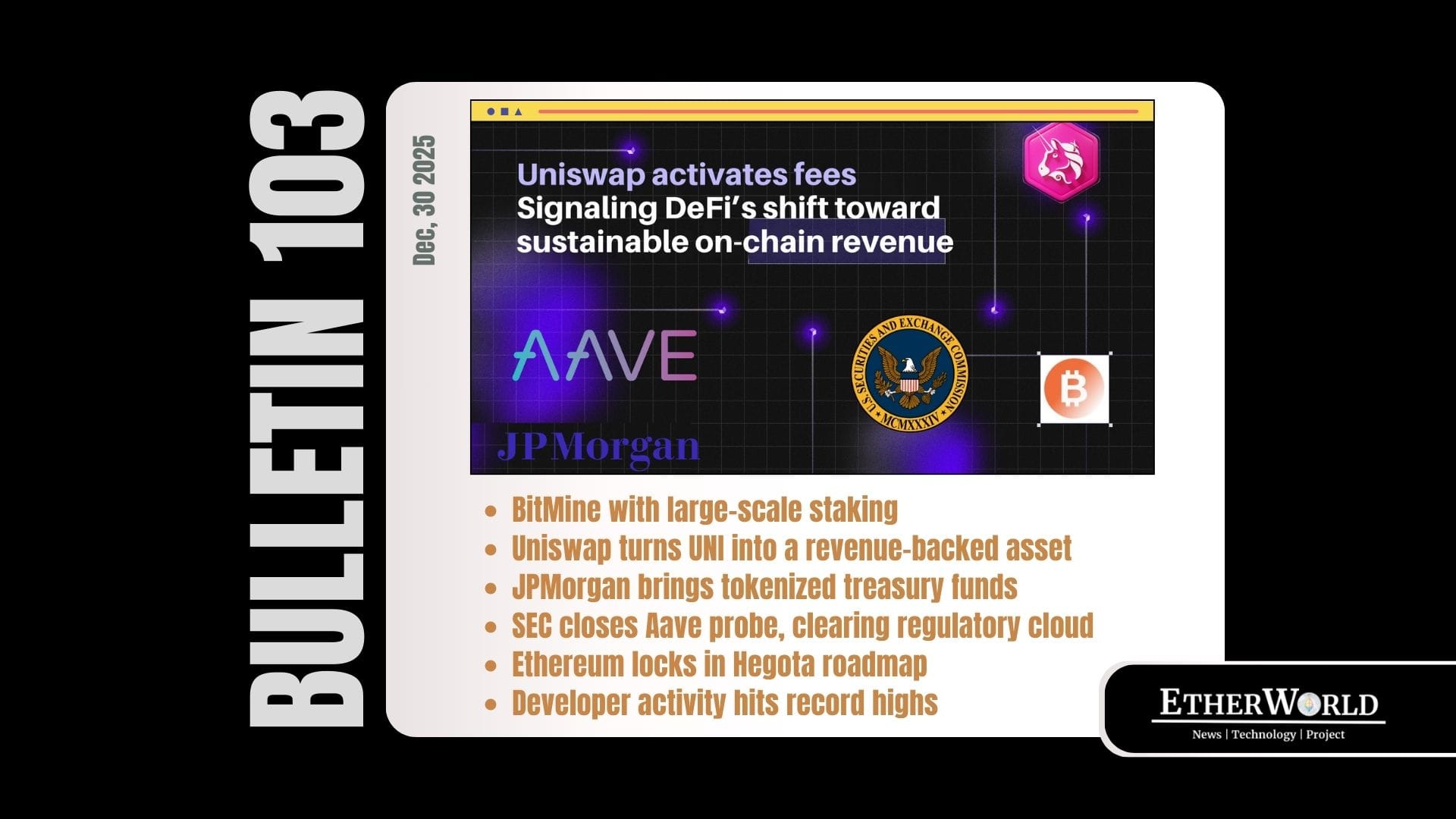
As 2025 closes, Ethereum is seeing a meaningful rotation in liquidity. Corporate treasuries are stepping in as speculative capital steps back. Retail sentiment is still range-bound, but behind the scenes, institutional settlement on-chain and the activation of protocol fees suggest Ethereum is entering a more grown-up phase.
TL;DR
• BitMine Immersion Technologies staked 342,560 ETH and launched a compliant validator network to solidify its position as a primary Ethereum treasury.
• Uniswap executed a 100 million UNI burn and activated its protocol fee switch, fundamentally altering the tokenomics of the largest decentralized exchange.
• JPMorgan launched the “MONY” tokenized treasury fund on the public Ethereum mainnet, moving traditional finance from permissioned pilots to public ledger settlement.
• The SEC concluded its four-year investigation into Aave with no charges, removing a significant regulatory overhang for the decentralized lending sector.
• Ethereum developers finalized the 2026 “Hegota” upgrade timeline, prioritizing censorship resistance to accommodate the influx of regulated capital.
• Smart contract deployments reached a quarterly record of 8.7 million, signaling all-time high developer activity despite price consolidation.
1. BitMine and the Corporate Staking Monopoly
BitMine Immersion Technologies has finalized a massive capital deployment, staking 342,560 ETH (approximately $1 billion) within a 48-hour window. This move brings their total holdings to 4.11 million ETH, representing roughly 3.4% of the total circulating supply. Alongside this accumulation, the firm announced MAVAN (Made in America Validator Network), a compliant staking infrastructure designed for US-based institutional clients.
By controlling a significant portion of the staking weight and launching a regulated validator layer, BitMine is positioning itself as the primary gatekeeper for compliant protocol yield. For builders, this underscores a growing divide between permissionless staking and the emerging "white-label" institutional staking market.
2. The Activation of the Uniswap Fee Switch
Following a successful governance vote, the Uniswap “UNIfication” proposal has been fully implemented. The protocol executed a burn of 100 million UNI tokens from its treasury and officially activated the protocol fee switch. This mechanism redirects a portion of liquidity provider fees to the protocol, transitioning the UNI token from a pure governance asset to a revenue-generating instrument.
Product leaders should expect a repricing of the DeFi sector as other major protocols, such as Aave and Maker, face increased pressure to mirror these deflationary and revenue-sharing models. The immediate effect is a reduction in circulating UNI supply and a more sustainable long-term treasury model.
3. Real-World Assets: JPMorgan and the $12B Milestone
JPMorgan has launched its "MONY" (My OnChain Net Yield) fund, a tokenized U.S. Treasury and money-market vehicle, directly on the public Ethereum mainnet. This coincides with a broader market report confirming that tokenized real-world assets (RWA) on Ethereum have surpassed $12 billion in total value. Unlike previous years, these assets are now dominated by live institutional capital rather than experimental pilots.
The move from permissioned subnets to public mainnet by a Tier-1 bank suggests that the infrastructure for privacy and compliance has reached a level of maturity acceptable to global regulators. For protocol researchers, the $163 billion in weekly stablecoin settlements further proves that Ethereum is the preferred settlement layer for USD-pegged assets, widening the gap between it and competing Layer 1 chains.
4. Regulatory De-risking: The Aave Investigation Closure
The SEC has officially closed its four-year investigation into Aave, the largest decentralized lending protocol, without filing any charges. This decision follows a period of intense scrutiny regarding the protocol’s decentralized nature and its potential classification as an unregistered securities offering.
The closure of this probe provides a "green light" for institutional participation in decentralized lending. It effectively validates the current architecture of Aave’s smart contracts and governance. Builders can now operate with a clearer understanding of the boundary between decentralized software and regulated financial services, likely leading to an influx of institutional "private pools" within the Aave ecosystem.
5. Protocol Evolution: Hegota and the 2026 Roadmap
Ethereum core developers have finalized the timeline for the "Hegota" upgrade, scheduled for late 2026. This hard fork will focus on EIP-7805, which introduces enhanced censorship resistance at the protocol level, and the integration of Verkle Trees to lower the hardware requirements for running nodes. This news arrives as EigenDA achieves a 1 GB/s throughput milestone, drastically increasing the data availability capacity for Layer 2 networks.
Hegota is specifically designed to protect the network's neutrality as large, regulated entities like BitMine and JPMorgan become dominant actors. By enshrining censorship resistance, the protocol ensures that institutional participation does not lead to the exclusion of permissionless transactions. For developers, this provides a clear multi-year roadmap for scaling and security.
6. Supply Dynamics and the ETF Divergence
A notable divergence has emerged between Ethereum and Bitcoin investment vehicles. While Bitcoin ETFs saw net outflows this week, Ethereum ETFs recorded consistent inflows, complemented by a staking queue that has flipped to a 2:1 entry-to-exit ratio. Approximately 745,000 ETH is currently waiting to be staked, signaling a massive "supply sink" as investors prioritize yield over liquidity.
This decoupling indicates that investors are beginning to value Ethereum as a productive asset rather than a purely speculative one. The simultaneous pressure of institutional staking, the Uniswap burn, and corporate accumulation is creating a supply crunch that differs from previous cycles. Market watchers should note that "paper ETH" in ETFs is being replaced by "staked ETH" which is much less likely to return to the market in the short term.
More from this week
- Top 25 Ethereum & Blockchain Updates in 2025
- Telcoin’s eUSD Goes Live on Polygon
- Aftermath of Coinbase Insider Breach
- Coinbase CEO Flags Zero Tolerance on Insider Misconduct
- India’s Crypto TDS Crosses ₹511 Crore in FY25
- Zerodha Cofounder Nikhil Kamath Says He Holds Zero Bitcoin & Plans to Explore BTC in 2026
- Trust Wallet Browser Extension Security Incident
- Polymarket Resolves Security Issue Linked to Third Party Authentication Provider
- Does India Need Stablecoins When UPI Already Works
- Devcon 8 Comes to Mumbai: Ethereum Heading to India in 2026
- India’s Multi-State Crypto Crackdown: ED Probes Fake Platforms
Want to post a job? Write to us as team@etherworld.co
Disclaimer: The information contained in this website is for general informational purposes only. The content provided on this website, including articles, blog posts, opinions, and analysis related to blockchain technology and cryptocurrencies, is not intended as financial or investment advice. The website and its content should not be relied upon for making financial decisions. Read full disclaimer and privacy Policy.
For Press Releases, project updates and guest posts publishing with us, email to contact@etherworld.co.
Subscribe to EtherWorld YouTube channel for ELI5 content.
Share if you like the content. Donate at avarch.eth
You've something to share with the blockchain community, join us on Discord!