Does India Need Stablecoins When UPI Already Works
India already has instant UPI payments so this deep dive examines whether stablecoins actually solve any real problem in the Indian context.
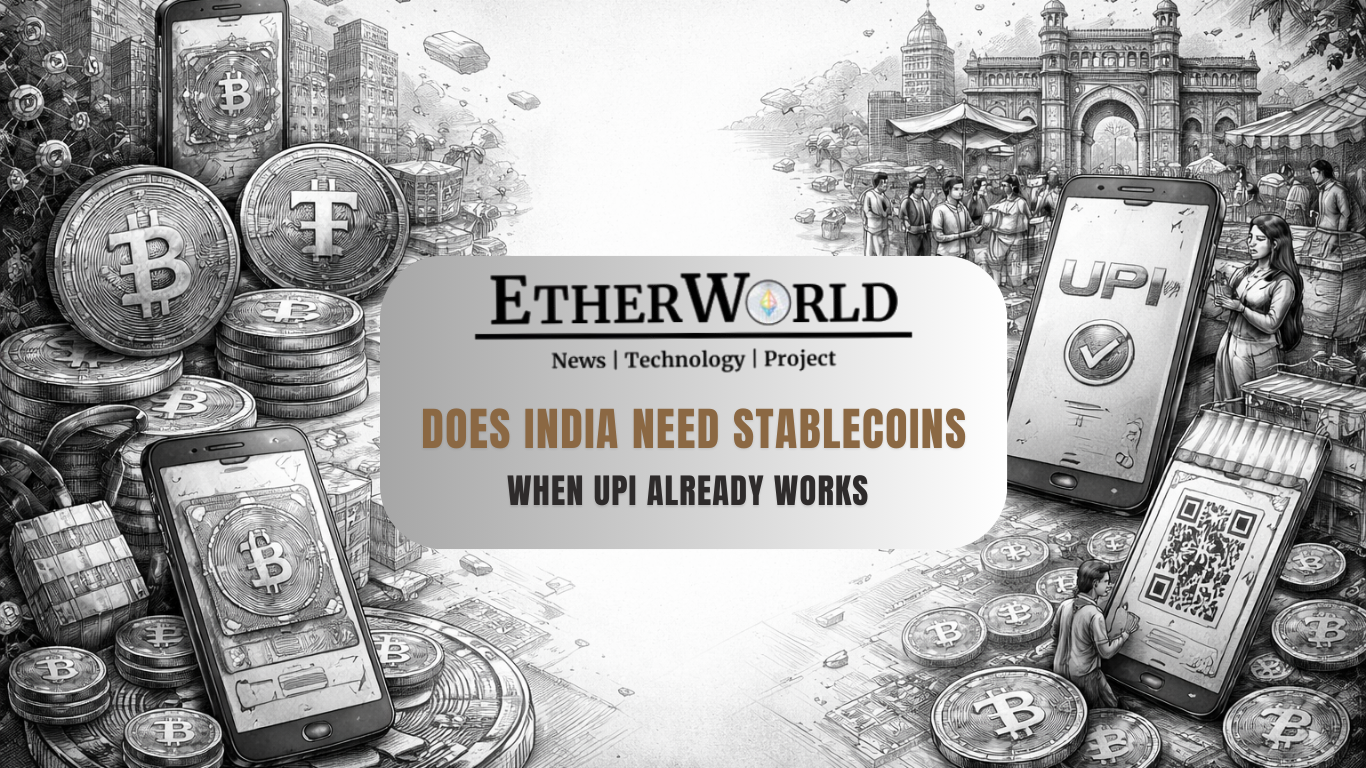
Stablecoins emerged globally to solve three core problems. Slow bank transfers. High transaction costs. Limited financial access.
In India, those problems were largely solved before stablecoins even became mainstream. UPI today offers instant settlement, near zero cost transactions, nationwide interoperability, consumer protection, bank backed trust, and regulatory clarity.
It works across banks, apps, devices, and income levels. From roadside vendors to large merchants, UPI has become financial infrastructure, not just a product.
It works at the speed of cash while retaining the traceability of digital money. Against this backdrop, the idea that INR stablecoins are needed to fix payments feels fundamentally misaligned with ground reality.
- Why Non USD Stablecoins Struggle
- The Sovereign INR Stablecoin Vision
- RBI’s Consistent Position on Stablecoins
- Where INR Stablecoins Actually Make Sense
- The Mistake of Competing With UPI
A single tweet from crypto researcher chainyoda has reignited one of the most fundamental questions in India’s Web3 debate.
Just paid 40 INR (45c) instantly for an auto rickshaw ride via UPI QR scan. Why do I need an INR stablecoin @0xAishwary? pic.twitter.com/xfwQHAfPKg
— chainyoda (@chainyoda) December 23, 2025
What makes the tweet powerful is not sarcasm but accuracy. In one sentence, it challenges years of imported crypto narratives by grounding the debate in Indian reality.
Why Non USD Stablecoins Struggle
As explored in EtherWorld’s analysis on the real problem with non USD stablecoins, these instruments often fail not because of weak technology but because they lack a compelling local reason to exist. USD stablecoins thrive globally because the dollar dominates cross border trade, offshore finance, and crypto markets.
INR stablecoins do not enjoy that structural advantage. In India, non USD stablecoins face three major challenges.
- First, they compete against an already optimized payment system.
- Second, they introduce additional complexity for users.
- Third, they struggle with liquidity and acceptance.
Asking an Indian user to replace a one tap UPI payment with wallet setup, private key management, and on chain confirmations solves nothing for everyday use.
The Sovereign INR Stablecoin Vision
India’s first sovereign backed stablecoin initiative was framed as a landmark moment. A regulated, compliant, RBI aligned digital representation of the rupee capable of supporting future financial infrastructure.
However, the strongest use cases were never about paying auto rickshaw fares or grocery bills. The sovereign stablecoin vision focuses on programmability, controlled circulation, auditability, and integration with emerging digital financial systems.
These are not consumer problems. They are institutional ones. As EtherWorld noted in its coverage of India’s sovereign backed stablecoin, its real promise lies in settlement layers, not retail payments.
RBI’s Consistent Position on Stablecoins
The Reserve Bank of India has been remarkably consistent in its stance on stablecoins. Senior RBI officials have repeatedly stated that India has no domestic case for stablecoins in everyday payments.
The reasoning is straightforward. India already has fast payments, cheap payments, inclusive access, and sovereign oversight.
Introducing privately issued stablecoins risks currency substitution, regulatory fragmentation, and financial instability without offering clear benefits. Chainyoda’s tweet unintentionally reinforces the RBI’s argument better than any policy speech.
Where INR Stablecoins Actually Make Sense
The problem is not INR stablecoins themselves. The problem is how they are positioned.
- INR stablecoins make sense in areas where UPI cannot operate. Cross border trade is a prime example.
- UPI does not seamlessly support international settlements. Stablecoins can reduce friction in trade, remittances, and global B2B payments.
- Tokenised assets are another domain. On chain bonds, invoices, commodities, and real world assets require programmable money for atomic settlement.
These are infrastructure use cases, not consumer convenience features.
The Mistake of Competing With UPI
Many stablecoin narratives fail because they try to compete with UPI rather than complement it. UPI is optimized for humans.
- Trying to replace UPI with stablecoins in domestic payments is like trying to replace email with blockchain messaging for office communication. It misunderstands the role of each tool.
- UPI is the front end of India’s digital economy. Stablecoins, if used correctly, should operate in the background layers of finance.
It shows that India does not need crypto rails to feel futuristic. The future is already operational.
When innovation narratives ignore this reality, they lose credibility. Indian users are pragmatic.
They adopt tools that save time, reduce cost, and remove friction. If a stablecoin cannot clearly outperform UPI for a specific task, it will not gain organic adoption.
India’s stablecoin debate does not need louder marketing. It needs sharper positioning.
The question is not whether INR stablecoins are good or bad. The question is where they belong.
They belong in wholesale finance, cross border settlements, tokenised markets, and programmable financial infrastructure. They do not belong in replacing QR payments that already work flawlessly.
If you find any issues in this blog or notice any missing information, please feel free to reach out at yash@etherworld.co for clarifications or updates.
Related Articles
Disclaimer: The information contained in this website is for general informational purposes only. The content provided on this website, including articles, blog posts, opinions, & analysis related to blockchain technology & cryptocurrencies, is not intended as financial or investment advice. The website & its content should not be relied upon for making financial decisions. Read full disclaimer & privacy policy.
For Press Releases, project updates & guest posts publishing with us, email contact@etherworld.co.
Subscribe to EtherWorld YouTube channel for ELI5 content.
Share if you like the content. Donate at avarch.eth.
You've something to share with the blockchain community, join us on Discord!
Author

Blockchain Content & Ops Specialist, Avarch LLC.