Vitalik Questions Ethereum’s Two-Client Node Design
Vitalik Buterin calls for simplifying Ethereum node infrastructure, questioning the complexity of the current two-client architecture.
A long-standing usability problem, running an Ethereum node remains too complicated, as highlighted by remarks made by Vitalik Buterin, sparking a new debate within the development community regarding Ethereum's architecture.
Operating personal infrastructure frequently feels like a specialised DevOps chore, despite the network's pride in decentralisation. Buterin's comments centre on making this process easier for everybody, not just experts, to manage their own nodes.
- Ethereum's Two-Client Architecture: Where Complexity Begins
- The Self-Sovereign Vision of Running an Ethereum Node
- Short-Term Solutions: Unified Note Setups & Simpler Deployment
- Local-Node-Focused Scaling: A New Direction in Ethereum Reserach
Ethereum's Two-Client Architecture: Where Complexity Begins
Two distinct software components, an execution client and a consensus client, were needed to run a full node once Ethereum switched to Proof-of-Stake. Within the network, each has a distinct function.
Practically speaking, this architecture requires node operators to manage two distinct daemons and make sure they communicate properly. Vitalik Buterin noted that managing two processes is far more difficult than managing a single daemon, particularly for people attempting to manage their own infrastructure.
The Ethereum Virtual Machine (EVM) is operated by the execution client, which also handles transactions and maintains the state of Ethereum. Block validation, synchronisation, and fork-choice rules that establish the canonical chain are handled by the consensus client in the meantime.
Execution layer clients includes Geth, Nethermind, Besu, Erigon, and Reth. Consensus layer clients include Prysm, Lighthouse, Teku, Nimbus, and Lodestar.
To coordinate block formation and validation, these two clients communicate via a local API known as the Engine API.
Technically speaking, this division increases security and modularity. However, it creates operational friction in real life. Two distinct processes must be installed, set up, and maintained by users while maintaining synchronisation. Node operations can be disrupted by any misconfiguration.
Vitalik Buterin's concern is simple; if using Ethereum necessitates maintaining numerous daemons and network connections, the barrier for users becomes unduly high.
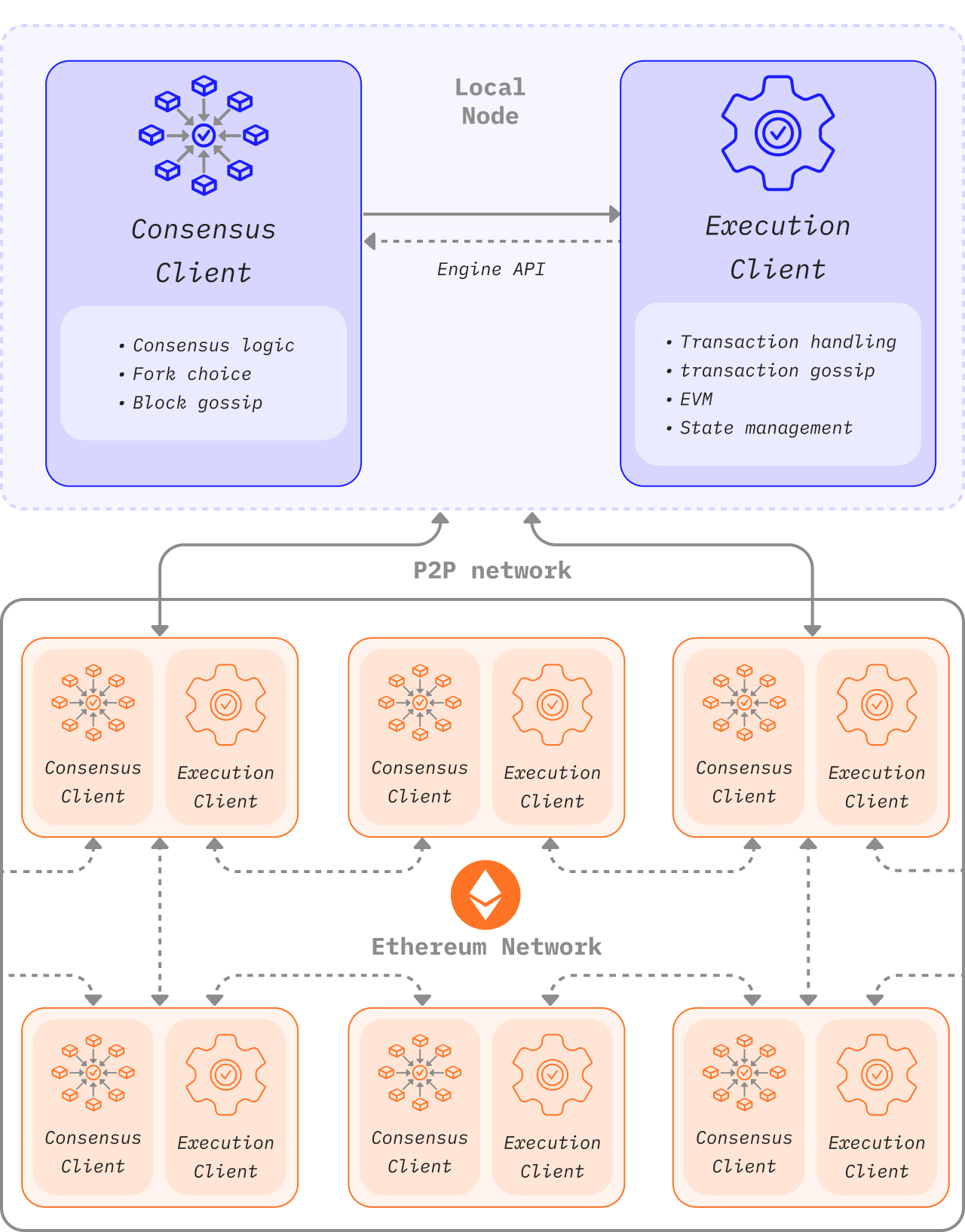
Image Source: Ethereum.org
The Self-Sovereign Vision of Running an Ethereum Node
A self-governing paradigm of network engagement has long been supported by Ethereum. Users can communicate with the network directly, independently verify blockchain data, and avoid depending on centralised infrastructure providers by operating their own node.
In practice, however, a lot of users continue to rely on hosted RPC services rather than operating their own nodes. The rationale is not philosophical, but rather pragmatic. Many people find self-hosting challenging because it takes time, technical expertise, and ongoing maintenance to set up and maintain node infrastructure.
Buterin contends that this presumption, that managing a node should be a difficult undertaking, is essentially incorrect. He believes that households and everyone should have access to Ethereum infrastructure, not just server-managing professionals.
Even individuals with specialised hardware might not have enough time to keep up with complex configurations. Therefore, enhancing usability as well as lowering hardware needs is a challenge.
The Nimbus team's unified node project, which aims to integrate execution and consensus functionality into a more efficient arrangement, is one early example of this strategy.
Additionally, Buterin proposed that standardized wrappers, like Docker-based packages that automatically connect suitable clients, might greatly simplify node deployment in the near future.
In the long run, if research projects like Lean Ethereum and its lean consensus process develop, the community might reexamine Ethereum's larger design.
We should be open to revisiting whole beacon/execution client separation thing.
— vitalik.eth (@VitalikButerin) March 15, 2026
Running two daemons and getting them to talk to each other is far more difficult than running one daemon.
Our goal is to make the self-sovereign way of using ethereum have good UX. In many cases…
Short-Term Solutions: Unified Note Setups & Simpler Deployment
Simplifying client deployment is one of the most pressing problems being discussed.
Developers are investigating standardised wrappers that combine execution and consensus clients rather than requiring users to connect them manually. These might be made available as prepackaged packages that handle client communication automatically or as containerised environments.
This can already be seen in projects that are experimenting with unified node architectures. Such tools could make node installation more like a standard program setup rather than a system administration effort by hiding configuration details from users.
The modular architecture of Ethereum is not to be eliminated. Rather, the objective is to enhance the user experience while maintaining the fundamental flexibility significantly.
If it is successful, operating a node could spread throughout the ecosystem much more widely.
Local-Node-Focused Scaling: A New Direction in Ethereum Reserach
Discussions about local node-favouring scaling strategies in Ethereum research reveal another aspect of this discourse. Future enhancements are intended to give users who operate local nodes real benefits over those who just use remote infrastructure.
According to one idea, Ethereum's scaling roadmap should be modified to enable local nodes to effectively access and validate the data that matters to them, while also retrieving additional data from the network as needed. This strategy is in line with the overarching goal of improving node functionality for regular users.
Users might keep the most pertinent data locally and utilise cryptographic proofs to validate new data when needed, rather than requiring nodes to store the blockchain's whole history record. This would enhance usability and lower storage needs without sacrificing security guarantees.
This kind of research reflects an increasing understanding within the Ethereum ecosystem that enhancing accessibility and scalability should coexist. Future upgrades could preserve decentralisation while greatly simplifying participation, provided they give priority to local infrastructure and node operators.
If you find any issues in this article or notice missing information, please feel free to reach out at team@etherworld.co for clarifications or updates.
To promote your Web3 articles, events, and projects, you may reach out anytime via EtherWorld PR for submissions and collaboration.
Related Articles
- Vitalik Buterin Outlines Ethereum’s 2025–2027 Roadmap at Devconnect
- Vitalik’s ZK API Proposal Aims to Make Ethereum the Home for AI
- Vitalik Addresses Online Claims About His FLI Donation
- Vitalik Pushes Back on “Sovereign AI” as Web4 Essay Sparks Debate
- Vitalik Buterin Bets on Privacy Pools, A New Chapter for Ethereum Privacy?
To follow blockchain news, track Ethereum protocol progress, and read our latest stories, subscribe to our weekly today.
Disclaimer: The information contained in this website is for general informational purposes only. The content provided on this website, including articles, blog posts, opinions, & analysis related to blockchain technology & cryptocurrencies, is not intended as financial or investment advice. The website & its content should not be relied upon for making financial decisions. Read full disclaimer & privacy policy.
To stay updated on blockchain news, Ethereum protocol progress, and our latest stories, subscribe to our weekly digest and YouTube channel for ELI5 content.
To promote your Web3 articles, events, project updates, and Press Releases, reach out anytime via EtherWorld PR for submissions and collaboration. For other queries, email contact@etherworld.co.
If you’d like to support our work, share the content and consider donating at avarch.eth.
Join our community on Discord and follow us on Twitter, Facebook, LinkedIn & Instagram.
Author

Content Writer