Vibehouse: Ethereum’s Vibecoded Consensus Client from Lighthouse
Vibehouse, an AI generated fork of Lighthouse, implemented ePBS in 72 hours and passed consensus tests on a multi node devnet.
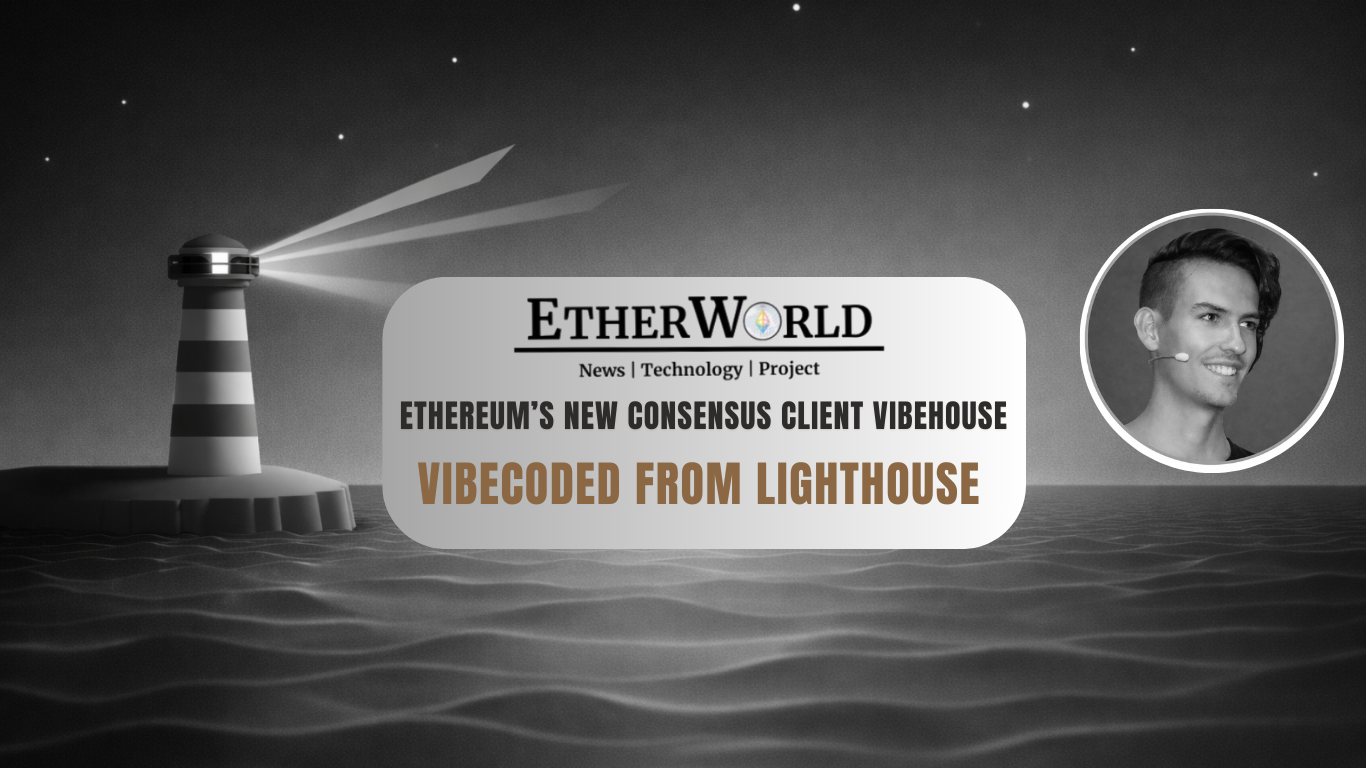
Ethereum core development may be entering a new experimental era. At ETH Denver, Lighthouse core developer Dapplion announced Vibehouse, a fully AI generated fork of Lighthouse, and it is not just a prototype. In under 72 hours, the client implemented ePBS, passed all consensus specification tests, and reached finality on a multi node devnet.
- What Is Vibehouse?
- Why This Experiment Exists
- The 72-Hour ePBS Moment
- How Vibecoding Works in Consensus Code
What Is Vibehouse?
Vibehouse is described as “the Lighthouse fork that runs on vibes.” It is forked from Lighthouse v8.0.1 (post-Fulu). From that base onward, the project leans heavily into agentic development where AI agents implement features, attempt to satisfy tests, iterate quickly, & respond to community requests.
The positioning is intentionally different from traditional clients.
- Vibehouse does not promise a formal roadmap.
- It markets itself as community-driven & fast-moving but sometimes breaking things, but learning aggressively.
- The project also emphasizes familiar Ethereum values, i.e., open source licensing, Rust tooling, & compatibility with spec-driven development.
The key point is that Vibehouse is using the existing Lighthouse codebase as a stable core, then pushing an AI-first workflow] on top of it to see how far the process can be accelerated without sacrificing correctness in testing.
I'll present ~Vibehouse~ at ETHDenver Thu 19 11:15am
— Lion ⟠ dapplion .eth (@dapplion) February 19, 2026
The client is already running Gloas ePBS on a multi-node local devnet + implementing ZK execution validity proofs and other fun features! pic.twitter.com/I4JHKvh3rK
Why This Experiment Exists
Dapplion’s explanation was unusually direct, i.e., the bottleneck is not always engineering talent. Often, it is review capacity.
Inside client teams, consensus code is constrained by a small set of highly trusted reviewers. That is normal. Those engineers must carefully validate logic, edge cases, spec compliance, & security assumptions. But it also means progress is limited by human attention.
Even if implementation is “easy,” shipping safely is hard when only one or two people can approve what goes into the client. Ethereum’s cadence reflects that reality.
We often talk about “one fork per year,” but behind that are months of coordination, testing, bug hunts, & multi-team alignment. The point of Vibehouse is to explore whether AI agents can remove some of the friction around implementation & iteration but not to remove humans from safety decisions, but to reduce the time wasted waiting for humans to wake up, respond, or context-switch.
The 72-Hour ePBS Moment
Vibehouse shipped a working ePBS implementation in under 72 hours. It passed spec tests, achieved finality on a multi-node devnet, & cleared multi-client kurtosis testing in CI-style loops. Those are strong signals that this was not “toy code.”
Agentic workflows potentially compress that cycle because the “developer” can be awake 24/7. If the testing team discovers a bug, they do not have to wait for a specific client engineer to pick it up. They can patch, test, & open a PR, with the agent doing much of the mechanical iteration. The time from bug report to fix could drop from days to hours.
If that happens, the impact is bigger than one feature. It changes how quickly Ethereum can converge on stability across clients, how quickly Devnets can progress, & how quickly forks can become ready.
How Vibecoding Works in Consensus Code
Ethereum’s consensus layer is defined by a detailed spec & accompanied by a large suite of spec tests with broad coverage. That test suite becomes the north star for agentic development. The agent doesn’t need intuition; it needs a target. It implements until tests pass, then it iterates again when new tests appear or new edge cases are discovered.
This is also why the experiment is more plausible in consensus code than in many other domains. Specs are strict. Tests are extensive. Behavior is measurable. Those qualities make it harder for an AI agent to “hallucinate” success, because the environment keeps scoring it.
Vibehouse also highlights tooling discipline which includes kurtosis-based multi-client testnets on PRs, CI checks, & a coverage mindset where coverage only goes up.
If AI agents can help honest developers build new clients & features quickly, they can also help adversaries spin up malicious clients quickly. The barrier to creating “something that looks like a client” drops. The ecosystem could face more experimental forks, more confusing variants, & potentially more attack attempts through client diversity that is not actually safe diversity.
This does not mean “AI is bad.” It means the security model changes when code generation becomes cheap. In that world, the defense is not pretending the tooling doesn’t exist.
Today, even small client improvements can take weeks or months to land. Not because teams don’t care, but because priorities are packed & coordination is expensive.
It is important to separate the experiment from the production client.Dapplion emphasized that Lighthouse remains committed to shipping secure code, with humans in the loop. Vibehouse is not “Lighthouse replaced by AI.” It is Lighthouse’s parallel laboratory.
If agentic development truly compresses Devnet cycles & expands testing coverage, Ethereum’s fork cadence could accelerate without sacrificing rigor.
If you find any issues in this blog or notice any missing information, please feel free to reach out at yash@etherworld.co for clarifications or updates.
To promote your Web3 articles, events, and projects, you may reach out anytime via EtherWorld PR for submissions and collaboration.
Related Articles
- Ethereum Clients' Node Syncing Methods
- Expected EIPs in Glamsterdam Upgrade (Consensus Layer)
- ERC-8004 Signals Ethereum’s Move Toward Agentic AI Markets
- Vitalik Rethinks the Role of Ethereum Layer 2s
- Vitalik Buterin Explains What Creator Coins Got Wrong
To follow blockchain news, track Ethereum protocol progress, and read our latest stories, subscribe to our weekly today.
Disclaimer: The information contained in this website is for general informational purposes only. The content provided on this website, including articles, blog posts, opinions, & analysis related to blockchain technology & cryptocurrencies, is not intended as financial or investment advice. The website & its content should not be relied upon for making financial decisions. Read full disclaimer & privacy policy.
To stay updated on blockchain news, Ethereum protocol progress, and our latest stories, subscribe to our weekly digest and YouTube channel for .
To promote your Web3 articles, events, project updates, and Press Releases, reach out anytime via EtherWorld PR for submissions and collaboration. For other queries, email contact@etherworld.co.
If you’d like to support our work, share the content and consider donating at avarch.eth.
Join our community on Discord and
Author

Blockchain Content & Ops Specialist, Avarch LLC.