Highlights from the All Core Developers Execution (ACDE) Call #233
Ethereum pushes Glamsterdam testing forward as Hegotá headliner debates remain unresolved.
Ethereum core developers are currently working across two fronts. On one side, Glamsterdam devnet work is moving ahead steadily. On the other, discussions around the Hegotá upgrade are still taking shape, especially when it comes to deciding the execution layer headliner.
With Devnet-3 expected soon, testing momentum is clearly building. At the same time, conversations around account abstraction and frame transactions are bringing up bigger questions around timing, complexity, and whether the ecosystem is truly ready for these changes.
Glamsterdam Updates
On the Glamsterdam front, development continues to move steadily with a strong focus on testing infrastructure and performance validation. Devnet-2 has now reached a stable state, giving teams confidence in the current implementation baseline.
The next milestone, Devnet-3, is expected to launch early next week, marking a critical step toward broader interoperability testing. A major highlight from this phase is the rollout of the Benchmark Core tool, which is now live for execution layer teams.
This tool is designed to standardize performance testing across clients, enabling developers to evaluate how changes impact throughput, latency, and execution efficiency. The benchmarking discussions emphasized the importance of real-world performance testing, rather than relying purely on theoretical improvements.
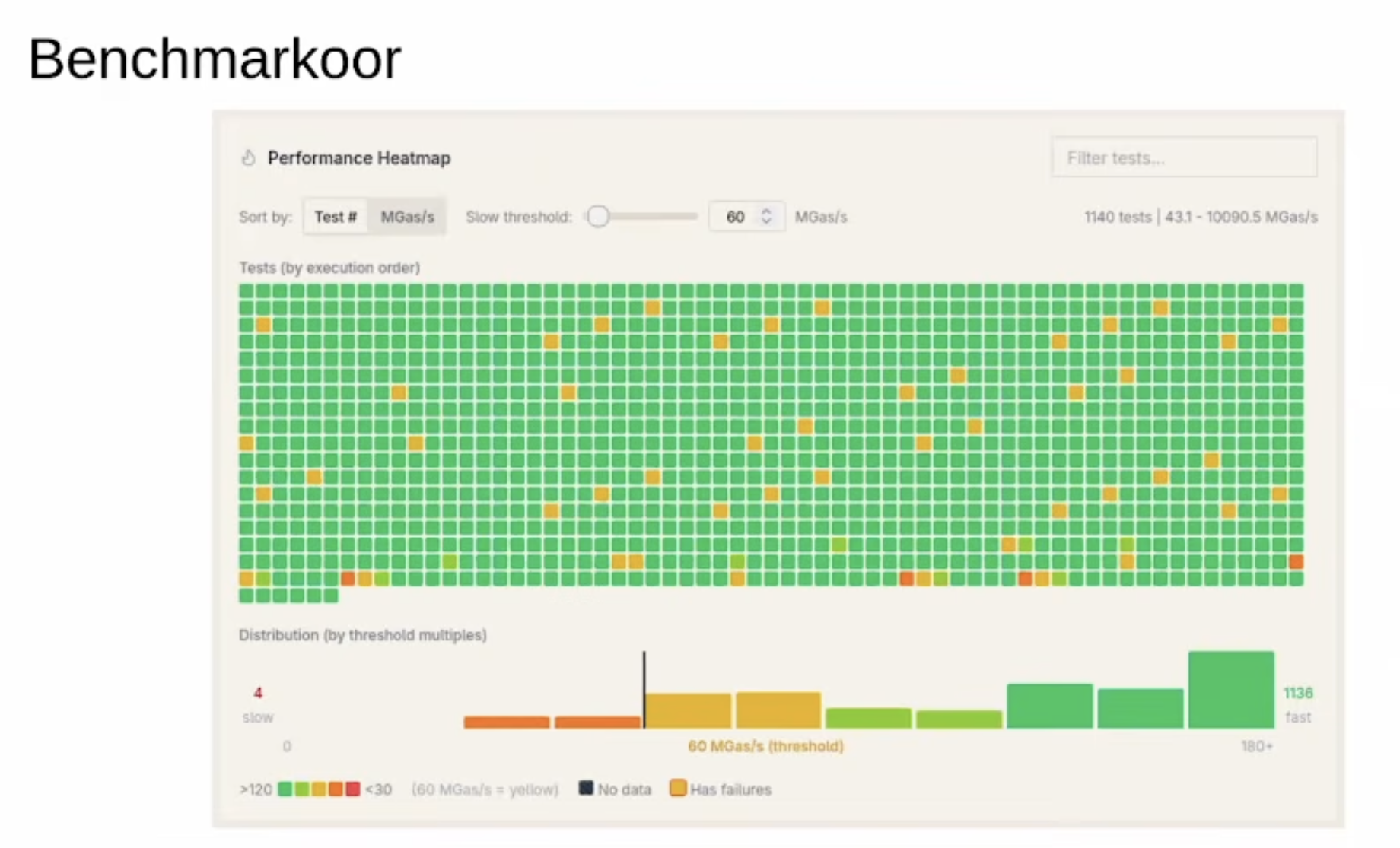
This reflects Ethereum’s broader shift toward data-driven upgrade validation and measurable performance benchmarks. Another important development under Glamsterdam is the progress of EIP-8070 (Sparse Mempool).
The proposal has now reached CFI status, indicating growing confidence in its design and relevance. A working prototype has already been implemented in Geth, with other client teams encouraged to review and provide feedback.
The sparse mempool concept aims to reduce unnecessary duplication and inefficiencies in transaction propagation. By optimizing how transactions are stored and shared across nodes, it has the potential to significantly improve network efficiency.
At the same time, developers are carefully evaluating its complexity trade-offs, particularly around implementation consistency across different clients and potential edge cases in real-world conditions. Overall, Glamsterdam continues to show strong execution momentum, with clear progress in both infrastructure readiness and protocol-level experimentation.
Hegotá Updates
In contrast to Glamsterdam’s steady technical progress, discussions around the Hegotá upgrade remain more fluid and unresolved. The primary focus has been on selecting an execution layer headliner, a feature that would define the upgrade’s core narrative and technical direction.
Despite extensive discussions and breakout sessions, no clear headliner has been selected so far, reflecting both the complexity of the proposals and the cautious approach developers are taking. FOCIL has now been CFI’d for Hegotá, signaling its importance within the upgrade scope.
However, it does not yet fully define the upgrade in the way a traditional headliner would. Frame transactions (EIP-8141) were initially considered a strong candidate for the headliner role.
However, after deeper evaluation, the proposal has been rejected as the primary feature and moved to CFI status as a non-headliner. Frame transactions introduce a structured approach to transaction execution, enabling batched operations with atomic guarantees.
This could significantly improve efficiency and composability at the protocol level, especially for more complex transaction flows. However, concerns around implementation complexity, ecosystem readiness, and coordination across clients led to the decision to defer its headliner status.
Development work continues, including implementations in EthereumJS and ongoing exploration of alternative approaches. Account abstraction remains a central theme in Hegotá discussions.
The frame transaction mempool document outlines three implementation strategies, with Strategy 2 currently emerging as the preferred direction. One of the key benefits highlighted is native batching, which allows multiple operations to execute together with atomic revert guarantees.
This can simplify complex workflows and reduce operational overhead for developers. At the same time, alternative approaches such as scheme transactions are being explored as potentially simpler paths toward achieving similar outcomes.
While there is strong community support for advancing account abstraction, client teams remain divided on the timing and scope of its inclusion. Overall, Hegotá remains in an exploratory phase, with key decisions still pending and multiple directions under active consideration.
Miscellaneous Updates
Beyond Glamsterdam and Hegotá, several important updates were discussed across testing, gas economics, and governance processes. Gas repricing is emerging as a major area of focus, with developers targeting a baseline of 60 Mgas per second.
To support this, around 18 operations are currently under evaluation for repricing.
- EIP-7976 proposes increasing calldata gas costs to 64, which could enable significantly larger blocks, potentially reaching up to 670 million gas.
- Meanwhile, EIP-7904 provides a detailed analysis of compute repricing, indicating that approximately 6.8 million transactions would be affected, most of them involving ephemeral contracts.
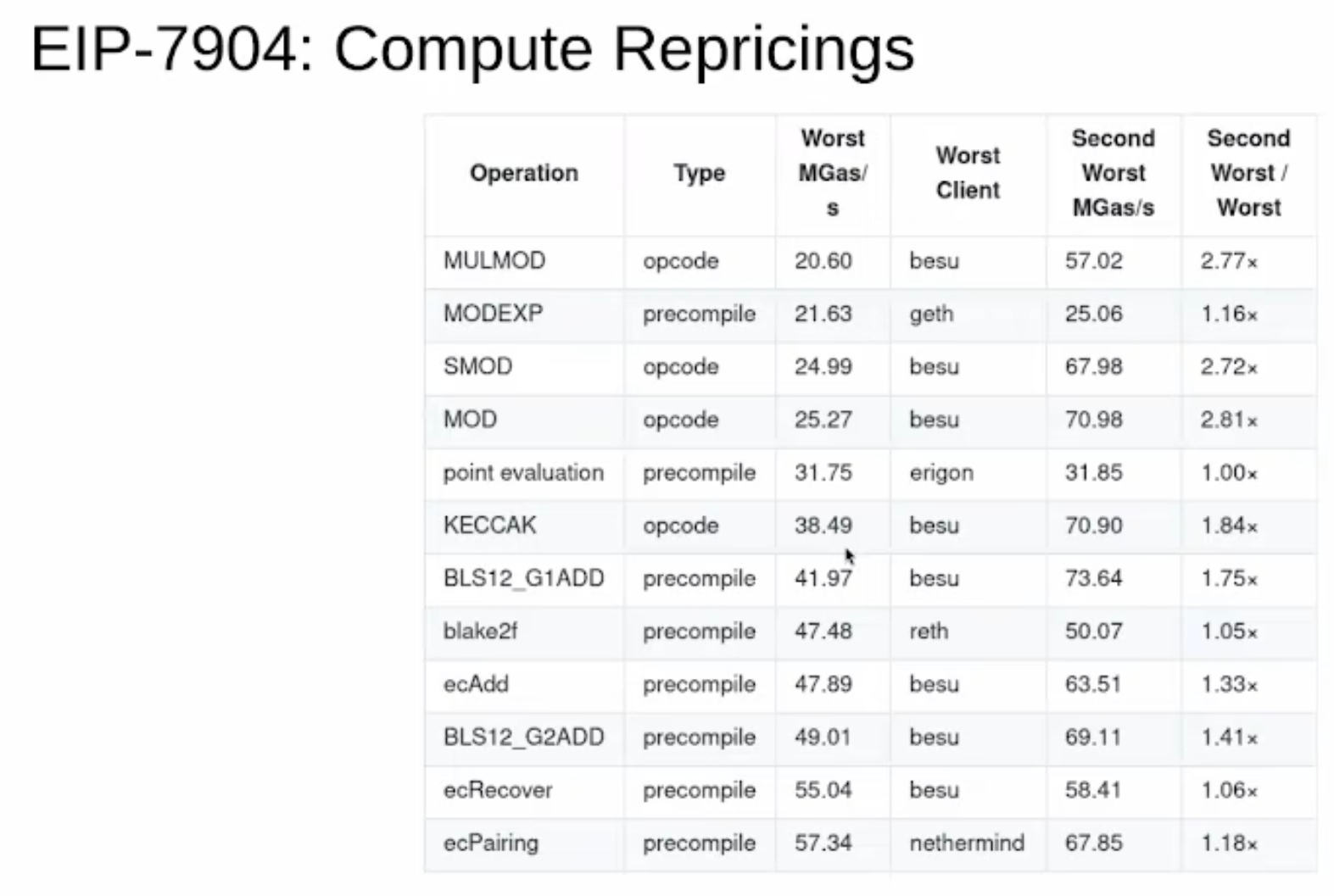
These changes are not just about increasing throughput, but also about aligning gas costs more accurately with actual computational resource usage, ensuring long-term sustainability of the network.
On the testing side, the ePBS Devnet-0 encountered a critical issue related to withdrawals, causing the network to break. As a result, the devnet will need to be relaunched with PTSC changes. This highlights the complexity of implementing proposer-builder separation at the protocol level and reinforces the importance of iterative testing and validation.
Additional research efforts include ongoing SSZ experiments and broader discussions around mempool design, including the complexity implications of sparse mempool implementations. From a governance perspective, several key decisions and action items were identified.
Frame transactions have been formally rejected as the Hegotá headliner, and no execution layer headliner has been finalized yet. Account abstraction will continue to be explored as a non-headliner theme.
Client teams have been asked to review the EIP-8070 sparse mempool proposal and provide feedback on its feasibility and complexity. At the same time, developers are analyzing stakeholder feedback from gas repricing surveys to guide future decisions.
Looking ahead, the immediate priority is the launch of Devnet-3, which will serve as a critical milestone for Glamsterdam. Meanwhile, Hegotá discussions are expected to continue as teams work toward identifying a clear direction for the upgrade.
If you find any issues in this blog or notice any missing information, please feel free to reach out at yash@etherworld.co for clarifications or updates.
To promote your Web3 articles, events, and projects, you may reach out anytime via EtherWorld PR for submissions and collaboration.
Related Articles
- Highlights of Ethereum's All Core Devs Meeting (ACDC) #153
- Highlights of Ethereum's All Core Devs Meeting (ACDE) #207
- Highlights of Ethereum's All Core Devs Meeting (ACDC) #152
- Highlights of Ethereum's All Core Devs Meeting (ACDE) #206
- Highlights of Ethereum's All Core Devs Meeting (ACDE) #205
To follow blockchain news, track Ethereum protocol progress, and read our latest stories, subscribe to our weekly today.
Disclaimer: The information contained in this website is for general informational purposes only. The content provided on this website, including articles, blog posts, opinions, & analysis related to blockchain technology & cryptocurrencies, is not intended as financial or investment advice. The website & its content should not be relied upon for making financial decisions. Read full disclaimer & privacy policy.
To stay updated on blockchain news, Ethereum protocol progress, and our latest stories, subscribe to our weekly digest and YouTube channel for ELI5 content.
To promote your Web3 articles, events, project updates, and Press Releases, reach out anytime via EtherWorld PR for submissions and collaboration. For other queries, email contact@etherworld.co.
If you’d like to support our work, share the content and consider donating at avarch.eth.
Join our community on Discord and follow us on Twitter, Facebook, LinkedIn & Instagram.
Author

Blockchain Content & Ops Specialist, Avarch LLC.