Highlights from the All Core Developers Execution (ACDE) Call #226
Ethereum core developers finalize the Hegotá fork direction, advancing key repricing EIPs, deferring state growth decisions, & setting January 5 as the decisive deadline for Glamsterdam scope finalization.
Ethereum’s core development process closed out the year with one of its most consequential coordination calls, setting the direction for the upcoming Hegotá upgrade while also focusing around scaling, state growth, repricing, and governance discipline.
At ACDE Call #226, developers finalized naming decisions, confirmed fork timelines, advanced multiple EIPs to “Considered for Inclusion” (CFI), deferred proposals, and laid out a compressed roadmap that places January 5 as a hard deadline for finalizing the Glamsterdam scope.
Hegotá: A Fork Identity Takes Shape
One of the earliest decisions was formalizing the fork’s identity. The consensus layer name Heze and execution layer name Bogotá were merged into the Hegotá, giving the fork a unified cross-layer identity. While largely symbolic, fork names matter.
They anchor external communication across wallets, infrastructure providers, researchers, and application developers. With Hegotá finalized, focus shifted quickly to substance.
Holiday cancellations left Ethereum governance with no margin for delay. Multiple late-December and early-January calls were scrapped, elevating January 5 into a decisive session rather than a routine restart.
By that call, developers aim to:
- Finalize the full Glamsterdam scope
- Resolve remaining CFI vs DFI decisions
- Remove all unresolved ambiguity
The Hegotá headliner process will follow a strict schedule:
- Jan 8 – Feb 4: Headliner proposals
- Feb 5 – Feb 26: Final discussion and selection
Non-headliner proposals will only open once headliners are locked, reinforcing priority discipline.
Glamsterdam Updates
The most impactful discussions revolved around EVM gas repricing, an area Ethereum has historically treated cautiously. Current benchmarks suggest Ethereum effectively caps out around 20 Mgas per second under worst-case workloads.
The repricing working group proposed a clear objective: Enforce a 60 Mgas per second execution floor across compute and state access.
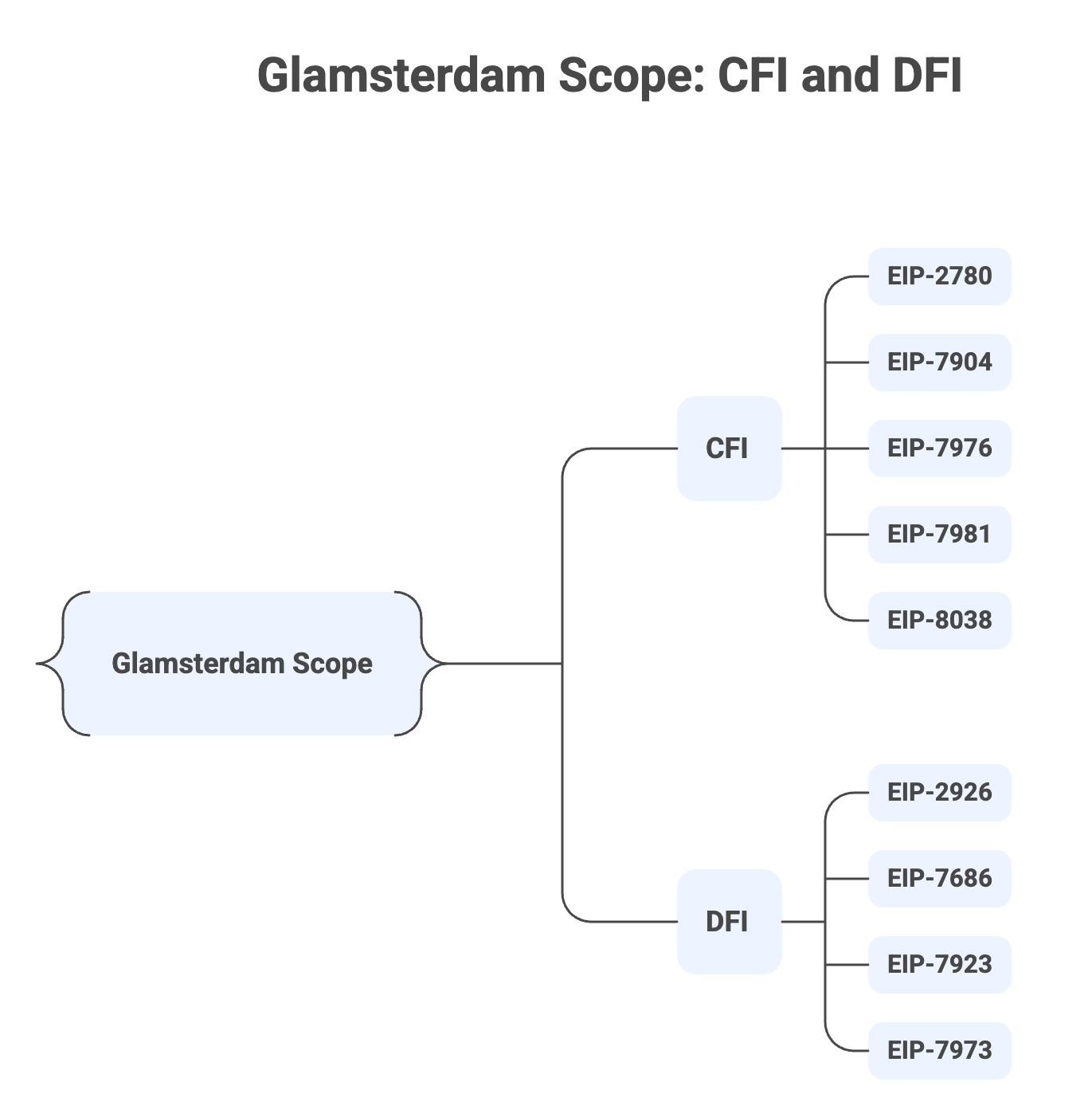
Several major EIPs were advanced to Considered for Inclusion, signaling intent without guaranteeing final inclusion.
- EIP-2780: Intrinsic Transaction Gas Reduction: This proposal restructures intrinsic gas costs, lowering baseline transaction fees while shifting state creation costs into execution. Simple transfers become cheaper; state-heavy transactions pay proportionally more.
- EIP-7904: General Repricing (Downscoped) : Originally broad, EIP-7904 was sharply reduced in scope. It now focuses solely on raising prices for operations that fall below the 60 Mgas/s floor, removing cost reductions to limit testing risk.
- EIP-7976 & EIP-7981: Data and Access List Repricing : These EIPs increase calldata and access list costs, aligning pricing with modern execution realities and upcoming protocol changes.
- EIP-8038: State Access Gas Cost Increase: Perhaps the most debated proposal, EIP-8038 reprices interactions with existing state. While backward-compatibility risks remain, developers agreed that failing to address state access would undermine all other scaling efforts.
Three competing proposals: EIP-8037, EIP-8073, and EIP-8075 which aim to address long-term state growth. Rather than rush a decision, developers deferred the entire category to January 5.
On the testing front, bal-devnet-1 was launched, providing early validation for repricing assumptions.
However, developers acknowledged that state benchmarking remains the hardest problem. Unlike opcode benchmarks, state tests are resource-intensive and slow to iterate, making infrastructure improvements a top priority.
Two proposals dominated the contract size discussion:
Despite strong advocacy, at least three major clients signaled DFI, citing complexity and timing concerns. Without alignment, both proposals were excluded from Hegotá.
January 5 is Ethereum’s final decision gate for Glamsterdam. Anything unresolved by then is unlikely to ship. The deadline enforces discipline, prevents scope creep, and forces clarity on repricing, state growth, and remaining edge cases.
If you find any issues in this blog or notice any missing information, please feel free to reach out at yash@etherworld.co for clarifications or updates.
Related Articles
Disclaimer: The information contained in this website is for general informational purposes only. The content provided on this website, including articles, blog posts, opinions, & analysis related to blockchain technology & cryptocurrencies, is not intended as financial or investment advice. The website & its content should not be relied upon for making financial decisions. Read full disclaimer & privacy policy.
For Press Releases, project updates & guest posts publishing with us, email contact@etherworld.co.
Subscribe to EtherWorld YouTube channel for ELI5 content.
Share if you like the content. Donate at avarch.eth.
You've something to share with the blockchain community, join us on Discord!
Author

Blockchain Content & Ops Specialist, Avarch LLC.