Hegotá Should Complete the Holy Trinity of Censorship Resistance
To maximize Ethereum’s neutrality, we propose that the Hegotá upgrade includes both FOCIL and encrypted mempools. This would complete the Holy Trinity of Censorship Resistance, achieving system-level defense against transaction censorship.

Censorship resistance and decentralization are Ethereum’s core reasons for existence. As Vitalik Buterin and others recently put it in The Trustless Manifesto, “Ethereum was not created to make finance more efficient. It was not created to make apps run faster. It was created to set people free - to empower anyone, anywhere to coordinate without permission and without trusting anyone they cannot hold accountable”. If Ethereum cannot credibly guarantee neutral transaction inclusion, it fails at the most fundamental promise that distinguishes it from traditional financial infrastructure.
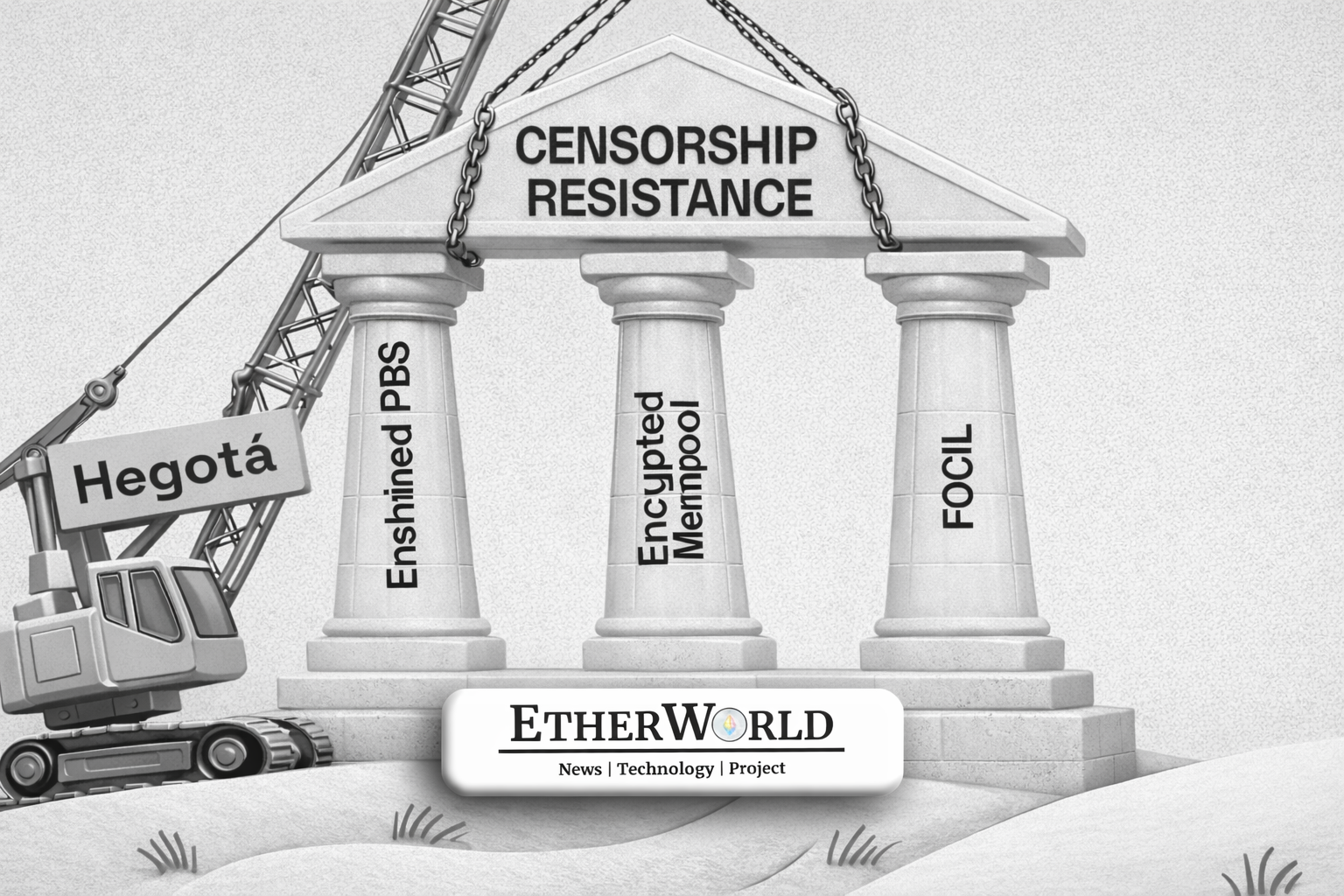
Last year, Marc Harvey-Hill from Nethermind coined the term "Holy Trinity of Censorship Resistance" to describe three complementary mechanisms aimed at mitigating censorship and centralization across Ethereum’s transaction supply chain: enshrined proposer-builder separation (ePBS), fork-choice enforced inclusion lists (FOCIL), and encrypted mempools.
The core idea was that censorship resistance fails at multiple points in the transaction pipeline, and no single mechanism can fix all of them. Without real-time protections, builders can selectively delay or deprioritize transactions, undermining neutrality even when eventual inclusion is preserved. Only a coordinated, system-level approach that is as end-to-end encrypted as possible can deliver censorship resistance in practice.
At the time, this framing was mostly conceptual. But with the Glamsterdam upgrade, progress became more concrete. Ethereum’s core protocol developers selected ePBS (EIP-7732) for inclusion, removing trusted relays and making proposer–builder separation native to the protocol.This addressed one major censorship choke point.
What remains are the other two pieces.
With FOCIL (EIP-7805) and the Universal Enshrined Encrypted Mempool (EIP-8105) now proposed as headliners for the Hegotá upgrade, Ethereum now has the opportunity to complete the Holy Trinity of Censorship Resistance and achieving a system-level defense against transaction censorship. Together, these mechanisms address inclusion guarantees and pre-inclusion visibility, the two remaining sources of real-time censorship and centralization pressure at the transaction layer.
To uphold Ethereum’s neutrality, both FOCIL and encrypted mempools should be included in the Hegotá upgrade.
Why This Cannot Wait
Ethereum’s transaction layer is broken, and is no longer being used as originally intended.
Most activity has shifted away from the public mempool because users know it’s not safe. Anyone broadcasting openly risks being front-run, sandwiched, or selectively delayed.
In response, users now rely on private order flow and trusted intermediaries. Transactions are routed through a handful of dominant builders who now decide what gets included and when.
This has created a builder centralizing feedback loop, whereby MEV extraction rewards scale and concentrates transaction flow in a small set of builders, increasing censorship risk.
If Ethereum wants to remain a neutral settlement layer, the transaction layer requires neutrality guarantees.
How ePBS, FOCIL, and Encrypted Mempools Fit Together
The Holy Trinity addresses censorship resistance across the transaction supply chain. Each component targets a different failure mode.
ePBS (EIP-7732) makes proposer–builder separation native to Ethereum, removing the need for trusted relays and shifting the builder–proposer interface into the protocol itself. By cutting out off-chain intermediaries, it eliminates one of the most prominent chokepoints for censorship and manipulation.
FOCIL (EIP-7805) makes censorship resistance enforceable by the protocol, not just optional. It lets validators collaboratively mandate the inclusion of specific transactions, so even if builders are centralized or uncooperative, users can rely on timely inclusion. This shifts power from a few block producers to the protocol as a whole - strengthening neutrality and making censorship harder to execute or sustain.
Universal Enshrined Encrypted Mempool (EIP-8105) removes pre-inclusion visibility by encrypting transaction contents until they are included in a block. This prevents builders from exploiting or censoring transactions based on their calldata, recipients, or economic intent.
The EIP achieves this by introducing encrypted transactions natively at the protocol level, allowing users to shield their transactions’ contents without relying on off-chain privacy workarounds or trusted third parties.
The design is cryptographically agnostic: users choose their own key providers, which can be based on threshold cryptography, TEEs, delay encryption, or other schemes. Key providers are registered onchain and can express trust relationships with one another, supporting a pluralistic ecosystem without fragmentation or monopoly risk.
Importantly, EIP-8105 preserves liveness. Encrypted envelopes always pay fees and execute, even if decryption fails or is delayed. Plaintext transactions continue to exist. Encrypted transaction envelopes always execute and always pay fees. If decryption keys are missing or delayed, payload execution can be skipped without reverting the envelope. The chain keeps working.
The Practical Effects They Achieve
Together, ePBS, FOCIL, encrypted mempools turn censorship resistance from a theoretical guarantee into a practical protocol property. Transactions can be broadcast publicly without exposing their contents before inclusion, and inclusion guarantees apply even when block building is centralized.
At the protocol level, this delivers:
- Real-time censorship resistance, not just eventual inclusion
- Front-running resistance built into the protocol, rather than an opt-in workaround
- Protocol-level protection that can become the default over time
- Restored base layer neutrality, by making the public mempool usable again
System-level improvements:
- Reduced mempool fragmentation and reliance on private order flow
- Lower builder centralization pressure as blinding weakens MEV’s compounding advantage
- An open market for key providers, with more stakeholders and fewer choke points
Benefits for stakeholders:
- Users can safely broadcast transactions without risk of front-running or censorship
- Institutions gain a neutral, trust-minimized settlement layer with built-in inclusion guarantees
- Institutions are provided a transaction layer with built-in front running resistance
- Application developers get MEV protection and censorship resistance without custom infrastructure
- Builders gain access to new fee-paying encrypted flow with less reliance on private relationships for private order
- Small builders can compete more fairly with larger builders because payload blinding makes builder size less decisive
- Key providers gain a native protocol role and are able to introduce different models
Hegotá Should Include FOCIL and Encrypted Mempools
Now is the time to act to complete the Holy Trinity of Censorship Resistance on Ethereum.
ePBS is already in motion. FOCIL and encrypted mempools are the two remaining pieces.
Delaying their inclusion means prolonging builder centralization, sustaining mempool fragmentation, and leaving systemic censorship risks unresolved.
Bringing them in together would allow users to broadcast transactions safely, guarantee timely inclusion, and remove the need to rely on trusted third-party private order flow.
And this would make Ethereum’s public mempool become usable again.
Read the Specs and Contribute Feedback:
Watch the ACDE Meeting to Hear Jannik Luhn Present EIP-8105
A Guiding Question for Readers
If the public mempool is “broken” today largely because of predictable frontrunning/sandwiching, do you think that protocol-level encrypted transactions could make the public mempool viable and attractive again (i.e., bring more flow back into a shared public lane) reducing reliance on private RPC / private mempools and lowering overall mempool fragmentation?
Author:
Luis Bezzenberger, Product Manager, brainbot GmbH (Core developer for Shutter)
Luis has been actively involved in the Ethereum Layer 2 and protocol space since 2016. With a background in finance and a strong affinity for technology and crypto, he transitioned into the blockchain sector. Since 2021, Luis has been serving as the Product Manager for Shutter at brainbot GmbH, where he leverages his expertise to drive innovation and development.
Disclaimer: The information contained in this website is for general informational purposes only. The content provided on this website, including articles, blog posts, opinions, & analysis related to blockchain technology & cryptocurrencies, is not intended as financial or investment advice. The website & its content should not be relied upon for making financial decisions. Read full disclaimer & privacy policy.
To stay updated on blockchain news, Ethereum protocol progress, and our latest stories, subscribe to our weekly digest and YouTube channel for ELI5 content.
To promote your Web3 articles, events, project updates, and Press Releases, reach out anytime via EtherWorld PR for submissions and collaboration. For other queries, email contact@etherworld.co.
If you’d like to support our work, share the content and consider donating at avarch.eth.
Join our community on Discord and follow us on Twitter, Facebook, LinkedIn & Instagram.