Ethereum Introduces “Strawmap”: A Strawman Roadmap for Ethereum’s L1 Future
EF Protocol publishes Strawmap, a technical strawman roadmap that visualizes Ethereum L1 upgrades through 2029, framing dependencies, headliners, & five long-term north stars.
The Ethereum Foundation’s Protocol team has publicly released Strawmap, a strawman roadmap designed to reframe how the community thinks about Ethereum L1 upgrades. Strawmap is a dense, technical, long-horizon visual that places Layer 1 upgrades on a single timeline through the end of the decade, not as a promise, but as a coordination sketch.
Strawmap does not claim to represent official consensus across Ethereum’s many stakeholders. Instead, it offers one reasonably coherent path among countless possible outcomes, with the intention of making tradeoffs visible earlier.
- What Strawmap Is
- The Five North Stars
- Headliners, Fork Cadence, & Governance
- Changes for Ethereum’s Upgrade Discourse
What Strawmap Is
Strawmap is presented as an invitation to view Ethereum L1 upgrades holistically. Rather than treating each fork as a standalone bundle of features, the document places proposals on a single visual timeline.
By mapping the upgrade landscape as a system, Strawmap aims to make sequencing constraints legible. It also extends the time horizon beyond what most planning tools or recurring governance calls track.
According to the origin story shared alongside the document, Strawmap started as a discussion starter at an EF workshop in January 2026. One motivation was to integrate lean Ethereum thinking with shorter-term initiatives.
Publishing Strawmap publicly also signals a governance posture. Instead of keeping architectural framing inside EF circles, the team is pushing it into open view, inviting critique from the broader ecosystem.
Introducing strawmap, a strawman roadmap by EF Protocol.
— Justin Drake (@drakefjustin) February 25, 2026
Believe in something. Believe in an Ethereum strawmap.
Who is this for?
The document, available at strawmap[.]org, is intended for advanced readers. It is a dense and technical resource primarily for researchers,… pic.twitter.com/gIZh5I8Not
Rather than focusing only on the next fork or two, the Strawmap spans through the end of the decade, outlining seven forks by 2029 under a rough cadence of one fork every six months. This long horizon provides a structural view of upgrade dependencies, technical sequencing and fork constraints, areas that often surface friction during live governance cycles.
The Five North Stars
On the far right of Strawmap sit five black-box north stars. These are not features scheduled for the next fork. They are long-range anchors that describe what Ethereum might want to become at the protocol level.
- Fast L1: This aims for fast user experience via shorter slots & finality in seconds. This is the north star where transaction confirmation feels closer to modern consumer expectations without giving up security assumptions.
- Gigagas L1: This aims a target of roughly 1 gigagas per second, framed as around 10K TPS, via zkEVMs & real-time proving. This points toward a future where proof systems move from offline batch artifacts to near-real-time protocol machinery.
- Teragas L2: This aims a target of 1 gigabyte per second, framed as around 10M TPS, via data availability sampling. This reflects Ethereum’s rollup-centric scaling thesis, where L1 becomes a settlement & DA layer enabling massive throughput on L2s.
- Post-quantum L1: This aims durable cryptography via hash-based schemes. This north star is less about immediate panic & more about designing upgrade paths that do not become impossible when cryptographic assumptions shift.
- Private L1 : This aims first-class privacy via shielded ETH transfers. This is an explicit statement that privacy is not only an app-layer concern, but potentially a protocol primitive, if the ecosystem chooses to pay the costs.
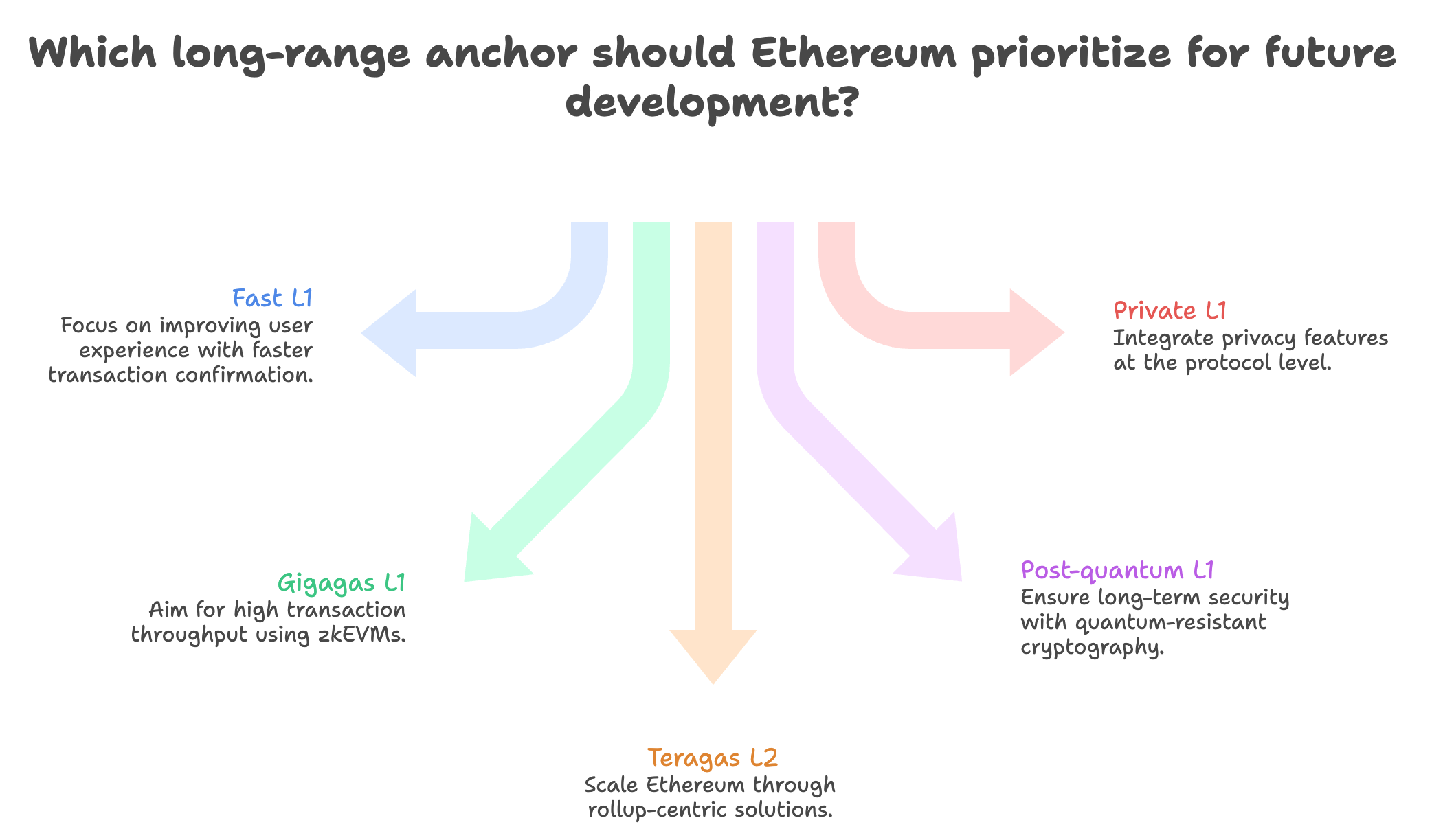
Together, these pillars describe an Ethereum that is faster, massively scalable, quantum resilient and privacy native. Strawmap is structured as a left-to-right timeline where forks advance across years. Upgrades are grouped into three horizontal layers:
- Consensus layer (CL)
- Data layer (DL)
- Execution layer (EL)
The visual language separates upgrade domains, then uses arrows to signal dependencies or natural progressions. The map also distinguishes types of items through styling.
There is also a naming scheme detail that signals how EF is thinking about continuity. Consensus layer forks follow a star-based naming pattern with incrementing first letters, moving through familiar names like Altair, Bellatrix, Capella, Deneb, Electra, Fulu.
Upcoming forks such as Glamsterdam & Hegotá appear with finalized names, while later forks use placeholders like I* & J*. Strawmap is trying to create a shared reference frame so that discussions about one EIP can be grounded in how it interacts with the rest of the system.
Headliners, Fork Cadence, & Governance Reality
Ethereum’s modern fork process increasingly treats forks as high-coordination events that cannot carry unlimited ambition without slipping schedules. Strawmap reflects the reality that to keep a faster cadence, the process often limits itself to one consensus headliner & one execution headliner per fork.
This framing matters because it turns governance into prioritization, not only design. If one headliner consumes the testing budget, attention, client bandwidth, & risk budget for a cycle, then other ambitious upgrades need to wait or move offchain.
Strawmap explicitly ties this to near-term examples, noting Glamsterdam’s headliners as ePBS on the consensus side & BALs on the execution side. It also notes an exceptional fork, labeled L*, that shows two headliners tied to a larger lean consensus effort, with a caution that such alignment would be unusual & consequential.
Changes for Ethereum’s Upgrade Discourse
Ethereum roadmap debates often oscillate between short-term shipping pressure & long-term vision talk.
- Short-term debates can feel fragmented because they are constrained by fork timelines.
- Long-term debates can feel vague because they are disconnected from executable sequencing.

Strawmap tries to merge these modes. It makes long-term goals visible while tying them to constraints like dependencies, sequencing, & fork capacity.
Ethereum cannot have a single official roadmap that genuinely reflects everyone. Rough consensus is emergent, continuous, & often uncertain. Strawmap acknowledges that reality upfront, including the fact that even within EF Protocol there are competing views, not to mention the diversity of non-EF perspectives.
EF describes Strawmap as living & malleable, with expectations of at least quarterly updates. That cadence makes it more like a shared whiteboard than a frozen PDF.
This release reads as an attempt to accelerate coordination without claiming authority. It is a map that admits it might be wrong, but argues that mapping is still useful.
If you find any issues in this blog or notice any missing information, please feel free to reach out at yash@etherworld.co for clarifications or updates.
To promote your Web3 articles, events, and projects, you may reach out anytime via EtherWorld PR for submissions and collaboration.
Related Articles
- Ethereum Clients' Node Syncing Methods
- Expected EIPs in Glamsterdam Upgrade (Consensus Layer)
- ERC-8004 Signals Ethereum’s Move Toward Agentic AI Markets
- Vitalik Rethinks the Role of Ethereum Layer 2s
- Vitalik Buterin Explains What Creator Coins Got Wrong
To follow blockchain news, track Ethereum protocol progress, and read our latest stories, subscribe to our weekly today.
Disclaimer: The information contained in this website is for general informational purposes only. The content provided on this website, including articles, blog posts, opinions, & analysis related to blockchain technology & cryptocurrencies, is not intended as financial or investment advice. The website & its content should not be relied upon for making financial decisions. Read full disclaimer & privacy policy.
To stay updated on blockchain news, Ethereum protocol progress, and our latest stories, subscribe to our weekly digest and YouTube channel for .
To promote your Web3 articles, events, project updates, and Press Releases, reach out anytime via EtherWorld PR for submissions and collaboration. For other queries, email contact@etherworld.co.
If you’d like to support our work, share the content and consider donating at avarch.eth.
Join our community on Discord and
作者

Blockchain Content & Ops Specialist, Avarch LLC.